Doneraile’s Reindeer Scar31779 BCE
31,779 BCE denotes an uncertain interval within Marine Isotope Stage 3, rather than a precise Irish event. During fluctuating Ice-Age conditions, Ireland was a cold, open Atlantic-margin landscape, with expanding ice, lower seas and uncertain routes. Castlepook Cave near Doneraile, County Cork, preserves Ireland’s richest late-glacial vertebrate collection, including mammoth, reindeer, giant deer, bear and hyaena. A reindeer femur dated to about 33,000 years ago bears a possible stone-tool cut, plausibly indicating carcass processing by humans. However, disturbed cave deposits and absent settlements, tools or human remains preclude claims for permanent population, culture or ritual. Later glaciation destroyed earlier evidence.

Dateline
The label 31,779 BCE is useful for arranging a modern chronology, but it must not be mistaken for a date at which Irish prehistory can be resolved to a particular year, season or generation. It corresponds broadly to about 33,730 years before AD 1950, within Marine Isotope Stage 3 (MIS 3), an unstable middle phase of the last Ice Age. Radiocarbon ages from this depth of time require calibration and commonly translate into broad probability ranges; cave deposits also mix evidence accumulated over long intervals. No king, community, battle, treaty or ritual in Ireland can responsibly be assigned to this numbered year. What can be described is a changing Ice-Age world, and a small but potentially momentous body of evidence from County Cork.
A Date Within an Ice-Age Interval
MIS 3, conventionally spanning roughly 57,000 to 29,000 years ago, was not a single uniform climate. North Atlantic temperatures swung sharply between colder episodes and relatively milder interstadials. Ireland lay at the oceanward edge of north-west Europe, exposed to Atlantic weather systems and to shifts in the growth of the British–Irish Ice Sheet. The detailed reconstruction of that ice sheet is strongest from around 31,000 years ago onwards, and even then it presents alternative minimum, optimum and maximum ice limits where direct evidence is lacking. Around the notional date used here, therefore, it is safer to speak of advancing or intermittently expanded ice and of regional uncertainty than to draw a neat line between an icy north and an ice-free south.
The great ice-sheet maximum came later. Large-scale reconstruction indicates sustained growth of the British–Irish Ice Sheet between about 31,000 and 26,000 years ago, with ice spreading across Ireland, Britain and adjacent shelves; its maximum area was reached around 26,000 years ago. At roughly 33,700 calendar years ago, the process that would transform Irish landscapes was under way but had not reached that later peak. Some ground may have been ice-covered or close to an ice margin, while other places supported cold-climate vegetation and grazing animals. The precise disposition of ice across the island at this moment remains contested because subsequent glaciers eroded, buried and rearranged older evidence.
Open Country, Not a Familiar Island
It would be misleading to imagine the wooded, wet and densely enclosed Ireland of later millennia. The available faunal and environmental evidence instead points towards a cold, largely open landscape. In favourable localities there may have been grasses, sedges, herbs and low shrubs, with scattered sheltered vegetation rather than continuous forest. Frost action, seasonal snow, strong winds, bare rock and thin soils would have shaped daily conditions. Rivers carried sediment across valleys whose later forms were extensively modified by ice; limestone caves offered cavities in which bones, sediment and water could gather.
Nor were coastlines necessarily those of the present. Global sea level was lower during the Ice Age, exposing parts of the continental shelf and enlarging the land areas around Ireland. Yet lower sea level did not automatically produce a simple, dry land bridge across every channel. The Irish Sea basin, changing ice margins, tides, estuaries and local relative sea level made movement through this north-western world geographically complex. For animals and, if people were present, for people as well, Ireland was part of a wider Atlantic-margin landscape whose routes cannot now be mapped with certainty from modern shorelines.
The Cave Fauna of Southern Ireland
The strongest direct evidence relevant to this era comes from cave collections, particularly Castlepook Cave near Doneraile in north County Cork. The cave is a maze of narrow limestone passages and chambers, excavated chiefly between 1904 and 1918. It has produced more than 2,000 surviving bones and is Ireland’s richest known site for vertebrate remains dating towards the Last Glacial Maximum. Modern re-dating has been important because early radiocarbon measurements from Irish caves were made before improved pretreatment methods could better isolate surviving bone collagen. Several Castlepook results were revised substantially older, confirming that parts of its faunal archive belong in MIS 3.
The assemblage is striking. It includes woolly mammoth, reindeer, giant deer, brown bear and spotted hyaena, with later cold-stage material including Arctic fox, wolf, Norwegian lemming and collared lemming. This is evidence for animals reaching Ireland across a long span of time, not a census of creatures standing together in one valley in 31,779 BCE. Caves are selective archives: carnivores can drag in prey, animals may die in chambers, water can redeposit bones, and nineteenth- and early twentieth-century excavation methods did not retain the contextual detail expected today. Brown bears may have used caves as dens; spotted hyaenas may have accumulated bones there. The existence of a mammoth or hyaena bone in a collection cannot by itself identify the habitat, season or human activity represented by any other bone.
Even so, the combined fauna supports an important conclusion. Southern Ireland was not simply an empty ice wilderness throughout the whole middle and late last glacial period. At intervals it contained, or was accessible to, substantial herbivores and carnivores associated with open cold environments. Reindeer are particularly significant because their seasonal movements and dependence on broad grazing country make them plausible targets for mobile hunter-gatherers elsewhere in Upper Palaeolithic Europe. That is an ecological possibility, however, not proof that Irish reindeer formed a predictable annual resource for a resident human population.
The Mark on a Reindeer Femur
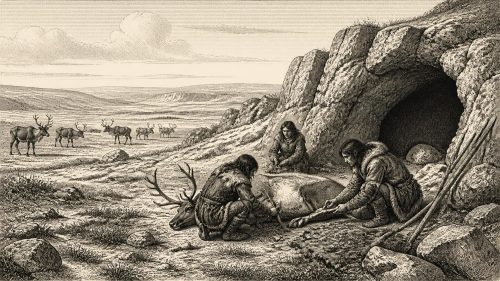
One Castlepook specimen has transformed the discussion. A fragment of reindeer femur in the old collection was directly dated to approximately 33,000 years ago and bears a deep incision interpreted by zooarchaeologist Ruth Carden as a cut made during carcass processing with a sharp stone implement. If the interpretation and association are sustained, it is the earliest known indication of human activity in Ireland by a very large margin: a hunter or hunters may have butchered reindeer in the Cork landscape during MIS 3.
The claim deserves attention precisely because its limits are clear. The bone dates the animal’s death, not a named year and not necessarily the instant at which the incision was made. It comes from a historic cave collection rather than a newly excavated, securely stratified occupation surface. There is no associated hearth, stone-tool assemblage, dwelling, burial, repeated campsite or identifiable butcher’s floor of comparable age. The incision is evidence requiring specialist taphonomic judgement, while the cave itself had been affected by water movement, carnivores and earlier excavation. The responsible conclusion is not that Ireland had a settled Palaeolithic population, but that Castlepook preserves a plausible and highly consequential trace of a human encounter with a reindeer.
People: What Can and Cannot Be Said
No human bones securely dated to this period have been found in Ireland, and no Irish artefact assemblage permits a cultural label. Modern humans were established elsewhere in north-west Europe by this broad era. Continental archaeologists use terms such as Aurignacian and Gravettian for changing Upper Palaeolithic traditions, but applying either label to Ireland would outrun the evidence. A single marked bone does not reveal language, kinship, dress, belief, artistic practice or the number of people involved.
If people did enter Ireland, the most defensible model is of small, mobile hunting and gathering parties operating within wider north-west European networks, rather than villages or permanent territorial polities. Their practical knowledge would have had to include finding fuel and shelter, processing animal carcasses, making and maintaining stone tools, reading animal movement and surviving sharp seasonal change. Such capacities are demonstrated at Upper Palaeolithic sites elsewhere; they are not yet demonstrated by an excavated settlement in Ireland. The distinction matters. Comparative archaeology can illuminate what was possible, but it cannot fill Castlepook’s silence with invented households.
No Politics, No Recorded Religion
Political affairs, diplomacy and organised conflict leave no identifiable record for Ireland at this depth of time. There were no states, written institutions, named peoples or borders that historians can recover. Competition over carcasses, shelter or access to routes is conceivable among predators and humans alike, but specific conflict is unknowable. Likewise, nothing from Ireland around this date supports a claim for shrines, ceremonial gatherings, graves, art or formal religious observance. Ice-Age Europeans elsewhere made ornaments, images and complex material culture, but none can be transferred automatically to the Irish record.
Economy, in the modern sense of farms, markets and exchange systems, is equally absent. The relevant economy was ecological: animals moving through accessible terrain, carnivores using caves, plants available in short growing seasons, and perhaps people converting a carcass into meat, marrow, hide, sinew and bone. There is no evidence for agriculture, livestock, metal, pottery, long-distance trade in goods or permanent built settlement. The reindeer femur’s importance lies in its modesty. It may record an act of processing, not a society fully revealed.
A Fragile Archive
The landscape visible in Ireland today is partly an inheritance of the glaciations that followed: drumlins, sculpted valleys, rock basins, erratics and sediment blankets. Those same processes help explain why the earlier human record is so scant. Advancing ice could erode surface camps, bury deposits beneath till and alter drainage routes; later sea-level rise submerged former coastal plains. Caves and protected sediment pockets are therefore disproportionately important, but they also demand caution.
For 31,779 BCE, Ireland’s history is not a chronicle of annual events. It is an evidence-based horizon of cold open country, large mammals, fluctuating ice and uncertain routes across a changing Atlantic margin. Castlepook Cave near Doneraile supplies the central clue: a dated reindeer femur with a mark plausibly made by a stone tool. It does not yield a calendar day, a personal name or a permanent settlement. It does, however, oblige Irish history to leave room for the possibility that people reached this far-western landscape long before the better documented post-glacial hunter-gatherer world.
Primary Sources
- A reconsideration of the radiocarbon dating of the Marine Isotope Stage 3 fauna from southern Ireland
- The Irish Quaternary Fauna Project
- Growth and retreat of the last British–Irish Ice Sheet, 31,000 to 15,000 years ago: the BRITICE-CHRONO reconstruction
- The timing and magnitude of the British–Irish Ice Sheet between Marine Isotope Stages 5d and 2: implications for glacio-isostatic adjustment, high relative sea levels and ‘giant erratic’ emplacement
- Late Pleistocene chrono-stratigraphy and ice sheet limits, southern Ireland
- Sedimentology and chronology of the advance and retreat of the last British-Irish ice sheet on the continental shelf west of Ireland
- Trimlines, blockfields and the vertical extent of the last ice sheet in southern Ireland
- Castlepook Cave, County Geological Site Report
- The Exploration of Castlepook Cave, County Cork, Being the Third Report from the Committee Appointed to Explore Irish Caves
- On the discovery of hyaena, mammoth and other extinct mammals in a carboniferous cavern in County Cork
- The Mammoth Caves of Castlepook, Near Doneraile
- Spotted Hyena Skull
- 2022:564 – Castlepook Cave, Castlepook South, Cork
- Heritage Artefacts of County Cork
- Phylogeographic, ancient DNA, fossil and morphometric analyses reveal ancient and modern introductions of a large mammal: the complex case of red deer (Cervus elaphus) in Ireland
- Irish Cave Exploration
- First evidence of a Late Upper Palaeolithic human presence in Ireland
- New insights on the fauna of Ireland's Younger Dryas and Early Holocene from Alice & Gwendoline Cave
- The IntCal20 Northern Hemisphere Radiocarbon Age Calibration Curve (0–55 cal kBP)
- The IntCal20 approach to radiocarbon calibration curve construction: a new methodology using Bayesian splines and errors-in-variables
- The earliest evidence for anatomically modern humans in northwestern Europe
- Early Upper Paleolithic colonization across Europe: Time and mode of the Gravettian diffusion
- Terra incognita: The Palaeolithic record of northwest Europe and the information potential of the southern North Sea
- Quaternary Geomorphology
- Ireland through Geological Time