Croom Union
At a Glance
Union Origins
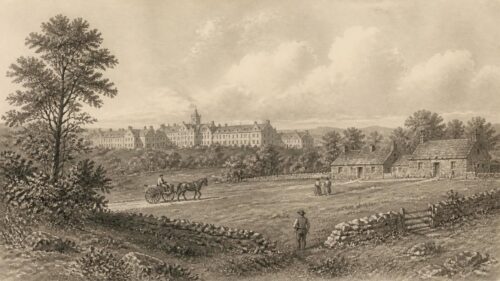
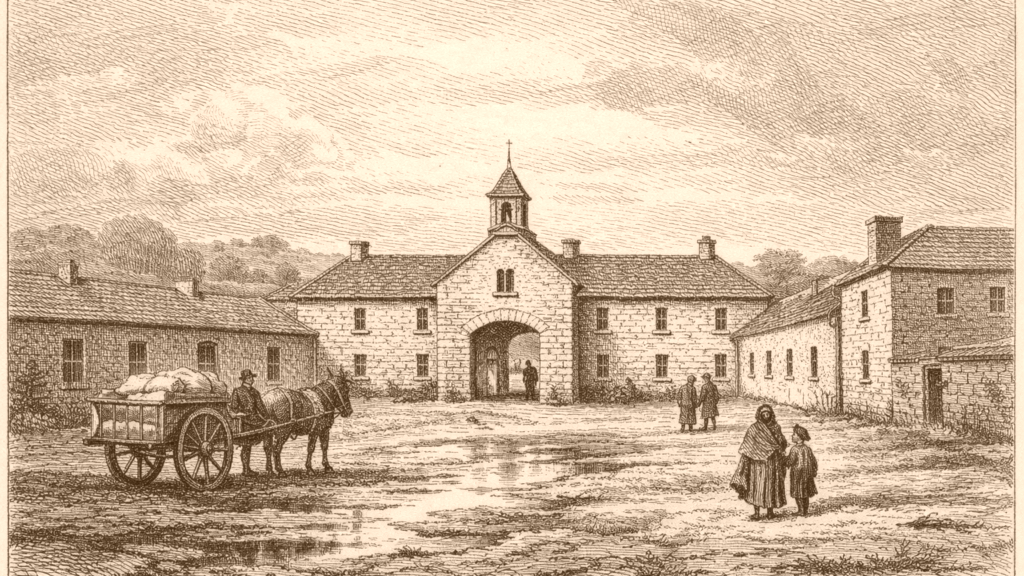
The record summary identifies Croom as a Poor Law union declared in March 1850, with a new workhouse built there in 1852. It also notes that the union was formed by regrouping electoral divisions that had previously belonged to Rathkeale, Newcastle West, and Limerick. Those are the only origin details stated in the description, and they are presented as administrative facts rather than as narrative explanation.
A separate archival description repeats the same basic chronology and adds that the minute books are for the Croom Union Board of Guardians, beginning in 1852 and continuing to 1922. The description gives the reference code, extent, and collection title, making clear that the material is preserved as a defined body of institutional records rather than as a single isolated volume.
Minute Books
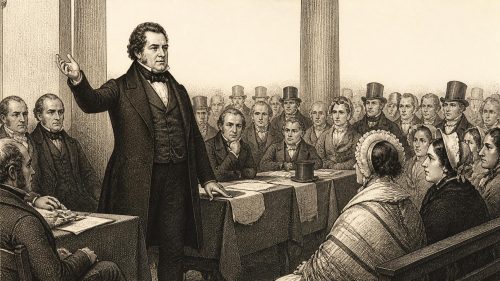
The minute books were kept at weekly meetings. Their entries are described as being arranged under headings that include the clerk’s reports, the treasurer’s account, reports of the master and other officers, and orders and letters from the Poor Law Commissioners. The same description also records members present, correspondence, proposals and resolutions passed, and payments made. This gives a direct picture of the routine business captured in the volumes.
The archive note also states that the books preserve census information on the population of the union in each decade. That feature distinguishes the series from a simple minute record, because it ties the minutes to a repeated summary of demographic information. The description does not list the census figures themselves, only the fact that such information is included in each volume.
Workhouse Tables
Every meeting is said to include a table headed as a return of paupers admitted into, or discharged from, the workhouse, together with the number of those who were sick, born, or died during the week ending on the stated date. The wording shows that the records tracked movement in and out of the institution as well as short weekly measures of condition and mortality. No broader conclusion is stated in the description itself.
From 1 August 1868, the description says that a second table was completed at each meeting. This later table records accommodation provided in the workhouse, temporary buildings, additional workhouses, permanent fever hospital, and fever sheds, along with categories for aged and infirm, able-bodied, boys and girls, children under two years, and those born. It also lists sicks and lunatics and separates admissions, discharges, deaths, and totals.
Record Extent
The archive listing gives the series a substantial span. It identifies individual volumes dated from 1852 to 1853, 1855, 1858, 1861, 1864, 1867, 1870, 1873, 1876, 1879, 1882, 1885 to 1886, 1889 to 1890, 1893 to 1894, 1896 to 1897, 1899 to 1900, 1903, 1906, and 1909 to 1910. Those dates are presented as volume ranges in the catalogue and show that the surviving material is distributed across many separate books.
The same catalogue states that the collection has twenty-six items overall, while the online series description gives the extent as twenty-five items for the board-of-guardians minute books section. The two descriptions are close enough to confirm a large surviving body of material, but they do not present the same count. That difference should be noted as a catalogue-level discrepancy, not resolved by inference here.
Poor Law
A directory of Irish women’s history sources lists many Poor Law Union collections, including minute books, rough minute books, agenda books, outdoor relief registers, and other related record types for different unions. In that broader listing, Croom is not named in the excerpt shown, but the range of entries shows how Poor Law material was catalogued alongside other local archives. The comparison is therefore limited to the visible list itself.
The workhouse page for Croom is titled as such and appears within a site devoted to workhouses, while the Limerick archive entry identifies Croom Union Board of Guardian minute books as a defined record group. Read together, these descriptions place the Croom material within both a workhouse reference frame and a local archival frame. They identify the institution, but they do not explain the contents of any single meeting.
Document Value
The available descriptions support a straightforward account of what the Croom Union statement contains: weekly board business, repeated statistical tables, and an extensive run of surviving volumes. They do not provide the contents of individual meetings, nor do they quote the decisions themselves. The absence of such detail is an omission in these descriptions, not evidence that the meetings were uneventful or that other records never existed.
Within the limits of these catalogue notes, Croom Union appears as a well-documented local institution whose surviving books trace workhouse admissions, deaths, discharges, staffing reports, correspondence, and population counts across multiple decades. The records are described in administrative language and can be read directly as evidence of record keeping, but not as a full history of the union’s operations beyond what the entries themselves list.