
Big Wind, Lisburn Line1839 CE
In 1839 Ireland experienced the Night of the Big Wind, a devastating storm of 6–7 January that damaged homes, farms, shipping and infrastructure, caused numerous deaths, and became a lasting marker in popular memory. Its effects intensified existing rural poverty and seasonal insecurity. Meanwhile, implementation of the 1838 Poor Law advanced through unions, guardians, rates and workhouse planning, while amendments refined administrative boundaries. Policing legislation strengthened state capacity in Dublin and nationally, amid O’Connell’s reform politics and continuing tithe disputes. National education and Griffith’s valuation expanded official knowledge. In August, the Belfast–Lisburn railway opened, signalling transport, commerce and institutional modernisation.
Dateline
Ireland’s 1839 was marked above all by a single winter night whose name outlasted many more formally recorded events. The storm remembered in Irish as Oíche na Gaoithe Móire, the Night of the Big Wind, struck on the night of Sunday 6 January and into Monday 7 January. It was neither a metaphor nor merely local folklore: contemporary newspapers, private diaries, coastguard reports and meteorological observations record a violent, island-wide windstorm. Yet 1839 was not defined only by disaster. In the same year, the machinery of the new Irish poor law was being made practicable, the state adjusted its systems of policing and local administration, and a railway began carrying passengers between Belfast and Lisburn. The contrast is revealing: one event exposed the fragility of daily life, while the others signalled an increasingly regulated and connected Ireland.
The Night That Became a Measure of Time
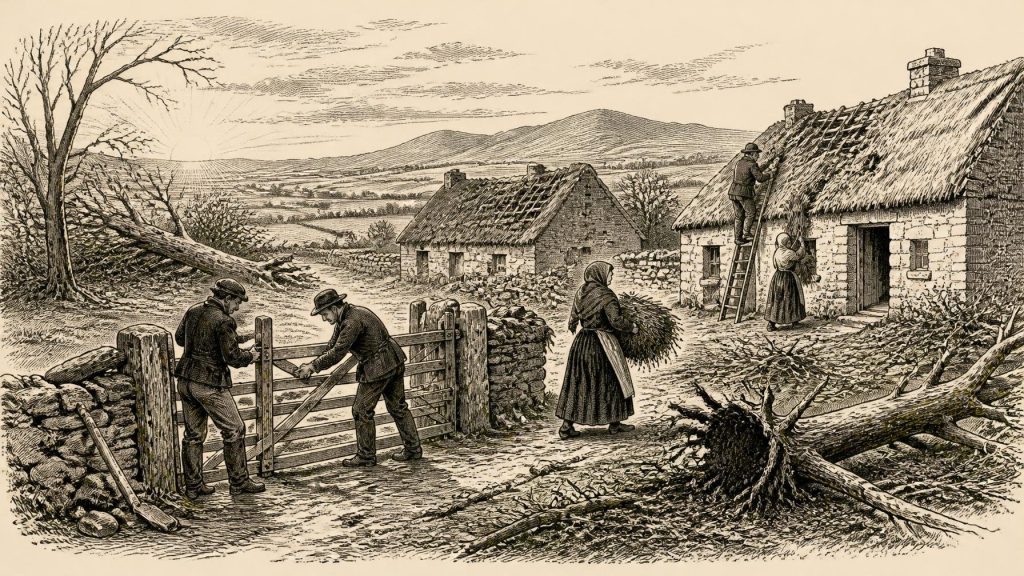
The Big Wind arrived after unsettled winter weather, strengthening during the evening of 6 January. It swept across Ireland with exceptional violence. Reports came from every province: roofs stripped from houses, chimneys and walls brought down, trees uprooted, vessels wrecked or driven ashore, and roads obstructed by fallen timber and debris. In Dublin, many buildings were damaged and the Liffey rose over the quays. Along exposed coasts, mariners and coastguard crews faced the gravest danger. The loss of twelve Roundstone coastguards in Connemara was among the documented tragedies; wrecks and drownings elsewhere around the coast added substantially to the death toll.
The scale of mortality should nevertheless be treated with care. Later retellings often give a figure of several hundred dead, but contemporary estimates were inconsistent and sometimes included losses in the wider British Isles. Modern examination of the evidence confirms numerous deaths in Ireland, especially at sea, but cannot securely establish one definitive total. What is beyond doubt is the breadth of destruction. The storm damaged the most vulnerable dwellings most severely. A substantial stone house might lose slates, glass and chimneys; a labourer’s cabin, especially one with a lightly built roof, could become uninhabitable in hours.
For many families, therefore, the event was not over when the gale abated. January was the hardest season in which to lose shelter, fuel, fodder or stored food. Repairs demanded cash, materials and labour at a time when rural employment was irregular. Slaters and masons briefly found plentiful work in some towns, but that welcome demand did not cancel the hardship of households unable to pay them. The storm also wrecked hayricks, damaged farm buildings and scattered fodder needed for cattle through the winter. A later official inquiry into western distress connected the effects of the gale with shortages of fodder and a partial failure of the potato crop in parts of the west during 1839. That was a grave local and seasonal pressure, not a foretelling of the potato blight of 1845.
The storm’s cultural afterlife was almost as important as its immediate material cost. It entered oral tradition as a shared point of reference. In communities where formal birth records were incomplete or inaccessible, people could locate an age or a family memory by saying that someone had been born before or after the Big Wind. The association of the storm with the eve of the Feast of the Epiphany also encouraged religious interpretations. Reports and later recollections preserve fears that the end of the world had come. Such reactions should not be dismissed as simple superstition: they convey what it meant to face darkness, noise, fire, flood and collapsing homes without modern forecasting, emergency communications or organised disaster relief.
Poverty Becomes an Administrative Question
The catastrophe fell upon a country already marked by deep insecurity. Many agricultural labourers and cottiers depended on tiny plots, seasonal wages, conacre arrangements and the potato. The diet of poorer households could be adequate in favourable years, particularly when supported by milk, but it rested on a narrow economic margin. A storm that destroyed a roof or fodder stack could turn ordinary poverty into an immediate emergency.
This context gave special force to the Poor Relief (Ireland) Act of 1838, whose implementation gathered pace during 1839. The law divided Ireland into poor-law unions centred on market towns, to be governed by boards of guardians and financed through a local poor rate. Its principle was deliberately restrictive. There was no general legal entitlement to relief, and the intended regular form of assistance was admission to a workhouse rather than relief at home. The system that would become so infamous during the Great Famine was, in 1839, still largely a framework on paper, in meetings, surveys and building plans. It is an anachronism to picture the country already covered in operating workhouses: most had yet to be built and opened.
On 15 March, Parliament passed an amending Poor Relief Act to resolve practical defects exposed by the new scheme. It enabled the commissioners to apply the law to places not clearly defined as townlands, to settle uncertain boundaries, and to constitute large towns as electoral divisions subdivided into wards for guardian elections. The technical language matters. Poor relief required officials to decide where one community ended and another began, who paid the rate, who could vote for guardians, and which town would become an institutional centre. Administrative geography was being reshaped alongside older county, parish, barony and townland identities.
Workhouse planning translated those decisions into a recognisable built form. The commissioners’ standard plans, associated with the English architect George Wilkinson, separated admissions, accommodation, yards, infirmary and service areas. Men, women, boys and girls were to be kept apart; even married couples were separated. The design embodied a harsh deterrent philosophy as well as an effort at order, hygiene and supervision. Sites had to be near a town, supplied with water and preferably above flood level. In 1839, committees, ratepayers, landowners, surveyors, builders and local suppliers were beginning to encounter this system not as an abstract statute but as a proposed institution in their own district.
Government, Policing and Political Limits
Irish politics in 1839 remained inseparable from Westminster. Daniel O’Connell was still the country’s most powerful popular political figure, but the great Repeal mobilisation of the 1840s had not yet begun. His immediate strategy was shaped by the Whig alliance formed after the Lichfield House compact of 1835: support at Westminster in return for practical reforms in Irish administration. O’Connell continued to press for representative local government, reform of the Church of Ireland tithe system, electoral change and what he called justice for Ireland, while opposing the Irish poor law introduced in 1838.
For ordinary people, state authority was perhaps felt more tangibly through rates, magistrates and police than through parliamentary speeches. The Constabulary (Ireland) Act, passed on 24 August 1839, provided for a reserve force based in or near Dublin, intended for rapid deployment in emergencies. On the same day, the Dublin Police Act made further provision for the capital’s metropolitan police district, including a power to add specified neighbouring places under the authority of the lord lieutenant. These measures did not create modern democratic local government. Rather, they strengthened an administrative state that could survey, tax, police and regulate, even as demands for more accountable Irish institutions continued.
Religious and property questions remained contentious beneath this political surface. The 1838 tithe rentcharge settlement was intended to shift the burden of the Church of Ireland levy away from direct collection from occupiers towards a charge on landlords, though disputes about arrears and responsibility persisted into 1839. The change reduced one source of the confrontations that had made the Tithe War so bitter earlier in the decade, but it did not remove the wider grievance of supporting an established church followed by only a minority of the population.
Steam Along the Lagan
Amid storm damage and administrative reform, a quieter but durable change occurred in Ulster. In August 1839 the Ulster Railway opened its first section between Belfast and Lisburn, a line of roughly seven miles. It was the first passenger railway in Ulster and only the second railway to open in Ireland, after the Dublin and Kingstown line of 1834. The railway had been authorised in 1836 and constructed from 1837; its arrival was therefore the culmination of earlier investment rather than a sudden transformation in 1839.
Even so, the opening mattered. Belfast was already a rapidly expanding commercial and industrial town, deeply connected to linen manufacture, port traffic and British markets. Lisburn, with its own strong linen connections, lay along the Lagan corridor south-west of the town. The new line promised speed, regularity and a different relationship between town and hinterland. It did not yet bind Dublin and Belfast together by rail, nor did it remake the island’s transport system overnight. But it made the railway a lived reality for passengers, carriers and businesses in one important Irish region.
Schools, Surveys and Ways of Knowing Ireland
1839 also shows the growth of institutions that classified and instructed the population. In March, debate at Westminster on the fifth report of the Commissioners of National Education in Ireland drew attention to teacher training at Marlborough Street in Dublin, with trainees also lodged near Glasnevin and introduced to agricultural instruction. The national school system was still controversial. Its advocates presented it as a means of bringing education to poor children across religious divisions; critics feared that its religious arrangements weakened Protestant control or compromised denominational teaching. The debate itself demonstrates that schooling had become a national political question, not merely a parish concern.
Meanwhile Richard Griffith’s valuation staff continued the long process, begun in 1830, of assessing land and buildings townland by townland. This was not yet the published tenement-by-tenement record later known as Griffith’s Valuation, but it formed part of the evolving state knowledge on which county charges and, increasingly, poor-law finance depended. Surveyors’ fieldwork, maps and valuation books converted fields, houses, boundaries and occupiers into taxable categories. In 1839, Ireland was being measured as well as governed.
The year thus joined an elemental event to institutional change. The Big Wind revealed how exposed many people were to weather, insecure housing and seasonal scarcity. The poor law, policing reforms, valuation and the Belfast–Lisburn railway showed other forces at work: the extension of state administration, new infrastructures and new habits of recording. None offered an immediate remedy for the losses of January. Together, however, they make 1839 a year in which the physical vulnerability of Ireland and the growing reach of modern institutions were unusually visible.
Primary Sources
- The ‘Night of the Big Wind’ in Ireland, 6–7 January 1839
- The Night of the Big Wind
- A Short History of Destructive Irish Storms
- The Night of the Big Wind – Great Storm of January 1839
- Poor Relief (Ireland) Act 1838
- Poor Relief (Ireland) Act 1839
- The Establishment of the Poor Law System
- The Union
- Building Milford Workhouse
- Life in the Workhouse
- Main Provisions of the Poor Law Act
- Valuation Office Records
- The Office of the Chief Secretary of Ireland: Chronology
- General Valuation of Ireland
- Tithe Rentcharge (Ireland) Act 1838
- Tithe Applotment and Valuation Records
- Education in Ireland, 19 March 1839
- National Education, 14 June 1839
- Railways (Ireland), 1 March 1839
- Steaming into the Future
- An Industrial Heritage Survey of Railways
- Bridging the Gap: The Belfast-Dublin Railway in the Nineteenth Century
- O'Connell, Daniel
- Dublin Police Act 1839
- History of the Office of Public Works