Contested Lordships1204 CE
In 1204, Ireland remained politically fragmented, with King John’s authority strongest in Anglo-Norman towns, castles and lordships. Justiciar Meiler fitz Henry curbed William de Burgh’s Connacht ambitions, while Cathal Crobhdearg Ua Conchobair negotiated terms to preserve part of his kingdom. In Ulster, John de Courcy’s displacement enabled the de Lacys’ rise, though royal law sought to regulate the outcome. Annals record raids, church plundering, Doire’s burning and Domnall Mac Carthaig’s southern victory. Ecclesiastical disputes at Iona demonstrated clerical power. Dublin fortifications, authorised fairs, and Duiske’s foundation linked royal administration, commerce, settlement and religious patronage amid continuing local conflict across Ireland.
Dateline
In 1204, Ireland was not a single political unit. King John was lord of Ireland, but royal authority operated most securely in the towns, castles and landed lordships established since the Anglo-Norman invasion. Beyond and between them, Irish kings, dynastic kindreds and ecclesiastical communities retained substantial power. The year’s records therefore do not describe one national story. They reveal several connected contests: between rival Anglo-Norman magnates, between the crown and its overmighty servants, and between local rulers defending their position in a changing political landscape.
Royal Authority and Powerful Lords
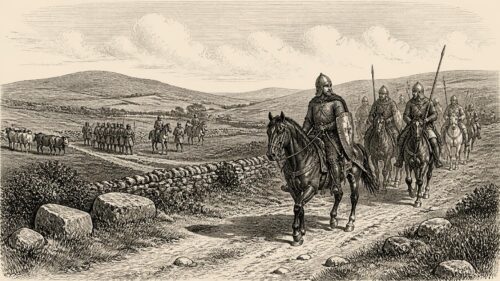
Meiler fitz Henry, King John’s justiciar in Ireland, was the crown’s principal officer on the island. His task was not simply to fight Irish rulers. He also had to contain Anglo-Norman barons whose castles, retinues and private alliances could make them almost independent. The collapse of much of John’s continental inheritance to Philip II of France in 1204 sharpened the king’s need for dependable revenue, loyal service and defensible authority in Ireland. That wider crisis helps explain why Irish affairs were being handled with unusual attention from the royal court.
William de Burgh’s position illustrates the problem. In the preceding years he had intervened violently in Connacht, exploiting the divisions surrounding Cathal Crobhdearg Ua Conchobair’s kingship. Campaigning associated with de Burgh had brought raids, church plundering and fortification to Connacht; Irish annals preserve the memory of this disruption in severe terms. Meiler and his allies had moved against de Burgh’s Munster power, and de Burgh had been compelled to submit his castles and hostages. In 1204 the argument became a matter for royal administration rather than merely a contest of armed followings.
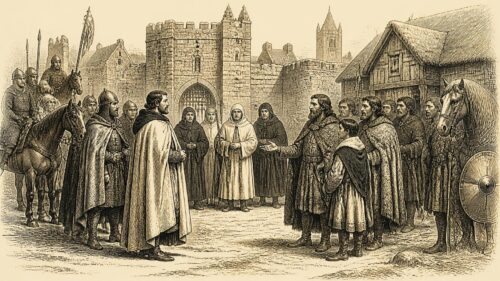
In March, commissioners were appointed to hear complaints made by Meiler and others against de Burgh, and complaints made by de Burgh in return. By September, John restored de Burgh to his Irish lands but expressly excepted Connacht. This was a consequential limitation. It did not make Connacht a peaceful or crown-governed province, but it checked one baron’s attempt to turn intervention there into a private conquest. The crown was reserving room to bargain directly with Cathal Crobhdearg rather than allowing de Burgh to dictate the settlement.
Connacht’s Calculated Diplomacy
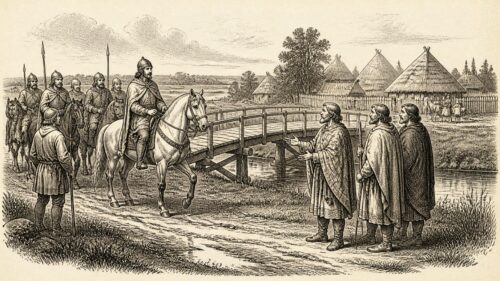
Cathal Crobhdearg’s response was pragmatic. His kingship had survived the danger posed by de Burgh, yet survival required accommodation as well as resistance. Royal records show him in contact with John by March 1204. In August he offered an extraordinary arrangement: he would surrender two-thirds of Connacht and hold the remaining third as an inheritable estate for an annual payment of 100 marks. The language and scale of the proposal show the pressure under which an Irish king operated when confronted by the crown’s legal claims and the military ambitions of settlers.
The proposal was not immediately completed. John wanted the justiciar first put in possession of the lands that Cathal proposed to relinquish, while Cathal sought security for what he was to retain. Nonetheless, the negotiations matter. They show that Connacht was neither simply “conquered” nor beyond political contact with the lordship. Cathal was attempting to preserve a dynasty and territory through terms intelligible to Angevin government: hereditary tenure, rent and a defined relationship to the crown. His later, better-known agreement with John in 1205 grew from this unfinished business.
The annals also contain notices that must be handled carefully. The Annals of the Four Masters, compiled centuries later from earlier material, place William de Burgh’s death under 1204 and connect it morally to his depredations in Connacht. Other evidence places his death in early 1205. The discrepancy is a useful warning against treating every annalistic year-heading as an exact modern date. What can safely be said of 1204 is that de Burgh’s Connacht ambitions had been curbed and that Cathal was negotiating from a position made stronger by that reversal.
The Struggle for Ulster
In Ulster, the fall of John de Courcy was remaking the political order. De Courcy had built a formidable lordship in eastern Ulster after 1177, but he had quarrelled with King John and with the de Lacy family of Meath. Hugh de Lacy’s armed challenge brought de Courcy’s dominance to an end through a confused sequence of fighting, capture, escape and legal pressure spread across 1203 and 1204. Medieval annals differ in their placement of individual episodes, and later accounts magnify the drama. The central fact for 1204 is clearer: de Courcy was displaced, while Hugh de Lacy and his brother Walter stood to profit.
The Annals of Ulster records a hosting by Hugh de Lacy and the “Foreigners of Meath” into Ulidia, driving de Courcy out. The Annals of the Four Masters similarly depicts de Courcy seeking protection among Cenél nÉogain in Tyrone and records losses among his followers at Carrickfergus. Yet the royal government was not prepared simply to accept a baronial coup as a settled fact. On 31 August 1204 John ordered Meiler fitz Henry and Walter de Lacy to summon de Courcy to royal service and arrange the consequences if he failed to comply. The writ also envisaged the transfer of specified Ulster lands to the de Lacy brothers following forfeiture.
A safe-conduct issued that autumn offered de Courcy a route to appear before the king, but it did not restore his former authority. The process reveals a characteristic feature of the lordship: military action, family rivalry and royal law were inseparable. Hugh de Lacy would receive the earldom of Ulster in May 1205, but that was the formal consequence of a struggle still unresolved in practical terms during 1204. For inhabitants of east Ulster, a change of lord meant fresh demands for service, supplies and obedience, as well as uncertainty about the security of churches and estates previously connected to de Courcy.
Violence in the North and South
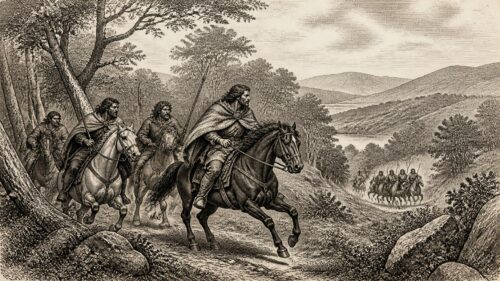
The year’s Irish annals preserve local experiences that royal records scarcely register. In the north, Diarmait son of Muirchertach Ua Lochlainn entered Tír Eógain with a force described as “Foreigners” and plundered the shrine of St Columba. Cenél nÉogain pursued the raiders, defeated them and killed Diarmait. The annalist attributes the outcome to the shrine’s miracles, a reminder that relics were not passive treasures: they were sources of prestige, sanctuary and collective identity. The precise location of this shrine is debated by modern scholars, but the episode plainly demonstrates both the vulnerability and the political importance of sacred places.
Doire, now Derry, was burned from the cemetery of St Martin to St Adomnán’s well. Such a terse entry conceals a great deal: homes, storehouses, ecclesiastical buildings, food reserves and tools could all be exposed to fire. It is not possible to reconstruct the number of victims or the extent of rebuilding from the notice alone. Still, the burning conveys the precariousness of life in an important northern ecclesiastical settlement, where religious community, local lordship and economic activity were closely intertwined.
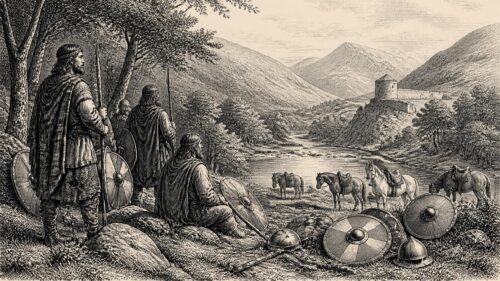
In Desmond, Domnall Mac Carthaig defeated a force of “Foreigners”, according to the Annals of Ulster; the annalist gives a striking total of 160 or more men killed. Exact numbers in medieval battle reports should not be accepted uncritically, but the entry confirms a substantial reverse for an invading Anglo-Norman force. Domnall’s victory fitted a wider pattern of resistance in south Munster. He was no isolated tribal leader confronting an undifferentiated outside power: his enemies and occasional allies included neighbouring Irish dynasties, settler lords and royal officials, all seeking advantage amid the fractured politics of Munster.
Churches, Communities and Iona
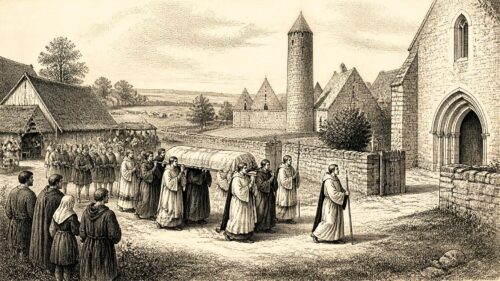
Church affairs were equally political. The annals report that Cellach, abbot of Iona, built a monastery within Iona’s enclosure “without right”, to the dishonour of the community. In response, a large ecclesiastical gathering, including the bishops of Tír Eógain and Tír Conaill, the abbot of Armagh’s house of SS Peter and Paul, and clergy from Doire, demolished it according to church law. Amalgaid Ua Fergail then took the abbacy of Iona by the choice of both “Foreigners and Gaedil”.
Iona lay off the coast of present-day Scotland, but its religious authority, Columban associations and personnel were deeply entangled with Ireland. The episode should not be read as a simple Irish-versus-foreign dispute. Its language instead records competing claims of community custom, ecclesiastical legality and political backing. It also shows that senior clergy could mobilise collectively and enforce a decision physically. Monastic sites were centres of worship and learning, but they were also landed institutions whose leadership and buildings carried real power.
Towns, Fairs and Building
1204 is traditionally associated with a royal measure later styled the Fairs Act 1204, concerning a castle and fortifications at Dublin and fairs at Donnybrook, Waterford and Limerick. The surviving royal instruction to Meiler called for a strong Dublin fortress, initially a tower, with ditches and walls, to protect royal treasure, administer justice and defend the city. Dublin’s citizens were to strengthen the town’s defences and money due to the crown was assigned to the work. This was the beginning of a programme, not evidence that the great stone castle familiar today sprang up in a single year.
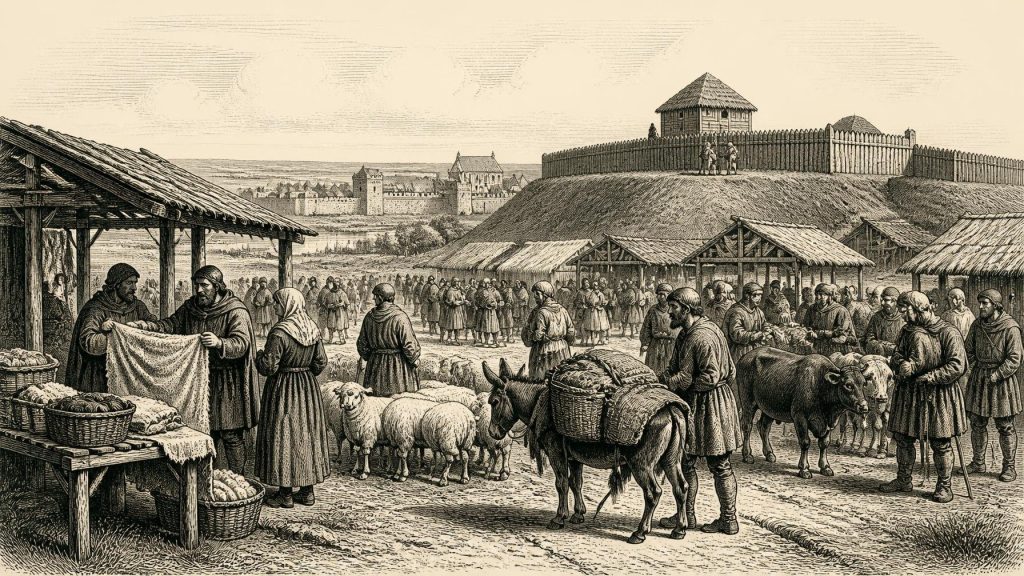
The fairs mattered as much as the fortification. An eight-day fair at Donnybrook, outside medieval Dublin, and comparable fairs at Waterford and Limerick offered regulated occasions for exchange, toll-taking and the gathering of people and goods. They linked royal government to urban finance: military and administrative investment could be coupled with privileges capable of generating trade and dues. We cannot list the stalls or measure the first year’s traffic, but farmers, livestock dealers, craftsmen, carriers, sailors and visiting merchants all had reason to watch such privileges closely.
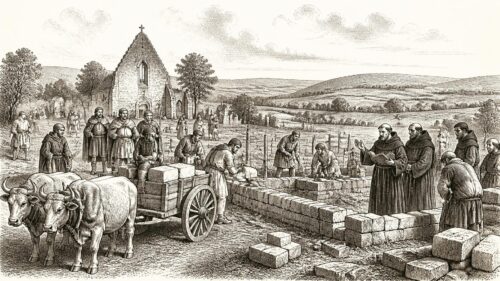
Further south-east, the foundation date of Duiske, the Cistercian house at Graiguenamanagh, is usually placed around 1204 and is associated with William Marshal, lord of Leinster. The evidence does not allow a confident claim that its full community or surviving church was established in that precise calendar year; dates between 1204 and 1207 appear in the scholarship. Even so, the project belongs to this moment of settlement and lordship along the Barrow valley. Cistercian foundations required land, endowment, labour, supply networks and links across the Irish Sea, bringing religious observance and economic development together.
Thus 1204 was a year of contested power rather than a decisive national turning-point. Royal officials tried to discipline magnates; Cathal Crobhdearg explored a compromise that might save Connacht; de Courcy’s Ulster lordship unravelled; and Irish rulers won local victories against settler forces. Meanwhile, fires, raids, shrines, monasteries, fairs and new building works show how deeply political conflict reached into ordinary communities. Ireland’s future was being shaped not only on battlefields and in royal writs, but at churches, river crossings, market grounds and fortified towns.
Primary Sources
- The Annals of Ulster, Year U1204
- Annals of the Four Masters, Annal M1204
- Annals of Inisfallen
- Annals of Loch Cé A.D. 1014–1590
- Annales Hiberniae
- His Majesty's Castle of Dublin
- Statute Law Revision Act 2007, Schedule 1
- John, Lord of Ireland, 1185–1216
- King and Magnate in Medieval Ireland: Walter de Lacy, King Richard and King John
- Meiler fitz Henry and the 1207 Royal Settlement of Desmond
- Lacy, Hugh de
- fitz Henry, Meiler
- Mac Carthaig (MacCarthy), Domnall Mór
- Marshal, William
- Iona and the Shrine of Columba, c. 800–1200
- The Cambridge History of Ireland, Volume 1: 600–1550
- Calendar of Documents Relating to Ireland, 1171–1307
- Holdings: Inspeximus of a Writ of King John to Fitz Henry, Justiciar of Ireland, Regarding Cathal, King of Connaught
- Confirmation by the Second Earl of Pembroke of his Father's Grant to Duiske Abbey
- Cistercian Monastery Restoration 1976
- King John and the Cistercians in Wales
- The Origins and Foundation Charter