
Year by Year
Explore Year by Year articles from the most modern historical year back to the oldest.
3,305 Articles Archived
Annal Year
Archived: 10 November 2026
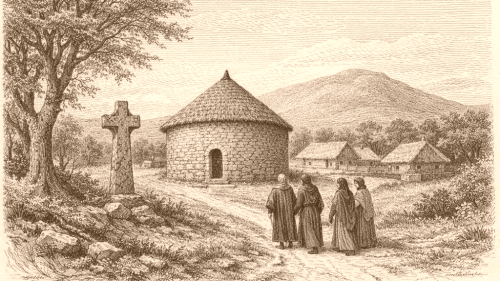
The surviving annals preserve only brief notices for the year commonly discussed as 615 CE, and they do so in different chronological frames. The Annals of Ulster places its relevant material under a heading marked AD 614, while the Annals of Tigernach uses T615, and Inisfallen later cross-references one battle notice to AU 615. This essay keeps those systems separate and identifies only the items explicitly placed in or linked to the year. It distinguishes securely dated notices from adjacent-year material and avoids filling the annal gap with conjecture.
Sparse Year
Archived: 10 November 2026
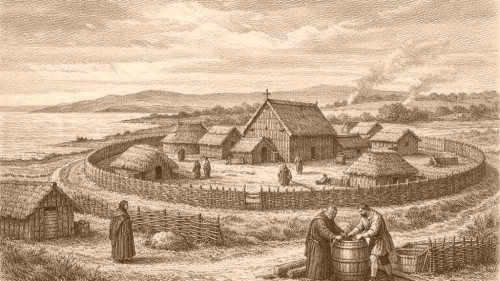
The surviving annalistic evidence for 614 CE is extremely sparse. One Irish sequence records only the burning of Bennchor under that year, while another tradition places a battle in Britain under 614 and notes that other annals assign it to 613. A fragmentary annal sequence also records a star seen in the third hour of the day for 614. These notices are brief, separate, and not linked by the texts themselves. This account distinguishes those securely dated entries from nearby or cross-referenced material, and it avoids filling gaps with conjecture about causes, participants, or wider consequences.
Ireland Witnessed
Archived: 10 November 2026
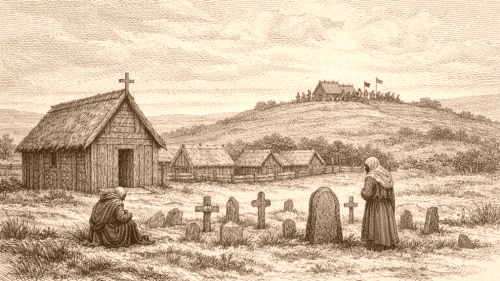
The annals preserve only a narrow and uneven picture of Ireland in 613 CE. For that year, one tradition records the death of Mael Coba son of Aed in battle and the succession of Suibne Menn, while another tradition records the death of Aed Allain, the accession of Mael Coba, and the repose of Colman abbot of Cluain. Nearby notices are explicitly dated to adjacent years, and several later compilations attach 613-year headings to material that appears elsewhere under different regnal schemes. This account distinguishes securely dated notices from broader contextual entries and refrains from filling annal gaps with conjecture.

Animal Dispersal
Archived: 8 October 2026
Ireland around 30,117 BCE lay within the climatically unstable Late Pleistocene, as the British–Irish Ice Sheet expanded unevenly and low sea levels reshaped coasts and possible dispersal routes. Derryvree, County Fermanagh, preserves freshwater organic deposits between glacial tills, indicating a treeless, wet tundra-like mosaic during a local ice-free interval. Castlepook Cave, County Cork, contains a time-spanning fauna including reindeer, mammoth, giant deer, predators and cold-adapted small mammals, demonstrating ecological richness but not a single contemporary assemblage. A cut-marked reindeer bone may suggest human carcass processing, yet no secure evidence proves settlement. Regional records reveal ice, water, vegetation and animal movements.

Reindeer Scars
Archived: 8 October 2026
Labelled 30,118 BCE, this horizon represents an uncertain Late Pleistocene interval, not a precise Irish date. During Marine Isotope Stage 3, Ireland contained shifting ice, periglacial terrain, wetlands and open grazing country as the British–Irish Ice Sheet expanded towards its later maximum. Derryvree sediments indicate local ice-free freshwater environments, while Castlepook Cave preserves cold-adapted fauna including mammoth, reindeer, giant deer, hyaena and wolf. An incised reindeer femur may indicate early human butchery, but its insecure context and lack of associated tools prevent firm conclusions. Later glaciation destroyed much evidence, requiring cautious interpretations based on dated deposits, animal remains and landforms.
Crag Intervals
Archived: 8 October 2026
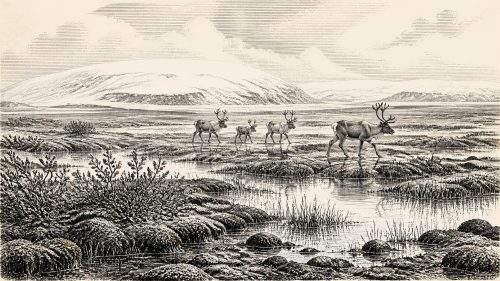
At approximately 30,119 BCE, Ireland lay within the climatically unstable later Marine Isotope Stage 3, beyond precise calendar dating or historical record. At Derryvree, County Fermanagh, organic sediments between two glacial tills document an ice-free local landscape of shallow pools, mosses, sedges, herbs and tundra-like vegetation. They demonstrate regional climatic fluctuation, not an ice-free island. Lower seas and shifting ice altered coasts, while Crag Cave records intermittent conditions. Faunal remains at Castlepook Cave indicate open-country mammals. A marked reindeer bone suggests tentative Upper Palaeolithic human activity, but no secure settlement evidence exists. Environmental change and renewed glaciation define this period.

Fermanagh Shrubs
Archived: 8 October 2026
Although 30,120 BCE lies within Derryvree’s calibrated radiocarbon range, no year-specific Irish history can be recovered. During unstable Marine Isotope Stage 3, Fermanagh’s Derryvree deposits record an ice-free interval between glacial advances: cold, treeless wetlands of pools, sedges, grasses, mosses, juniper and herbs. Later ice buried and preserved this evidence. Castlepook Cave in Cork contains remains of diverse Ice Age animals, but mixed deposits prevent a single contemporary reconstruction. A modified reindeer bone may indicate brief human butchery, not settlement. Ireland was periodically habitable amid shifting ice and sea conditions, yet lacks evidence for societies, economies, culture or enduring occupation.

Castlepook Relics
Archived: 8 October 2026
About 30,121 BCE, Ireland lay in a cold, unstable Late Ice Age landscape as the British–Irish Ice Sheet expanded. Open tundra-like habitats, altered coastlines and routes supported cold-adapted fauna, while glaciation later destroyed or buried much evidence. Castlepook Cave in County Cork preserves Ireland’s vertebrate archive for this period, though its mixed deposits span many millennia and were excavated. Bones of mammoth, reindeer, giant deer, hyaena, wolves and Arctic mammals demonstrate animal access. A possibly tool-marked reindeer bone may indicate human activity around 33,000 years ago, but cannot establish settlement, society or sustained occupation. The period remains an environmental history.

Derryvree Interbeds
Archived: 8 October 2026
30,122 BCE cannot be reconstructed as a precise year, but falls within a late-MIS-3 interval represented by the Derryvree BIRM-166 organic silt. Deposited between glacial tills in County Fermanagh, it records a locally ice-free freshwater tundra wetland with grasses, sedges, dwarf shrubs, mosses, insects and water plants. Ireland formed an unstable mosaic of ice, periglacial terrain and open habitats before later ice-sheet expansion. Castlepook Cave, County Cork, preserves diverse cold-stage fauna, including mammoth, reindeer and predators, though remains accumulated over time. A marked reindeer bone may indicate human butchery, but sustained occupation remains unproven. Evidence illuminates environmental change, not society.

Bogbean Pollen
Archived: 7 October 2026
30,123 BCE is a modern label for an uncertain Late Pleistocene horizon, not a recorded Irish year. At Derryvree, County Fermanagh, organic freshwater sediments between glacial tills, radiocarbon-dated broadly to this period, preserve bogbean, pollen, mosses and insects. They indicate locally ice-free, treeless tundra wetland with pools, sedges, grasses, herbs and juniper. Ireland experienced changing ice margins before the later Last Glacial Maximum, while lower sea levels did not guarantee access routes. Castlepook Cave, County Cork, contains cold-climate fauna. A possibly tool-marked reindeer bone may indicate human carcass processing, but cannot demonstrate settlement. No evidence supports society, agriculture or institutions.
Some records do not yet have a verified historical year and are awaiting chronological placement.