Castlepook’s Mammal Passage30117 BCE
Ireland around 30,117 BCE lay within the climatically unstable Late Pleistocene, as the British–Irish Ice Sheet expanded unevenly and low sea levels reshaped coasts and possible dispersal routes. Derryvree, County Fermanagh, preserves freshwater organic deposits between glacial tills, indicating a treeless, wet tundra-like mosaic during a local ice-free interval. Castlepook Cave, County Cork, contains a time-spanning fauna including reindeer, mammoth, giant deer, predators and cold-adapted small mammals, demonstrating ecological richness but not a single contemporary assemblage. A cut-marked reindeer bone may suggest human carcass processing, yet no secure evidence proves settlement. Regional records reveal ice, water, vegetation and animal movements.
Dateline
The label “30,117 BCE” is useful for arranging a modern chronology, but it must not be mistaken for a date that people in prehistoric Ireland could have known, recorded or marked. At this depth of time, calendar-year precision is unavailable. The evidence consists of sediments, fossils, ice-sheet landforms and laboratory measurements with margins of error, rather than dated documents or events. The responsible question is therefore not what happened in Ireland in one particular year, but what can be said about the island during the broad interval in which that notional year falls: the Late Pleistocene, within Marine Isotope Stage 3, a climatically unstable portion of the last Ice Age.
Radiocarbon ages are not calendar ages. They must be calibrated because atmospheric carbon-14 levels have varied through time, and the resulting ranges can be broad, especially beyond 30,000 years ago. For Ireland, one especially relevant measurement comes from organic sediments at Derryvree, near Maguiresbridge in County Fermanagh: 30,500 radiocarbon years BP, with an uncertainty of roughly 1,100 years. Modern calibration has been expressed as an approximate span of 36,900–31,700 calibrated years BP, or about 34,950–29,750 BCE. The present label falls within that broad range, but cannot be tied to a particular season, generation, pool or episode of animal movement.
A Changing Ice-Age Island
Ireland was then part of a wider north-west European world transformed by cold, lowered sea level and growing ice masses. Yet it would be misleading to picture the whole island as uniformly buried beneath a permanent, continent-like ice cap at every moment. The British–Irish Ice Sheet expanded and contracted unevenly. Recent reconstructions indicate rapid growth during the later part of MIS 3: ice was advancing through the North Minch around 32,000–31,000 years ago, and by around 30,000 years ago a combined British–Irish ice sheet had developed. Modelled conditions at that later point include a substantial ice dome over Northern Ireland and separate southern Irish ice caps.
Those reconstructions are major advances in understanding ice-sheet history, but they do not make a precise map possible for 30,117 BCE. They also emphasise that different sectors reached their greatest extent at different times. Northern and western margins could advance early, while southern and eastern sectors followed another timetable. The most cautious conclusion is that Ireland was entering, or already experiencing, a profound regional reorganisation of ice, water, coastlines and habitats. Some localities could have remained ice-free long enough for freshwater deposits and vegetation to form, while others lay beneath, beside or in front of advancing ice.
Sea level was far lower than it is today because enormous quantities of water were stored in northern ice sheets. The Irish Sea basin and continental shelves were therefore very different landscapes, though low sea level did not automatically create a simple, dry and dependable route between Ireland and Britain. Ice, marine inlets, changing shorelines and the configuration of the Irish Sea all mattered. Animal dispersal into Ireland is demonstrated by fossil assemblages; the exact paths by which each species arrived remain an interpretation rather than an observed fact.
Derryvree’s Freshwater Interval
Derryvree is among the most important Irish windows onto this cold world. Roadworks exposed a sequence within a drumlin: glacial till below, freshwater silts, fine sands and organic material in the middle, and another substantial till above. The order is clear. Ice had affected the locality; a period followed in which standing or slow-moving water and organic deposits accumulated; then ice returned and sealed the deposit. This is direct stratigraphic evidence for local environmental change, not evidence for a settled community.
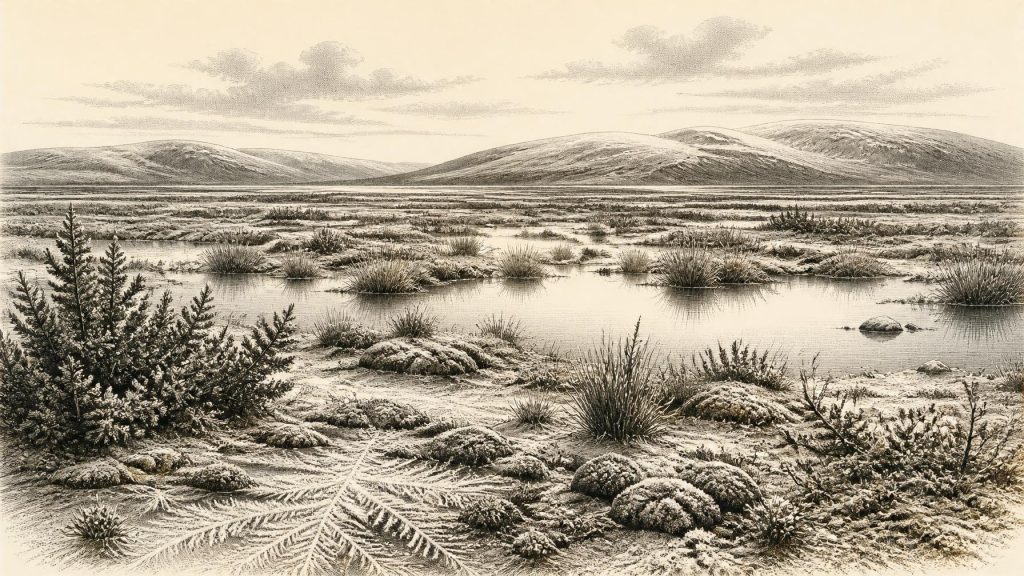
The plant and insect remains support a picture of a treeless, cold, waterlogged landscape. Grasses, sedges, juniper and herbs were accompanied by mosses; aquatic and wetland remains point to pools or quiet water surrounded by plant-rich ground. Scholars have described the setting as tundra or muskeg. These are useful ecological comparisons, not claims that a modern Arctic wetland stood unchanged in Fermanagh. The evidence supports an open mosaic of wet places, low vegetation and harsh winters. It does not support woodland, farming, fields or a familiar green Irish countryside.
The Derryvree deposit also demonstrates the value of restraint. A wetland horizon beneath a drumlin tells us about one locality during a broad interval. It cannot prove that all of Ireland was simultaneously open tundra, nor that every nearby animal species occupied the same place at the same time. Nevertheless, its buried seeds, pollen, mosses and insects preserve a kind of environmental everyday life otherwise unavailable: shallow water, saturated ground, short growing seasons and hardy plants capable of surviving an exacting climate.
The Cave Archive at Doneraile
Far to the south, Castlepook Cave near Doneraile in County Cork has yielded Ireland’s most remarkable assemblage of Late Pleistocene mammals. Excavations begun by Richard J. Ussher in the early twentieth century recovered a huge quantity of bones, although only a fraction survives in museum collections. Reindeer, woolly mammoth, giant deer, brown bear, wolf, Arctic fox, mountain hare, lemmings and spotted hyaena are among the animals identified from the cave complex. Their presence overturns any image of Ice-Age Ireland as biologically empty.
That list must, however, be read as an archive spanning time, not as a single parade of animals observed on one day. Cave deposits were accumulated, disturbed and excavated before modern recording standards. Radiocarbon programmes have shown that some specimens belong to MIS 3, while others are much later. Improved bone pretreatment and redating have further altered the chronology: a 2020 reassessment found that several earlier Castlepook dates were significantly too young, in some cases by thousands of radiocarbon years. The cave is therefore invaluable, but it is not a neatly sealed snapshot of 30,117 BCE.
Even so, the MIS 3 fauna gives a credible indication of the wider ecological possibilities around this era. Reindeer and lemmings indicate cold-adapted environments; Arctic fox and mountain hare belong to the same broad northern ecological register. Mammoth, giant deer, wolf, bear and hyaena reveal a food web of large herbivores, predators and scavengers. The cave itself may have been used or entered by carnivores, and bones could have been transported, gnawed, redeposited or accumulated over long periods. A cave bone proves that an animal, or part of one, reached the cave system; it does not always prove where that animal lived, died or was killed.
The Human Question
The possibility of people in Ireland at this early date deserves attention precisely because the evidence is so slight. A reindeer femur from Castlepook has been reported as bearing an incision interpreted as damage made by a sharp stone tool while the bone was fresh. If that interpretation is sustained, it may indicate that a person or small group processed a reindeer carcass in Ireland during the Upper Palaeolithic, far earlier than the island’s formerly accepted human record.
It cannot bear more weight than that. No securely associated Palaeolithic tool assemblage, hearth, occupation floor, dwelling, burial, human skeleton or artwork has been established at Castlepook for this period. The cave’s complicated deposits and the antiquarian history of excavation make context especially important. Nor could one marked bone establish whether people hunted the animal, scavenged it, visited briefly, travelled regularly across the region or formed a lasting population. The evidence is potentially momentous, but it is evidence for a possible encounter with a carcass, not proof of an Irish settlement.
This distinction also limits what can responsibly be written about society. There are no known rulers, tribes, political institutions, diplomatic relations or wars in Ireland at this date. There is no evidence for farming, herding, pottery, metalworking, monuments, formal religion, literacy or trade networks. These are not merely missing details awaiting recovery; they are categories for which the surviving Irish record of this age provides no secure basis. If people did reach the island, their material trace has either not survived, has not been recognised, or was exceptionally slight.
Movement Without Kingdoms
The principal historical development around this date was environmental, not political: Ireland lay within a shifting Ice-Age corridor in which ice margins, exposed shelf landscapes, wetlands and animal ranges changed repeatedly. Mammals crossed into and disappeared from the island over long periods. Their movements imply ecological connections with Britain and continental Europe, but not commerce or diplomacy. Predators followed prey; herbivores sought forage; people, if present, may have followed animal movements. Such statements are informed inferences from fossils and landscape reconstruction, not direct testimony.
What survives most clearly is a landscape in transition. Fermanagh preserves a cold freshwater interval between glacial advances. Cork preserves a fragmented cave archive of animals adapted to open, often severe conditions. Crag Cave in County Kerry preserves episodes of speleothem growth, showing that liquid water and temporary climatic amelioration occurred during parts of the last glacial cycle. Together these records show an Ireland of pronounced regional variation rather than an undifferentiated frozen blank.
For 30,117 BCE, then, the most defensible history is one of ice, water, plants and animals, with only a cautious possibility of human presence. It was an Ireland without recorded names or communities, but not without life. Its evidence survives less in monuments than in a reindeer bone, a cave deposit, a moss-rich silt and the sediments left when ice briefly yielded ground to water.
Primary Sources
- A Reconsideration of the Radiocarbon Dating of the Marine Isotope Stage 3 Fauna from Southern Ireland
- The Irish Quaternary Fauna Project
- Growth and Retreat of the Last British–Irish Ice Sheet, 31,000 to 15,000 Years Ago: the BRITICE-CHRONO Reconstruction
- The Timing and Magnitude of the British–Irish Ice Sheet Between Marine Isotope Stages 5d and 2
- Deglaciation Chronology of the Donegal Ice Centre, North-west Ireland
- Stratigraphic and Palaeo-Geomorphological Evidence for the Glacial-Deglacial History of the Last British-Irish Ice Sheet in the North-Western Irish Sea
- Pattern and Timing of Retreat of the Last British-Irish Ice Sheet
- Episodic Speleothem Deposition Tracks the Terrestrial Impact of Millennial-Scale Last Glacial Climate Variability in SW Ireland
- Landscapes and Environments of the Last Glacial-Interglacial Transition: A Time of Amazingly Rapid Change in Ireland
- Figure 6.— The Subdivision of the Quaternary Period in Ireland
- A Middle Midlandian Freshwater Series at Derryvree, Maguiresbridge, County Fermanagh, Northern Ireland
- Archaeological Heritage of County Cork
- Heritage Artefacts of County Cork
- 2022:564 – Castlepook Cave, Castlepook South, Cork
- Occurrence of Mammalia Relicts at Site Castlepook Cave
- The Exploration of Castlepook Cave, County Cork
- The IntCal20 Northern Hemisphere Radiocarbon Age Calibration Curve (0–55 cal kBP)
- IntCal Publications
- A Stratigraphic Framework for Abrupt Climatic Changes During the Last Glacial Period Based on Three Synchronized Greenland Ice-Core Records
- First Evidence of a Late Upper Palaeolithic Human Presence in Ireland
- The Problem of a Late Quaternary Landbridge Between Britain and Ireland
- Relative Sea-Level Changes and Crustal Movements in Britain and Ireland Since the Last Glacial Maximum
- Outreach and Education Resources
- Mammals