Ransoms And Rivalries1,029 CE
The Ireland of 1029 was not ruled from a single centre. The annals instead show a political landscape of dynasties, church settlements, port-towns and regional over-kingships, each trying to hold advantage in the uncertain generation after Brian Bóruma and Máel Sechnaill mac Domnaill. The entries for this year are terse, but they are unusually revealing: a Dublin prince was captured and ransomed on a spectacular scale; leading men were killed in Leinster, Brega, Connacht, Ulster and the north-west; a church-linked tragedy took place in Cairbre Mór; and one of Ireland’s foremost craftsmen died. Where the sources disagree in detail, they still point in the same direction: 1029 was a year in which power was negotiated through hostages, cattle, silver, kinship, pilgrimage and violence.
Dublin, Brega And A Royal Ransom
The most striking firmly dated event of the year was the capture of Amlaíb, son of Sitriuc, the Hiberno-Norse king of Dublin. The Annals of Ulster call Amlaíb “king of the foreigners”, while other annals describe him as the son of Sitriuc, lord or king of Dublin. His captor was Mathgamain Ua Riagáin, king of Brega. Brega, in the rich east-midland lands around Meath, lay close enough to Dublin for its rulers to be both rivals and necessary partners of the port-town. The episode shows that Dublin’s rulers were not isolated urban kings: they were deeply entangled with Irish inland politics.
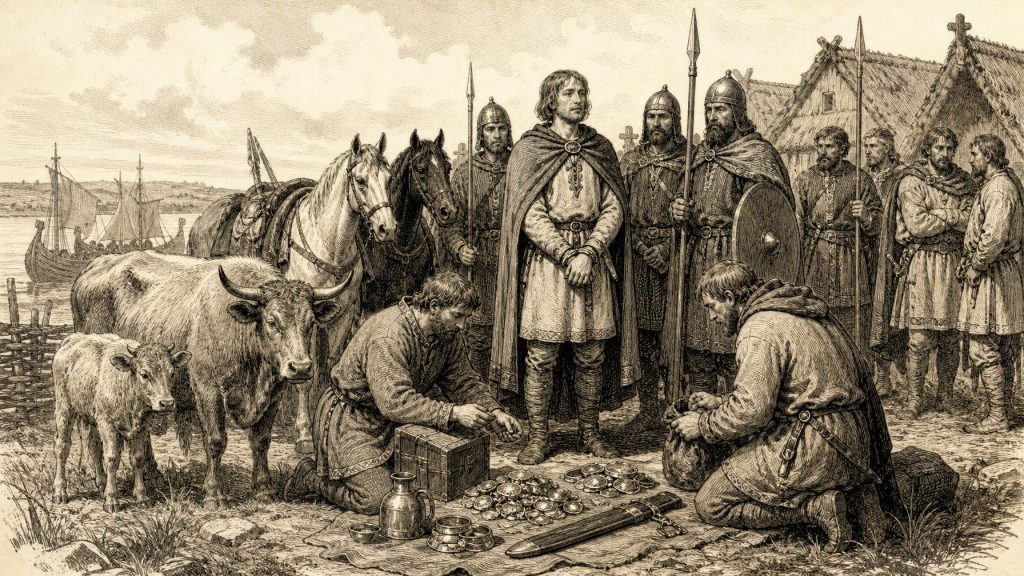
The ransom was enormous. The sources vary in some details, but agree on its basic character: Amlaíb was released only after the payment of 1,200 cows, a great number of British or Welsh horses, gold, silver, hostages, and the famous “sword of Carlus”. The Annals of Ulster preserve the fullest list, adding Irish pledges from both Leinster and Leth Cuinn, and a further settlement for peace. This was not a simple payment of money. It was a public political settlement, measured in livestock, precious metal, elite horses, prestigious weaponry and living guarantees.
The ransom also illuminates the economy of the time. Cows were still a central unit of wealth in Gaelic Ireland, but Dublin was a silver-using, coin-minting and seaborne trading town. Sitriuc had introduced Irish coinage in Dublin around the end of the tenth century, and imported silver, craft goods and luxury objects circulated through Hiberno-Norse networks. The ransom of 1029 therefore sits at the meeting point of two overlapping economies: the cattle wealth of rural lordship and the bullion-and-coin world of the Irish Sea. The mention of Welsh horses is equally suggestive. It reminds us that Dublin’s contacts reached across the sea to Britain, and that high-status animals were part of elite exchange as well as military display.
Sitriuc’s Christian Dublin
Amlaíb’s capture came just after a notable moment in Dublin’s religious history. Several annals record that Sitriuc son of Amlaíb, king of Dublin, went to Rome in 1028. Christ Church Cathedral’s own historical tradition places the foundation of the original Viking church of the Holy Trinity at about 1030, by Sitriuc and Dúnán, Dublin’s first bishop. It would be unsafe to say that the church was founded in 1029 itself; the evidence belongs to the years around 1028–1030. Yet the connection is important for understanding the atmosphere of this year. Dublin’s rulers were Christian patrons, international pilgrims and political actors in Irish affairs.
That dual identity mattered. The same dynasty that minted coins and traded across the Irish Sea also dealt in hostages with Brega and Leinster, and founded churches that looked towards wider western Christendom. Dublin in 1029 was not merely a “Viking” town in the old raiding sense. It was Hiberno-Norse: Scandinavian in inheritance, Irish in political entanglement, Christian in public identity, and commercial in outlook.
Violence Among The Kingdoms
Beyond the Dublin ransom, the annals for 1029 record a series of killings that reveal the competitive nature of regional kingship. Donn Sléibe son of Brogorbán, king of Uí Fhailgi in the midlands, was killed by his own people. Such a phrase is brief but significant. It suggests not an external conquest but internal rejection, feud or deposition within the ruling community. Kingship in early medieval Ireland depended on consent, kin backing and military credibility; a king who lost these could be removed violently.
In the north-east, Donnchad Ua Donnacáin, king of Fernmag, and Cináed son of Angeirrce, king of Conaille, are said to have fallen by one another at Cill Shléibhe, identified in later forms with Killeavy. The annalistic phrasing presents the event almost as a mutual duel, though we cannot know whether it was single combat or a stylised way of describing battle. Either way, it points to the contested frontier politics of Airgialla and neighbouring peoples, where local kings could perish in conflicts that mattered greatly to their own territories even if they left little narrative trace.
Connacht also appears unstable in the records. The Annals of Ulster, the Four Masters and Loch Cé record the killing of Brian Ua Conchobair, heir designate of Connacht, though they differ over the agency: some say he was killed by his own people, while the Four Masters name Máel Sechnaill son of Máel Ruanaid, king of Crumthann. The Annals of Tigernach place Brian’s killing under the preceding year and instead record the blinding of Conchobar, a Connacht royal heir, by Tadc Ua Conchobair in 1029. The safest conclusion is not to force these notices into one neat story, but to recognise a wider succession crisis around the Connacht kingship in these years. Killing and blinding were political tools: a dead or physically disqualified rival could no longer easily claim royal status.
Cairbre Mór And A Church Tragedy
One of the darkest entries concerns Inis na Lainne in Cairbre Mór, the territory associated with Cairbre Drom Cliabh in what is now County Sligo. The Annals of Ulster record that Aed Ua Ruairc, Aengus Ua hAenghusa, the superior of Druim Cliab, and sixty others were burned there. Other annals give different totals and titles: the Four Masters name Aed Ua Ruairc as lord of Dartraige and mention the lord of Cairbre; Chronicon Scotorum gives a much larger death-roll; Tigernach’s version also connects the disaster with Cairbre’s nobility and Drumcliff. The variations warn us not to overstate the precise number of dead, but the substance is clear: a major local catastrophe involved lay nobles and churchmen together.
The presence of the superior of Druim Cliab, Drumcliff, is important. Drumcliff was an early monastic site associated with Colum Cille, and ecclesiastical settlements were deeply embedded in lordship, landholding and local identity. The annals do not explain who set the fire or in what circumstances the victims were trapped. It may have been a military attack, a siege of a house, or some other violent episode. What can be said responsibly is that the tragedy shows how closely church personnel, relics and ruling families could be bound together in moments of danger.
Tír Conaill And Northern Rivalries
In the north-west, Muirchertach Ua Maíl Doraid, king of Cenél Conaill, was killed by the Uí Chanannáin, at Ráth Canannáin according to some versions. This was an internal struggle within the broad Cenél Conaill world, not simply an invasion from outside. The Ua Maíl Doraid and Ua Canannáin kindreds were among the families contending for authority in Tír Conaill before the later rise of the O’Donnells. The killing therefore marks one stage in a long competition for dominance in the Donegal region.
The same northern world is also glimpsed in the death notice for Máel Coluim son of Máel Brigte son of Ruaidrí, described in some annals as king of Alba. This was not an Irish kingship, but Irish annalists regularly recorded events in Gaelic Scotland and the Irish Sea world. His appearance under 1029 reflects the shared political and cultural horizon linking Ireland, Alba, the Isles and the Hiberno-Norse ports.
Pilgrimage, Craft And Learning
Not every significant development in 1029 was a battle or a killing. The Annals of Inisfallen record Flaithbertach Ua Néill on pilgrimage to Armagh. Other annals place his journey to Rome around 1030, so the chronology should be treated carefully. Still, the notices together show that elite pilgrimage formed part of political and religious life. A powerful northern ruler might seek penitential prestige at Armagh, the church of Patrick, and perhaps at Rome, without ceasing to be a political actor.
The death of Máel Brigte Ua Brolcháin, called chief artificer or chief wright of Ireland, is another valuable notice. The annals rarely name craftsmen unless they were unusually eminent. His title suggests a recognised master of building or fine craft, probably within the learned and ecclesiastical world where churches, shrines, bells, book-covers and reliquaries required skilled hands. His death reminds us that eleventh-century Ireland was not only a landscape of raids and dynastic feuds. It was also a society of workshops, patrons, scribes, metalworkers, woodworkers and church communities that preserved and displayed sacred and royal authority through objects.
Everyday Life Behind The Annals
The annals focus on elites, but 1029 also belonged to farmers, herdsmen, boatmen, women working in dairying and textiles, clerics, labourers and the unfree. Archaeological studies of early medieval Ireland describe a predominantly rural landscape of raths, crannógs, fields, mills, routeways and ecclesiastical enclosures. Cattle remained central to status and exchange, while mixed farming supplied milk, butter, cheese, grain, meat and wool. The huge bovine ransom paid for Amlaíb only makes sense in this wider world: cattle were mobile wealth, political currency and a visible measure of lordship.
Yet 1029 also shows change. Dublin’s silver, Welsh horses and international contacts sat alongside inland cattle wealth. Church centres such as Armagh, Drumcliff and the emerging Holy Trinity in Dublin linked local communities to wider Christian geographies. Regional kingship remained violent and unstable, but it was not chaotic in the modern sense: it followed recognisable rules of honour, compensation, hostage-taking, succession and sanctified authority. The year’s records are fragmentary, but together they give a vivid annual cross-section of eleventh-century Ireland: rural and maritime, Gaelic and Hiberno-Norse, devout and violent, traditional in its cattle wealth yet increasingly tied to the wider economies and churches of north-western Europe.
Primary Sources
- The Annals of Ulster: Year U1029
- The Annals of Tigernach: Annal T1029
- Chronicon Scotorum: Annal CS1029
- Annals of the Four Masters: Annal M1029
- Annals of Inisfallen
- Annals of Loch Cé
- The Annals of Ulster
- Annals of the Four Masters
- Sitriuc Silkbeard (Sitric, Sigtryggr Ólafsson Silkiskeggi)
- Ua Néill, Flaithbertach
- Life after Brian: the high-kingship
- History | Christ Church Cathedral
- Christ Church Cathedral | The United Dioceses of Dublin and Glendalough
- 950-1450: Vikings, Normans and Medieval Mints
- Viking | National Museum of Ireland
- Coin | British Museum
- Early Medieval Ireland: Archaeological Excavations, 1930-2009
- The Archaeology of Livestock and Cereal Production in Early Medieval Ireland, AD 400-1100
- Changing human-cattle relationships in Ireland: a 6000-year isotopic perspective
- Mapping social, ideological and economic transformations: Settlement and landscape in the early medieval kingdom of Brega, AD 400-1100
- Drumcliff
- Home – Discover Drumcliffe
- The Annals attributed to Tigernach
- Family Names of Ireland