Castlepook’s Reindeer Passage31898 BCE
Circa 31,898 BCE, Ireland lay within the climatically unstable later Marine Isotope Stage 3, not a precisely datable historical year. Castlepook Cave in County Cork preserves the island’s richest faunal archive from this period, including mammoth, reindeer, giant deer, hyaena, wolf and Arctic fox, indicating changing cold, largely open environments. A reindeer bone bearing a possible stone-cut mark may record brief Palaeolithic butchery, but disturbed deposits and absent tools or occupation layers preclude claims of settlement. Altered coastlines may have enabled visitors’ arrival. Approaching glaciation later erased much evidence, making Castlepook’s fragmentary record vital yet necessarily cautious for Irish prehistory.

Dateline
The label 31,898 BCE cannot identify a documented Irish event, a ruler, or even a single season. At this depth of time, modern calendar-year precision is unavailable. The number lies roughly 33,850 years before AD 1950, the conventional reference point for “before present”, but radiocarbon measurements require calibration and normally produce ranges rather than exact years. The responsible subject is therefore Ireland during the later part of Marine Isotope Stage 3, the unstable climatic interval before the Last Glacial Maximum. Its evidence is sparse, unevenly dated and frequently disturbed by ice, water and early excavations.
That scarcity makes one place unusually important: Castlepook Cave, near Doneraile in north County Cork. The cave’s bone deposits are Ireland’s richest known record of large animals in the long interval leading towards the maximum glaciation. They offer a glimpse of a cold, open country that was very different from modern Ireland, and possibly of a fleeting human visit. They do not, however, demonstrate a settled population, a named community or a continuous Palaeolithic occupation of the island.
A Date Without a Chronicle
“31,898 BCE” is a modern conversion, not a date anyone living then could have recognised. No written records, settlements, graves, hearths, tool assemblages or works of art securely belong to this particular point in Irish prehistory. Even the broad chronology needs care. Radiocarbon ages are measured in radiocarbon years before present and then calibrated against independently dated records, including tree rings and other archives, to estimate calendar ages. At around 34,000 calendar years ago, the calibration curve is less precise than it is for recent millennia. A specimen may be assigned a calibrated probability range, while the event that deposited or altered it may remain less securely dated still.
The appropriate frame is thus not “Ireland in one year”, but Ireland around the later Middle Midlandian or MIS 3 cold stages, perhaps roughly 35,000–32,000 calendar years before present in broad regional terms. Climate did not move steadily towards the deep cold of the Last Glacial Maximum. Greenland ice-core records and North Atlantic evidence show abrupt swings between relatively milder interstadials and severe stadials. Ireland lay at the Atlantic edge of those changes, where shifting sea ice, snowfall, wind and summer warmth could transform habitats over periods far shorter than an archaeological era.
By comparison, the Last Glacial Maximum, when the British–Irish Ice Sheet covered Ireland extensively and reached the continental shelf in several sectors, came later: broadly about 27,000–23,000 calibrated years before present for maximum coverage. Reconstructions suggest that the Irish ice sheet was growing and reorganising in the preceding millennia, but its onset and extent varied strongly from region to region. It is unsafe to picture the whole island either as ice-free grassland or as a single uninterrupted ice cap at the notional date in question.
Castlepook’s Bone Archive
Castlepook Cave is the central Irish archive for this period because its limestone passages preserved more than two thousand Pleistocene animal remains recovered principally during excavations in the early twentieth century. They include woolly mammoth, reindeer, giant deer, brown bear, wolf, Arctic fox, mountain hare, lemmings and, most strikingly, spotted hyaena. The latter is known in Ireland with particular confidence from Castlepook. Such a list does not mean every species lived side by side on one day. Cave assemblages commonly accumulate over long intervals and through several processes: animals may die naturally, carnivores may drag prey or scavenged carcasses underground, water may move bones, and later sediment disturbance may mix material.
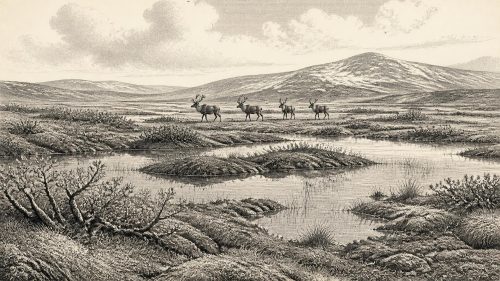
Even so, the fauna establishes what was possible in southern Ireland during portions of MIS 3. Reindeer and lemmings indicate cold conditions; mammoth and horse-like open-country communities elsewhere in north-west Europe suggest broad, largely treeless landscapes; hyaenas, wolves and bears reveal a food web with large carnivores as well as herbivores. Giant deer, often misleadingly called “Irish elk”, were neither uniquely Irish nor elk. Their later fame comes from Ireland’s abundant fossil finds, but in this earlier setting they belonged to a wider Eurasian species able to exploit suitable open and mixed environments.
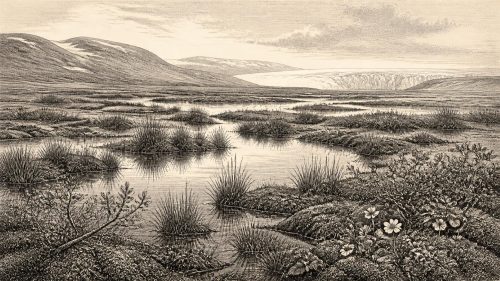
The landscape should not be imagined as a featureless snow desert. During milder episodes, grasses, sedges, herbs, dwarf shrubs and patches of willow or birch could have found room in sheltered places. During colder phases, frost-shattered ground, sparse vegetation and strong winds would have dominated more widely. Organic silts preserved beneath glacial deposits at Derryvree, County Fermanagh, provide a separate northern Irish reminder that treeless, wet, tundra-like environments existed during earlier parts of the Midlandian. Yet Derryvree is not a diary of County Cork, and its deposits cannot be used to prescribe the weather of a single year at Castlepook. The value of these sites is comparative: together, they show that Pleistocene Ireland contained changing mosaics rather than a permanent, uniform climate.
The Reindeer Bone and Human Possibility
One Castlepook reindeer bone has become especially significant. Reassessment identified a mark interpreted as having been made with a sharp stone edge while the bone was fresh; public heritage accounts associate the specimen with a date around 33,000 BCE. If that interpretation is accepted, it is evidence that a person butchered at least part of a reindeer in Ireland far earlier than the securely established Mesolithic settlement record. It would be a remarkable trace: not a village, not a cemetery and not proof that families lived permanently on the island, but a brief act of carcass processing preserved on bone.
Its implications must remain proportionate to its scale. The specimen was recovered from a cave whose deposits were excavated long ago, before modern recovery methods, and the broader cave stratigraphy has been disturbed. The date belongs to the bone, not automatically to a securely excavated human activity floor. A single cut-like mark must also be distinguished from a complete pattern of butchery, such as repeated cut marks, associated stone tools, refitting fragments, hearths or a tightly dated occupation layer. This is why some archaeological summaries rightly describe the evidence as potential or claimed Palaeolithic human activity, while treating Mesolithic communities of the early Holocene as Ireland’s first clearly demonstrated colonising population.
Nevertheless, the inference is plausible enough to change the questions historians and archaeologists ask. At periods of lowered sea level, the coastlines around Ireland differed greatly from those of today. Much of the present continental shelf was exposed, although the precise availability of a dry, continuous route between Ireland and Britain remains debated and depended on local ice and sea-level conditions. A small hunting party could have reached south-west Ireland by travelling across exposed terrain, along coastal margins, over ice-related connections, or conceivably by water; the bone itself cannot decide which route was used. Nor can it tell us whether the visitors were local residents, seasonal hunters or people passing through a wider north-west European range.
Life at the Edge of the Ice
If humans did enter Ireland around this period, their economy would have been mobile and opportunistic. Reindeer offered meat, fat, marrow, hide, sinew, antler and bone; a carcass could have supplied far more than a meal. But that practical observation is an interpretation based on well-attested Upper Palaeolithic behaviour elsewhere, not a direct record of an Irish camp. No securely associated Irish stone toolkit currently allows archaeologists to identify the visitors’ cultural tradition, their language, kinship arrangements, clothing, shelters or travel plans.
There is equally no evidence for political affairs, diplomacy, territorial lordship or organised warfare in Ireland at this date. Such categories depend on social institutions that leave recognisable traces, and none has survived here. Competition between carnivores and people for large carcasses is conceivable, particularly in a landscape used by hyaenas and wolves, but it should not be romanticised as “conflict”. The cave’s most securely documented story may be animal use of a refuge or den over repeated episodes, rather than a human drama.
Religion, art and learning are also beyond direct recovery in Ireland for this moment. Contemporary Upper Palaeolithic groups on the European mainland made sophisticated tools, ornaments and cave art, showing that symbolic traditions flourished in the wider world. It does not follow that any person who reached Ireland left art, ritual deposits or a recognised sacred site here. The absence of evidence is partly a product of preservation: later glaciers eroded surfaces, reworked sediments and removed many open-air sites. It is not proof that visitors lacked beliefs or knowledge; it is a limit on what Irish evidence can responsibly say.
A Landscape Soon Remade
The great regional development was environmental, not political. Ireland stood near the threshold of fuller glaciation. Ice expansion later scoured much of its surface, altered drainage, deposited till and helped create the raw physical framework of many modern lowlands, lakes and valleys. This destructive power explains why cave deposits, protected fissures, sub-till organic beds and offshore cores matter so much: they are fragments that escaped total erasure.
Castlepook therefore represents both discovery and caution. Around the notional year 31,898 BCE, Ireland was not an empty backdrop awaiting history. It was a changing Pleistocene environment inhabited, at least intermittently, by formidable mammals and perhaps visited by people capable of processing a reindeer carcass. Yet the evidence is too slight to make that possible visit into a “first settlement” or a national origin story. The honest history of this date is one of cold grasslands, cave-bone archives, advancing ice and a single provocative mark whose meaning remains important precisely because it is so small.
Primary Sources
- Castlepook Cave, County Geological Site Report
- A Reconsideration of the Radiocarbon Dating of the Marine Isotope Stage 3 Fauna from Southern Ireland
- Growth and Retreat of the Last British–Irish Ice Sheet, 31,000 to 15,000 Years Ago: the BRITICE-CHRONO Reconstruction
- BRITICE-CHRONO Maps and GIS Data of the Last British-Irish Ice Sheet 31 to 15 ka
- Maximum Extent and Dynamic Behaviour of the Last British–Irish Ice Sheet West of Ireland
- Radiocarbon Constraints on the Age of the Maximum Advance of the British-Irish Ice Sheet in the Celtic Sea
- Oscillating Retreat of the Last British-Irish Ice Sheet on the Continental Shelf Offshore Galway Bay, Western Ireland
- Pattern and Timing of Retreat of the Last British-Irish Ice Sheet
- Ireland: Submerged Prehistoric Sites and Landscapes
- The Last Land-Bridge Between Ireland and Britain: a Geological Perspective
- A Middle Midlandian Freshwater Series at Derryvree, Maguiresbridge, County Fermanagh, Northern Ireland
- Palaeoecology: Irish Quaternary Association Field Guide
- New Insights on the Fauna of Ireland’s Younger Dryas and Early Holocene from Alice & Gwendoline Cave
- Prehistoric Details: Mell Flint Flake
- Archaeological Heritage of County Cork
- Heritage Artefacts of County Cork
- The Mesolithic in Ireland: When Was It?
- The Irish Elk: When and Why Did This Giant Deer Go Extinct and What Did It Look Like?
- Phylogeographic, Ancient DNA, Fossil and Morphometric Analyses Reveal Ancient and Modern Introductions of a Large Mammal: the Complex Case of Red Deer in Ireland
- Pleistocene Vertebrates in the British Isles
- IntCal20 Northern Hemisphere Radiocarbon Age Calibration Curve (0–55 cal kBP)