Doneraile’s Faunal Corridor31897 BCE
Around 31,897 BCE, a modern label corresponding approximately to 33,800 calibrated years before present, Ireland lay within the variable later Pleistocene, before the Last Glacial Maximum. Castlepook Cave near Doneraile, County Cork, preserves Ireland’s richest long-term faunal archive, containing mammoth, giant deer, reindeer, bears, hyaenas and other animals. These remains show intermittent habitats for substantial mammals, but cave processes and early excavation complicate interpretation. A possibly cut-marked reindeer bone may indicate very early human activity, yet remains unconfirmed. No secure contemporary settlements, tools, hearths or human remains exist. Ice reshaped landscapes, leaving cave deposits as fragmentary records of environmental change.

Dateline
A Date Beyond Annals
“31,897 BCE” is a modern calendar label, not a year that can be recovered from Irish evidence. No annals, settlements, graves, tools in secure context or dated human remains allow events in Ireland to be fixed to a particular calendar year this far back. In archaeological terms, the label falls very approximately around 33,800 calibrated years before present (cal BP), within the later Pleistocene and Marine Isotope Stage 3. Such conversion is only a broad orientation: radiocarbon results require calibration, yield ranges rather than single historical dates, and the curve itself is refined as research advances. The responsible history of this moment is therefore a history of environmental phases, surviving animal remains and the limits of what those remains can show.
Ireland was then part of the wider north-west European Ice Age world, but it was not yet at the maximum of the last British–Irish Ice Sheet. That maximum belongs later, broadly after 27,000 cal BP and particularly to the period around 26,500–19,000 cal BP. At roughly 33,800 cal BP, ice masses were growing and climates were highly variable. It would be misleading to picture one uniform island: glaciers, exposed ground, changing coastlines, rivers and periglacial terrain altered over long intervals and from region to region. The later advance of ice also eroded or buried much older landscape evidence, leaving caves and protected sediment pockets disproportionately important.
Southern Caves, Deep Time
The chief Irish evidence relevant to this period comes from limestone caves, especially Castlepook Cave, also known as Mammoth or Doneraile Cave, near Doneraile in north County Cork. Excavations from 1904 to 1918 recovered a very large assemblage of bones from narrow galleries and chambers. Geological Survey Ireland describes Castlepook as Ireland’s richest known source for vertebrate life leading towards the Last Glacial Maximum, with individually dated bones extending across a long span, roughly 45,700 to 19,950 years BP. That exceptional time depth is also the cave’s central difficulty: it is a repository accumulated over many millennia, not a sealed camp floor from one visit or one season.
Modern reassessment has made the chronology more demanding rather than simpler. Earlier radiocarbon measurements were re-examined with improved pretreatment and calibration, producing substantially older results for parts of the Castlepook faunal sequence. The revised work places significant southern Irish fauna in Marine Isotope Stage 3 and suggests that some species, notably giant deer and spotted hyaena, may have disappeared locally before the Last Glacial Maximum. This does not establish that every animal represented at Castlepook lived together, nor that each was present in 31,897 BCE. It does establish that southern Ireland intermittently supported substantial Pleistocene mammals during the broad climatic world to which this calendar label belongs.
An Ice-Age Animal Community
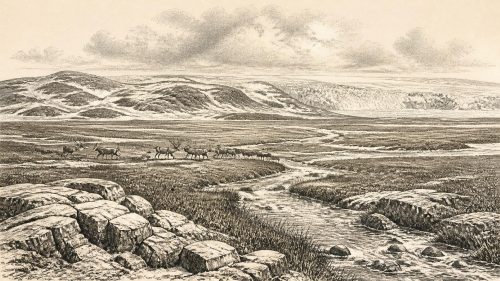
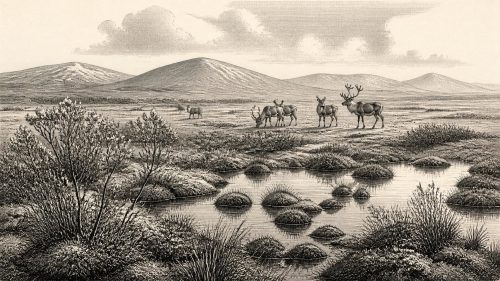
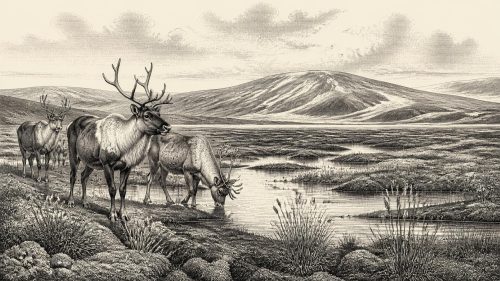
Castlepook’s fauna includes woolly mammoth, giant deer, reindeer, brown bear and spotted hyaena; later parts of the sequence also include Arctic fox, wolf and lemmings. Other southern Irish caves have yielded pre-Last Glacial Maximum red-deer remains. The mixture indicates that Ireland was not simply an empty white expanse throughout the later Pleistocene. Where suitable ground and vegetation were available, large herbivores and predators could use parts of the island. Yet these are occurrence records, not a census. They cannot tell us the number of animals, the exact area occupied, whether herds were resident or seasonal, or the precise vegetation outside a particular cave.
The likely setting was open, cold and windy, with a patchwork of herb-rich grassland, sedges, dwarf shrubs and sparsely vegetated ground rather than later Irish woodland. Such environments could sustain grazing and browsing animals, while mammoth, deer and reindeer in turn supported carnivores and scavengers. Cave bone collections, however, are filtered records. Hyaenas may have dragged carcass parts into dens; carnivores gnawed bone; water shifted sediments; and early excavators removed material before modern recording standards existed. A bone found in a cave may represent predation, scavenging, natural death, water transport or human handling elsewhere. The cave is a powerful archive precisely because bone survived there, but it must not be mistaken for a straightforward picture of life within its chambers.
The Human Question
The most consequential, and least settled, issue is whether people reached Ireland during this earlier part of the Upper Palaeolithic. A reindeer femur from Castlepook has been publicly reported as carrying a mark interpreted as made by a sharp stone tool and as dating to about 31,000 BCE. If both the identification of the mark and its association with the dated animal are sustained by full contextual analysis, it would indicate that people processed an animal in Ireland during an Ice Age interval far earlier than the traditionally accepted evidence for human presence.
That conditional matters. No securely stratified stone-tool assemblage, hearth, dwelling, human fossil or unequivocal occupation surface of this age has yet been recovered in Ireland. The cave’s deposits were disturbed by natural processes and by the extensive early twentieth-century excavations. The recent Castlepook project has therefore sought surviving deposits, new samples and clearer contextual links between the historic bone collection and the cave itself. Its research report describes modified bones as the strongest evidence so far documented for a Pleistocene hominin presence, but frames excavation as necessary to test that proposition. The National Museum of Ireland continues to state the more cautious conventional position: clear Palaeolithic human presence has not yet been demonstrated.
The better-established Irish evidence for Palaeolithic people is much later. A brown-bear kneecap from Alice and Gwendoline Cave in County Clare has marks interpreted as butchery and has yielded calibrated dates of about 12,810–12,590 cal BP. Even that find is assessed in the light of cave taphonomy and limited original context, but it has a direct dating and published specialist analysis. It is not evidence for people in 31,897 BCE. Rather, it demonstrates the difference between a dated, published late-glacial indication of human activity and the still-investigated earlier possibility at Castlepook.
No Politics, No Settlements
There can be no responsible account of political affairs, diplomacy, named communities or warfare in Ireland for this date. There are no written records and no archaeological evidence for territory, leaders, alliances, formal institutions or conflict. Nor can permanent settlement be inferred. If Upper Palaeolithic people did visit southern Ireland during a milder interval, they may have been highly mobile hunter-gatherers exploiting animal movements and familiar places across a wider north-west European landscape. But that is an interpretation based on comparison with contemporary societies elsewhere, not evidence for a named group, camp or route in Ireland.
The same restraint applies to economy and trade. Animal remains can illuminate food webs and perhaps hunting opportunities; they do not demonstrate exchange networks, ownership or routine provisioning. A cut-marked reindeer bone, if confirmed, would show the use of sharp stone technology in carcass processing, not agriculture, animal husbandry, markets or long-distance trade. There is no basis for describing fields, livestock, boats, villages or a settled economy. Ireland’s much later Mesolithic record, beginning after the final retreat of the ice, cannot be projected backwards into this far older and harsher landscape.
Culture Beyond Recovery
Religion, language, stories, music and learning are also beyond direct recovery. Upper Palaeolithic communities elsewhere in Europe made complex stone and bone technologies, ornaments and cave art, but none of that permits an Irish attribution without Irish finds. It would be particularly unsafe to assign continental archaeological cultures, identities or artistic traditions to Castlepook merely because the cave fauna belongs to the same broad climatic age. The absence of evidence is not proof that people lacked symbolic life; it is a warning that Ireland has not preserved, or has not yet yielded, material evidence from which such life can be responsibly reconstructed.
What can be said is that the Irish record was shaped by connection and interruption. Mammals reached the island during parts of the Pleistocene, demonstrating that ecological movement into Ireland was possible under changing glacial and sea-level conditions. Later ice-sheet expansion transformed those possibilities, altered drainage and coastlines, and destroyed or concealed many earlier traces. The survival of bones in karst caves, rather than the survival of villages on open ground, explains why the evidence is so uneven. The apparent prominence of Cork and a few other cave districts reflects preservation and discovery as much as ancient geography.
A Landscape Before History
For Ireland around 31,897 BCE, then, the most important development was not a datable event but a precarious environmental window within the later Ice Age. Southern cave archives indicate that sizeable mammals occupied or visited parts of the island before the Last Glacial Maximum. Castlepook preserves the richest signal: a long, mixed accumulation from which mammoth, deer, reindeer, bears and hyaenas emerge, alongside an unresolved possibility of very early human action. The evidence supports a dynamic, cold landscape connected to wider European ecological processes. It does not support a year-by-year narrative of Irish society.
This is nonetheless Irish history in its deepest sense. The cave deposits preserve the conditions from which Ireland’s later human story eventually emerged: shifting ice, temporary habitats, animal dispersal and the fragmentary survival of evidence. Future excavation, dating, micromorphology and biomolecular work may refine the Castlepook sequence and test the human interpretation. Until then, the honest account of this distant point is one of calibrated ranges, cave taphonomy and carefully bounded possibility—not invented certainty.
Primary Sources
- The Irish Quaternary Fauna Project
- A reconsideration of the radiocarbon dating of the Marine Isotope Stage 3 fauna from southern Ireland
- First evidence of a Late Upper Palaeolithic human presence in Ireland
- Castlepook Cave, County Geological Site Report
- 2022:564 – Castlepook Cave, Castlepook South, Cork
- Archaeology Research Excavation Grant 2022: Final Report
- Maximum extent and dynamic behaviour of the last British–Irish Ice Sheet west of Ireland
- Pattern and timing of retreat of the last British-Irish Ice Sheet
- Growth and retreat of the last British–Irish Ice Sheet, 31,000 to 15,000 years ago: the BRITICE-CHRONO reconstruction
- Stratigraphic and palaeo-geomorphological evidence for the glacial-deglacial history of the last British-Irish Ice Sheet in the north-western Irish Sea
- New insights on the fauna of Ireland's Younger Dryas and Early Holocene from Alice & Gwendoline Cave
- Phylogeographic, ancient DNA, fossil and morphometric analyses reveal ancient and modern introductions of a large mammal: the complex case of red deer in Ireland
- The colonization of Ireland: A human ecology perspective
- The IntCal20 Northern Hemisphere radiocarbon age calibration curve (0–55 cal kBP)
- IntCal: International Radiocarbon Calibration
- Prehistoric Details: Mell Flint Flake
- Prehistoric Ireland
- Heritage Artefacts of County Cork 2021
- Archaeological Heritage of County Cork 2020
- Discoveries in the Caves of County Clare