Fermanagh’s Mossy Pools31899 BCE
Around 31,899 BCE, Ireland lay within the cold, unstable Marine Isotope Stage 3, before the Last Glacial Maximum. Lower sea levels and shifting ice margins altered connections with Britain and Europe, without proving a continuous land route. Derryvree, County Fermanagh, preserves sediments showing an ice-free interlude of treeless wetlands, mosses, pools, grasses, insects and severe seasonal conditions. Castlepook Cave records diverse cold-stage fauna, including mammoth, reindeer, giant deer, wolves and hyaenas, though species did not necessarily coexist. A possibly tool-marked reindeer bone suggests early human activity, but requires testing. No settled communities, economy or social history can be securely reconstructed.

Dateline
A Date Beyond Annals
31,899 BCE is a modern calendar label, not a year for which Ireland preserves an event, a ruler, a settlement diary or even an annually resolved archaeological sequence. At this depth of time, the responsible language is approximate. Counted from the conventional radiocarbon “present” of AD 1950, the label falls broadly around 33,800–33,900 calendar years before present (cal BP), within the Late Pleistocene and Marine Isotope Stage 3 (MIS 3), conventionally spanning roughly 57,000–29,000 cal BP. It belongs to the Middle Upper Palaeolithic world of north-west Europe, but there is no basis for assigning a particular Irish human action to this single numbered year.
That distinction matters because radiocarbon ages are measurements with uncertainties, not ready-made calendar dates. They must be calibrated against records of changing atmospheric carbon-14. For the period in question, IntCal20 extends the Northern Hemisphere calibration curve to 55,000 cal BP, but its older sections rely on several kinds of archive—such as floating tree-ring sequences, cave deposits, sediments and corals—and calibrated results remain ranges. The exact conversion of a BCE label is therefore less meaningful than the broad horizon: Ireland at about 34,000 years ago, before the Last Glacial Maximum and during a cold, unstable phase of the last ice age.
An Island Not Yet Entombed
Ireland was then at Europe’s north-western edge, exposed to pronounced climatic swings across the North Atlantic. It was not necessarily an island in the modern geographic sense. Global sea level was much lower than today because vast amounts of water were held in northern ice sheets, and the Irish Sea basin and continental shelves had a very different shape. Connections between Ireland, Britain and the wider European landmass varied through time, controlled by sea level, ice margins and local land movement. Such changing geography made animal movement possible at some stages, but it does not automatically demonstrate a simple, continuous dry route at this precise moment or a regular human crossing.
The full Last Glacial Maximum lay ahead. Research on the British–Irish Ice Sheet places its extensive shelf-edge occupation substantially later, around 27,000–23,000 cal BP in many reconstructions, while individual sectors advanced and retreated in complex ways. Around 34,000 cal BP, evidence from Ireland instead allows for ice-free terrain in at least some regions. This was not a green pre-glacial Ireland awaiting farmers. It was a demanding, largely treeless landscape, vulnerable to frost, wind, seasonal snow and abrupt environmental change. Later ice would scour, bury and rearrange much of the evidence from this earlier interval.
Derryvree’s Environmental Archive
The most informative landscape evidence comes from Derryvree at Maguiresbridge, County Fermanagh. There, excavators found freshwater silts and fine sands trapped between two distinct tills: deposits left by ice before and after the organic sequence. An old radiocarbon determination of 30,500 ± 1,100 radiocarbon years BP from the organic beds does not date a single “Derryvree year”, and its calibration is necessarily broad. Nevertheless, the sequence is important evidence that a period of non-glacial conditions intervened between glacial episodes in this part of Ireland during MIS 3.
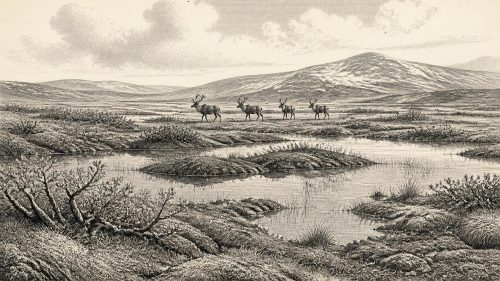
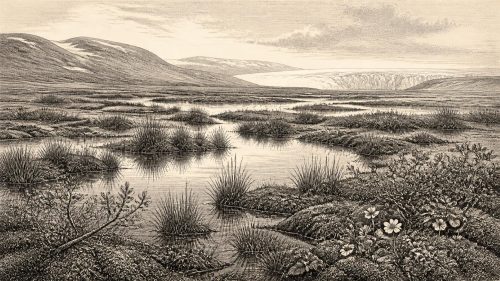
Pollen, plant remains, mosses and insects from the deposits point to open, treeless ground rather than forest. Grasses, sedges, juniper and herbs occurred around wet, organic-rich ground, while beetle evidence and the sedimentary setting indicate muskeg-like conditions: mossy wetlands with shallow open pools and abundant plant debris. Earlier Irish Quaternary schemes termed this the Derryvree Cold Phase. That label remains useful as a description of a regional deposit and inferred cold interval, but it should not be mistaken for a perfectly uniform climate across the entire island or a precisely bounded event in the global record.
This Fermanagh evidence supplies a valuable corrective to images of a wholly ice-covered Ireland. It demonstrates an environment in which freshwater accumulated, plants grew and insects completed their life cycles. Yet it also speaks of severity. A landscape dominated by low vegetation and saturated ground would have had a short productive season, hard winters and little shelter. The pools and mosses at Derryvree illuminate a particular northern locality; they provide a model for cold open habitats, not a photographic reconstruction of every Irish valley at the same time.
Castlepook and the Animal World
In southern Ireland, Castlepook Cave near Doneraile in north County Cork is central to the animal evidence. The cave’s old collections contain bones of woolly mammoth, reindeer, giant deer, brown bear, wolf, foxes, mountain hare, stoat, collared lemming, Norwegian lemming and spotted hyaena. No one should imagine that every named species stood together outside the cave at one instant. Cave deposits can accumulate over long periods; carnivores, water, sediment movement and nineteenth- and twentieth-century collecting all complicate associations. Still, the assemblage firmly shows that Ireland supported a striking range of cold-stage mammals during parts of MIS 3.
The ecological implications are substantial. Reindeer and lemmings fit an open, cold environment; mammoth and giant deer point to enough vegetation across wider landscapes to sustain large herbivores; wolves and spotted hyaenas indicate predation, scavenging and competition around carcasses. Caves may have been carnivore dens, occasional shelters or traps for remains rather than neutral samples of the animals roaming nearby. Castlepook is especially associated with spotted hyaena in Ireland, and tooth-marked bone makes scavenging a concrete process rather than a romantic embellishment. The evidence supports a dynamic food web, but not precise estimates of animal numbers or a claim that Ireland was continuously occupied by each species.
Modern re-dating has altered this picture. Ruth Carden’s reassessment of bone from Castlepook, Foley and Shandon caves found that several older determinations had underestimated antiquity by thousands of radiocarbon years. The revised results place important southern Irish fauna firmly in MIS 3 and suggest that giant deer and spotted hyaena may have disappeared locally before about 40,000 cal BP. Consequently, a broad Castlepook fauna cannot simply be assigned wholesale to c. 34,000 cal BP. Around the horizon represented by 31,899 BCE, the safest conclusion is that southern Irish habitats were capable of supporting cold-adapted animals, while the exact local species mix remained variable through time.
The Question of People
Human presence is the most intriguing and least settled aspect of this Irish horizon. A fragment of reindeer bone from Castlepook has been reported as dating to about 33,000 years ago and as carrying marks consistent with processing by a stone tool. If that interpretation is sustained, it would push evidence of human activity in Ireland dramatically earlier than the previously accepted Late Upper Palaeolithic evidence. It is an important research claim, not evidence for a known village, named group or settled population in 31,899 BCE.
The caution is archaeological rather than dismissive. A bone’s date establishes when the animal lived and died, within a statistical range; it does not establish the date, identity or duration of any human encounter with it. Marks must be differentiated from carnivore damage, trampling, excavation damage and other processes. The Castlepook material also comes from historic collections and cave sediments rather than a recently excavated, intact living floor containing hearths, stone tools, food waste and structures together. Researchers have returned to the cave with geophysics and excavation precisely because undisturbed contexts are needed to test the claim properly.
It follows that there is no evidential foundation for political affairs, diplomacy, warfare, institutions, religion, literacy or formal learning in Ireland at this date. Nor can historians responsibly reconstruct households, clothing, languages, kinship rules or ritual from one possible modified bone. If small human parties did reach Ireland, they would have belonged to the mobile hunter-gatherer societies of Upper Palaeolithic Europe and would have depended on expert knowledge of seasonal terrain, animals, fire, stone and hide. That is an inference from the wider European archaeological context, not a documented Irish social history.
Economy Without Markets
There was no economy of fields, livestock, coins, ports or market exchange. Agriculture lay tens of millennia in the future. The only economic activity that can even tentatively be contemplated is subsistence: the acquisition and processing of animal and plant resources by mobile foragers, if people were present. Reindeer would have offered meat, fat, hide, sinew and bone; large carcasses could have been valuable yet dangerous opportunities in a landscape shared with wolves and hyaenas. But no Irish tool-kit, hearth or repeatedly used butchery site securely demonstrates such practices at this date.
Likewise, “trade” is too strong a word for the available evidence. The lower seas of the Pleistocene changed routes and ranges, and animals evidently colonised Ireland during favourable intervals. Human movement from Britain or continental Europe is conceivable in geographical terms, but there is no Irish artefactual network from which to infer exchange partnerships. The absence of evidence is partly a preservation problem: later glaciation removed or buried surfaces, while acidic soils destroy bone and organic materials. Caves preserve exceptional scraps, not a complete census of life.
What This Horizon Means
The best portrait of Ireland around 31,899 BCE is therefore one of ecological possibility and archaeological restraint. Derryvree offers tangible evidence for cold, open wetlands with mosses, pools and sparse vegetation. Castlepook records an Ice Age animal world that included large herbivores and formidable carnivores. A reindeer bone may indicate that people briefly entered that world and processed an animal, but the case remains under investigation. There are no securely known communities, territories or beliefs to narrate.
Far from making this period empty, that uncertainty is its historical significance. Ireland was not outside the Pleistocene story: it was a changing north-western landscape intermittently available to animals and, perhaps, people before ice-sheet expansion transformed it again. The surviving evidence asks for precision of method rather than false precision of storytelling. Around this modern calendar label, the Irish record is not an annal of one year. It is a thin but remarkable archive of silt, pollen, beetles, caves, bones and questions still being tested.
Primary Sources
- A reconsideration of the radiocarbon dating of the Marine Isotope Stage 3 fauna from southern Ireland
- The Irish quaternary fauna project
- Irish Pleistocene biostratigraphy
- A Middle Midlandian Freshwater Series at Derryvree, Maguiresbridge, County Fermanagh, Northern Ireland
- Figure 6.— The subdivision of the Quaternary Period in Ireland
- Introduction to the Late Quaternary and Holocene of Northern Ireland
- Author’s Final Review Copy
- Extent and deglacial chronology of the last British–Irish Ice Sheet: implications of exposure dating using cosmogenic isotopes
- Trimlines, blockfields and the vertical extent of the last ice sheet in southern Ireland
- Early deglaciation of the British-Irish Ice Sheet on the Atlantic shelf northwest of Ireland driven by glacioisostatic depression and high relative sea level
- Ireland: Submerged Prehistoric Sites and Landscapes
- The IntCal20 Northern Hemisphere Radiocarbon Age Calibration Curve (0–55 cal kBP)
- IntCal Publications
- Mid-to-late Marine Isotope Stage 3 mammal faunas of Britain: a new look
- Occurrence of mammalia relicts at site Castlepook Cave
- New insights on the fauna of Ireland's Younger Dryas and Early Holocene from Alice & Gwendoline Cave
- Archaeology Research Excavation Grant 2022
- 32564 – Castlepook Cave, Ballyhooly, Cork
- Heritage Artefacts of County Cork
- Ireland's Palaeolithic Archaeology – Fleeting Footprints in a Frozen Land