Derryvree’s Tundra Pools31908 BCE
31,908 BCE is a nominal point within a late Middle Midlandian interval, not a documented Irish event. Freshwater sediments at Derryvree, County Fermanagh, show that ice-free areas supported treeless tundra wetlands, pools, mosses, grasses and sedges amid severe climatic conditions before ice-sheet expansion. Cave remains at Castlepook, County Cork, attest to cold-adapted fauna, including mammoth, reindeer and predators, though disturbed contexts limit interpretation. Possible human butchery evidence remains unconfirmed and cannot demonstrate settlement. Ireland’s geography, ice cover and access routes varied regionally. The period is best understood as an ecological frontier shaped by fluctuating climate, mobile fauna and encroaching ice.
Dateline
The label 31,908 BCE is a modern chronological convenience, not a date at which an event can be isolated in Ireland’s prehistoric record. No written source, settlement sequence or annually resolved archaeological layer permits calendar-year precision so far back. The responsible setting is the later part of the Middle Midlandian, within Marine Isotope Stage 3 of the last Ice Age. The most useful Irish evidence comes from deposits that can be dated only as ranges. In particular, freshwater silts preserved beneath later glacial sediments at Derryvree, near Maguiresbridge in County Fermanagh, produced a radiocarbon result calibrated to roughly 36,900–31,700 years before present: approximately 34,950–29,750 BCE. The nominal year falls within that broad interval, not at a demonstrable moment within it.
A Landscape Between Ice Advances
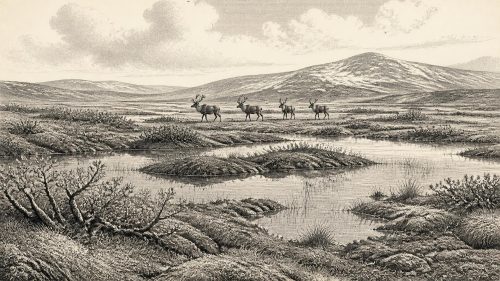
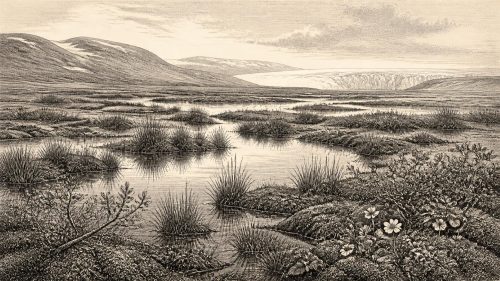
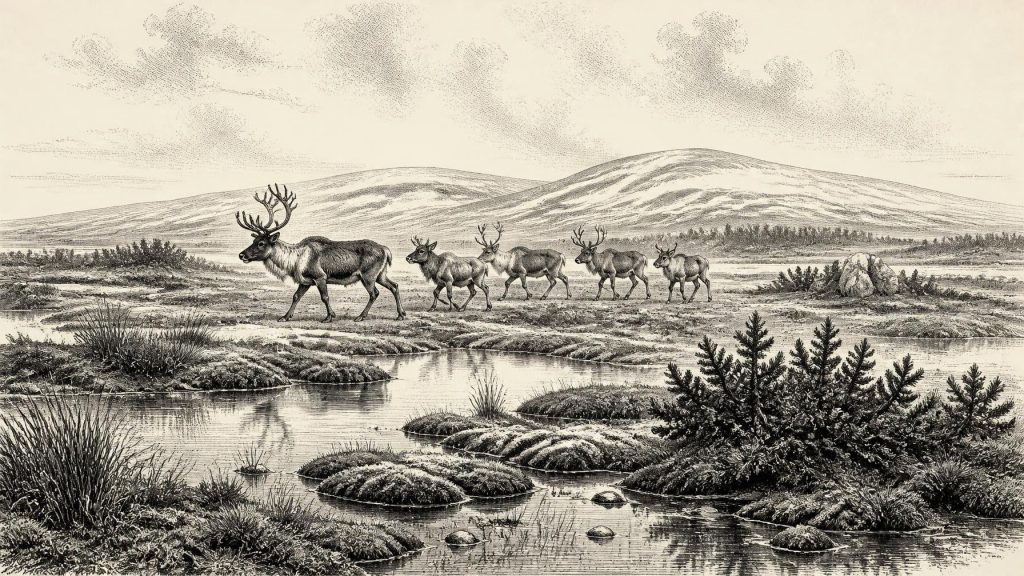
Derryvree offers an unusually valuable glimpse because its fine sands and organic silts were sealed between two tills, deposits left by separate incursions of glacier ice. During the period represented by the intervening freshwater sediments, south Fermanagh was not buried beneath an ice sheet. It had shallow water, wet ground and plant-rich hollows in a cold, open landscape. Pollen, moss remains and insects indicate tundra or muskeg rather than woodland: grasses, sedges, herbs and juniper were present, while dry ground was probably patchy and sparsely vegetated. Pools and saturated mossy ground could persist beside exposed mineral soils, shaped by freezing, thawing and seasonal meltwater.
This was not the peak of the Last Glacial Maximum, which came later. Yet it was no mild precursor to modern Ireland. Winters were severe, summers short, and the vegetation was treeless. Permafrost or seasonally frozen ground would have constrained drainage and rooting depth. Wind, frost action and solifluction – the slow movement of waterlogged soil over frozen subsoil – continually remodelled exposed slopes. The familiar wooded and densely settled Irish countryside belongs to a vastly later world. Around this horizon, the island’s natural history was principally one of climatic fluctuation, mobile animal populations and advancing or retreating ice margins.
The wider chronology remains difficult. Recent reconstructions of the British–Irish Ice Sheet begin at about 31,000 years before present because earlier margin evidence is sparse and uncertain. They depict initial ice nourishment on high ground, including an accumulation centre in Northern Ireland, while allowing considerable uncertainty in its extent. Other modelling has proposed short-lived ice caps in mountainous parts of Ireland during particularly cold stages. These are reconstructions from landforms, sediments, dates and physical models, not a surveyed map of conditions in any single year. The sound conclusion for 31,908 BCE is therefore regional variation: parts of Ireland remained ice-free or only locally glaciated, while the processes that would later create a much larger ice sheet were gathering force.
Derryvree’s Living Evidence
The Derryvree deposit is important precisely because it records an environment rather than an imagined scene. Its botanical and insect evidence supports a cold, largely treeless wetland mosaic, with open pools and surrounding moss vegetation. It demonstrates that north-central Ireland could sustain terrestrial and freshwater ecosystems during a late Pleistocene interval subsequently overwritten by glaciation. It does not identify every plant growing in every county, nor does it yield a complete annual climate record. Organic deposits are local archives: a Fermanagh hollow cannot simply stand for Cork limestone, the western seaboard or upland Kerry. Nevertheless, the sequence strongly cautions against the old simplification that Ireland was continuously and uniformly ice-covered throughout the last glacial cycle.
Animal bones from Irish caves add another, differently imperfect, archive. Castlepook Cave near Doneraile in north County Cork has produced Ireland’s most celebrated assemblage of earlier late-Pleistocene mammals. Material attributed to woolly mammoth, reindeer, giant deer, brown bear, wolf, Arctic fox, hare, lemmings and spotted hyaena points to a fauna capable of living in open, cold-country environments. A mammoth bone has yielded a radiocarbon date of about 33,400 ± 1,200 radiocarbon years before present, while other specimens and later re-dating programmes show that the assemblage spans more than one episode. Such dates establish that animals reached Ireland during the broader pre-maximum glacial world; they do not establish that all species met at one watering place, or in the exact year named here.
Castlepook also illustrates the limits imposed by excavation history. Much of its bone material was recovered during early twentieth-century digging, before modern methods of recording stratigraphy, micromorphology and spatial context. Cave water, animal activity and older excavation can mix deposits. Some bones may have been dragged in by carnivores; others may have been moved by sediment or water. Modern excavation resumed in 2022 to locate surviving deposits in the Entrance Gallery, Elephant Hall and connecting passages. That work is significant because intact contexts, if found and dated, can test interpretations built on museum collections. Until then, the cave is compelling evidence for a rich Ice Age fauna, but a difficult source for reconstructing exact ecological communities or events.
Humans: A Possibility, Not a Population
The question most likely to be asked of this period is whether people were in Ireland. The answer must be carefully qualified. A reindeer femur from Castlepook has been publicised as carrying a mark consistent with a sharp stone tool used during butchery and as belonging to this broad early late-Pleistocene horizon. If the mark is confirmed as human-made and contemporary with the death of the animal, it would be evidence for one act of carcass processing by people who reached Ireland far earlier than the traditionally recognised late-glacial evidence. It would be an important discovery.
But a cut or chop mark is not a camp. No securely dated stone-tool assemblage, hearth, dwelling floor, human burial, art panel or occupation surface is known in Ireland from around 31,908 BCE. Nor does a single modified bone demonstrate an enduring resident population, a named archaeological culture, a language or a route used repeatedly. The animal itself may have lived in Ireland without being hunted there; equally, the cave’s disturbed history complicates association. The later, better-supported evidence of a butchered brown-bear patella at Alice and Gwendoline Cave in County Clare dates to about 12,800–12,600 calibrated BCE, more than nineteen millennia after the nominal year. It cannot be used to fill the earlier gap.
It is reasonable to say that Upper Palaeolithic hunter-gatherers elsewhere in north-west Europe had the skills to exploit large game and to make sharp stone flakes. It is not responsible to turn that general comparison into a detailed Irish household. There is no evidence here for a permanent village, family structure, clothing, ritual, art, leadership or seasonal schedule. If people did visit, their numbers may have been very small and their presence brief. Their relationship to local animals could have ranged from opportunistic scavenging to hunting, but the Irish evidence does not yet decide between those possibilities.
No Politics, No Trade Network
Terms such as political affairs, diplomacy and warfare have no secure application to Ireland at this depth of time. There were no recorded kingdoms, chiefs, boundaries or treaties, and archaeology has not revealed a settlement landscape from which institutions can be inferred. Nor is there evidence for an Irish exchange network, mining economy or agriculture. The economy that can cautiously be discussed is ecological: grazing animals consumed the productive patches of cold open vegetation; carnivores and scavengers followed animal herds and carcasses; people, if present, would have depended on mobile resources rather than crops or livestock.
Connections beyond Ireland remain an important question, but not a licence for certainty. Lower global sea levels altered the geography of the continental shelf and reduced some sea distances. Ice extent, coasts, rivers and the Irish Sea changed through time, however, and the precise accessibility of Ireland at this particular horizon is unresolved. Fossil animals prove dispersal occurred in some form. They do not prove a continuous land bridge, a specific migration corridor or human travel by a particular route. In this period, the island’s changing position within a wider north-west European environment is better understood as a research problem than as a fixed map.
What This Year Can Mean
The chief development represented by 31,908 BCE was environmental, not political: Ireland stood within a volatile phase before the major expansion of the last British–Irish Ice Sheet. Derryvree preserves evidence that an ice-free Fermanagh supported cold wetlands and tundra vegetation during a calibrated interval encompassing this nominal date. Castlepook, though chronologically and stratigraphically more complex, shows that mammoth, reindeer and formidable predators formed part of Ireland’s wider Pleistocene history. Together, these records replace an empty frozen island with a more dynamic picture – but not with a conventional historical narrative.
That distinction matters. Archaeological evidence can responsibly illuminate land, water, vegetation, animals and the possibility of fleeting human activity. It cannot give Ireland of 31,908 BCE a government, a battle, a religion or an economy of trade. The surviving traces are sparse because later ice eroded landscapes and because caves preserve only selected remains. Their value lies not in supplying false precision, but in showing that long before farms, monuments and written names, Ireland repeatedly became a contested ecological frontier between habitable tundra, mobile fauna and encroaching ice.
Primary Sources
- A Middle Midlandian Freshwater Series at Derryvree, Maguiresbridge, County Fermanagh, Northern Ireland
- Growth and Retreat of the Last British–Irish Ice Sheet, 31,000 to 15,000 Years Ago: The BRITICE-CHRONO Reconstruction
- Trimlines, Blockfields and the Vertical Extent of the Last Ice Sheet in Southern Ireland
- Dynamic Cycles, Ice Streams and Their Impact on the Extent, Chronology and Deglaciation of the British-Irish Ice Sheet
- The Last Glacial Maximum British–Irish Ice Sheet: A Reconstruction Using Digital Terrain Mapping
- Pattern and Timing of Retreat of the Last British–Irish Ice Sheet
- Maximum Extent and Dynamic Behaviour of the Last British–Irish Ice Sheet West of Ireland
- New Data for the Last Glacial Maximum in Great Britain and Ireland
- Phylogeographic, Ancient DNA, Fossil and Morphometric Analyses Reveal Ancient and Modern Introductions of a Large Mammal: The Complex Case of Red Deer (Cervus elaphus) in Ireland
- Pleistocene Vertebrates in the British Isles
- The Irish Quaternary Fauna Project
- On the Exploration of Castlepook Cave, County Cork
- The Subdivision of the Quaternary Period in Ireland
- Palaeoecology: Field Guide to the Irish Quaternary
- Castlepook Cave, Castlepook South, Cork: Excavation Report 2022:564
- An Foras Forbartha Areas of Scientific Interest in County Cork
- Archaeological Heritage of County Cork
- New Insights on the Fauna of Ireland’s Younger Dryas and Early Holocene from Alice & Gwendoline Cave
- The IntCal20 Northern Hemisphere Radiocarbon Age Calibration Curve (0–55 cal kBP)
- A Stratigraphic Framework for Abrupt Climatic Changes During the Last Glacial Period Based on Three Synchronized Greenland Ice-Core Records
- A 60,000 Year Greenland Stratigraphic Ice Core Chronology