Greenagho’s Mosses31909 BCE
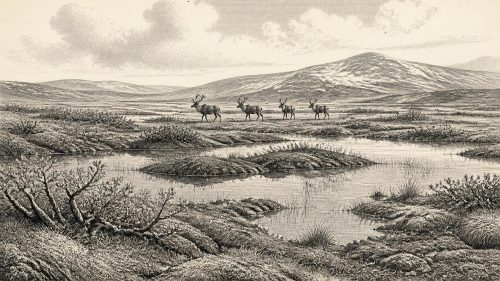
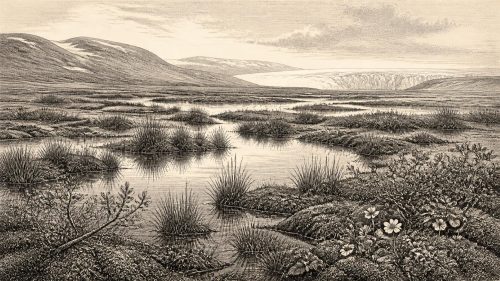
About 31,909 BCE, Ireland lay in the later Marine Isotope Stage 3, approaching but preceding extensive Last Glacial Maximum ice cover. Greenagho deposits in County Fermanagh indicate cold, open, largely treeless ground with mosses, sedges and freshwater hollows. Castlepook Cave, County Cork, preserves a time-mixed faunal collection including mammoth, giant deer, reindeer, hyaena, bear, wolves, foxes, hares and lemmings, evidencing changing cold-country ecosystems rather than one moment. Lower seas may have permitted intermittent animal movement, though no certain land bridge is known. A possibly butchered reindeer bone suggests, but cannot prove, early human visitation. No communities or culture are evidenced.

Dateline
31,909 BCE is a modern chronological label, not a year that anyone then living in Ireland could have named or recorded. It corresponds roughly to 33,858 years before the conventional radiocarbon-dating present of 1950, but archaeology cannot isolate events in Ireland to that individual calendar year. The responsible view is therefore a broader one: this was within the later part of Marine Isotope Stage 3, before the Last Glacial Maximum, when climates and ice margins were changing markedly. The available evidence consists chiefly of cave-bone collections, sedimentary deposits, pollen and other environmental traces, many with wide dating ranges and complicated histories of deposition. It reveals an Ice Age landscape, but not an annual chronicle.
A Cold Country Before Maximum Glaciation
At this point in the last glacial cycle, Ireland was moving towards the much more extensive ice cover that developed later. The most recent British–Irish Ice Sheet reconstructions model substantial growth after about 31,000 years ago and an Ireland almost wholly ice-covered by around 28,000 years ago. That does not allow a simple picture for c. 33,900 calibrated years before present. Conditions varied between regions, seasons and short climatic phases, while the exact timing of ice advance remains an active research question. The island was not yet the uniformly ice-dominated terrain of the later glacial maximum, but neither was it a hospitable temperate landscape.
Evidence from County Fermanagh is especially valuable because it records cold, non-glacial intervals rather than merely the action of ice. At Greenagho near Belcoo, organic deposits beneath later glacial sediments have produced a minimum radiocarbon age of 32,460 BP. Other work has discussed an associated calibrated range of approximately 37,200–35,700 cal BP, though the dating and correlations require caution. Mosses, sedges and poorly preserved herb pollen point towards open country with a northern, cold-climate character. Such deposits do not recreate a particular day or season in 31,909 BCE. They do, however, support an image of sparse, treeless or near-treeless vegetation, freshwater hollows and exposed ground in parts of Ireland before later ice overran or transformed many landscapes.
Castlepook’s Time-Mixed Bone Record
The leading Irish source for the wider period is Castlepook Cave, also called Mammoth Cave, near Doneraile in north County Cork. Its limestone galleries were investigated intermittently from the nineteenth century and were extensively excavated in the early twentieth. More than 2,000 vertebrate bones have been recovered, making it the richest known Irish site for fauna leading towards the Last Glacial Maximum. The collection includes woolly mammoth, giant deer, reindeer, brown bear and spotted hyaena, with wolf, Arctic fox, mountain hare, collared lemming and Norwegian lemming also represented in the broader assemblage.
This list should not be read as though every species shared the same hillside in 31,909 BCE. Castle deposits accumulated over long spans; some bone was brought in by carnivores, some moved through water or falling sediment, and early excavations did not preserve the stratigraphic information expected today. Direct radiocarbon dates on individual Castlepook bones range widely. Geological Survey Ireland summarises the dated material as extending from about 45,700 to 19,950 years BP. The Irish Quaternary Fauna Project demonstrated both the power and the problem of the collection: bones assigned to one cave layer could be of markedly different ages. Castlepook is therefore evidence for repeated animal use of a regional landscape, not a single frozen moment.
Even with that qualification, the fauna is significant. Reindeer, lemmings, Arctic fox and mountain hare are consistent with cold, open habitats. Mammoth and giant deer indicate that at least some phases supported large grazing or browsing mammals. Brown bears, wolves and spotted hyaenas show that predators and omnivores formed part of this ecosystem. Hyaenas are particularly informative because dens can accumulate bones from animals carried in as food, making cave assemblages a record both of prey and predator behaviour. Yet the relative abundance of bones cannot straightforwardly measure animal abundance beyond the cave. Carcass transport, scavenging, bone survival and collectors’ choices all shaped what reached museum drawers.
Land, Water and Movement
Lower global sea levels altered the outlines of the continental shelf, but they did not automatically create a dependable dry route from Ireland to Britain or continental Europe. The geography of the Irish Sea basin, glacial loading of the land and the position of ice margins all mattered. For animals, and perhaps for people, routes could have opened or closed over time through exposed shelf terrain, coastal corridors, ice, water crossings or combinations of these. The fossil record proves that a diverse mammalian fauna reached Ireland during pre-maximum phases of the Late Pleistocene; it does not identify a single route, a single migration or a permanent land bridge at this date.
The economic life visible in the evidence is consequently ecological rather than social. Large herbivores converted tough vegetation into meat, hide, bone and antler; carnivores hunted, scavenged and competed for carcasses; caves offered shelter or dens and trapped sediments and remains. There is no evidence from Ireland around this notional year for farming, livestock keeping, metalworking, pottery, permanent houses, fields, stores, boats or an exchange network. “Trade” would therefore be an unjustified term. Equally, the absence of known settlements does not prove that every open area was untouched: glacial erosion, later sediment movement, rising seas and the small scale of archaeological investigation have all reduced the chance of survival and discovery.
The Human Question
The possibility of human presence must be stated carefully. A reindeer femur from Castlepook has been publicised as bearing marks consistent with butchery by a sharp stone tool and as dating to roughly 33,000 years ago. If the marks are confirmed as human-made and securely associated with the dated animal, they would indicate an extraordinarily early Upper Palaeolithic human visit to Ireland. Such an episode might have involved the processing of a reindeer carcass for meat, marrow, hide or sinew. It would be important evidence for activity on the far western edge of Europe before the ice sheet reached its later maximum.
It would not, however, establish a resident population in 31,909 BCE. The femur comes from a historic collection rather than a modern, securely excavated occupation surface. No associated hearth, stone-tool assemblage, dwelling, burial, human skeleton, artistic work or repeated camp sequence has been published from Castlepook for this phase. Fresh research at the cave has rightly sought surviving deposits, but it has also underlined how earlier excavation and water movement complicate interpretation. The National Museum of Ireland continues to say that no clear evidence has yet emerged for human presence in Ireland during the Palaeolithic. The prudent conclusion is that Castlepook raises a serious and potentially transformative question; it does not settle the history of settlement.
No Polities, No Recorded Beliefs
There is no basis for describing political affairs, diplomacy, warfare, named peoples, chiefs, clans or territories in Ireland at this date. Those are institutions and identities that require evidence of organised, enduring human communities, and none has been recovered for this period. Nor can archaeology identify an Irish language, a body of learning, ritual practice, formal religion or artistic tradition around 31,909 BCE. The cave’s evocative gallery names, such as Hyena Hall and Elephant Hall, belong to modern investigators, not to Ice Age inhabitants.
If people did briefly reach Ireland during this broader interval, comparison with Upper Palaeolithic groups elsewhere in north-west Europe makes small, mobile hunting parties a reasonable hypothesis, not an Irish fact. Such people would have needed detailed environmental knowledge and practical skills in clothing, fire, food processing and movement through dangerous cold-country terrain. But Ireland has not yielded the material evidence needed to assign a technology, culture or social system to them. The distinction matters: a cut-mark interpretation can suggest an encounter between people and an animal; it cannot support a story about a village, a chiefdom or a nation.
A Landscape More Certain Than Its People
For 31,909 BCE, Ireland’s best-attested history is thus environmental. Open, cold habitats supported a succession of Ice Age mammals; caves in the limestone south preserved fragments of their presence; freshwater deposits in Fermanagh retained traces of austere vegetation; and a growing ice sheet was beginning to reshape the island on a far larger scale. Castlepook and Greenagho do not provide an event for a calendar year. They provide something more appropriate to the evidence: a cautiously reconstructed world in which climate, animals, caves and advancing ice are real, while the presence, movements and meanings of people remain unresolved.
Primary Sources
- The Irish Quaternary Fauna Project
- New Insights on the Fauna of Ireland’s Younger Dryas and Early Holocene from Alice & Gwendoline Cave
- Castlepook Cave, County Cork Geological Site Report
- Prehistoric Details: Mell Flint Flake
- Growth and Retreat of the Last British–Irish Ice Sheet, 31,000 to 15,000 Years Ago: the BRITICE-CHRONO Reconstruction
- Pattern and Timing of Retreat of the Last British-Irish Ice Sheet
- New Data for the Last Glacial Maximum in Great Britain and Ireland
- Trimlines, Blockfields and the Vertical Extent of the Last Ice Sheet in Southern Ireland
- Stratigraphic and Palaeo-Geomorphological Evidence for the Glacial-Deglacial History of the Last British-Irish Ice Sheet in the North-Western Irish Sea
- Early Midlandian–Middle Midlandian, Pleistocene, Northern Ireland
- Ireland: Submerged Prehistoric Sites and Landscapes
- Relative Sea-Level Changes and Crustal Movements in Britain and Ireland Since the Last Glacial Maximum
- The Problem of a Late Quaternary Landbridge Between Britain and Ireland
- Origin of British and Irish Mammals: Disparate Post-Glacial Colonisation and Species Introductions
- Irish Quaternary Vertebrates
- Occurrence of Mammalia Relicts at Site Castlepook Cave
- 2022:564 – Castlepook Cave, Castlepook South, Cork
- Archaeological Heritage of County Cork
- Palaeoecology
- Advance and Retreat of the Marine-Terminating Irish Sea Ice Stream into the Celtic Sea During the Last Glacial: Timing and Maximum Extent