Dryas at Derryvree31872 BCE
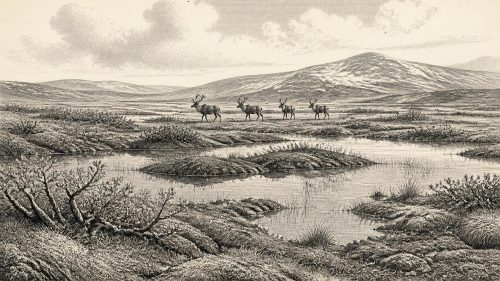
Nominally dated to 31,872 BCE, this period in Ireland belongs to the climatically volatile Late Pleistocene, not a precisely identifiable year. Derryvree, County Fermanagh, preserves freshwater silts between glacial tills, indicating open, treeless tundra with cold-adapted plants including mountain avens. Castlepook Cave, County Cork, contains time-mixed MIS 3 remains of mammoth, giant deer, reindeer, carnivores and smaller cold-stage fauna, but cannot represent one moment or island-wide conditions. A possibly cut-marked reindeer femur suggests human visitation, though disturbed context and absent tools, hearths or settlements prevent confirmation. Lower sea levels changed geography, while ice, habitats and possible access routes remained variable.

Dateline
The label 31,872 BCE is useful for placing this entry in a long chronological sequence, but it cannot identify an Irish event in a particular year. No calendar, writing, named community or historical chronicle existed on the island. In the archaeological convention of “before present”, measured from 1950, it falls broadly about 33,800 years ago, within the Late Pleistocene and Marine Isotope Stage 3 (MIS 3). At this depth of time, radiocarbon ages require calibration and carry substantial uncertainty; deposits, animal remains and environmental sequences are more meaningful than a seemingly exact modern year.
The nearest evidence comes from separate Irish archives which cannot be assumed to describe the same season, generation or even century. A freshwater deposit at Derryvree, near Maguiresbridge in County Fermanagh, produced a conventional radiocarbon determination of 30,500 years before present, with a wide error range. When considered through modern calibration, that evidence belongs broadly to the mid-30,000s calibrated years before present. In north County Cork, Castlepook Cave near Doneraile has yielded animal remains dating across a much longer span, roughly 45,700 to 19,950 radiocarbon years before present. Together, these sources illuminate Ireland around this nominal date; neither permits a year-by-year narrative.
A Cold Landscape, Not One Frozen Island
Ireland was in an Ice Age, but “Ice Age” should not be mistaken for a single, unchanging condition. MIS 3 was climatically volatile. Colder intervals alternated with comparatively milder episodes, while the British–Irish Ice Sheet expanded, retreated and reorganised in different regions. Recent reconstructions stress that its margins did not advance everywhere in step. Around 31,872 BCE, Ireland was approaching the later Last Glacial Maximum rather than standing at its peak, which was reached much later, principally around 26,000–24,000 years ago in the wider British–Irish system.
That distinction matters. It is not responsible to picture either an entirely ice-buried Ireland or a comfortably temperate green island. Some terrain may have been covered by ice at particular times, while other areas supported cold, open habitats. The details remain debated because later glaciers eroded much of the earlier landscape and because surviving sediments are scattered. Evidence for ice-sheet activity before the Last Glacial Maximum is real but difficult to date precisely. The most defensible picture is of a severe, regionally variable environment in which ice, periglacial ground, exposed soil, shallow waters and tundra vegetation all had changing local importance.
Derryvree’s Freshwater Record
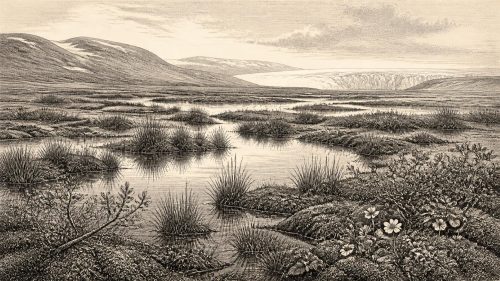
Derryvree is especially valuable because roadworks exposed organic silts and fine sands enclosed between two thick sheets of glacial till. The sequence preserves a freshwater episode between phases of glaciation. Its plant and animal evidence was interpreted as showing open tundra and a periglacial climate: a landscape shaped by intense cold, seasonal freezing and sparse cover rather than forest. Such a setting could include wet hollows, streams or pools even where the wider terrain was bleak and exposed.
Macrofossils from Derryvree include plants associated with cold conditions, among them mountain avens (Dryas octopetala), a low flowering shrub now familiar in Arctic and alpine environments. Their presence is evidence for suitable local habitats, not a complete botanical inventory of Ireland. Nor does it establish that every part of the island looked alike. Yet it offers a rare, concrete correction to generic images of the past: at least in this Fermanagh basin, freshwater sediments recorded a treeless, cold-adapted plant community. The name Dryas therefore evokes an actual palaeobotanical trace, rather than a romantic label for a lost wilderness.
There was no modern Irish coastline. Global sea levels were lower than today, exposing broad areas of continental shelf around north-west Europe and altering drainage and coastal geography. Nevertheless, the precise configuration of land, sea and ice between Ireland and Britain at this point remains complex. It would be unsafe to state that people or animals could simply walk from continental Europe into Ireland. Any movement into the island’s region depended on shifting routes, sea barriers, ice margins and the availability of habitable ground. The evidence shows connection within a changing north-west European ecological zone, not a mapped road or a known migration corridor.
Castlepook and the Animal World
Castlepook Cave provides the principal southern Irish archive for the animal life preceding the Last Glacial Maximum. More than 2,000 bones have been recovered from its galleries, although many were excavated between 1904 and 1918, before modern methods of recording stratigraphy were routine. The cave contained remains attributed to woolly mammoth, giant deer, reindeer, brown bear and spotted hyaena, as well as wolf, Arctic fox, hares and lemmings. This is an impressive assemblage, but it should not be converted into a single crowded tableau dated to 31,872 BCE. Individual bones belong to different moments across thousands of years.
The cave was also not a neutral storehouse. Carnivores could carry prey and carrion into galleries; animals could die there; water and sediment could move remains; older excavators could disturb their contexts. Spotted hyaena is of particular importance because a denning or scavenging animal can create a bone accumulation that resembles the aftermath of human activity without being one. Scientific value lies precisely in disentangling those processes. Castlepook’s remains prove that a diverse cold-stage fauna reached Ireland during MIS 3. They do not prove that every species was present together, that the cave was a hunting camp, or that its fauna represents the whole island.
Modern radiocarbon redating has made this caution sharper. Improved pretreatment of bone collagen showed that several older determinations from Castlepook and neighbouring southern caves were markedly too young, in some cases by several thousand radiocarbon years. The revision shifted important animals further back into MIS 3 and suggested that giant deer and spotted hyaena may have disappeared locally before about 40,000 calibrated years ago. The lesson is methodological as well as chronological: conclusions about Irish prehistory must remain open to revision when museum collections, laboratory techniques and surviving deposits are re-examined.
A Possible Human Trace
The greatest historical question is whether people were in Ireland at all around this time. A reindeer femur from Castlepook has been reported as carrying a mark interpreted as having been made by a sharp stone tool during butchery. County Cork heritage material places the specimen at about 31,000 BCE, and the find has prompted renewed investigation of the cave. If that interpretation is sustained, it would push evidence for human activity in Ireland far earlier than the well-established later prehistoric record.
It remains a promising but limited indication, not proof of an established population. No securely associated stone-tool assemblage, hearth, dwelling surface, burial or camp has yet demonstrated a permanent Upper Palaeolithic community at Castlepook. The marked bone came from an old cave collection whose original context was disturbed and incompletely recorded. A cut mark can be important evidence, but its formation, age and relationship to the bone’s movement through a carnivore-visited cave require rigorous testing. The responsible conclusion for 31,872 BCE is therefore conditional: people may have reached Ireland during this broad period, but the scale, duration and frequency of their presence are unknown.
If small groups did enter the island, comparison with Upper Palaeolithic societies elsewhere in north-west Europe suggests mobile hunter-gatherers capable of making and using stone tools, processing animal carcasses and responding rapidly to changing landscapes. That is an interpretation from wider European evidence, not a direct description of a named Irish band. There is no basis for assigning a language, ethnicity, clothing style, kin group or route of arrival to them. Nor can one infer a permanent settlement, an annual reindeer hunt or a continuous line of descent to later inhabitants of Ireland.
No Kingdoms, No Recorded Diplomacy
Political affairs, warfare and diplomacy cannot be recovered for Ireland in this period. There were no states, kingships, borders, treaties or institutions visible in the evidence. If humans were present, their social organisation may have centred on small, mobile groups and relationships of kinship, cooperation and seasonal movement, but this remains an inference rather than an excavated fact. There is likewise no direct Irish evidence for religion, art, formal learning or ritual at 31,872 BCE. Absence of surviving evidence is not proof that people lacked beliefs or stories; it means that archaeology cannot responsibly specify them.
Economy, too, must be described narrowly. There was no farming, stock-keeping, village market or metalworking. Any human livelihood would have relied on knowledge of animals, plant resources, fuel, weather and safe passage through demanding country. A reindeer bone potentially modified during butchery could imply the extraction of meat, marrow, hide or sinew, but it cannot reveal the whole economy. Nor is there evidence for Irish trade. Materials and ideas may have moved through social networks elsewhere in Upper Palaeolithic Europe, yet no artefact from Ireland presently demonstrates an exchange system at this date.
The Historical Significance of Uncertainty
For this nominal year, the most important development is not a battle, ruler or foundation but the survival of fragile evidence. Derryvree records a cold freshwater tundra environment between glacial episodes. Castlepook preserves traces of animals moving through, dying in or being carried into a complex cave system during a long stretch of the Ice Age. Its reindeer femur raises the possibility that humans also visited Ireland roughly within this timeframe. These archives show that the island was neither outside prehistory nor easily readable within it.
Future excavation, microscopic study of bone surfaces, improved dating and analysis of undisturbed cave sediments may alter the balance of evidence again. Until then, 31,872 BCE should be understood as a point within a calibrated range and a changing glacial world: open tundra around Derryvree, rich but time-mixed animal deposits at Castlepook, and a tantalising yet unconfirmed horizon for Ireland’s earliest people.
Primary Sources
- A reconsideration of the radiocarbon dating of the Marine Isotope Stage 3 fauna from southern Ireland
- The Irish Quaternary Fauna Project
- Castlepook Cave, County Geological Site Report
- Heritage Artefacts of County Cork
- Archaeological Heritage of County Cork
- 2022:564 – Castlepook Cave, Castlepook South, Cork
- Archaeology Research Excavation Grant 2022: Final Report
- Middle Midlandian Freshwater Series at Derryvree, Maguiresbridge, County Fermanagh, Northern Ireland
- Middle Midlandian Freshwater Series at Derryvree, Maguiresbridge, County Fermanagh, Northern Ireland
- Middle Midlandian Interstadial Deposits at Greenagho, Near Belcoo, County Fermanagh, Northern Ireland
- Palaeoecology: IQUA Field Guide 16
- The Timing and Magnitude of the British–Irish Ice Sheet Between Marine Isotope Stages 5d and 2
- Growth and Retreat of the Last British–Irish Ice Sheet, 31,000 to 15,000 Years Ago: The BRITICE-CHRONO Reconstruction
- Growth and Retreat of the Last British–Irish Ice Sheet, 31,000 to 15,000 Years Ago: The BRITICE-CHRONO Reconstruction
- Stratigraphic and Palaeo-geomorphological Evidence for the Glacial-deglacial History of the Last British-Irish Ice Sheet in the North-western Irish Sea
- Extent and Deglacial Chronology of the Last British–Irish Ice Sheet: Implications of Exposure Dating Using Cosmogenic Isotopes
- Pattern and Timing of Retreat of the Last British-Irish Ice Sheet
- Maximum Extent and Dynamic Behaviour of the Last British–Irish Ice Sheet West of Ireland
- Pattern, Style and Timing of British–Irish Ice Sheet Advance and Retreat Over the Last 45,000 Years: Evidence from NW Scotland and the Adjacent Continental Shelf
- The IntCal20 Northern Hemisphere Radiocarbon Age Calibration Curve (0–55 cal kBP)
- IntCal Publications
- The Exploration of Castlepook Cave, Co. Cork. With 3 Plates.
- Mammoth Cave (Castlepook Cave)
- The Cave of Castlepook, Doneraile, Co. Cork