Reindeer Bone at Mammoth Cave31871 BCE
About 31,871 BCE is not a meaningful historical year but an approximate label for later MIS 3, roughly 34,000 calibrated years ago. Castlepook, or Mammoth, Cave in County Cork yielded a reindeer femur reportedly bearing stone-tool butchery marks. If confirmed, it may indicate a brief Upper Palaeolithic visit, not permanent settlement. Early excavation, mixed deposits and dating uncertainty require caution. The cave’s fauna, including reindeer, mammoth, giant deer, predators and lemmings, demonstrates a cold, open, changing landscape supporting animals before the glacial maximum. Ireland’s earliest secure human evidence remains a cut-marked bear bone from Clare, dated about 12,810–12,590 calibrated BP.

Dateline
The label 31,871 BCE gives a useful point of entry, but it cannot describe a year in the historical sense. No written calendar existed in Ireland, and archaeology cannot identify an event, ruler or community on this particular turn of a modern year. Converted only approximately, the label falls around 33,820 years before 1950, within the later part of Marine Isotope Stage 3 (MIS 3), a long and climatically unstable interval of the Last Glacial period. At this depth of time, dates are properly expressed as calibrated ranges or broad phases, not annual anniversaries. The evidence for Ireland is especially fragmentary: caves, animal bones, sediments, landforms and laboratory measurements offer short glimpses rather than a continuous national narrative.
That restraint matters because this period has recently become central to the question of Ireland’s first people. A reindeer femur from Castlepook Cave, also known as Mammoth Cave, near Doneraile in north County Cork, has been reported as bearing marks consistent with stone-tool butchery and as dating to about 33,000 years ago. If the marks are confirmed as human-made and securely associated with the bone’s age, they would indicate a very early Upper Palaeolithic human presence in Ireland. They would not, however, prove a permanent settlement, a village, or an island-wide population. Around the notional date 31,871 BCE, the responsible conclusion is therefore both exciting and limited: southern Ireland had the environments and animals in which a brief human incursion may have occurred, while the archaeological proof remains slight and under active reassessment.
Dating an Uncalendarable Past
Radiocarbon years are not calendar years. A laboratory measures the remaining radioactive carbon in a sample such as bone collagen, then estimates when the animal died. The result must be calibrated against changing atmospheric carbon levels, using curves assembled from independently dated archives including tree rings, cave deposits, lake sediments and corals. At more than 30,000 years ago, those conversions have appreciable uncertainties. A result may translate into a range of calendar ages rather than a single point, and revised pretreatment of old bone can alter earlier determinations. Modern dating conventions also count “before present” from AD 1950, not from the present day.
Castlepook illustrates why this is more than a technical warning. Its bones were largely recovered during early twentieth-century cave excavations, before the standards of modern stratigraphic excavation, sieving, recording and contamination control. The cave system contains deposits from more than one phase of the Late Pleistocene and later material as well. Carnivores could drag carcass parts underground; water, roof falls and burrowing could shift sediments; and nineteenth- and twentieth-century collecting could separate finds from their original contexts. The caves are invaluable archives, but not sealed time capsules. A date on one reindeer bone establishes the age of that animal, within a statistical range; it does not automatically date every bone nearby or demonstrate when a possible visitor entered the cave.
The reported modification is consequently important precisely because it must be tested. Cut, chop or percussion marks are judged by their microscopic form, direction, position on the skeleton and contrast with tooth scoring, trampling damage, weathering or excavation marks. A convincing pattern can show that fresh tissue was removed with a sharp stone edge. Yet it cannot by itself reveal whether people killed the animal, encountered a carcass, took only tendons or meat, camped outside, or visited once. The most secure later evidence for human activity in Ireland remains the cut-marked brown-bear patella from Alice and Gwendoline Cave in County Clare, directly dated to about 12,810–12,590 calibrated years BP. Castlepook’s much older claim deserves attention, but it should not be allowed to erase the difference between a promising modified bone and a demonstrated habitation site.
A Southern Ice-Age Landscape
At roughly 34,000 calibrated years BP, Ireland was not yet at the Last Glacial Maximum, when the British–Irish Ice Sheet attained its greatest Late Pleistocene extent by about 27,000 years BP. Ice was nevertheless a dominant regional force. Its growth, shifting margins and meltwater would later scour or bury large tracts of the island, destroying many places where people or animals might once have left traces. That geological loss helps explain why Ireland’s record is so much poorer than those of parts of Britain and continental Europe.
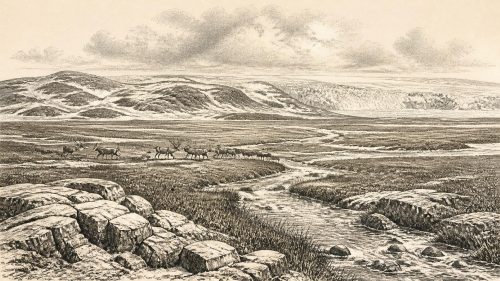
It would be wrong to picture the whole island either as a single ice cap or as a modern green countryside in winter. The extent and timing of ice changed, and southern refuges or ice-free tracts have been debated through geological research. Castlepook’s limestone caves lie in a part of Munster where fissures and chambers preserved animal remains through a phase otherwise badly represented in the landscape. The climate was cold and strongly seasonal. Nearby Greenland ice-core records demonstrate that the wider North Atlantic world could change abruptly between relatively milder interstadials and colder stadials on timescales far shorter than archaeological periods. A calendar label such as 31,871 BCE therefore conceals an environmental world in motion.
Lower global sea levels exposed more of the continental shelf than exists today, broadening coastal plains and changing the shape of the Irish Sea basin. That did not necessarily create an easy, continuous walking route between Ireland, Britain and the European mainland. The exact geography varied with sea level and ice, while water crossings may still have been required. For a possible Upper Palaeolithic visit, neither a land bridge nor boats can be assumed from the Castlepook bone alone. The evidence permits the possibility of movement into Ireland; it does not yet explain the route, frequency or direction of that movement.
Animals Before Communities
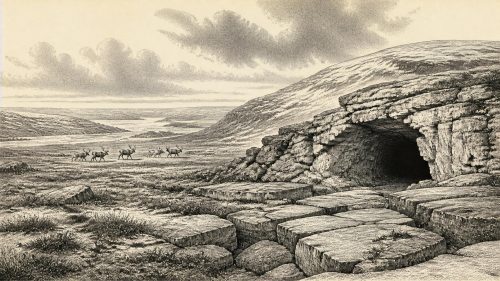
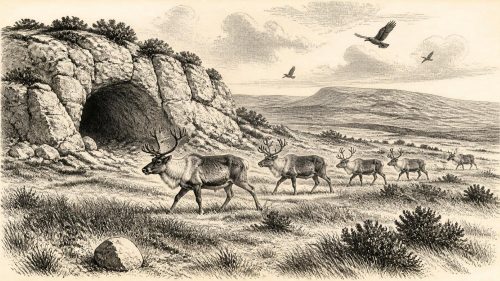
The strongest evidence for Ireland at this depth of time is zoological. Castlepook has produced one of the island’s richest Late Pleistocene faunal collections. Its broad MIS 3 assemblage includes reindeer, woolly mammoth, giant deer, brown bear, wolf, Arctic fox, spotted hyaena, mountain hare and lemmings, though not every specimen need be contemporary with every other specimen. The cave has a long and mixed history. The proper picture is not a single frozen moment in which every listed animal stood together at the entrance, but repeated use of a changing cold-stage landscape by different species.
Even so, the collection is powerful evidence for open country rather than dense temperate forest. Reindeer and lemmings point towards tundra-like or steppe-tundra habitats; mammoth and giant deer suggest extensive grazing and browsing opportunities; foxes, wolves and hyaenas reveal a food web in which carcasses were contested and caves could serve as dens, shelters or traps. Sparse shrub cover, grasses, sedges, herbs and patches of more sheltered vegetation are a more defensible reconstruction than an unbroken treeless plain. The old phrase “mammoth steppe” is useful if treated as an ecological comparison, not as a precise map of every Irish valley.
These animals also set limits on interpretation. Mammoth bone in a cave does not mean that people hunted mammoths, and hyaena remains do not mean hyaenas lived beside every human party. A bone assemblage records preservation as much as living abundance. Large mammals leave durable traces; small creatures and plants are less likely to survive later glacial erosion or early excavation. Absence from a collection is therefore weak evidence of true absence from the landscape. Yet the mixture undeniably overturns the notion that Ice-Age Ireland was simply lifeless beneath ice. At intervals before the glacial maximum, parts of the island supported substantial animal communities.
People: Possibility, Not Population
If the modified reindeer femur does represent human work, its makers were Upper Palaeolithic hunter-gatherers, not an ancestral Irish nation or a settled farming people. They had no agriculture, livestock, metal, pottery, towns or monuments. Across north-west Europe, people of this broad era made sophisticated stone technologies, used animal materials and organised their movements around season, terrain, food and social ties. Such regional knowledge provides a plausible framework for interpreting a butchered limb bone in Cork. It cannot supply the missing Irish evidence of toolkits, hearths, dwellings, burials, ornaments or repeated occupation.
Accordingly, everyday life in Ireland around this point cannot be narrated in detail. A small visiting group, if present, may have processed an animal rapidly and moved on. They may have sheltered near a cave, or the cave may have received the discarded or scavenged bone without ever being a campsite. There is no evidence from which to identify their language, kinship system, seasonal round, clothing, leadership or beliefs. Nor can archaeology responsibly identify political affairs, diplomacy, war or territorial boundaries. Such categories depend on sustained communities and records that the Irish evidence does not provide.
Conflict is visible only at the ecological level: predators, scavengers and people may all have competed for carcasses and shelter, but even this is an inference from animal behaviour and cave taphonomy rather than a documented encounter. Likewise, there is no Irish evidence of ritual, cave art, teaching traditions or long-distance exchange at this date. Stone used to cut a carcass might eventually allow sourcing and technological study if it were found in context; at present, no associated artefact assemblage provides that information. The silence is not proof that people possessed no culture. It is a measure of what has survived and what has been recovered.
An Economy of Movement
The only economy that can be cautiously envisaged is one of mobile foraging. Reindeer are seasonally mobile animals and their carcasses offered meat, marrow, hide, sinew and bone. Marks on a femur, if anthropogenic, could relate to removing meat or accessing other tissues. This is a sensible interpretation of a single modified animal element, but it does not reveal an annual subsistence strategy. There is no securely dated Irish evidence here for specialised reindeer hunting, mammoth hunting, storage, trade or a permanent camp.
Nor should later Mesolithic Ireland be projected backwards. The securely documented post-glacial hunter-gatherer settlement record begins far later, after the severe glacial maximum and major environmental transformations. The gap between a possible MIS 3 incursion and the better-attested Late Glacial and Early Holocene evidence is immense. It may represent long absence, intermittent visits that left little trace, evidence destroyed by ice, or some combination of all three. Future excavation and redating at Castlepook may clarify the matter, but it may also complicate it. That is how deep prehistory advances: not through a single dramatic claim, but through the slow comparison of context, dating, bone surfaces, sediments and landscapes.
For Ireland around 31,871 BCE, then, the principal historical development is the existence of a cold, open and inhabited-by-animals landscape capable of receiving people from the wider Upper Palaeolithic world. Castlepook Cave offers a tantalising reindeer bone that may record one such encounter. It is not yet a foundation story. Its real value lies in making Ireland’s remote past less empty while reminding us how carefully an apparent first must be handled.
Primary Sources
- A reconsideration of the radiocarbon dating of the Marine Isotope Stage 3 fauna from southern Ireland
- The Irish Quaternary Fauna Project
- The exploration of Castlepook Cave, Co. Cork. With 3 plates.
- Castlepook Cave
- 2022:564 – Castlepook Cave, Castlepook South, Cork
- Archaeological Heritage of County Cork: A Guide to Record of Monuments and Places
- Growth and retreat of the last British–Irish Ice Sheet, 31,000 to 15,000 years ago: the BRITICE-CHRONO reconstruction
- Pattern and timing of retreat of the last British-Irish Ice Sheet
- New data for the Last Glacial Maximum in Great Britain and Ireland
- The IntCal20 Northern Hemisphere Radiocarbon Age Calibration Curve (0–55 cal kBP)
- IntCal Publications
- Radiocarbon Dating and Chronological Modelling: Radiocarbon Dating
- A stratigraphic framework for abrupt climatic changes during the Last Glacial period based on three synchronized Greenland ice-core records
- Quaternary Site Descriptions
- Palaeoecology
- Irish Quaternary Vertebrates
- The colonization of Ireland: A human ecology perspective
- First evidence of a Late Upper Palaeolithic human presence in Ireland
- Revisiting Alice and Gwendoline Cave, Co. Clare: New light on the 1902 excavations
- New insights on the fauna of Ireland's Younger Dryas and Early Holocene from Alice & Gwendoline Cave
- Prehistoric Ireland
- Mammoth Cave