Juniper Beneath the Drumlins31861 BCE
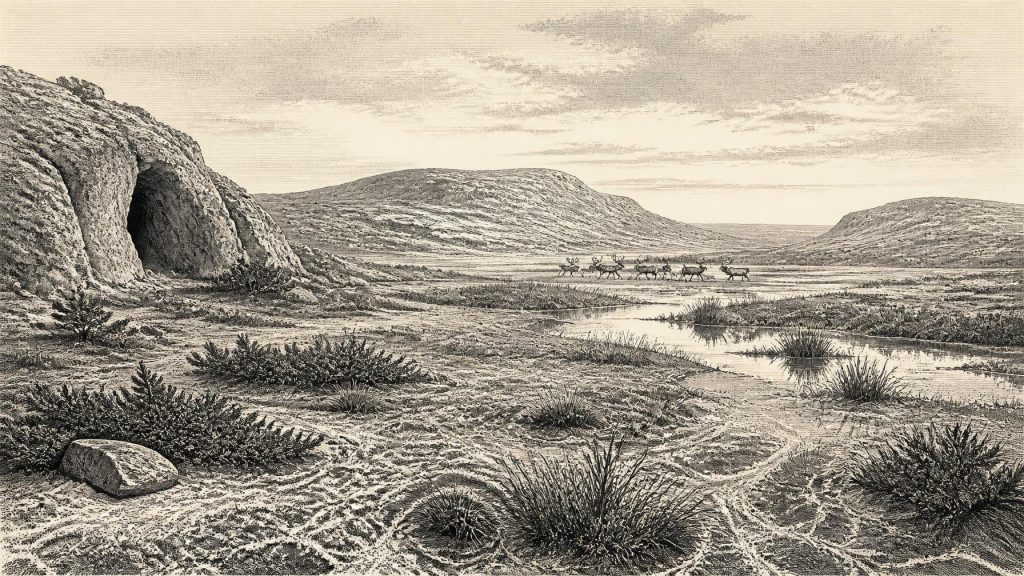
Around 31,861 BCE, Ireland was a climatically unstable Late Pleistocene landscape approaching more extensive glaciation, not a historically documented society. Derryvree sediments in Fermanagh indicate open, treeless tundra or wet muskeg, with grasses, sedges, juniper, herbs and cold-adapted mosses. Castlepook Cave in Cork preserves remains of reindeer, mammoth, giant deer, bears, wolves, hyaenas, Arctic foxes and lemmings, demonstrating a diverse cold-stage fauna. Possible cut marks on a reindeer bone may indicate Upper Palaeolithic human activity, but remain unconfirmed and cannot prove settlement. Later ice reshaped and obscured older landscapes, leaving fragmentary evidence of Ireland’s ecological connection with Ice Age Europe.
Dateline
The label 31,861 BCE gives a misleading impression of precision. No Irish community kept a calendar, wrote a record or left a year-dated object at this depth of time. In archaeological terms, the point is best treated as roughly 33,800 calibrated years before present, within Marine Isotope Stage 3 of the Late Pleistocene. Even that conversion is only an orientation: radiocarbon determinations carry laboratory error, calibration produces ranges rather than single years, and deposits may contain material moved by water, animals or later ice. Ireland at this time must therefore be reconstructed through dated animal bones, buried lake and marsh sediments, pollen, mosses, insects, cave deposits and the landforms left by advancing glaciers.
The most responsible picture is of an island-region approaching a major climatic transformation, not of a known historical episode. Around this broad period, parts of Ireland were still capable of supporting cold-adapted plants and animals, while the British–Irish Ice Sheet was growing unevenly. Conditions varied sharply between sheltered limestone caves in the south, lowland basins in the north and exposed uplands or coasts. The modern political map is useful only for locating evidence: there were no Irish kingdoms, borders, chiefs, treaties or diplomatic institutions that can be identified in the record.
A Date Within a Range
Radiocarbon chronology provides the essential caution. “Before present” conventionally means before 1950, while calibrated ages are estimates of calendar age derived from changing atmospheric carbon levels. A modern BCE year can be converted only approximately at this antiquity. The closest Irish environmental sequence is at Derryvree in County Fermanagh, where organic-rich freshwater silts lay beneath later glacial deposits. A published radiocarbon determination of about 30,500 radiocarbon years BP calibrates broadly to approximately 36,900–31,700 calendar years BP. That range encompasses the notional year considered here, but it does not prove that every feature of the Derryvree deposit formed in one particular season, generation or calendar year.
This distinction matters because the material was preserved in an active Pleistocene landscape and later sealed beneath till. Sediment records are powerful evidence for local or regional environments, yet they are not a diary. They show that north-central Ireland contained ice-free ground until at least about 34,000 years ago in one influential reconstruction, before the large late-stage expansion of the Irish Ice Sheet. They do not offer a complete map of every valley, nor a precise boundary between ice, frozen ground, snowfields, lake water and exposed vegetation at 31,861 BCE itself.
An Open, Cold Landscape
The Derryvree evidence points towards a treeless, open tundra or muskeg environment. Plant remains and pollen include grasses, sedges, juniper and other herbs, accompanied by mosses suited to wet, cold ground. This was not the familiar green, wooded Ireland of later millennia. Parts of the land were probably patchworks of sparse herb-rich vegetation, damp basin margins, shallow freshwater and seasonally frozen soils. Wind, frost action and meltwater would have shaped exposed surfaces; in low places, organic mud and silt could accumulate when conditions allowed.
Interpretation nevertheless requires restraint. Pollen can travel a long way, particularly from trees, so a small amount of pine or hazel pollen is not automatic proof of nearby woodland. Fossil assemblages also combine organisms living in slightly different microhabitats and perhaps over centuries. The defensible conclusion is not that all Ireland was identical tundra, but that the Fermanagh basin preserves evidence of a severe, open, cold-stage environment. It forms a valuable northern counterpart to the better-known animal remains from limestone caves in the south.
Climate was unstable on the scale of centuries and millennia. Marine and ice-core records show repeated abrupt shifts across the North Atlantic during Marine Isotope Stage 3. Ireland stood close to the Atlantic edge of that changing system. A cooling trend was under way, although the later Last Glacial Maximum had not yet reached its fullest extent. The major British–Irish Ice Sheet maximum is generally placed much later, around 27,000 years ago or after, depending on sector and method. Thus this was neither an uncomplicated warm interval nor the uniformly ice-buried Ireland sometimes imagined for the whole Ice Age.
Castlepook’s Animal Evidence
Castlepook Cave, near Doneraile in County Cork, is central to understanding this broader period. Excavations and subsequent study recovered a remarkable Pleistocene fauna: reindeer, woolly mammoth, giant deer, brown bear, wolf, spotted hyaena, Arctic fox and lemmings among it. Direct dates on different bones span a long interval, which is important in itself. The cave was used or received remains at different times; it is not a single frozen moment. Its collections show that southern Ireland was visited by, or formed habitat within the range of, a varied cold-stage fauna before later ice and sedimentary disturbance altered the landscape.
For a date near 31,861 BCE, reindeer deserve particular emphasis. Reindeer were adapted to open country and could exploit lichens, sedges and other tundra resources. Their presence fits the environmental evidence without allowing us to prescribe a precise herd route or season. Mammoth and giant deer remains indicate that large herbivores also reached the region during parts of the Late Pleistocene, while carnivores and scavengers such as hyaenas and wolves reveal a food web far more diverse than Ireland’s modern terrestrial fauna. Cave bone accumulations, however, may reflect natural deaths, carnivore activity, material carried into a den, water movement or human action; their discovery inside a cave does not mean that every animal lived there.
Spotted hyaena is especially revealing because it could transport and gnaw bones, creating accumulations that resemble human food debris at first glance. Earlier investigators recognised bone breakage and gnawing at Castlepook, while modern zooarchaeology has sought to separate tooth damage, sediment abrasion, excavation damage and possible stone-tool cuts. This is why the cave is both extraordinarily important and difficult. It preserves a long Pleistocene archive, but much of the first excavation was undertaken more than a century ago, before current recording standards, and some deposits or collections were mixed or disturbed.
The Human Question
There is no securely excavated settlement, hearth, house floor, burial, tool assemblage or human skeleton that can describe daily life in Ireland at this date. Accordingly, it would be wrong to write of an established population, named culture, language, ritual system or seasonal camp network. There is no evidence for farming, metalworking, monuments, long-distance trade institutions, organised warfare or formal religion. These absences are meaningful: they mark the limits of present knowledge, not evidence that such matters can be confidently reconstructed.
A reindeer femur from Castlepook has nonetheless prompted a major reassessment. Recent study identified marks that have been proposed as cut marks made during butchery, and the bone has been associated in public reporting with an age of roughly 33,000 years. If the interpretation is sustained by further microscopic study, comparable finds and secure stratified contexts, it would indicate human activity in Ireland during the Upper Palaeolithic, vastly earlier than the formerly accepted record of post-glacial colonisation. It would not, by itself, demonstrate permanent settlement. A single modified bone could represent a brief visit by mobile hunter-gatherers exploiting an animal carcass.
The appropriate wording remains conditional. The evidence is potentially transformative, but the question is being investigated rather than closed. No lithic assemblage has yet been securely linked to the specimen, and neither the number of visitors nor their route into Ireland is known. Lower sea levels altered the shape of the Irish Sea basin, but the existence, timing and usefulness of a terrestrial connection or navigable crossing between Ireland and Britain remain debated. Any people present may have arrived by a route that is now submerged, glaciated or otherwise archaeologically invisible.
Life Without a Recorded Society
If people did reach Ireland in this phase, their economy would most plausibly have been that of highly mobile Upper Palaeolithic hunter-gatherers, relying on knowledge of animal movements, weather, raw materials and safe shelter. That is an inference from wider north-west European archaeology, not a documented Irish social fact. Castlepook’s cave system could have offered temporary shelter or a place to process a carcass, but it may equally have been chiefly a carnivore den and natural trap. The distinction awaits better-dated, undisturbed deposits and a fuller analysis of bone surfaces and sediments.
What can be stated securely is that people, if present, would have entered an ecologically demanding world rather than an empty white wilderness. Reindeer, giant deer and other grazing animals linked plant resources to predators and scavengers. The Awbeg valley’s limestone caves offered protected cavities within a broader open landscape, while Fermanagh’s buried organic sediments preserve the quieter evidence of marsh plants and shallow water. Human prospects would have depended on short-lived opportunities in a climate prone to rapid change. The subsequent spread of ice was capable of removing campsites, reworking sediments and drowning or burying routes of approach.
A Landscape Before the Ice Peak
The greatest development relevant to Ireland around this notional year was environmental: the transition towards the more extensive glaciation that followed. Ice-sheet reconstruction shows that expansion was not instantaneous. Some areas retained ice-free or partly ice-free ground while ice centres developed and margins advanced elsewhere. Later ice profoundly remodelled the island, scouring bedrock, depositing till, reshaping drainage and concealing many older surfaces. That destructive history helps explain why evidence for any Palaeolithic presence is so sparse compared with Britain and continental Europe.
For Ireland Year by Year, then, 31,861 BCE is best understood not as a year of kings or battles but as a point within a cold Pleistocene interval illuminated by fragile archives. Derryvree supplies calibrated evidence for open northern tundra within a broad overlapping range. Castlepook supplies dated remains of an unexpectedly rich southern fauna and a cautiously interpreted possibility of human butchery. Together they show an Ireland still ecologically connected to wider Ice Age Europe, climatically precarious and on the threshold of heavier glaciation. They do not yet permit the invention of a settled Irish people, a specific hunt or a calendar-bound event.
Primary Sources
- The Irish Quaternary Fauna Project
- Trimlines, blockfields and the vertical extent of the last ice sheet in southern Ireland
- Maximum extent and dynamic behaviour of the last British–Irish Ice Sheet west of Ireland
- Pattern and timing of retreat of the last British-Irish Ice Sheet
- Growth and retreat of the last British–Irish Ice Sheet, 31,000 to 15,000 years ago: the BRITICE-CHRONO reconstruction
- British–Irish Ice Sheet and polar front history of the Goban Spur, offshore southwest Ireland over the last 250,000 years
- The subdivision of the Quaternary Period in Ireland
- Introduction to the Late Quaternary and Holocene of Northern Ireland
- Landscapes and environments of the last glacial-interglacial transition: a time of amazingly rapid change in Ireland
- Guide to the National Museum of Ireland
- Mammals: National Museum of Ireland Natural History Collections
- Castlepook Caves: Areas of Scientific Interest in County Cork
- 2022:564 – Castlepook Cave, Castlepook South, Cork
- Ireland's Palaeolithic Archaeology – Fleeting Footprints in a Frozen Land
- The colonization of Ireland: A human ecology perspective
- New insights on the fauna of Ireland's Younger Dryas and Early Holocene from Alice & Gwendoline Cave
- The problem of a late quaternary landbridge between Britain and Ireland
- The IntCal20 Northern Hemisphere Radiocarbon Age Calibration Curve (0–55 cal kBP)
- IntCal Publications
- IntCal Data
- Growth, dynamics and deglaciation of the last British-Irish ice sheet: the deep-sea ice-rafted detritus record
- Pleistocene vertebrates in the British Isles
- Proceedings of the Royal Irish Academy: Castlepook Cave report