Maguirebridge’s Moss-Rich Silt31900 BCE
Around 31,900 BCE, Ireland’s history is reconstructed from environmental rather than written evidence. Freshwater silts at Derryvree, County Fermanagh, dated broadly to 36,900–31,700 calibrated years BP, preserve a cold, treeless wetland of grasses, sedges, herbs and mosses between glacial deposits. Greenagho confirms earlier ice-free intervals, while ice-sheet growth and retreat made conditions regionally variable. Castlepook Cave, County Cork, contains cold-stage fauna, though deposits span periods and dating remains uncertain. A cut-marked reindeer bone may indicate early human visits, but no secure evidence demonstrates permanent settlement. Glaciers later destroyed or buried evidence, leaving fragmentary records of Ireland’s changing Ice Age landscape.

Dateline
A Date Without a Diary
“31,900 BCE” is a useful modern label, not a year that can be recovered from Ireland’s prehistoric record. No Irish calendar, written account, ruler, settlement sequence or human life can be assigned to that precise point. In radiocarbon and ice-sheet research, dates are normally expressed as ranges of calibrated years before present (cal BP, where “present” is AD 1950), often with sizeable uncertainty. In that convention, 31,900 BCE is roughly 33,850 years before present. It falls within Marine Isotope Stage 3 (MIS 3), a long and climatically unstable part of the last glacial cycle, and just before the great expansion of the British–Irish Ice Sheet that culminated several millennia later.
The responsible history of Ireland at this time is therefore not a narrative of named people or events. It is an account assembled from thin, uneven archives: freshwater silts caught beneath later glacial deposits in County Fermanagh; bones preserved in limestone caves, especially in north Cork; pollen, mosses, beetles and other small fossils; and the landforms and sediments left by advancing ice. These do not produce a national snapshot. They instead show that parts of Ireland could support cold-adapted life during intervals before the Last Glacial Maximum, while also revealing how fragile that evidence is.
Derryvree’s Cold Wetland
The most directly relevant environmental archive lies at Derryvree near Maguiresbridge in County Fermanagh. Roadworks in 1969 exposed freshwater silts and fine sands enclosed between two thick till sheets in a drumlin. The lower and upper tills record separate episodes when glacier ice moved across the locality; the organic-rich material between them preserves an ice-free interval. Its conventional radiocarbon determination was 30,500 years BP, with a substantial error range. Later discussion of calibration has placed the deposit broadly within about 36.9–31.7 thousand calibrated years BP. This is a broad window, not an annual date, but it encompasses the chronological neighbourhood of 31,900 BCE.
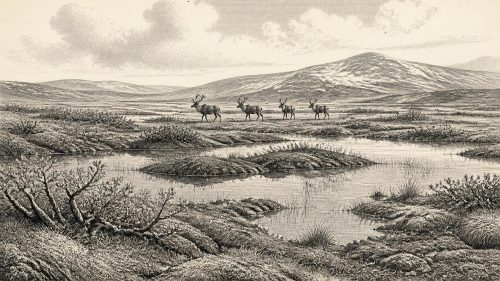
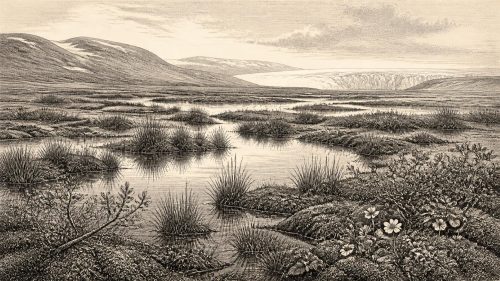
The Derryvree fossils describe a hard landscape. Pollen was dominated by grasses, sedges and herbs, while plant macrofossils included mosses characteristic of cold, damp ground. Juniper and other low-growing vegetation are part of the wider interpretation. Researchers have described the setting as open, treeless tundra or muskeg: waterlogged ground with pools, sedge-rich patches and sparse vegetation on drier surfaces. The climate was periglacial, meaning cold enough for repeated freezing and thawing, but not necessarily one in which the site itself lay beneath permanent glacier ice. This was not the wooded, rain-fed Ireland familiar today.
That evidence is local. It allows us to say that north-central Ireland had, at some point in the dated interval, an exposed freshwater and tundra environment. It does not prove that every Irish valley, coast or upland looked the same on a day in 31,900 BCE. Pollen can travel, preservation is selective, and the deposits have survived precisely because later sediments sealed them. Yet Derryvree remains exceptionally important because it gives direct Irish evidence for life on land before the ice sheets reached their greatest late-glacial extent.
An Island in Transition
By this stage global sea level was lower than today because much water was held in northern ice sheets. The outlines of Ireland and the surrounding shelf were consequently different, and areas now beneath the Irish and Celtic Seas were dry land or shallow coastal plain at various times. That did not automatically make Ireland a simple extension of Britain or continental Europe. The routes available to animals and people changed with sea level, local ice margins, river systems and climate; the geography was dynamic rather than a single, enduring “land bridge”.
Ice-sheet reconstruction makes the moment especially difficult to portray. Older interpretations sometimes stressed broad ice-free areas in Ireland until relatively late. More recent work shows that the British–Irish Ice Sheet had a longer and more complex history, with glaciation before the Last Glacial Maximum and retreat–advance behaviour during MIS 3. The BRITICE-CHRONO reconstruction places major growth after about 31,000 years BP, while other studies argue for earlier ice-sheet development and regional fluctuation. For approximately 33,850 cal BP, the safe conclusion is neither that Ireland was entirely ice-free nor that it was wholly buried under ice. Conditions varied regionally, and the available dating cannot resolve every advance or retreat to a particular modern calendar year.
The Derryvree and Greenagho records are central to this caution. At Greenagho, also in Fermanagh, organic lacustrine material beneath till has been dated to an earlier part of MIS 3, broadly around 37.2–35.7 thousand cal BP in later syntheses. It demonstrates that ice-free landscapes existed in the north-west before subsequent glacier expansion. Derryvree, with its younger cold-stage freshwater deposit, shows that such exposed environments did not simply disappear in one uniform advance. Ireland’s last glaciation was a sequence of changing margins, not an instant transformation.
Cave Fauna in the South
Far to the south, Castlepook Cave near Doneraile, County Cork, is Ireland’s richest known cave archive for Pleistocene vertebrates. Antiquarian excavations and subsequent research recovered remains attributed to woolly mammoth, giant deer, reindeer, brown bear, wolf, Arctic fox, mountain hare, lemmings and spotted hyaena. Such a list should not be read as a single herd roaming together across a single season. Cave deposits can accumulate over very long periods; carnivores may drag prey or scavenged carcasses underground; water can redistribute bones; and early excavations did not meet modern stratigraphic standards.
Even so, the range of animals establishes that Ireland was periodically part of a wider north-west European world of cold-stage mammals. Reindeer and lemmings fit open, cold habitats. Mammoth, giant deer and horse-sized prey animals, where securely dated, point towards productive patches within an open mosaic rather than a featureless snow desert. Spotted hyaena is particularly striking: Castlepook has supplied Ireland’s strongest evidence for the species, and its presence indicates that large carnivores could exploit the same animal resources as people might have done. A cave was not necessarily anyone’s home. At Castlepook it was, at least in part, a carnivore-affected bone trap and den-like refuge.
Direct redating has changed the chronology. Work on southern Irish cave bones found that several earlier measurements had underestimated their age, in some instances by thousands of radiocarbon years, owing to the difficulties of dating old bone and the improvement of pretreatment methods. The redated evidence suggests that some species, including giant deer and spotted hyaena, may have disappeared locally before the Last Glacial Maximum, perhaps around 40,000 cal BP. Thus the fauna illustrates a broad MIS 3 ecological setting, but it cannot tell us precisely which species stood in any particular Irish locality in 31,900 BCE.
The Reindeer Bone and Human Possibility
The most tantalising evidence concerns a reindeer femur fragment from Castlepook. It has been reported as bearing deep marks consistent with cutting or chopping by a stone tool, and public accounts have associated its radiocarbon age with roughly 33,000 years ago. If the marks are confirmed as humanly made and contemporary with the bone, they would indicate that Upper Palaeolithic people reached Ireland far earlier than the formerly accepted late-glacial evidence. A short visit by hunters following reindeer herds across the then altered north-west European landscape is plausible.
But plausibility is not proof of a population. There is no securely associated dwelling floor, hearth, diagnostic lithic assemblage, human burial, human bone, cave art or continuously occupied settlement in Ireland dated to the 32nd millennium BCE. The reindeer bone is a significant research lead, not a licence to imagine tribes, chiefs, territories or a permanent colony. Current excavation and reassessment at Castlepook aim to recover undisturbed deposits, refine dates and test how bones entered the cave. Until such work produces a clearer context, the most defensible wording is that Ireland may have been visited by people during MIS 3, not that it possessed an established human society in 31,900 BCE.
Life Beyond Political History
For this period, political affairs, diplomacy, organised warfare, religion, formal learning and trade networks are all beyond the evidence. There are no kingdoms, ethnic communities, languages, shrines or exchange systems that can responsibly be named. Nor should animal bones be converted into a detailed human economy. If people did reach Ireland, their subsistence would likely have depended on mobile hunting, scavenging and the careful use of animal materials, as among Upper Palaeolithic groups elsewhere in Europe; that is an analogy, not an Irish archaeological fact.
The real story is environmental contingency. Open wetlands at Derryvree, cold-adapted animals in southern caves and the approaching growth of ice show an Ireland repeatedly made accessible, habitable in places and then transformed. Later glaciers eroded or buried many open-air traces, while acidic soils are unfavourable to the preservation of bone. Caves and sediments beneath till are therefore not merely isolated curiosities: they are the surviving fragments of a record that has been heavily destroyed.
At 31,900 BCE, then, Ireland should be envisaged not as an empty stage awaiting conventional history, but as a changing glacial-age landscape. Its most secure inhabitants were plants, insects and animals adapted to exposed cold ground. Whether small groups of humans briefly shared that landscape remains an important, unresolved question. The moss-rich silts of Maguiresbridge and the bone accumulations of Castlepook preserve the evidence; interpretation must remain more modest than the drama of the Ice Age itself.
Primary Sources
- Middle Midlandian Freshwater Series at Derryvree, Maguiresbridge, County Fermanagh, Northern Ireland
- Middle Midlandian Interstadial Deposits at Greenagho, Near Belcoo, County Fermanagh, Northern Ireland
- A Reconsideration of the Radiocarbon Dating of the Marine Isotope Stage 3 Fauna from Southern Ireland
- The Irish Quaternary Fauna Project
- Growth and Retreat of the Last British–Irish Ice Sheet, 31,000 to 15,000 Years Ago: The BRITICE-CHRONO Reconstruction
- The Timing and Magnitude of the British–Irish Ice Sheet Between Marine Isotope Stages 5d and 2
- Trimlines, Blockfields and the Vertical Extent of the Last Ice Sheet in Southern Ireland
- Stratigraphic and Palaeo-Geomorphological Evidence for the Glacial-Deglacial History of the Last British-Irish Ice Sheet in the North-Western Irish Sea
- Radiocarbon Constraints on the Age of the Maximum Advance of the British-Irish Ice Sheet in the Celtic Sea
- Pattern and Timing of Retreat of the Last British-Irish Ice Sheet
- The IntCal20 Northern Hemisphere Radiocarbon Age Calibration Curve (0–55 cal kBP)
- Landscapes and Environments of the Last Glacial-Interglacial Transition: A Time of Amazingly Rapid Change in Ireland
- Palaeoecology: Quaternary of Northern Ireland
- The Subdivision of the Quaternary Period in Ireland
- Castlepook Cave, County Geological Site Report
- Archaeology Research Excavation Grant 2022: Castlepook Cave Project Final Report
- 2022:564 – Castlepook Cave, Castlepook South, Cork
- Heritage Artefacts of County Cork 2021
- New Insights on the Fauna of Ireland's Younger Dryas and Early Holocene from Alice & Gwendoline Cave
- Exploring Controls of the Early and Stepped Deglaciation on the Western Margin of the British Irish Ice Sheet