Doneraile’s Reindeer Ledger31835 BCE
31,835 BCE is a modern label for a poorly resolved MIS 3 period, not a recorded Irish year. Radiocarbon dates require calibration, and cave finds often lack secure context. Ireland’s cold, variable Late Pleistocene landscapes included open tundra-like vegetation, wetlands and altered coastlines, while Derryvree provides environmental evidence. Castlepook Cave near Doneraile preserves fauna including reindeer, mammoth, hyaena and bear, accumulated across different times and processes. A cut-marked reindeer femur may indicate butchery by mobile Upper Palaeolithic visitors around 31,000 BCE. However, it proves neither settlement nor continuity. No evidence supports claims about institutions, culture or ritual; further investigation continues.
Dateline
The label 31,835 BCE is a modern chronological convenience, not a date that anyone in prehistoric Ireland could have named or recorded. There was no Irish calendar, writing, polity or historical chronicle from which a year-specific event can be recovered. In simple calendar arithmetic it corresponds to about 33,785 years before AD 1950, the conventional “present” used in archaeological dating. But that apparent precision is misleading: evidence of this age is normally expressed through radiocarbon determinations and calibrated ranges, not as a securely identifiable single year.
The responsible setting is the later part of the Late Pleistocene, broadly within Marine Isotope Stage 3 (MIS 3), a long and climatically unstable portion of the last Ice Age. Ireland was approaching, but had not necessarily yet reached, the fullest extent of the last British–Irish Ice Sheet. The evidence is too patchy to reconstruct every locality in one notional year. It can, however, illuminate the kinds of environments, animals and possible human movements that existed across parts of Ireland during the wider period around 34,000 calibrated years ago.
Dating a Deep Past
Radiocarbon dating does not deliver a direct calendar anniversary. A measurement estimates the remaining radioactive carbon in once-living material; it must then be calibrated against independently built records of changing atmospheric carbon. The resulting calendar range can be broad, particularly this far back in time. Moreover, a date on a bone establishes, within statistical limits, when the animal died. It does not automatically date a human action on that bone, identify where the animal was killed, or prove that people lived nearby.
That distinction matters acutely in Ireland. Much of the relevant evidence was recovered from caves during nineteenth- and early twentieth-century excavations, before modern standards of layer-by-layer recording, sediment sampling and spatial plotting. Caves are not simple time capsules. They may serve as animal dens, traps, shelters, drainage routes and repositories for material moved by carnivores, water, sediment collapse or later excavation. Recent improvements in pretreatment of bone collagen have shown that some earlier Irish radiocarbon dates were too young by several thousand years. The chronology is therefore a field of continuing refinement, not a finished ledger.
A Cold, Changing Island
Around this broad horizon, Ireland was part of a northern European world repeatedly reshaped by cold phases, milder intervals, changing sea levels and expanding ice. The Last Glacial Maximum, when the British–Irish Ice Sheet attained its greatest overall extent, came later, broadly between about 26,500 and 19,000 years ago. Reconstructions of ice-sheet growth show that conditions at about 31,000 years before present remained regionally variable and that some ice margins are poorly constrained. It would be wrong either to picture the whole island as a single unbroken ice cap or to imagine a familiar green, wooded countryside.
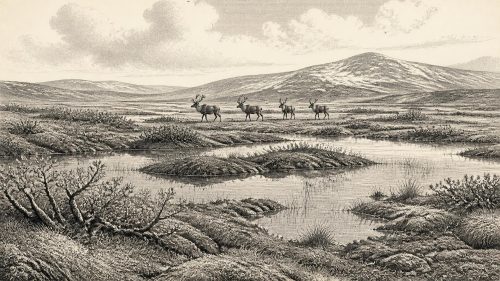
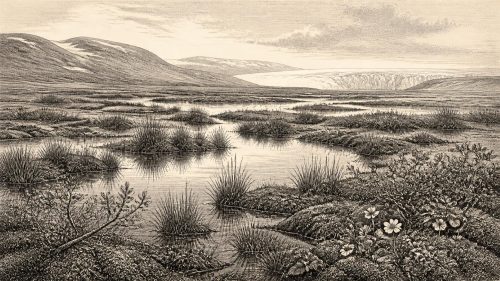
Where land was exposed and ecologically productive, it supported cold-adapted life. The best evidence suggests open landscapes rather than extensive closed forest: ground vegetation, grasses, sedges, herbs, dwarf shrubs, patches of bare mineral soil, wet hollows and seasonally frozen ground. Growing seasons were short, winters harsh and shelter unevenly distributed. Such country could still be biologically rich in particular places and seasons, especially where grazing animals found forage and predators or scavengers followed them.
Its geography also differed from that of modern Ireland. Global sea level was lower during glacial conditions, exposing far more of the continental shelves. Ireland was not necessarily joined to Britain or continental Europe by a dependable dry-land bridge at this precise stage, and the changing Irish Sea basin cannot be reduced to a single simple route. Yet lower seas altered coastlines, distances and potential pathways for animals and, possibly, people. This is evidence for a changing physical setting, not proof that a particular group crossed it in 31,835 BCE.
Derryvree’s Periglacial Record
The clearest Irish environmental archive for the broader MIS 3 period lies far from County Cork, at Derryvree near Maguiresbridge in County Fermanagh. Roadworks in 1969 exposed freshwater silts and fine sands enclosed between two sheets of glacial till within a drumlin. The deposits produced a radiocarbon determination of 30,500 ± 1,170/1,030 radiocarbon years before present. That is not an exact calendar equivalent to the date considered here, but it belongs broadly to the same Middle Midlandian, MIS 3 world.
Pollen, plant remains, mosses and insects from Derryvree indicate a treeless, tundra-like and periglacial environment. Grasses and sedges were important, while moss-rich, waterlogged ground and open pools have prompted comparison with muskeg. The record is valuable precisely because it provides direct local environmental evidence rather than an imagined national landscape. It does not mean every Irish valley looked identical. Rather, it demonstrates that freshwater habitats and cold open vegetation could persist in parts of Ireland before later glacial advance covered and sealed the deposits.
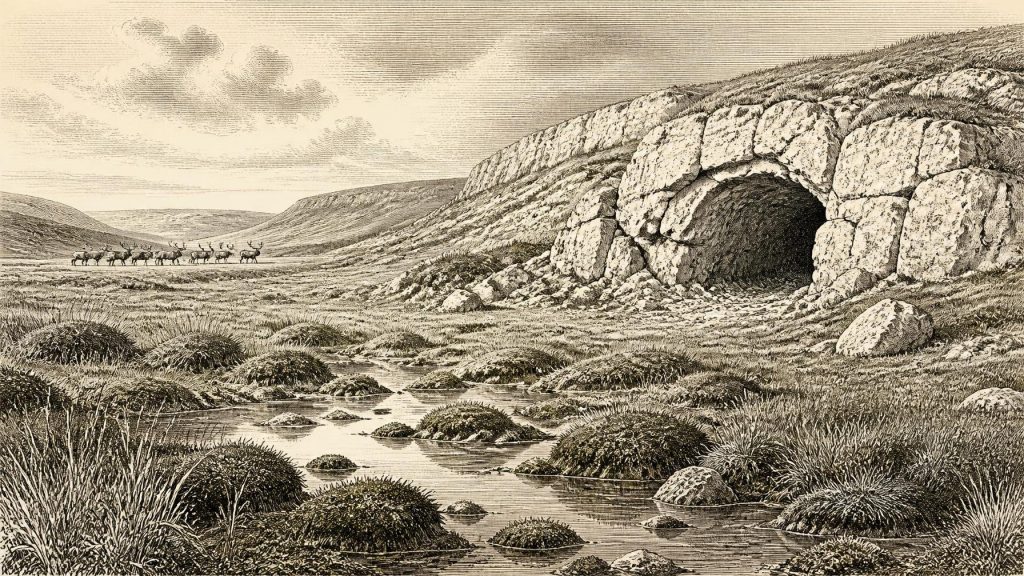
In everyday ecological terms, water and seasonality mattered. Pools and marshy ground could sustain plants, insects and birds; better-drained patches could provide grazing; limestone caves and rock features offered shelter to some animals but also hazards and traps. The land was not empty merely because it was cold. It was a demanding mosaic in which food and refuge were distributed unevenly.
Castlepook and the Animal World
For southern Ireland, Castlepook Cave near Doneraile in north County Cork is indispensable. Also known as Mammoth Cave, it was explored in the early twentieth century and yielded a substantial assemblage of Late Pleistocene animal remains. Subsequent study and redating have made it one of the most important Irish records of fauna from before the Last Glacial Maximum. The cave has preserved remains attributed across a long span of time, rather than from one simultaneous animal community.
Its wider assemblage includes evidence for reindeer, brown bear, fox, hare, Arctic lemming, spotted hyaena and woolly mammoth, alongside other mammals. These names should be handled carefully. Their presence establishes that appropriate habitats and movement corridors existed at particular times in the broader glacial cycle; it does not show that all species stood together in the Awbeg Valley in 31,835 BCE. Some animals may have used the cave themselves, died naturally, or been carried in by scavengers. Spotted hyaena, notably, is known in Ireland from Castlepook and could accumulate bones in a den, complicating any attempt to read a bone deposit as a human campsite.
Nevertheless, the fauna changes the scale on which this early Irish landscape must be imagined. Reindeer indicate cold-country grazing opportunities. Mammoth remains point to an ecosystem far richer in large Pleistocene mammals than later Ireland. Carnivores and scavengers reveal an active food web in which carcasses were contested resources. Giant deer, hyaena and mammoth are not symbols of a timeless ‘Ice Age’; the redated evidence suggests that some may have disappeared locally before the glacial maximum. Each specimen must therefore be assigned to its own date and context wherever possible.
The Reindeer Femur Question
One Castlepook find is especially relevant to this date: a reindeer femur bearing a deep incision interpreted by zooarchaeologist Ruth Carden as a mark made by a sharp stone tool during carcass processing. County Cork heritage material has presented the bone as dating to about 31,000 BCE, while public reporting has described it as roughly 33,000 years old. It raises the striking possibility that Upper Palaeolithic people handled or butchered reindeer in Ireland far earlier than the previously recognised late-glacial evidence for human activity.
The claim deserves attention, but also restraint. The femur came from an old cave collection, not from a newly excavated, intact occupation floor. No securely associated stone-tool assemblage, hearth, dwelling, human skeleton, burial, ornament or food-preparation area of comparable age has yet been recovered. A bone date and a proposed cut mark are important evidence, but they do not establish permanent settlement, continuous population, ancestry from those visitors to later Irish people, or a named archaeological culture.
If the mark is confirmed as anthropogenic and contemporary with the animal’s death, the most economical interpretation would be a brief visit by a small, mobile hunting or foraging party, perhaps processing a carcass obtained nearby or elsewhere. Reindeer could provide meat, marrow, fat, hide, sinew, antler and bone. That inference fits wider Upper Palaeolithic practices in north-west Europe, but it remains an inference. Ireland has not yielded the accompanying evidence needed to describe the visitors’ language, kinship, clothing, ritual or length of stay.
Society Beyond the Evidence
There is no basis for describing political affairs, diplomacy, warfare, chieftainship, law or territorial states in Ireland at this point. Nor is there direct Irish evidence for farming, fields, trade ports, formal religious monuments, schools or durable settlements. These absences are not minor gaps in an otherwise familiar national story: they define the nature of the record. The most important ‘politics’ recoverable here are environmental pressures—access to food, shelter, safe passage and seasonal resources—rather than institutions or rulers.
Likewise, no artefacts allow a responsible account of artistic traditions, ceremonial practice or learning. Continental Europe preserves spectacular Upper Palaeolithic art and ornament, but these cannot be transferred automatically across the sea to Ireland. The absence of such evidence may partly reflect later glacial erosion, changing coastlines and the limited survival or discovery of suitable sites. It remains absence, however, and should not be filled with invented caveside rituals or imagined tribes.
An Archive Still Opening
The historical importance of this horizon lies in its uncertainty as much as in its drama. Derryvree preserves hard-won evidence for a cold, open freshwater landscape; Castlepook preserves an unusually rich faunal archive and a potentially transformative trace of human butchery. Modern excavation at Castlepook has sought surviving undisturbed Pleistocene deposits that may test older claims through better stratigraphy, dating and microscopic analysis.
For Ireland around 31,835 BCE, the firm conclusion is modest but significant. Parts of the island supported cold-climate ecosystems during MIS 3, and animals moved through landscapes whose form and coastlines differed greatly from those of today. A reindeer femur from Doneraile offers a serious, though not yet fully contextualised, possibility of human activity. It is not an annual event, a settlement story or the beginning of an unbroken Irish population. It is a fragmentary clue from a deep past whose most responsible history remains one of evidence, calibration and careful doubt.
Primary Sources
- A Reconsideration of the Radiocarbon Dating of the Marine Isotope Stage 3 Fauna from Southern Ireland
- The Irish Quaternary Fauna Project
- New Insights on the Fauna of Ireland’s Younger Dryas and Early Holocene from Alice & Gwendoline Cave
- The IntCal20 Northern Hemisphere Radiocarbon Age Calibration Curve (0–55 cal kBP)
- Growth and Retreat of the Last British–Irish Ice Sheet, 31,000 to 15,000 Years Ago: the BRITICE-CHRONO Reconstruction
- Growth and Retreat of the Last British-Irish Ice Sheet, 31,000 to 15,000 Years Ago: the BRITICE-CHRONO Reconstruction
- Dimensions and Chronology of the Last Ice Sheet in Western Ireland
- Early Deglaciation of the British-Irish Ice Sheet on the Atlantic Shelf Northwest of Ireland Driven by Glacioisostatic Depression and High Relative Sea Level
- Timing and Pace of Ice-Sheet Withdrawal Across the Marine–Terrestrial Transition West of Ireland During the Last Glaciation
- Oscillating Retreat of the Last British-Irish Ice Sheet on the Continental Shelf Offshore Galway Bay, Western Ireland
- Stratigraphic and Palaeo-Geomorphological Evidence for the Glacial-Deglacial History of the Last British-Irish Ice Sheet in the North-Western Irish Sea
- Deglaciation Chronology of the Donegal Ice Centre, North-West Ireland
- Palaeoecology
- The Irish Quaternary: A Guide to the Evidence
- Cenozoic: Tertiary and Quaternary
- The Exploration of Castlepook Cave, County Cork, Being the Third Report from the Committee Appointed to Explore Irish Caves
- Occurrence of Mammalia Relicts at Site Castlepook Cave
- 2022:564 – Castlepook Cave, Castlepook South, Cork
- Heritage Artefacts of County Cork
- Geology of Ireland