Castlepook’s Deep Incision31742 BCE
31,742 BCE is a modern label, not a precise Irish date; the relevant setting is later Marine Isotope Stage 3, before glaciation. Ireland was a cold, unstable, open landscape with changing ice margins, lower seas and Pleistocene fauna. Castlepook Cave, County Cork, preserves reindeer, mammoth, giant deer, hyaena and remains, although antiquarian excavation and disturbed deposits limit interpretation. A reindeer femur, roughly 33,000 years old, bears a mark possibly made by a stone tool during butchery. If confirmed, it may be Ireland’s earliest human trace, indicating brief activity rather than settlement. Further stratified excavation, dating and taphonomic study are required.
Dateline
The label 31,742 BCE is useful only as a modern filing device. No community in Ireland then kept a calendar, and the evidence cannot identify a particular year, season, person or event. Arithmetically, that numbered year falls about 33,691 years before AD 1950, the conventional ‘present’ used in radiocarbon reporting; it should not be mistaken for a precise archaeological date. At this depth of time, dates are expressed as radiocarbon measurements and broad calibrated ranges, with substantial uncertainty. The responsible historical setting is therefore later Marine Isotope Stage 3, or MIS 3, an unstable interval of the last Ice Age before the Last Glacial Maximum.
Ireland at about this point was not the green, wooded island familiar from later prehistory. It was part of a changing north-west European world of cold climates, lower sea levels and shifting ice margins. The island’s evidence is exceptionally fragmentary: bones in caves, buried organic sediments, pollen, beetle remains, glacial landforms and laboratory dates. There are no settlements, hearths, stone-tool assemblages, graves or human remains securely attributable to this moment. Yet one difficult object from north County Cork gives the period unusual importance: a reindeer femur from Castlepook Cave near Doneraile, bearing a deep mark that has been interpreted as evidence of carcass processing with a sharp stone implement.
A Date Range, Not a Dateline
Radiocarbon years are not identical to calendar years, because atmospheric carbon-14 has varied through time. The IntCal20 calibration curve, which reaches back to 55,000 calibrated years before present, helps convert laboratory measurements into calendar estimates, but its older section relies on several independent natural archives and retains wide uncertainty. Consequently, an article anchored to 31,742 BCE can responsibly describe a millennial-scale context, not announce what happened in Ireland in that calendar year.
The relevant Irish evidence commonly clusters around the mid-30th millennium before present. Older reconstructions associated deposits at Derryvree, County Fermanagh, with a cold phase around 30,000 radiocarbon years ago, while modern reviews stress that the build-up of the British–Irish Ice Sheet was regionally complex. Some sectors had experienced earlier glaciation; elsewhere, conditions and ice margins changed through MIS 3. By the global Last Glacial Maximum, conventionally placed around 26,000–19,000 calibrated years before present, Ireland was much more extensively glaciated. Around 31,742 BCE, therefore, the principal story is not an island uniformly entombed beneath its final ice cover, but a landscape entering a harsher and increasingly unstable phase.
The Doneraile Cave Archive
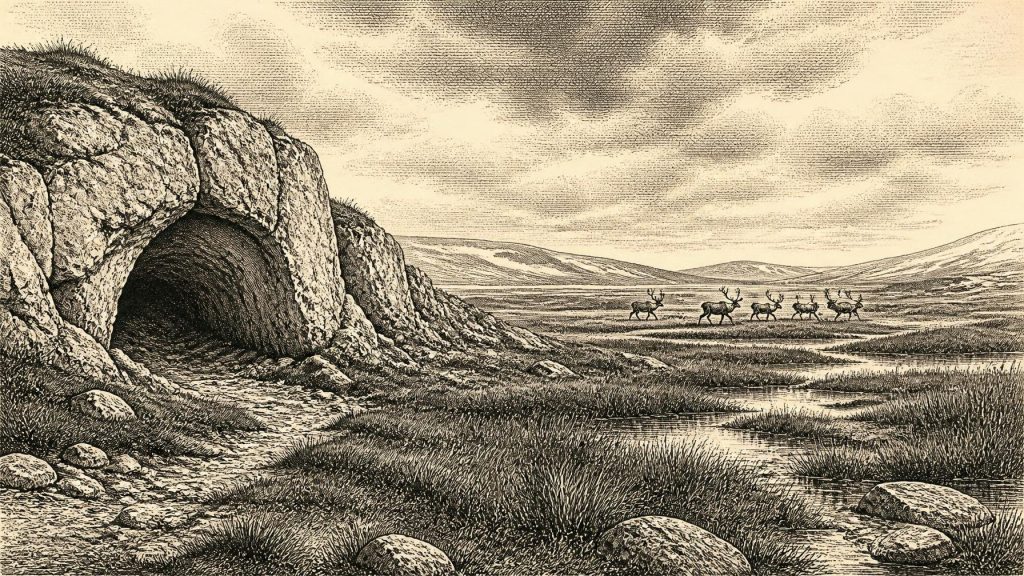
Castlepook Cave, also called Mammoth Cave or Doneraile Cave, lies in limestone country near the Awbeg valley. It is a long cave system whose chambers received animal remains over very long spans of the Pleistocene. Early twentieth-century excavators recovered a remarkable bone collection, later held by the National Museum of Ireland. Such antiquarian work preserved material of immense value, but it also created an interpretative problem: excavation methods then did not record layers, positions and associations to modern standards. Water movement, sediment disturbance and carnivore activity could also have mixed remains before excavators ever reached them.
Re-dating has made Castlepook more important and more complicated. Ruth Carden and colleagues showed in 2020 that improved pretreatment and ultrafiltration of bone collagen produced dates substantially older than several earlier measurements from Castlepook and other southern Irish caves. Their results support the presence in Ireland of a MIS 3 fauna including animals such as reindeer, giant deer and spotted hyaena well before the Last Glacial Maximum; some species may have disappeared locally before about 40,000 calibrated years before present. This is secure evidence for Ice-Age animal communities, though not for a single, continuous fauna across the entire island.
The especially arresting find is a fragment of reindeer hind-leg femur reported as dating to roughly 33,000 years ago. It carries a deep incision which zooarchaeologist Ruth Carden has interpreted as a fresh-bone cut or chop mark, consistent with a sharp stone tool used during butchery. If that interpretation is sustained, it pushes evidence of human activity in Ireland far earlier than the previously accepted terminal-Pleistocene evidence from Alice and Gwendoline Cave in County Clare, dated to about 12,800–12,600 calibrated years before present.
But the wording matters. The bone’s radiocarbon date measures the death of the reindeer, not the exact moment when the mark was made. The mark may indicate that people processed the carcass; it does not identify their language, ancestry, social organisation, route into Ireland or duration of stay. Nor does it prove butchery occurred inside the cave. County Cork heritage material reasonably suggests that a carcass could have been processed outdoors and the discarded bone later carried into the cave by scavengers. No securely associated stone tools have yet been found. Castlepook is thus best understood as powerful, provisional evidence for a human visit or activity episode, not as proof of a settled Palaeolithic population.
Open Ground and Mobile Herds
Even without a human camp, animal and environmental evidence gives a vivid outline of the world in which any visitors moved. Castlepook’s fauna includes cold-adapted and open-country species: reindeer, woolly mammoth, spotted hyaena, wolf, fox, hare and large deer among them. The precise overlap of every species cannot be assumed, since cave accumulations combine deposits of different ages. Nonetheless, the assemblage demonstrates that southern Ireland could at times sustain a rich Pleistocene food web. Reindeer were particularly suited to seasonal, exposed environments, while large herbivores supported predators and scavengers.
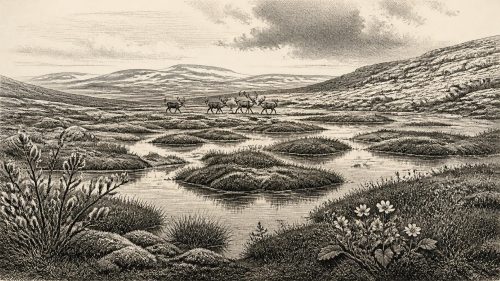
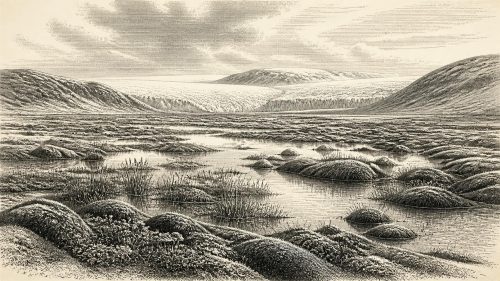
At Derryvree, organic silts sealed between tills beneath drumlins preserve a different sort of archive. Pollen, plant macrofossils and invertebrate evidence have been read as a treeless, wet tundra or muskeg environment, with sedges, mosses and other cold-climate vegetation. These records do not provide a photograph of Castlepook in 31,742 BCE, and their chronology has long been debated. They do, however, independently support the broad picture of open vegetation, shallow water and seasonal extremes in parts of Ice-Age Ireland. Trees were scarce or absent in these cold phases; woodland, farming clearances and peat bogs of the later Irish landscape belonged to a far distant future.
Lower global sea level changed the map. Ireland was not necessarily connected by a simple, dry land bridge throughout this interval, and sea level, coasts, ice and currents altered repeatedly. It is safer to say that the distances and barriers separating Ireland, Britain and continental Europe differed fundamentally from those of today. If people did reach Cork, they came into a northern Atlantic frontier where access was possible only under particular geographical conditions and where survival depended on detailed local knowledge. Their movement may have followed herds, river valleys, exposed coastal plains or seasonal opportunities, but these remain models rather than demonstrated routes.
People Without a Recorded Society
The marked femur permits only the narrowest inferences about human life. If it is anthropogenic, the cutter had access to a sharp stone edge and understood how to reduce an animal carcass. That might imply a small, mobile hunting party rather than a village; it might also represent a brief expedition by people normally based elsewhere. Similar Upper Palaeolithic populations elsewhere in Europe made sophisticated blades, projectile points, clothing, shelters and ornaments, but none of those things has been securely recovered from Ireland for this time. It would be misleading to assign Castlepook’s possible visitors a named archaeological culture, let alone an ethnicity.
There is no evidence for political authority, territory, chiefs, diplomacy, formal warfare, law or institutions on the island in this period. Nor can archaeologists identify households, kin groups, marriage customs, gendered tasks, languages or social rank. Human conflict may have existed wherever people lived, but the Irish record provides no battle site or weapon cache from which to discuss it. Predation was more immediate and better evidenced: hyaenas and other carnivores could dismember carcasses, gnaw bones and transport them into caves. Their agency is one reason cave bone assemblages demand meticulous taphonomic analysis before human action is claimed.
Religion and learning are equally beyond the evidence. No Irish cave art, portable art, burial rite, shrine or symbolic object can securely be placed in this interval. A cut on a reindeer bone is not a ritual, an inscription or an artistic tradition. The absence is significant: it tells us that Ireland’s record, unlike that of some mainland European regions, has not yet yielded material through which belief or symbolic culture can responsibly be reconstructed. That is not evidence that visiting people lacked stories, beliefs, skills or traditions; it is a limit on what archaeology can recover.
Economy at the Edge of Ice
There was no Irish agriculture, herding, metalworking, pottery production or market exchange in the evidence for this time. Any economy was based on the direct use of wild resources. Reindeer offered meat, marrow, hide, sinew, antler and bone; other large herbivores may have supplied comparable materials. The practical importance of a stone cutting tool, if the Castlepook mark is correctly identified, lies not merely in obtaining food but in converting a carcass into portable, useful materials. Still, a solitary modified bone cannot establish a specialised hunting economy or a regular trade network.
Nor should Ireland be imagined as an isolated stage with a self-contained history. Its fauna, climate and possible human visitors belonged to wider north-west European ecological systems. The nearest useful comparisons are continental and British Upper Palaeolithic landscapes, but comparison must not become substitution. Evidence from elsewhere shows what people in cold Europe were capable of; it does not supply the missing Irish campsites. The direct Irish record remains cave fauna, environmental sequences and one potentially transformative modification on a reindeer bone.
The Importance of Uncertainty
Recent excavation at Castlepook has sought surviving, stratified Pleistocene deposits in parts of the cave not fully explored by earlier investigators. That work is crucial because deposits found in secure context, alongside modern dating, microscopic wear study and sediment analysis, could test whether the marked femur represents human butchery, carnivore damage or another process. It could also clarify when animals entered the cave and whether people ever occupied its chambers. Until then, the most defensible account of Ireland around 31,742 BCE is modest but compelling: an open, cold and changing land supported Ice-Age mammals; ice-sheet growth was reshaping its geography; and a reindeer bone from north Cork may preserve the earliest known trace of a human hand in Ireland.
Primary Sources
- A reconsideration of the radiocarbon dating of the Marine Isotope Stage 3 fauna from southern Ireland
- The timing and magnitude of the British–Irish Ice Sheet between Marine Isotope Stages 5d and 2: implications for glacio-isostatic adjustment, high relative sea levels and ‘giant erratic’ emplacement
- Oscillating retreat of the last British-Irish Ice Sheet on the continental shelf offshore Galway Bay, western Ireland
- Maximum extent and dynamic behaviour of the last British–Irish Ice Sheet west of Ireland
- Dimensions and chronology of the last ice sheet in Western Ireland
- Trimlines, blockfields and the vertical extent of the last ice sheet in southern Ireland
- First evidence of a Late Upper Palaeolithic human presence in Ireland
- Phylogeographic, ancient DNA, fossil and morphometric analyses reveal ancient and modern introductions of a large mammal: the complex case of red deer (Cervus elaphus) in Ireland
- The Irish Quaternary Fauna Project
- New insights on the fauna of Ireland's Younger Dryas and Early Holocene from Alice & Gwendoline Cave
- The IntCal20 Northern Hemisphere Radiocarbon Age Calibration Curve (0–55 cal kBP)
- IntCal Publications
- Quaternary
- Quaternary Site Descriptions
- Figure 6.— The subdivision of the Quaternary Period in Ireland
- 2022:564 – Castlepook Cave, Castlepook South, Cork
- Archaeology Research Excavation Grant 2022
- Mammoth Cave
- Heritage Artefacts of County Cork
- Karst of Ireland
- Anthropogenic changes to the Holocene nitrogen cycle in Ireland