Castlepook’s Stone-Edge Question31741 BCE
31,741 BCE is a modern label for an uncertain Late Pleistocene interval, not a recordable Irish year. Castlepook Cave, County Cork, produced a reindeer femur dated broadly around 33,000 years ago, whose deep fresh-bone incision may represent stone-tool butchery. If confirmed, it would be Ireland’s earliest evidence of human contact, though excavation methods, mixed cave deposits and carnivore activity prevent stronger conclusions. Fauna indicate a cold, varied landscape of tundra, herbivores and predators. Derryvree sediments document ice-free periglacial wetlands during the wider period. Approaching ice-sheet expansion constrained possible mobile visitors; no settlement, society, route or repeated occupation is securely demonstrated.
Dateline
The label 31,741 BCE is a modern chronological convenience, not a year that anybody in Ireland could have named or recorded. It falls roughly 33,700 years before AD 1950, within the Late Pleistocene and the later part of Marine Isotope Stage 3 (MIS 3), a climatically unstable interval of the last Ice Age. Archaeology cannot responsibly describe a particular Irish day, season or event at this depth of time. Its dates are normally expressed as radiocarbon ages, often with substantial uncertainty, and then converted into broad calibrated ranges. What can be recovered is a fragmentary picture of changing habitats, animals, ice and, perhaps, a fleeting human presence.
The most important Irish object for this broad period is a marked reindeer femur from Castlepook Cave near Doneraile, in north County Cork. Its significance is potentially enormous, but so are the limits of the evidence. The bone has been reported as dating to about 33,000 years ago, while a County Cork heritage publication places it broadly around 31,000 BC. It bears a deep incision interpreted by zooarchaeologist Ruth Carden as a cut or chopping mark made with a sharp stone implement while the bone was fresh. If that interpretation and association are sustained, it would indicate that people handled and processed reindeer in Ireland far earlier than the previously accepted evidence for human activity on the island.
A Date Measured in Millennia
There is no legitimate annual narrative for 31,741 BCE. The number should not be confused with a precisely dated visit to Castlepook, let alone the first arrival of a settled people. At this age, even a carefully measured radiocarbon determination represents a probability distribution rather than a calendar anniversary. Calibration is essential because atmospheric carbon-14 has varied over time; the current IntCal20 curve extends back to 55,000 calibrated years before present. But calibration cannot repair every weakness in an old excavation or prove that a surface mark was made by a person.
Castlepook’s original deposits were excavated between 1904 and the years before the First World War, principally under the naturalist Richard J. Ussher. The cave’s galleries and chambers yielded many thousands of bones. Their discovery was a major contribution to Irish Quaternary research, yet the work pre-dated modern expectations of fine stratigraphic recording, systematic sieving, three-dimensional plotting and laboratory analysis of bone surfaces. Surviving specimens have since been studied and redated, but the assemblage accumulated over a long interval and in different parts of a complex cave. It is not one camp, one hunting episode or one season frozen in time.
That context matters. A reindeer femur is direct physical evidence of a reindeer; its date concerns the death of that animal. An incision is physical evidence of damage to bone. The proposition that the damage was made by a stone tool during human butchery is an expert interpretation based on its form, position and fresh-bone character. It is a serious and testable interpretation, not a licence to populate north Cork with a known tribe, named leader or permanent settlement. No securely associated hearth, stone-tool assemblage, dwelling surface, human burial or repeated occupational sequence of this age has yet been published from Castlepook.
The Cave Above the Awbeg
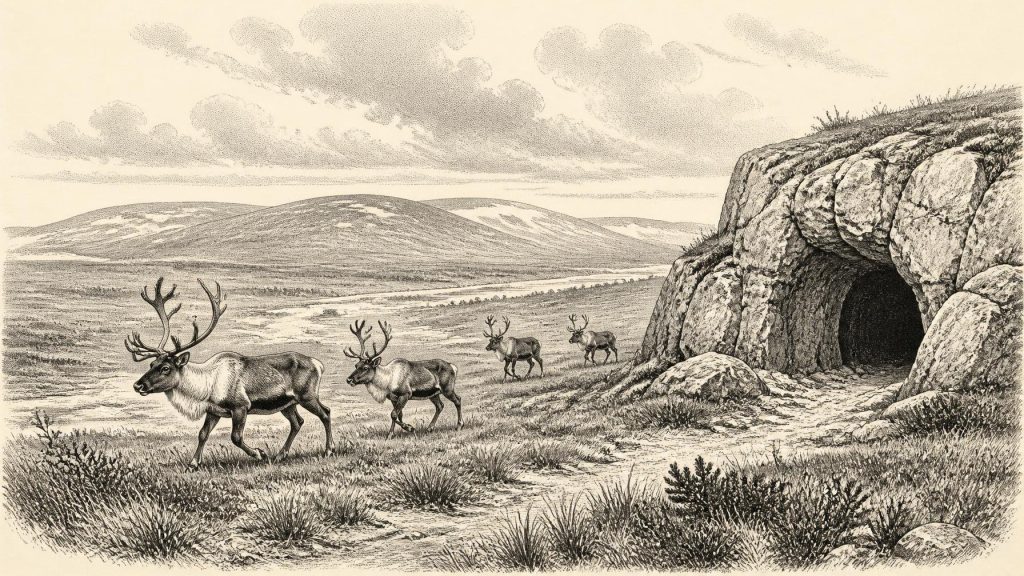
Castlepook, sometimes called Mammoth Cave in earlier accounts, lies in limestone country above the Awbeg Valley, north of the Blackwater. Its fossil archive demonstrates that Ireland was not an empty, featureless ice-world throughout the later Pleistocene. Reindeer are prominent among the remains, alongside animals recorded from the cave collection or closely relevant Irish deposits including woolly mammoth, giant deer, brown bear, wolf, Arctic fox, hare, lemmings and spotted hyaena. These names should not be read as a single, perfectly contemporary community. Different animals and bones may belong to different phases, while cave sediments can be disturbed by water, collapse, scavengers and earlier excavation.
Spotted hyaena is especially important to interpretation. Hyaenas often used caves as dens and could carry carcass portions underground, gnaw bones and create dense mixed deposits. Wolves and other scavengers could also move remains. Thus, even if people cut the reindeer femur, the animal was not necessarily killed or butchered inside the cave. The cave may have received a discarded limb later dragged in by carnivores. This possibility does not nullify the human interpretation; rather, it defines its modest scale. At most, the bone currently suggests an episode of human-animal contact somewhere in the surrounding landscape.
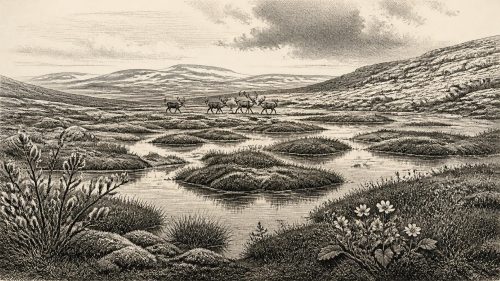
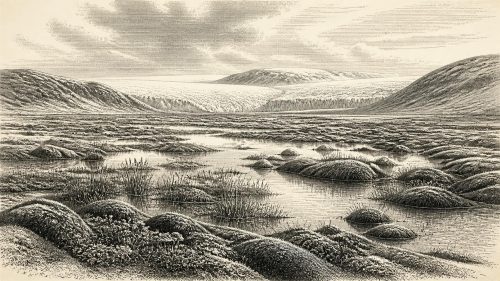
The broader faunal evidence nevertheless gives that landscape substance. Reindeer, mammoth and giant deer imply productive plant resources, particularly during favourable seasons. Arctic foxes and lemmings point towards cold conditions and open habitats. Predators and scavengers followed prey and competed over carcasses. The scene was probably a shifting mosaic rather than an unbroken white wilderness: herb-rich tundra, grasses and sedges, patches of low shrub, bare mineral ground, wet hollows and streams, all influenced by slope, drainage, snowfall and the changing position of ice.
Derryvree’s Northern Counterpart
Evidence from Derryvree near Maguiresbridge, County Fermanagh, offers the clearest Irish environmental window onto the wider later-MIS-3 world. Roadworks in 1969 exposed freshwater silts and fine sands trapped between two thick tills in a drumlin. The organic sediments yielded a radiocarbon age of 30,500 years BP, with reported laboratory uncertainty of +1,170/-1,030 years. That is not an exact equivalent of 31,741 BCE, and it must not be treated as one. Yet it shows that, during part of this broad climatic phase, the locality was free of overriding glacier long enough for a freshwater environment to develop before later ice covered it.
Pollen, plant macrofossils, mosses and insect remains from Derryvree indicate treeless, open tundra or muskeg conditions, with pools rich in plant matter and surrounding wet ground. The evidence supports a periglacial climate: severe winters, short growing seasons and frozen or seasonally frozen soils. It does not tell us that every part of Ireland looked alike. Fermanagh’s lowland wetland, north Cork’s limestone cave country, exposed uplands and the then-altered coast all had distinct local conditions. Still, together they rebut any simple assumption that Ireland was either uniformly ice-covered or uniformly habitable at every moment before the Last Glacial Maximum.
The future direction of change was towards more persistent cold and major ice-sheet growth. Recent BRITICE-CHRONO reconstructions place substantial expansion of the British–Irish Ice Sheet within the interval from about 31,000 years ago, with its maximum overall ice volume later, around 23,000 years ago. Reconstructions remain revised as new dates are assessed, and Irish ice margins did not necessarily advance at the same time as Scottish or marine sectors. Around the notional year addressed here, therefore, Ireland stood near an important threshold: climatic oscillations still permitted ice-free habitats in some times and places, but the onset of the main glacial advance was approaching.
Visitors, Not Yet a Society
If the Castlepook cut mark was made by people, those people were highly mobile Upper Palaeolithic hunter-gatherers, probably exploiting a short-lived opportunity rather than establishing a demonstrable permanent colony. Reindeer could provide meat, fat, hide, sinew, antler and bone. Cutting a limb from a carcass required practical knowledge and a sharp edge; this much can reasonably be inferred from the proposed butchery trace. But the evidence does not reveal clothing, language, family size, seasonal route, tool-making tradition or whether the visitors came once or repeatedly.
There is likewise no evidence for political affairs, warfare, diplomacy, chiefs, territorial boundaries or institutions in Ireland at this date. Such terms belong to later human societies and cannot be supplied by analogy merely because they make a narrative more familiar. Cooperation would have been vital for any travellers in a severe landscape, and knowledge of weather, animals, raw materials and safe routes would have been socially shared. That is a general inference about survival, not proof of a particular Irish community.
Religion, art and learning must be handled with the same discipline. Upper Palaeolithic groups elsewhere in Europe made sophisticated tools, ornaments, images and burial places, but none of those achievements can automatically be transferred to Ireland. Castlepook is not known as a shrine, and there are no Irish monuments, artworks, graves or inscriptions attributable to this time. Nor is there a bridge from this possible episode to later Celtic traditions, medieval place-names or modern identities. Any learning present was embodied expertise: the accumulated skills needed to move, hunt, process food and endure cold.
An Island at the Edge
Low global sea levels altered Ireland’s coastal outline because vast quantities of water were stored in continental ice. This did not automatically create a simple land bridge to Britain or mainland Europe. Deep basins, channels, ice margins and rapidly changing shorelines mattered, and the precise routes available to animals or people varied over time. The Castlepook fauna does show ecological connections with the wider north-west European Ice-Age world. It does not demonstrate a permanent highway, regular trade or a settled population linked by routine travel.
Accordingly, the economy of Ireland in this period cannot be described as an Irish economy in the later sense. There were no demonstrated farms, fields, herds, villages, markets or exchange networks. If people visited, their subsistence may have included opportunistic hunting and carcass processing, but even this remains a cautious reading of one exceptional bone. The cave fauna records an ecosystem in which large herbivores, carnivores and scavengers moved through an exposed landscape; it does not supply a census of human residents.
Castlepook’s marked femur is valuable precisely because it is so small and difficult. It opens the possibility that people reached Ireland during a much earlier phase of the Ice Age than once believed. It cannot yet answer how often they came, by what route, or whether they stayed. For 31,741 BCE, the most responsible history is therefore not a story of kingdoms or founders, but of evidence under pressure: a cold, changing island; wet tundra in Fermanagh; reindeer and carnivores in north Cork; advancing ice in the wider region; and one bone that may preserve the earliest known trace of a human stone edge in Ireland.
Primary Sources
- Prehistoric Details
- The Mesolithic in Ireland: when was it?
- A Middle Midlandian Freshwater Series at Derryvree, Maguiresbridge, County Fermanagh, Northern Ireland
- Palaeoecology
- Figure 6.— The Subdivision of the Quaternary Period in Ireland
- Growth and Retreat of the Last British–Irish Ice Sheet, 31,000 to 15,000 Years Ago: the BRITICE-CHRONO Reconstruction
- Growth and Retreat of the Last British–Irish Ice Sheet, 31,000 to 15,000 Years Ago: the BRITICE-CHRONO Reconstruction
- Timing, Pace and Controls on Ice Sheet Retreat: An Introduction to the BRITICE-CHRONO Transect Reconstructions of the British–Irish Ice Sheet
- BRITICE Glacial Mapping Project
- The IntCal20 Approach to Radiocarbon Calibration Curve Construction: A New Methodology Using Bayesian Splines and Errors-in-Variables
- The IntCal20 Northern Hemisphere Radiocarbon Age Calibration Curve (0–55 cal kBP)
- IntCal: International Radiocarbon Calibration
- On the Cave of Castlepook, Near Doneraile, Co. Cork
- Heritage Artefacts of County Cork
- County Cork Heritage Grant Scheme 2023: The Castlepook Cave Project
- Castlepook Cave, Co. Cork, 2022 Excavation Report
- New Insights on the Fauna of Ireland's Younger Dryas and Early Holocene from Alice & Gwendoline Cave
- New Insights on the Fauna of Ireland's Younger Dryas and Early Holocene from Alice & Gwendoline Cave
- The Brown Bear (Ursus arctos L.) in Ireland
- Pleistocene Vertebrates in the British Isles
- The Irish Quaternary Fauna Project
- Irish Pleistocene Biostratigraphy
- The Colonization of Ireland: A Human Ecology Perspective
- Last Glacial Maximum Cirque Glaciation in Ireland and Implications for Reconstructions of the Irish Ice Sheet