Derryvree’s Water-Milfoil Record31728 BCE
Approximately 31,728 BCE, Ireland lay in the climatically unstable Late Pleistocene, within MIS 3, rather than a recoverable historical year. Derryvree, County Fermanagh, preserves freshwater sediments between glacial tills, indicating cold, open, largely treeless wetlands with hardy plants during an ice-free interval. Other Ulster sites support environmental fluctuation. Castlepook Cave’s long-lived faunal assemblage records mammals including mammoth, reindeer, lemmings, hyaena and foxes, but not a single contemporaneous community. A modified reindeer bone may indicate an early human visit, yet permanent occupation remains unproven. Falling temperatures preceded later glaciation, while sparse, uncertain evidence rules out claims about societies, beliefs or events.
Dateline
The label 31,728 BCE is a modern chronological convenience, not a date that can be matched to a recorded Irish event. No people in Ireland used a calendar of this kind; there are no writings, rulers, settlements or securely dated episodes from which the history of one exact year can be recovered. In the scientific convention of years before AD 1950, it falls roughly 33,677 years before present. That places it in the Late Pleistocene, broadly within Marine Isotope Stage 3 (MIS 3), a long and climatically unstable part of the last Ice Age.
Modern calendar-year precision is not available at this depth of time. Radiocarbon measurements must be calibrated, their uncertainty is substantial, and a dated deposit may have formed over years, centuries or longer. The responsible question is therefore not what happened in Ireland in one notional year, but what the best archaeological, geological and palaeoenvironmental evidence can illuminate about the island around the later part of MIS 3. The answer is a history principally of cold environments, changing ice margins, animal movement and very fragmentary traces whose interpretation remains contested.
A Date Within a Wide Range
The closest well-known Irish environmental sequence is at Derryvree near Maguiresbridge, County Fermanagh. Road works exposed organic freshwater silts and fine sands lying between two layers of glacial till within a drumlin. Till is debris deposited directly by glacier ice. The sequence therefore establishes an important order of events: an earlier phase of glaciation, an interval in which freshwater sediments, plants and small animals accumulated, and a later ice advance that sealed the deposit beneath more till.
Organic material from Derryvree produced a conventional radiocarbon age of about 30,500 ± 1,100 radiocarbon years BP. When translated through modern calibration methods, this has been placed broadly around 36,900–31,700 calibrated years BP. The notional year 31,728 BCE falls within that broad range, but it cannot be identified as the moment when the basin formed, when a particular plant grew, or when a particular animal passed by. Derryvree is evidence for an interval, not a diary.
That distinction matters because Irish Ice Age chronology has repeatedly been refined. Older schemes applied local names such as the Derryvree Cold Phase or Middle Midlandian; modern researchers commonly relate the wider interval to MIS 3 and compare it with evidence from the British–Irish Ice Sheet, surrounding seas and continental Europe. These frameworks are useful, but they should not conceal uneven evidence. A deposit in Fermanagh cannot provide a complete weather map for Ireland, while dates from a Cork cave cannot demonstrate that every animal listed there lived together.
Freshwater on Cold Ground
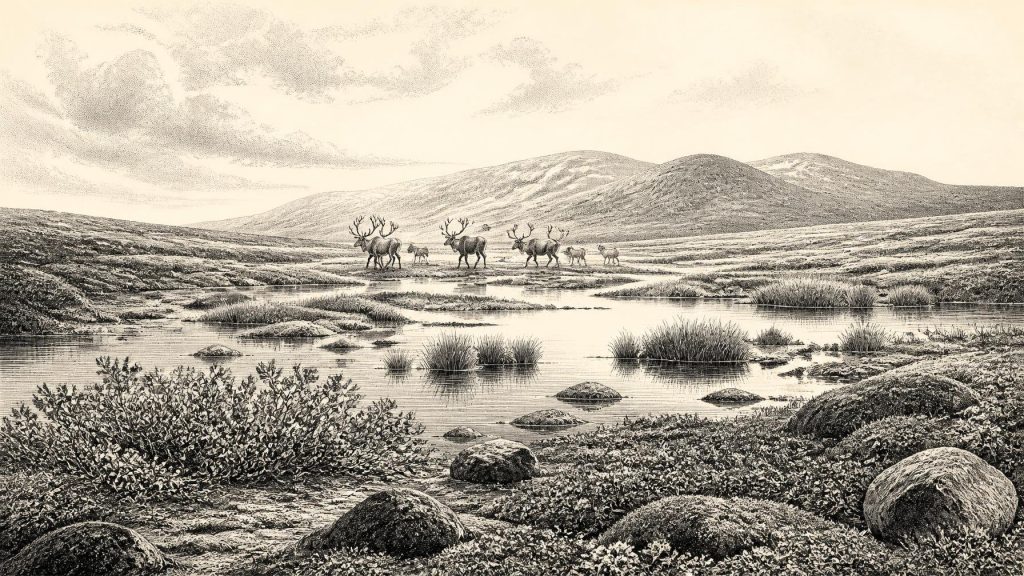
Derryvree’s fossils nevertheless offer an unusually vivid local picture. Plant macrofossils, pollen and insect remains indicate a cold, open, largely treeless setting with freshwater and wet ground. Mosses, sedges, bogbean, water-milfoil, dwarf willow, lesser clubmoss and mountain avens occur among the indicators discussed from the deposit. Such species do not reconstruct a familiar green, wooded Ireland. They point instead towards a periglacial landscape: one strongly shaped by severe cold, frost action, short growing seasons and probably seasonal contrasts.
“Periglacial” should not be imagined as a permanent wall of ice standing immediately beside every pool. It describes terrain affected by conditions associated with glaciation, including frozen or seasonally frozen soils, sparse vegetation and unstable surfaces. At Derryvree, shallow water and marshy margins evidently persisted long enough for organic sediments to form. That is significant evidence that at least some north-central Irish ground was not continuously smothered by glacier ice during the relevant span.
Other deposits in Ulster, including organic horizons at Greenagho, Hollymount and Aghnadarragh, reinforce the broader point that the island’s Ice Age history was not a simple alternation between total ice cover and modern-like countryside. They preserve evidence for changing cold environments between phases of glaciation. Yet their ages and local settings differ. They support regional comparison, not the invention of a single island-wide landscape for 31,728 BCE.
Castlepook and the Animal World
The strongest evidence for large mammals comes from Castlepook Cave, also known as Mammoth Cave, near Doneraile in north County Cork. Its limestone chambers yielded one of Ireland’s richest Pleistocene bone collections during excavations undertaken mainly in the early twentieth century. Later dating and reassessment have shown that its faunal record spans a long portion of the Ice Age, rather than one brief episode. Individual dates range broadly from about 45,700 to 19,950 years BP.
Among the cold-stage animals represented are woolly mammoth, reindeer, giant deer, brown bear, wolf, red fox, Arctic fox, collared lemming, Norwegian lemming and spotted hyaena. The assemblage demonstrates that Ireland was accessible to a varied cold-climate fauna during parts of the period leading towards the Last Glacial Maximum. Reindeer and lemmings are especially useful reminders that the ecological setting could be far more open and northern in character than later Irish landscapes.
But the cave was not a census point. Bones may have been brought in by hyaenas, washed or disturbed by water, moved during earlier excavations, or derived from different deposits and ages. Spotted hyaena in particular may have accumulated carcass remains in the cave. Castlepook therefore supports the presence of these animals in Ireland across a long interval; it does not prove that mammoth, hyaena, reindeer and every smaller species shared the Awbeg Valley in the same decade, still less the same year.
The landscape beyond the cave was also different in scale. Lower global sea levels exposed continental shelf areas now submerged, although local ice loading, changing coastlines and sea level make the exact routes between Ireland, Britain and mainland Europe difficult to reconstruct. The fauna confirms that dispersal occurred when conditions allowed it. It does not establish a simple, continuously dry land bridge available at every point in MIS 3.
The Human Question
Human presence is the most sensitive issue. A reindeer femur from Castlepook, recovered in 1972 and later re-examined, has been reported as approximately 33,000 years old and as bearing a deep modification interpreted by Ruth Carden as a sharp-tool cut or chop associated with carcass processing. If that interpretation is confirmed, it would be extraordinarily important: it could indicate a brief Upper Palaeolithic human visit to Ireland more than 20,000 years before the previously accepted evidence of human activity.
It should not, however, be enlarged into a story of an established Ice Age population. The bone is not accompanied by a securely stratified stone-tool industry, hearth, dwelling, burial, artwork or occupation surface of comparable age. Recent archaeological work at Castlepook has confirmed that Pleistocene deposits survive and merit further investigation, but it has not produced proof of a permanent settlement in the period considered here. The National Museum of Ireland continues to state that clear evidence for humans in Ireland during the Palaeolithic has not yet emerged.
The careful conclusion is thus twofold. The marked reindeer bone is a serious and potentially transformative piece of evidence, deserving continued specialist study of its dating, surface modification and archaeological context. It is not yet a basis for naming a people, describing a camp, assigning territory or claiming continuous occupation. At 31,728 BCE, the archaeological record permits possibility, not a settled human history.
No Polities, No Recorded Beliefs
There is no evidence from Ireland around this time for political institutions, chiefs, kingship, diplomacy, warfare, law or collective identities that can responsibly be described. Nor is there evidence for religious monuments, formal burials, ritual practice, art, language or learning. These absences are not proof that no visiting people possessed beliefs, skills or social relationships; any human group entering Ireland would necessarily have had them. Rather, the Irish evidence does not preserve them in a form that allows historical description.
For the same reason, economy and trade must be treated narrowly. There were no demonstrated farms, fields, livestock, metalwork, exchange networks or built settlements. The most defensible economic interpretation concerns the animal world: herbivores such as reindeer and mammoth could exploit seasonal vegetation, while carnivores and scavengers followed prey or carcasses. If people briefly reached the island, the proposed modification of the Castlepook reindeer bone suggests the practical processing of meat or hide, but one bone cannot reveal a wider subsistence system.
Approaching a Greater Freeze
The larger historical development was environmental change. The Last Glacial Maximum lay ahead rather than precisely at this point: major reconstructions show that the British–Irish Ice Sheet grew and changed configuration over time, with different sectors advancing and retreating differently. By roughly 29,000–12,000 years ago, during MIS 2, extensive parts of Ireland, Britain and their surrounding shelves were covered by kilometre-thick ice. The advance and later erosion of that ice destroyed, displaced or buried many older land surfaces, helping to explain why Ireland’s record of this age is so sparse.
Accordingly, Derryvree’s water-milfoil pollen and wetland silts are historically weightier than any imagined scene of tribal life. They reveal that cold freshwater habitats and hardy plants existed during a window between glacial episodes. Castlepook’s bones show that large mammals entered or occupied parts of Ireland during the wider Ice Age interval. Together they replace an outdated picture of an eternally frozen island with one of environmental fluctuation, local refuges or ice-free ground, and repeated ecological opportunity constrained by severe cold.
Ireland around 31,728 BCE was not yet a country of recorded communities. It was a changing Ice Age landscape whose story survives unevenly in sediments, fossils, cave deposits and the difficult science of dating them. The evidence is enough to establish cold wetlands, open ground, mobile fauna and looming glacial transformation. It is not enough to populate the island with named hunters, conflicts, beliefs or a calendar-bound event. That restraint is not a failure of history; it is the clearest account the evidence permits.
Primary Sources
- A Middle Midlandian Freshwater Series at Derryvree, Maguiresbridge, County Fermanagh, Northern Ireland
- The IntCal20 Northern Hemisphere Radiocarbon Age Calibration Curve (0–55 cal kBP)
- Radiocarbon Constraints on the History of the Western Irish Ice Sheet Prior to the Last Glacial Maximum
- Growth and Retreat of the Last British–Irish Ice Sheet, 31,000 to 15,000 Years Ago: the BRITICE-CHRONO Reconstruction
- A Reconsideration of the Radiocarbon Dating of the Marine Isotope Stage 3 Fauna from Southern Ireland
- The Deglaciation of the Western Sector of the Irish Ice Sheet from the Inner Continental Shelf to its Terrestrial Margin
- Dating Constraints on the Last British-Irish Ice Sheet: a Map and Database
- Pattern and Timing of Retreat of the Last British-Irish Ice Sheet
- Irish Pleistocene Biostratigraphy
- Quaternary Site Descriptions
- Some Aspects of Quaternary Glacial Processes and Karst Formation in Fermanagh
- Prehistoric Details
- Castlepook Cave: County Geological Site Report
- Castlepook Cave, Castlepook South, County Cork: Archaeology Research Excavation Grant 2022
- Occurrence of Mammalia Relicts at Site Castlepook Cave
- The Irish Quaternary Fauna Project
- Pleistocene Vertebrates in the British Isles
- Mammoth Cave
- BSBI: Menyanthes trifoliata
- BSBI: Myriophyllum alterniflorum
- BSBI: Salix herbacea
- BSBI: Dryas octopetala
- BSBI: Selaginella selaginoides
- New Insights on the Fauna of Ireland's Younger Dryas and Early Holocene from Alice & Gwendoline Cave