
The Castlepook Hindleg31691 BCE
31,691 BCE is a modern label for a broad Late Pleistocene interval, not a recoverable Irish date. Evidence from Derryvree indicates locally wet, treeless tundra with cold-adapted plants and insects, while Castlepook Cave preserves a mixed, poorly stratified fauna including reindeer, mammoth and hyaena. A reindeer femur, possibly cut by a stone tool, may indicate brief Upper Palaeolithic human activity, but cannot establish hunting, settlement or continuity. Lower seas altered access, as habitats and ice margins shifted. Subsequent ice expansion likely destroyed evidence. Ireland was an intermittently habitable frontier, understood through uncertain environmental fragments rather than political or social history.
Dateline
“31,691 BCE” is a modern chronological label, not a year that can be recovered from the Irish archaeological record. No people then living in or near Ireland used a calendar of this kind, and the available evidence cannot identify an event in a particular season, let alone a particular year. The responsible frame is therefore broader: this notional date falls in the Late Pleistocene, within Marine Isotope Stage 3, during the later part of the last Ice Age. In Irish terms it lies approximately within a span of c. 35,000–33,000 calibrated years before present, though individual scientific dates retain substantial uncertainty.
There were no states, rulers, written languages, named peoples or diplomatic relations that can be identified in Ireland at this depth of time. The nearest evidence is instead a small and difficult archive of sediments, pollen, plant remains, insects, animal bones, glacial landforms and one especially provocative object: a reindeer femur from Castlepook Cave, near Doneraile in north County Cork. Together these sources reveal a cold and changing north-west European landscape. They do not provide a conventional political history. Their importance lies in showing what Ireland may have offered to animals, and perhaps to occasional human visitors, shortly before the island was overwhelmed by the expanding last ice sheet.
A Calendar Label, Not a Dated Episode
The distinction between radiocarbon years and calendar years matters particularly here. Radiocarbon ages are measured against the conventional present of AD 1950 and must be calibrated because atmospheric carbon levels have varied over time. Beyond the range covered by annually dated tree rings, the resulting calendar estimates are necessarily less fine-grained. A single measurement from an old Irish deposit should not be translated into an exact BC year and then treated as a date on a diary page.
The principal environmental comparison comes from Derryvree, near Maguiresbridge in County Fermanagh. Road works in 1969 exposed freshwater silts and fine sands preserved between two bodies of glacial till beneath a drumlin. Organic material from the deposit produced a determination of 30,500 ± 1,170/1,030 radiocarbon years BP. With calibration and its large uncertainty taken seriously, it illuminates a broad period rather than one moment. It is commonly associated with the Derryvree cold phase, an ice-free interval before the principal late-glacial advance across Ireland.
This is not evidence that Derryvree and Castlepook were occupied or used at precisely the same time. They are separated by more than 300 kilometres, and each record has its own formation history. Yet both belong to the same larger problem: reconstructing an Ireland that was neither the familiar green island of later millennia nor necessarily a uniform sheet of ice. Conditions, ice margins and habitats changed markedly across time and place.
Derryvree’s Wet Tundra
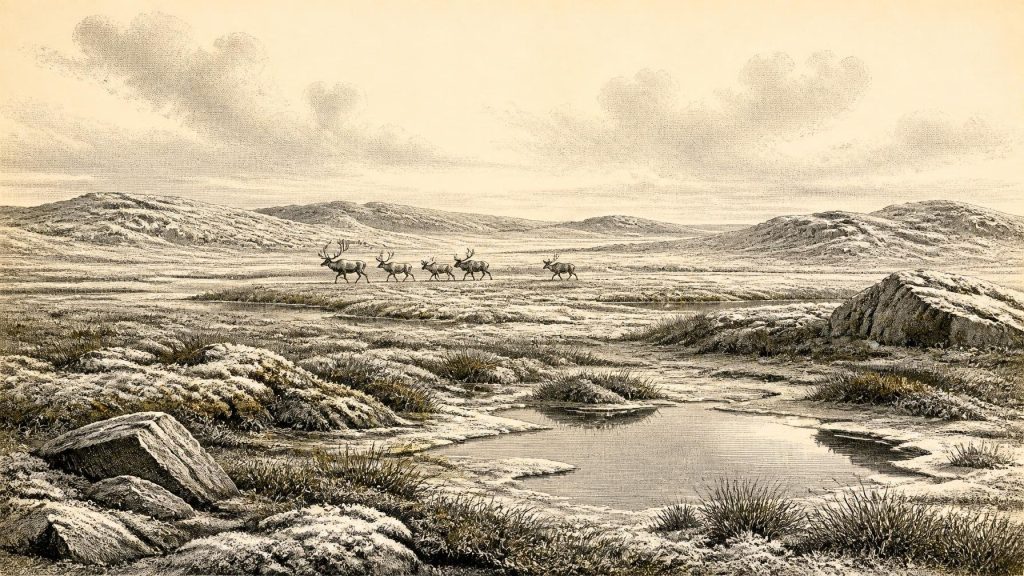
The Derryvree deposit is among the clearest Irish glimpses of the environment available around this broad horizon. Its pollen, plant macrofossils and insect remains point to open, treeless vegetation under periglacial conditions. Mosses, sedges and arctic-alpine plants occurred in wet ground around freshwater. Fossils include dwarf willow, mountain avens and bogbean, species capable of surviving in cold landscapes but requiring particular niches of moisture, shelter or seasonal growth. The old term “muskeg” has sometimes been used for this setting: wet, mossy and sedgy ground, with pools and saturated patches, rather than an uninterrupted dry steppe.
The evidence supports an image of low vegetation, exposed soils, frost action and shallow water in at least part of south Fermanagh. It does not support a claim that the whole island looked identical. Plant pollen can travel, deposits preserve some habitats better than others, and a road-cut section is a local sample. Nevertheless, the lack of woodland indicators in good condition, together with the cold-adapted flora and fauna, makes a wooded Ireland implausible for this interval. Tree cover, settled farmland and the peat bogs familiar today belonged to much later environmental worlds.
Seasonality would have been a governing fact of life for every animal in such country. Long winters, frozen or waterlogged ground, limited winter forage and changing snow cover would shape movements across the landscape. In summer, damp basins and river margins may have offered concentrated plant growth. The terrain was dynamic: erosion, sediment wash, frost heave and advancing or retreating ice could repeatedly alter routes and habitats. “Ireland” is useful as a geographical shorthand, but the coastlines and surrounding seas were not those of the modern island. Lower global sea levels exposed extensive continental-shelf landscapes and reduced, though did not necessarily remove, the difficulty of movement between land areas.
Castlepook and the Animal Record
Castlepook Cave, also called Mammoth Cave or Doneraile Cave, is the key southern Irish faunal archive. Excavations in the early twentieth century recovered a large collection of Pleistocene animal remains, now principally associated with the National Museum of Ireland. Subsequent study and radiocarbon dating showed that the cave assemblage includes animals from more than one phase of the Late Pleistocene. Re-dating published in 2020 demonstrated that several Castlepook specimens were significantly older than earlier measurements had suggested, pushing some of the fauna back into Marine Isotope Stage 3.
That revision is consequential, but it also enforces caution. A cave bone collection is not automatically a snapshot of a single living community. Carnivores may drag remains into caves; water and sediment can redistribute them; scavenging, trampling and excavation may damage surfaces; and antiquarian digging often removed deposits without the stratigraphic recording expected today. Castlepook can therefore demonstrate that particular species reached Ireland during broad phases of the Ice Age, while leaving open whether every animal represented was contemporary with every other one.
Its fauna nevertheless indicates that Ireland was connected ecologically to the wider cold-stage world of north-west Europe. Reindeer are central to the evidence, alongside remains attributed across the cave sequence to animals including woolly mammoth, giant deer, brown bear, wolf, fox, hare, collared lemming and spotted hyaena. This was not an isolated island fauna in the modern sense. It was a fluctuating assemblage of animals able to exploit open ground, cold climates and the changing land-and-water geography of the north Atlantic margin.
Spotted hyaenas are especially revealing. Their presence does not mean an African-style savannah existed in Cork. Ice Age spotted hyaenas ranged much farther north in Europe than their modern descendants. At Castlepook they also offer a practical warning about the bone record: a cave may have served as a carnivore den or a place into which scavenged carcass parts were carried. A limb bone found there need not mark the place where an animal died, was hunted or was first butchered.
The Reindeer Femur
The Castlepook reindeer femur is the archaeological object most directly relevant to this article’s approximate date. It bears a deep linear mark interpreted by zooarchaeologist Ruth Carden as damage made by a sharp stone edge while the bone was fresh. County Cork heritage material has presented the specimen as dating to about 31,000 BC, and public reporting has described it as evidence for the butchery of reindeer by Stone Age hunters roughly 33,000 years ago.
If that interpretation is confirmed, its implications are considerable. It would show that a person used a sharp lithic implement on a reindeer carcass in Ireland during the Upper Palaeolithic, more than twenty millennia before the long-recognised Mesolithic settlement of the post-glacial island. It would make Ireland part of the wider human geography of Late Pleistocene north-western Europe, where mobile hunter-gatherers followed resources through severe and unstable climates.
But the claim must remain properly scaled. The femur dates the animal’s death, not an exact act of cutting. The identification of the incision as a tool mark is a specialist interpretation distinct from the radiocarbon measurement. The bone derives from an old cave collection rather than a modern excavation of an intact floor containing associated tools and hearths. No securely associated Upper Palaeolithic lithic assemblage, fireplace, house site, burial, human bone, ornament or artwork has yet been published from Ireland for this period. Nor can the find tell us whether people killed the reindeer, scavenged it, removed meat, hide, sinew or marrow, or processed the carcass elsewhere before carnivores carried the bone into the cave.
The most defensible conclusion is that brief human activity in Ireland is possible, and that the Castlepook femur may preserve an exceptionally early trace of it. Permanent settlement, continuous occupation and descent from these possible visitors to later Irish communities are not established.
Life Without a Social Record
Because the Irish evidence is so slight, it cannot responsibly sustain claims about political affairs, conflict, diplomacy, kinship systems, language, religion or learning. There is no basis for imagining chiefs, tribes, territorial borders or organised warfare in Ireland around this date. Equally, there is no Irish evidence for ceremonial monuments, cave art, formal burial, trade goods or religious practice. The sophisticated art and technologies known from Upper Palaeolithic Europe provide a useful comparative setting, but they cannot be transferred to Ireland as if absence of evidence were proof of their presence.
If people entered the island, their economy was almost certainly based on immediate knowledge of animal movements, plant resources, weather and safe passage through a difficult landscape. A reindeer carcass could provide meat, fat, marrow, hide, sinew and bone: resources with potential value to mobile hunter-gatherers. That is an inference from the animal and from wider Upper Palaeolithic practice, not a direct description of a Castlepook camp. There is no sound evidence for farming, herding, pottery, metalworking, permanent houses or long-distance exchange networks centred on Ireland.
An Island Before the Ice
The larger development around the notional year 31,691 BCE was environmental change. Reconstructions of the British–Irish Ice Sheet show growth and reorganisation before its later maximum, while also acknowledging major gaps in dating control. By c. 27,000–23,000 years BP, ice reached much more extensive limits and covered Ireland and large areas of its continental shelf. Around the earlier interval considered here, however, the evidence allows for ice-free refuges and cold open habitats in some areas, alongside growing ice masses and local upland glaciation.
That precarious setting explains both the importance and the fragility of the record. The later ice sheet scoured landscapes, moved sediments and destroyed or buried many sites that might once have preserved human traces. The absence of known camps is therefore not proof that no person ever arrived; neither does one marked bone establish a populous or enduring occupation. Ireland at this time is best understood as an intermittently habitable Ice Age frontier: a place of wet tundra, mobile herds, carnivores and advancing ice, known to archaeology through fragments that demand restraint as much as imagination.
Primary Sources
- A Middle Midlandian Freshwater Series at Derryvree, Maguiresbridge, County Fermanagh, Northern Ireland
- The Irish Quaternary Fauna Project
- A Reconsideration of the Radiocarbon Dating of the Marine Isotope Stage 3 Fauna from Southern Ireland
- Growth and Retreat of the Last British–Irish Ice Sheet, 31,000 to 15,000 Years Ago: the BRITICE-CHRONO Reconstruction
- The Timing and Magnitude of the British–Irish Ice Sheet Between Marine Isotope Stages 5d and 2: Implications for Glacio-Isostatic Adjustment, High Relative Sea Levels and ‘Giant Erratic’ Emplacement
- Dimensions and Chronology of the Last Ice Sheet in Western Ireland
- Trimlines, Blockfields and the Vertical Extent of the Last Ice Sheet in Southern Ireland
- Timing and Pace of Ice-Sheet Withdrawal Across the Marine–Terrestrial Transition West of Ireland During the Last Glaciation
- Early Deglaciation of Western Ireland and Implications for the Extent, Timing and Impact of the Last British-Irish Ice Sheet
- Stratigraphic and Palaeo-Geomorphological Evidence for the Glacial-Deglacial History of the Last British-Irish Ice Sheet in the North-Western Irish Sea
- Advance and Retreat of the Marine-Terminating Irish Sea Ice Stream into the Celtic Sea During the Last Glacial: Timing and Maximum Extent
- Radiocarbon Constraints on the Age of the Maximum Advance of the British–Irish Ice Sheet in the Celtic Sea
- Ireland: Submerged Prehistoric Sites and Landscapes
- The Colonization of Ireland: A Human Ecology Perspective
- New Insights on the Fauna of Ireland’s Younger Dryas and Early Holocene from Alice & Gwendoline Cave
- The IntCal20 Northern Hemisphere Radiocarbon Age Calibration Curve (0–55 cal kBP)
- Radiocarbon Dating and Chronological Modelling
- Palaeoecology
- The Subdivision of the Quaternary Period in Ireland
- Spotted Hyena Skull
- Heritage Artefacts of County Cork
- UCD School of Archaeology Research Day 2022
- Irish Caves Database: Mammoth Cave
- Reindeer Bone Found in Cork Cave Shows Human Activity in Ireland 33,000 Years Ago