
Castlepook’s Mammoth Country31548 BCE
31,548 BCE is a modern label within a broad, uncertain Late Ice Age horizon, not a recoverable Irish year. Derryvree, County Fermanagh, preserves freshwater sediments between glacial tills, indicating a temporary ice-free, treeless tundra wetland during Marine Isotope Stage 3. Castlepook Cave, County Cork, contains rich but disturbed animal remains, including mammoth, reindeer, giant deer, bear and hyaena, showing intermittent connections with north-western European fauna. A marked reindeer bone may indicate Upper Palaeolithic butchery, but cannot prove settlement. Ireland remained cold, environmentally variable and sparsely evidenced before major ice expansion later reshaped its landscapes and obscured earlier traces from view.
Dateline
31,548 BCE is a modern calendar label, not a year that can be recovered from Ireland’s prehistoric record. No writing, named rulers, settlements with annual chronologies, or environmental sequence resolved to twelve-month precision survives from this depth of time. In the archaeological convention in which “present” is AD 1950, the label falls roughly 33,500 years before present. That arithmetic is useful for placing it on a timeline, but it is not a radiocarbon result. The responsible historical setting is the later part of Marine Isotope Stage 3, within Ireland’s Midlandian cold stage: a fluctuating interval of the last Ice Age, long before the later maximum expansion of the British–Irish Ice Sheet.
What can be said is necessarily regional and probabilistic. Organic sediments beneath a drumlin at Derryvree, near Maguiresbridge in County Fermanagh, and animal remains from Castlepook Cave near Doneraile in County Cork, provide important but very different windows onto Ireland in broadly this era. They do not supply a national snapshot, still less an event for one year. Together, however, they show that parts of Ireland supported cold-adapted plants and animals during intervals before the Last Glacial Maximum, and that the island’s relationship with ice, sea and neighbouring lands was changing.
A Date Range, Not a Chronicle
Radiocarbon ages cannot simply be read as calendar dates. The amount of radioactive carbon in the atmosphere has altered through time, so a laboratory measurement must be calibrated against independently dated records. The current IntCal20 Northern Hemisphere curve reaches back to 55,000 calibrated years before present, but its older sections combine several kinds of evidence and retain substantial uncertainty. At around 33,500 years before present, an individual determination may translate into a broad and sometimes irregular calendar range. It cannot normally identify a single season, let alone a named year.
This matters particularly in Ireland, where evidence is sparse and later glaciation destroyed, buried or rearranged much of what might once have survived. A year such as 31,548 BCE should therefore be treated as a point within a wide chronological horizon. It belongs generally to a time when climatic shifts were abrupt by geological standards, sea levels were much lower than today, and local landscapes could differ greatly in their exposure to frost, water, vegetation and ice. It does not permit claims about the weather across the island, a migration on a particular route, or the presence of a permanent human community.
Freshwater Under Fermanagh Ice
The clearest Irish environmental record relevant to this horizon was exposed by roadworks in 1969 at Derryvree. Excavators cut through a drumlin and found freshwater silts and fine sands, including organic material, sealed between two layers of till. Till is sediment deposited directly by glacial ice. The sequence establishes a powerful relative history: ice laid down the lower till; a non-glacial interval followed, during which waterborne sediment and organic matter accumulated; and later ice covered the deposits with another till. The freshwater bed was consequently preserved beneath a landform created and modified by glaciation.
Organic material from the Derryvree sequence produced a conventional radiocarbon age of about 30,500 ± 1,100 radiocarbon years BP. With calibration, discussion of the deposit has placed it broadly within the later part of MIS 3, approximately 36,900–31,700 calibrated years BP. The modern label 31,548 BCE lies near and just beyond the younger edge of that often cited broad range depending on the conversion used, so it must not be presented as dating the pool, its plants or its animals to that exact year. Its importance is environmental rather than calendrical: it demonstrates an ice-free interval in this part of Fermanagh before a later advance of glacier ice.
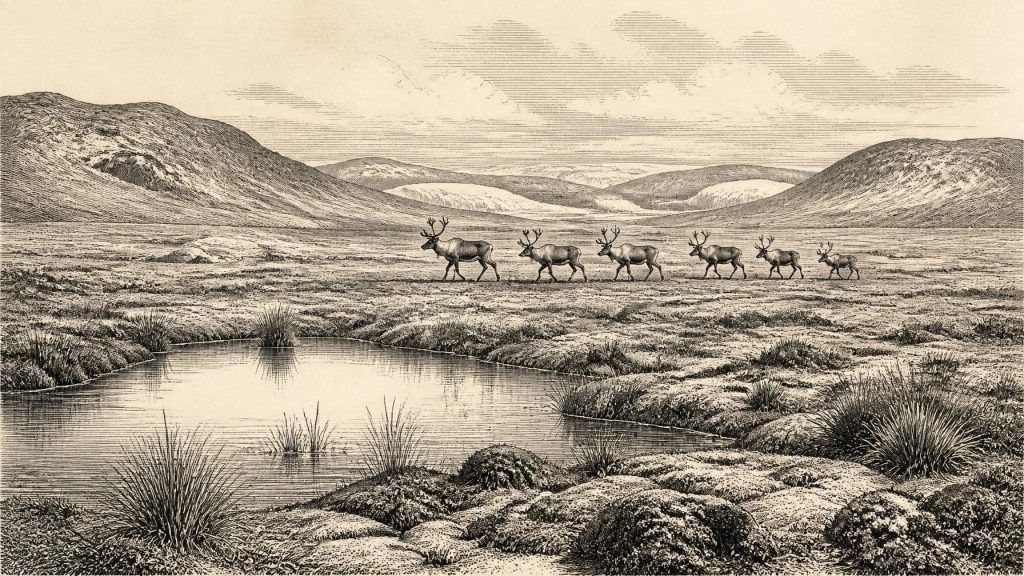
Pollen was poorly preserved, but plant macrofossils, mosses and insect remains indicated open, treeless tundra or muskeg-like wetland. Sedges, mosses, bogbean and other plants suited to wet ground grew around shallow freshwater. The assemblage suggests a periglacial landscape, shaped by severe cold and seasonal freezing, rather than a woodland comparable to later prehistoric or modern Ireland. Even where drier ground existed, vegetation was probably thin and discontinuous. Yet Derryvree was not sterile: pools, saturated soils, plants and invertebrates formed a functioning local ecosystem.
The lesson is also one of restraint. Derryvree is one unusually preserved locality, not a map of the whole island. It cannot prove that Cork, Connacht, Leinster and Ulster shared identical conditions at the same moment. Nor does the presence of freshwater deposits mean mild weather. It records an environmental opening between episodes of glaciation in a cold world where exposed terrain, frozen ground and unstable drainage were likely common.
Animals in the Limestone Country
Castlepook Cave, also called Mammoth Cave, offers the other major body of evidence. Its complicated limestone passages near Doneraile have produced more than 2,000 vertebrate remains and are Ireland’s richest known source for fauna of the period leading towards the Last Glacial Maximum. The collection includes woolly mammoth, reindeer, giant deer, brown bear and spotted hyaena, as well as, in later parts of the Ice Age record, wolf, Arctic fox, mountain hare and lemmings. These animals do not all belong to one living community or one narrow date. The cave accumulated bones over a long period, while water movement, carnivore activity and early excavation disturbed the original contexts.
Nonetheless, direct dating shows that cold-stage mammals reached Ireland repeatedly during MIS 3. The Irish Quaternary Fauna Project concluded that a wide range of mammals colonised the island between at least about 45,000 and 20,000 years ago. Subsequent re-dating has revised some older measurements and reinforced the need to assess each specimen rather than treating a cave collection as a single deposit. For the broad period around 31,548 BCE, Castlepook supports the conclusion that reindeer and other large mammals could occupy, or at least pass through, parts of southern Ireland in a cold, open environment.
Spotted hyaena are especially significant. Castlepook is the only known Irish site with their remains, and hyaenas were capable of carrying bones into dens and modifying them while feeding. Their presence warns against an easy equation between a bone in a cave and a human hunting camp. Mammoths, too, should not be imagined as evidence of a vast herd permanently resident beside the cave. Fossils establish that a species occurred in Ireland during a broad span; they do not reveal the size, duration or seasonality of its local population. Still, the combined fauna evokes an Irish landscape connected, at intervals, to the wider animal world of north-western Europe.
The Human Question
A reindeer femur from the Castlepook collection has made this period especially important for Irish archaeology. Re-examined by zooarchaeologist Ruth Carden, the fragment was reported in 2021 as roughly 33,000 years old and as bearing a deep mark interpreted as the work of a stone tool during butchery. If that interpretation is sustained, it would be evidence that one or more Upper Palaeolithic people processed a reindeer in Ireland far earlier than the long-accepted evidence for human presence after the last ice.
Its potential importance should not obscure its limitations. The bone derives from an old cave collection, not from a newly excavated, tightly dated occupation surface. No associated hearth, lithic assemblage, dwelling, burial, art or repeated settlement layer securely demonstrates a resident population at this date. Natural damage, carnivore action and the history of recovery all make microscopic assessment and contextual control crucial. The modified femur is best described as a compelling but still limited indication of possible human activity, rather than proof of an established Irish society.
If people did reach Ireland in this interval, they were almost certainly highly mobile hunter-gatherers, not inhabitants of villages, farms or territories with known boundaries. This is an inference from the wider European Upper Palaeolithic, not a fact demonstrated by a settlement in Ireland. Reindeer could have offered meat, fat, marrow, hides, sinew and bone; knowledge of animal movement, shelter and fuel would have been essential. But one marked bone cannot show whether people hunted the animal, found a carcass, processed it at the cave, camped nearby or crossed the region only briefly.
No Polities, No Recorded Beliefs
There is no evidence for political institutions, diplomacy, war, formal trade networks, named groups or religious practice in Ireland at this point. It would be misleading to impose later ideas of tribes, chieftains or national territory on a landscape whose human presence is itself uncertain. Equally, there is no basis for identifying ritual at Castlepook or Derryvree. Caves can acquire ceremonial meanings in later societies, but here they are primarily geological traps and repositories whose deposits preserve faunal and environmental evidence.
Culture and learning can be discussed only conditionally. Any human visitors would have possessed sophisticated practical knowledge: how to move through cold terrain, work stone, read tracks, manage fire and co-operate in small groups. Such capacities are well established among Upper Palaeolithic peoples elsewhere in Europe. Ireland, however, has not yielded securely associated tools or artworks from this horizon, so none can responsibly be assigned to it. The historical record is one of possibility at the edge of visibility, not of a documented cultural tradition.
Approaching the Great Freeze
The Last Glacial Maximum still lay ahead. Research on the British–Irish Ice Sheet places its major maximum extent broadly after 30,000 years ago, with Irish and Irish Sea ice becoming far more extensive around 25,000–23,000 calibrated years BP and with the global cold maximum spanning a wider interval. Later ice would scour and reshape much of the island, advance across the surrounding shelf and help account for the fragmentary survival of earlier evidence. The familiar drumlin country of Fermanagh is itself part of that longer history of ice movement and deposition.
Thus Ireland around the modern label 31,548 BCE was neither a settled island nor simply an unbroken sheet of ice. The strongest evidence points to a dynamic, cold-stage geography: ice-free freshwater ground in at least part of Fermanagh during a broadly relevant interval; open vegetation; large mammals recorded in southern cave deposits; and uncertain, tantalising signs that human hunters may have entered the island. The defining fact is not a dated event but the fragility of the evidence itself. Ireland’s earliest recoverable story survives in silts beneath till, bones in limestone darkness and the calibrated ranges through which scientists cautiously connect them.
Primary Sources
- The IntCal20 Northern Hemisphere Radiocarbon Age Calibration Curve (0–55 cal kBP)
- IntCal
- A Middle Midlandian Freshwater Series at Derryvree, Maguiresbridge, County Fermanagh, Northern Ireland
- Palaeoecology
- Figure 6.— The Subdivision of the Quaternary Period in Ireland
- The Irish Quaternary Fauna Project
- A Reconsideration of the Radiocarbon Dating of the Marine Isotope Stage 3 Fauna from Southern Ireland
- Castlepook Cave: County Geological Site Report
- Heritage Artefacts of County Cork
- Archaeological Heritage of County Cork
- Archaeology Research Excavation Grant 2022: Castlepook Cave Project Final Report
- 2022:564 – Castlepook Cave, Castlepook South, Cork
- The Timing and Magnitude of the British–Irish Ice Sheet Between Marine Isotope Stages 5d and 2
- Trimlines, Blockfields and the Vertical Extent of the Last Ice Sheet in Southern Ireland
- Stratigraphic and Palaeo-Geomorphological Evidence for the Glacial-Deglacial History of the Last British-Irish Ice Sheet in the North-Western Irish Sea
- Deglaciation, Earth Crustal Behaviour and Sea-Level Changes in the Determination of Insularity: A Perspective from Ireland
- Maximum Extent and Dynamic Behaviour of the Last British–Irish Ice Sheet West of Ireland
- Oscillating Retreat of the Last British-Irish Ice Sheet on the Continental Shelf Offshore Galway Bay, Western Ireland
- Phylogeographic, Ancient DNA, Fossil and Morphometric Analyses Reveal Ancient and Modern Introductions of a Large Mammal: The Complex Case of Red Deer in Ireland
- First Evidence of a Late Upper Palaeolithic Human Presence in Ireland
- New Insights on the Fauna of Ireland’s Younger Dryas and Early Holocene from Alice & Gwendoline Cave
- Ireland: Submerged Prehistoric Sites and Landscapes