
Castlepook’s Reindeer Question31581 BCE
Around 31,581 BCE, Ireland lay in Marine Isotope Stage 3, an unstable Last Ice Age interval known only through environmental evidence rather than annual history. Derryvree sediments in Fermanagh indicate an ice-free freshwater tundra landscape, with sedges, mosses, aquatic plants and sparse cold-adapted vegetation. Elsewhere, glaciers and ice centres were expanding, while lowered sea levels altered coasts and routes. Castlepook Cave in Cork preserves diverse fauna, including reindeer, mammoth, giant deer, predators and lemmings, although deposits span time and processes. A possibly tool-made reindeer-bone incision suggests brief human activity, but remains contested and proves neither permanent settlement nor continuous occupation.
Dateline
Modern calendar-year precision is not available for Ireland in 31,581 BCE. The number is best treated as a convenient point within deep prehistory: roughly 33,531 calibrated years before AD 1950 (cal BP), during Marine Isotope Stage 3, a climatically unstable part of the last Ice Age. No contemporary Irish calendar, writing, settlement sequence or event record exists. What can responsibly be said comes from radiocarbon dates, cave bones, buried wetland sediments, pollen and plant remains, geological strata, and reconstructions of the British–Irish Ice Sheet. These sources give ranges, not an annal for a single year.
A Date Within a Range
The most useful local chronological bracket is provided by the organic silts found beneath a drumlin at Derryvree, near Maguiresbridge in County Fermanagh. Excavated from between two distinct till sheets, the deposits produced the radiocarbon measurement Birm-166, 30,500 radiocarbon years BP, with a substantial uncertainty. Later calibration places its likely calendar age broadly between about 31,700 and 36,900 cal BP. Thus 31,581 BCE falls within the wide interval represented by this remarkable deposit, but it cannot be assigned to a particular season, generation, or even century within it.
That distinction matters. Radiocarbon years are not calendar years, because the atmospheric proportion of radioactive carbon has varied through time. Calibration curves translate a laboratory result into probabilities across a calendar range; the farther back one goes, the less reasonable it becomes to turn the result into a sharply dated historical scene. Ireland at this point therefore belongs to palaeoenvironmental history rather than conventional year-by-year history.
Derryvree’s Treeless Wetland
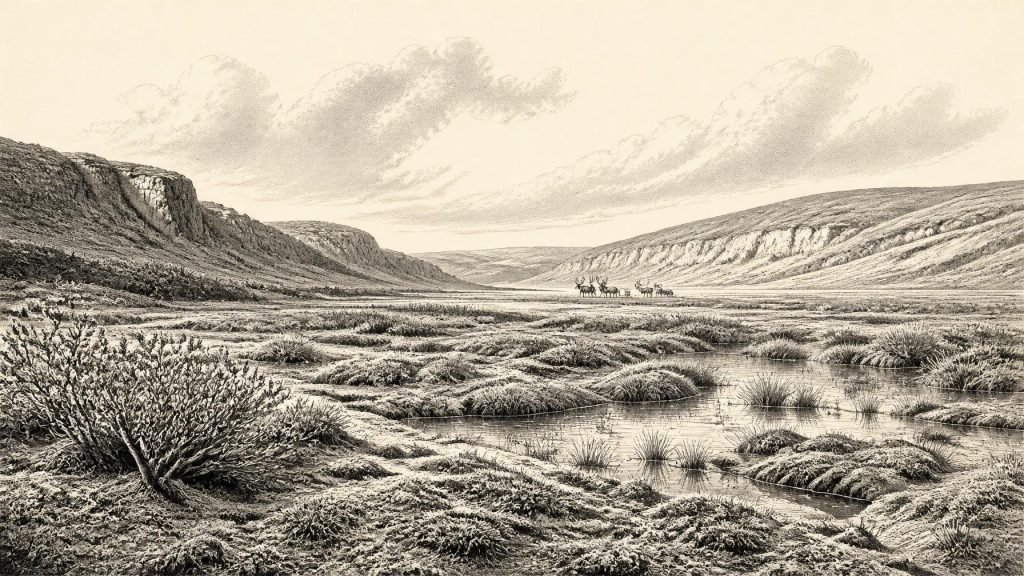
Derryvree nevertheless offers unusually direct evidence for an Irish landscape around this broad period. The silts and fine sands held seeds, mosses, pollen and small animal remains from a freshwater setting. Their assemblage indicates open tundra or tundra-steppe vegetation under a periglacial regime: a cold landscape shaped by repeated freezing and thawing, rather than a wooded island of the later Holocene. Sedges and mosses grew in wet ground; bogbean, water-milfoil and other aquatic or waterside plants indicate pools or slow water. Dwarf willow, mountain avens and other cold-adapted plants point to sparse vegetation beyond the water’s edge.
This was not simply a featureless snowfield. In the ice-free interval recorded at Derryvree, water, soil, plants and insects supported a low but varied biological productivity. The setting may be pictured as a mosaic of wet hollows, sedge-rich ground, patches of herbaceous vegetation and bare or frost-disturbed surfaces. The exact mix altered with local drainage, season and climate. Trees were absent or extremely scarce: the evidence is for a cold, open country, not for the oak-and-hazel woodland usually associated with prehistoric Ireland.
The deposits are also a warning against imagining that the entire island always shared one condition. At 33,000-odd years ago, climate shifted abruptly on North Atlantic and Greenland timescales, while ice masses advanced and retreated unevenly. An ice-free freshwater environment in Fermanagh does not prove that every Irish region was ice-free at once. Conversely, it demonstrates that the later, near-island-wide glaciation was not the unchanging backdrop to all of the last Ice Age.
Ice Building Around Ireland
In geological terminology this belongs to the Midlandian glaciation, Ireland’s part of the Late Pleistocene cold stage. The ultimate maximum of the British–Irish Ice Sheet lay later, principally between about 27,000 and 19,000 cal BP in Ireland, though its marine margins did not all reach their greatest extent at the same moment. Large ice masses would subsequently override or bury much earlier ground surface, explaining why survival of deposits such as Derryvree is exceptional.
For 31,581 BCE, researchers must balance local sediment evidence against regional ice-sheet modelling and offshore records. Some models reconstruct expanding ice caps in upland Ireland and increasingly extensive ice around the north-west Atlantic margins during this phase. Yet the Derryvree organic bed records ice-free conditions in its locality during the broad calibrated interval. The sound conclusion is not a definitive map for one numbered year, but a changing archipelago of cold landscapes: exposed ground and freshwater basins in some places, glaciers and growing ice centres in others, all within a wider system moving towards more severe glaciation.
Sea level was far lower than today because immense quantities of water were held in continental ice. The outlines of coasts and shallow seas consequently differed greatly from modern maps. But low sea level should not automatically be converted into a simple land bridge from Ireland to Britain. The geography of the Irish Sea, the distribution of ice, and the availability of passable terrain varied over time. Animal movement into Ireland is demonstrated by fossils; the precise routes by which every animal, and any human visitor, travelled remain uncertain.
Castlepook’s Animal Archive
The most vivid evidence from southern Ireland comes from Castlepook Cave, also called Mammoth Cave, near Doneraile in north County Cork. Early twentieth-century excavations recovered a rich collection of Pleistocene animal bones from its limestone passages. Subsequent dating and reassessment show that at least part of the assemblage belongs to Marine Isotope Stage 3, well before the Last Glacial Maximum. It includes, across its complex deposits, remains attributed to reindeer, giant deer, mammoth, brown bear, spotted hyaena, wolf, foxes, mountain hare, stoat and lemmings.
These bones do not form a neat census of animals living together on one day. Caves accumulate material through many processes: animals die in them, carnivores drag in prey, water redeposits bones, and earlier excavators disturb sediments. The historical Castlepook digs removed much material before modern excavation standards were established. Accordingly, the assemblage securely shows that an unexpectedly diverse large-mammal fauna reached Ireland during parts of the late Ice Age; it cannot, by itself, establish the exact composition of the landscape in 31,581 BCE.
Even so, the fauna and Derryvree’s flora complement one another. Reindeer, lemmings and arctic fox fit a cold, largely open environment. Mammoth and giant deer suggest that some Irish districts could support large grazing or browsing mammals when vegetation, season and access allowed. Hyaena and wolf show that predators as well as prey were present. Their presence makes clear that Ice Age Ireland was not biologically empty before the later ice maximum. It was a place of episodically viable habitats, though far harsher and less stable than the modern island.
The Mark on a Reindeer Bone
Castlepook has become especially important because a reindeer femur from the old collection has been reported as bearing a deep incision interpreted by zooarchaeologist Ruth Carden as a cut or chop made with a sharp stone edge during carcass processing. Public accounts and County Cork heritage material associate the object with about 31,000 BC, while renewed dating of Castlepook fauna has demonstrated the antiquity of several animal remains. If the interpretation of the mark is upheld, the bone would be evidence that people handled a reindeer in Ireland tens of millennia before the first long-recognised Mesolithic settlements.
That conditional wording is essential. A date on the bone establishes the age of the animal, not automatically the age or cause of every mark on its surface. Nor was the femur recovered from a recently excavated, intact occupation floor. No securely associated hearth, lithic tool assemblage, dwelling, human burial, artwork or repeatedly used butchery place of comparable age has yet been identified at Castlepook. Recent work at the cave has deliberately sought undisturbed deposits and further evidence precisely because the question is significant and unresolved.
It would be irresponsible either to dismiss the femur without examination or to turn one possible butchery mark into a story of a settled Ice Age people. The most that can presently be inferred is a possible, very slight human footprint: perhaps a brief visit, hunting or scavenging episode, in which a sharp stone implement was used on fresh bone. It does not demonstrate a permanent population, a named culture, a language, ancestry, or continuous occupation of Ireland.
No Polities, No Proven Settlements
For this reason the ordinary headings of political history mostly have no evidence beneath them. There is no basis for identifying political authorities, diplomacy, warfare, territorial borders, leaders, laws or institutions in Ireland at this date. There is likewise no evidence for farms, trade systems, built settlements, formal religion, monuments, writing or schools. Such absences should be stated plainly rather than filled with plausible-sounding invention.
If people did enter Ireland during this cold interval, their economy would have depended on immediate knowledge of animals, stone, weather and seasonal movement. That is a general inference from Upper Palaeolithic lifeways elsewhere in north-west Europe, not a documented Irish social system. The Castlepook evidence does not tell us whether visitors travelled in a small party, how long they remained, what tools they carried beyond the possible sharp edge implied by the cut, or whether they returned.
An Island Before Its Human History
The clearest historical significance of 31,581 BCE is therefore ecological and methodological. Ireland was passing through one of the last Ice Age’s unstable cold phases. Fermanagh preserves evidence of an open freshwater tundra landscape; Cork caves preserve traces of animals whose descendants would not form part of Ireland’s later fauna; expanding ice was beginning to reshape routes, habitats and the chances of survival. These are firm, though uneven, lines of evidence.
The human story remains much thinner. Ireland’s National Museum still rightly stresses the absence of clear, conventional Palaeolithic occupation evidence, while the Castlepook reindeer femur has opened a serious new possibility that demands more testing. By contrast, substantial evidence for settlement begins much later, with Mesolithic hunter-gatherers after the final great ice retreat. At this deep date, the responsible history is not of tribes or events, but of cold water, mobile animals, advancing ice and a single contested mark that may eventually alter the beginning of Ireland’s human past.
Primary Sources
- A Middle Midlandian Freshwater Series at Derryvree, Maguiresbridge, County Fermanagh, Northern Ireland
- Irish Pleistocene Biostratigraphy
- The Irish Quaternary Fauna Project
- A Reconsideration of the Radiocarbon Dating of the Marine Isotope Stage 3 Fauna from Southern Ireland
- Episodic Speleothem Deposition Tracks the Terrestrial Impact of Millennial-Scale Last Glacial Climate Variability in SW Ireland
- Growth and Retreat of the Last British–Irish Ice Sheet, 31,000 to 15,000 Years Ago: the BRITICE-CHRONO Reconstruction
- Early Deglaciation of the British-Irish Ice Sheet on the Atlantic Shelf Northwest of Ireland Driven by Glacioisostatic Depression and High Relative Sea Level
- Dynamic Cycles, Ice Streams and Their Impact on the Extent, Chronology and Deglaciation of the British–Irish Ice Sheet
- New Data for the Last Glacial Maximum in Great Britain and Ireland
- Pattern and Timing of Retreat of the Last British–Irish Ice Sheet
- Maximum Extent and Dynamic Behaviour of the Last British–Irish Ice Sheet West of Ireland
- First Evidence of a Late Upper Palaeolithic Human Presence in Ireland
- New Insights on the Fauna of Ireland's Younger Dryas and Early Holocene from Alice & Gwendoline Cave
- Prehistoric Details
- Guide to the National Museum of Ireland
- Prehistory
- Archaeology Research Excavation Grant 2022
- 32564: Castlepook Cave, Ballyhooly, Cork
- Heritage Artefacts of County Cork
- Occurrence of Mammalia Relicts at Site Castlepook Cave
- Mammoth Cave, Castlepook
- Composition and Consequences of the IntCal20 Radiocarbon Calibration Curve
- IntCal: International Radiocarbon Calibration