Tundra Vegetation31486 BCE
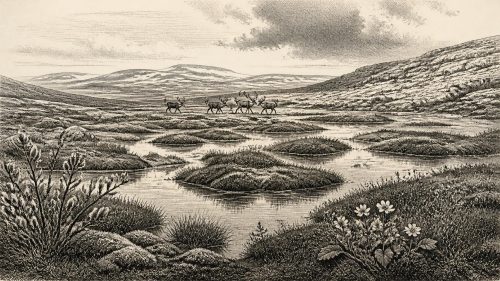
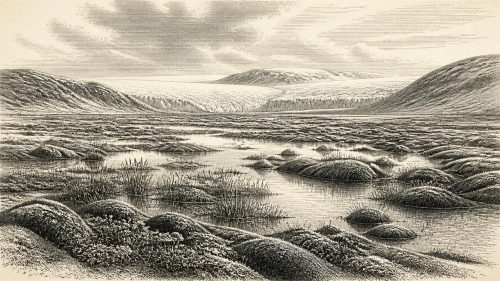
Around 31,486 BCE, Ireland cannot be described through conventional history, as no calendar, writing, polity or dated events existed. Derryvree, County Fermanagh, preserves freshwater sediments between glacial tills, broadly dated to the later 30,000s–early 30,000s calibrated BP. Fossil plants and insects reveal open, wet tundra with mosses, sedges, dwarf willow, mountain avens and bogbean during an ice-free interval. Climatic instability and growing glaciers preceded the Last Glacial Maximum. Cave remains indicate diverse cold-adapted fauna, but accumulated over long periods. A cut-marked Castlepook reindeer bone may suggest transient human presence, yet cannot establish settlement. Evidence supports cautious environmental reconstruction, not history.
Dateline
“31,486 BCE” is a useful label in a chronological series, but it cannot describe an Irish year in the ordinary historical sense. There was no calendar, writing, named polity or recorded event from which a dated narrative could be made. In radiocarbon practice, the year falls roughly 33,436 years before AD 1950, within the Late Pleistocene and Marine Isotope Stage 3 (MIS 3), a long, climatically volatile part of the last Ice Age. Modern calendar-year precision is unavailable. The responsible evidence consists of sediment layers, fossil plants and insects, animal bones, cave deposits and scientific dates expressed as ranges with sizeable uncertainty.
The closest important Irish environmental archive is at Derryvree, near Maguiresbridge in present-day County Fermanagh. In 1969, roadworks cut through a drumlin and revealed organic freshwater silts and fine sands sandwiched between two thick layers of till: the stony, unsorted sediment deposited by glacier ice. The sequence records an earlier glaciation, an interval in which water and organic matter accumulated at the site, and a later advance that buried the deposit beneath fresh till. Its best-known radiocarbon determination, Birm-166, was 30,500 radiocarbon years BP, with a substantial error margin. When considered with modern calibration, the deposit belongs broadly within the later 30,000s to early 30,000s calibrated years BP, often expressed approximately as 36,900–31,700 cal BP, or about 34,950–29,750 BCE. The requested year lies within that broad window, not at an identifiable point in its sequence.
Freshwater Between Glaciers
Derryvree’s importance is that it preserves a local landscape which later ice almost entirely concealed. Its fine sediments accumulated in or beside quiet freshwater: a pool, marshy hollow or sluggish watercourse, rather than on an exposed glacier surface. Pollen, plant macrofossils, mosses and insects recovered from the beds indicate open tundra vegetation and a periglacial regime. Periglacial does not simply mean snowy. It describes terrain strongly shaped by frost, seasonal freezing and thawing, unstable drainage and sparse vegetation, while remaining locally free of glacier ice.
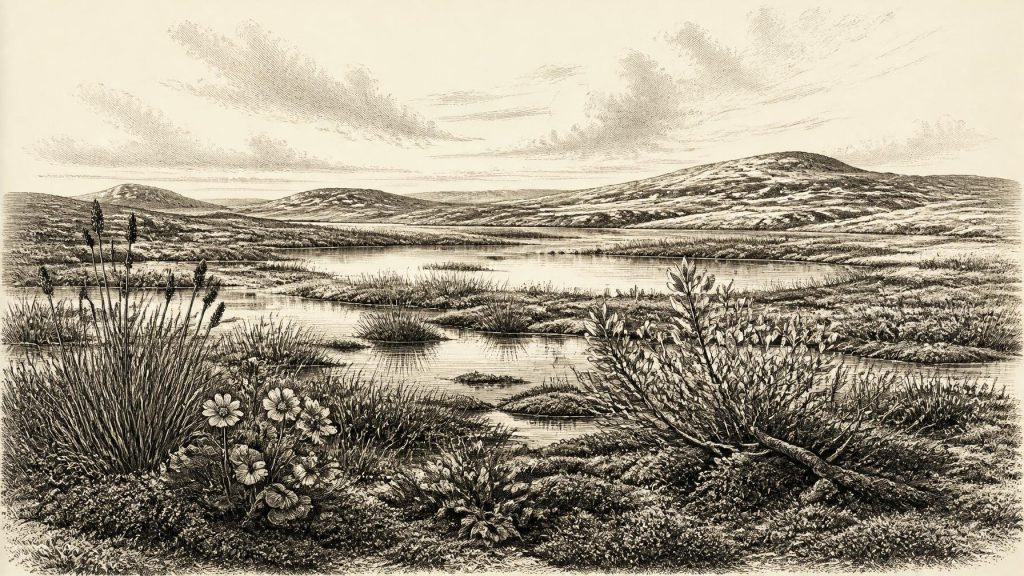
The evidence suggests wet hollows and shallow pools bordered by mosses, sedges, grasses, herbs and low shrubs. Fossils include bogbean (Menyanthes trifoliata), an aquatic plant of marsh and pool margins; dwarf willow (Salix herbacea); and mountain avens (Dryas octopetala), plants associated with cold, open environments. Their presence does not allow a painting of every slope or season, but it decisively rules out the familiar later Irish landscape of dense woodland, enclosed fields and extensive peat bog. The original investigators characterised the setting as tundra or muskeg: damp, plant-rich ground with open water, mossy margins and severe climatic constraints.
This was therefore not necessarily a blank white wilderness. During the growing season, sheltered wet ground could be biologically productive. Insects lived among emergent vegetation; plants colonised saturated soils; and grazing animals could have found forage in suitable patches. Yet that productivity was seasonal and precarious. Cold winters, wind exposure, frost-shattered ground and permafrost-like conditions would have limited tree growth, altered water movement and made the landscape difficult for large animals as well as people. Derryvree documents a functioning ecosystem, but not an easy or stable homeland.
An Island in a Changing Ice-Age World
The wider climatic setting was unstable. Greenland ice cores show that MIS 3 was punctuated by abrupt cold and warmer phases across the North Atlantic region. Ireland’s glacial record reflects the local consequences of such change: glaciers advanced, retreated or reorganised; rivers shifted; vegetation altered; and habitats opened or disappeared. It would be unsafe, however, to assign the Derryvree layers, or 31,486 BCE itself, to one particular named Greenland event. The radiocarbon range is too broad, and a northern Irish wetland cannot be assumed to respond at the same instant as an ice-core signal thousands of kilometres away.
Nor should this date be confused with the Last Glacial Maximum, the period when the British–Irish Ice Sheet reached its greatest known extent, broadly after about 27,000 cal BP and especially around 27,000–23,000 cal BP in many reconstructions. At 31,486 BCE, that full expansion still lay ahead. Geological research nevertheless shows that ice growth was already under way and spatially complex. Some uplands and northern sectors may have nourished glaciers while other districts preserved ice-free ground. Derryvree supplies direct evidence for such a local ice-free interval in Fermanagh before later ice overran the area.
Sea level was far lower than today because immense quantities of water were locked in continental ice. Ireland’s surrounding shelf consequently formed a substantially different landscape, though its exact coastlines and possible routes cannot be reconstructed with year-by-year confidence. At this earlier point, the island’s relationship to Britain and the European mainland remains more uncertain than popular maps often imply. Lower sea level did not automatically create a simple dry land bridge across every channel; glaciers, cold seas, tidal waters and changing relief also mattered. Any journey into Ireland would have occurred in a demanding and shifting north-west European setting.
Animals, Caves and a Difficult Human Question
The animal evidence most relevant to this general era comes chiefly from limestone caves, especially Castlepook Cave, also known as Mammoth Cave, near Doneraile in present-day north County Cork. Collections made there in the early twentieth century, and later work, have identified a striking Ice-Age fauna: woolly mammoth, giant deer, reindeer, brown bear, wolf, fox, hare, Arctic fox, lemmings and spotted hyaena. Such a list confirms that parts of Ireland supported cold-adapted animals during phases of the Pleistocene. It does not mean that all these species lived together at Castlepook at one moment. Cave deposits can incorporate remains accumulated over many millennia by animals, water, sediment movement and excavators.
This qualification is especially important because the cave was extensively excavated in 1904. Much of its original stratigraphic context was disturbed or removed, and later radiocarbon work has demonstrated that some older determinations from Irish cave assemblages require reassessment. A reindeer antler previously treated as late-glacial, for example, proved substantially older when redated using improved methods. The scientific lesson is not that old cave finds are useless, but that specimen histories, contamination, excavation records and dating techniques must be examined before a bone is made to carry a historical argument.
One Castlepook reindeer femur has attracted particular attention. It has been publicly described by County Cork heritage authorities as approximately 33,000 years old and as bearing a deep mark interpreted by zooarchaeologist Ruth Carden as a sharp stone-tool cut or chop made during carcass processing. If that interpretation is sustained, it may represent extraordinarily early evidence of people handling a reindeer in Ireland, broadly near the period considered here. The possible implication is a brief Upper Palaeolithic visit, perhaps by a small travelling group, rather than settlement.
That is interpretation, not established proof of an Irish population. The bone does not come with a securely associated hearth, lithic assemblage, dwelling floor, burial, repeated butchery deposit or occupation surface of the same age. Its date is the age of the animal’s surviving organic material; it does not independently date the incision, name the tool-user or reveal whether people stayed for hours, days or generations. Natural breakage, carnivore activity and the limitations of old collections must remain part of the assessment. The most defensible conclusion is that there is a serious but still limited possible indication of human activity, not evidence for a permanent community.
What Cannot Be Written
Accordingly, no political affairs can be recovered for Ireland at this date. There is no evidence for chiefs, kingdoms, territorial borders, diplomacy, war or organised institutions. Nor is there Irish evidence from which to identify a language, a religious rite, an artistic tradition, formal learning or a trade network. Archaeologists may compare Ireland with Upper Palaeolithic communities elsewhere in Europe, who used sophisticated stone technologies and maintained social connections across considerable distances, but comparison is not evidence that the same practices occurred on this island.
Everyday life is likewise largely beyond direct recovery. If people reached Ireland, they would have needed food, shelter, clothing and practical knowledge of a cold landscape; however, no Irish structure, hearth, tool kit or camp can yet demonstrate how those needs were met. Reindeer, if encountered, could in principle have offered meat, fat, hide, sinew, antler and bone, but one contested modified femur cannot prove a subsistence system. The strongest evidence is environmental: open, wet tundra at Derryvree; a varied cold-stage fauna in Irish caves; and continuing climatic change before the great ice-sheet expansion.
The enduring significance of this distant point is therefore methodological as much as dramatic. Ireland around 31,486 BCE is not a story of a known people or event. It is a world reconstructed from a buried Fermanagh wetland and difficult Cork cave bones: freshwater surviving between glacial episodes, cold-adapted plants and animals occupying viable patches of terrain, and a tantalising possibility that humans may once have entered that landscape. The gaps are real. So too are the sediments, fossils and carefully calibrated ranges that allow this cautious glimpse of Ireland’s deep past.
Primary Sources
- A Middle Midlandian Freshwater Series at Derryvree, Maguiresbridge, County Fermanagh, Northern Ireland
- Early Midlandian–Middle Midlandian, Pleistocene, Northern Ireland
- BSBI: Menyanthes trifoliata
- BSBI: Salix herbacea
- BSBI: Dryas octopetala
- Irish Pleistocene Biostratigraphy
- The Irish Quaternary Fauna Project
- New Insights on the Fauna of Ireland’s Younger Dryas and Early Holocene from Alice & Gwendoline Cave
- Heritage Artefacts of County Cork
- The Exploration of Castlepook Cave, Co. Cork. With 3 Plates.
- Ireland: Submerged Prehistoric Sites and Landscapes
- The Colonization of Ireland: A Human Ecology Perspective
- Maximum Extent and Dynamic Behaviour of the Last British–Irish Ice Sheet West of Ireland
- Growth and Retreat of the Last British–Irish Ice Sheet, 31,000 to 15,000 Years Ago: the BRITICE-CHRONO Reconstruction
- Exploring Controls of the Early and Stepped Deglaciation on the Western Margin of the British Irish Ice Sheet
- New Data for the Last Glacial Maximum in Great Britain and Ireland
- A Stratigraphic Framework for Abrupt Climatic Changes During the Last Glacial Period Based on Three Synchronized Greenland Ice-Core Records: Refining and Extending the INTIMATE Event Stratigraphy
- The IntCal20 Northern Hemisphere Radiocarbon Age Calibration Curve (0–55 cal kBP)
- Irish Association for Quaternary Studies Field Guide 17: The Subdivision of the Quaternary Period in Ireland
- Irish Association for Quaternary Studies Field Guide 13
- Ireland: Submerged Prehistoric Sites and Lands
- Anthropogenic Changes to the Holocene Nitrogen Cycle in Ireland