Hyenahall’s Reindeer Corridor31414 BCE
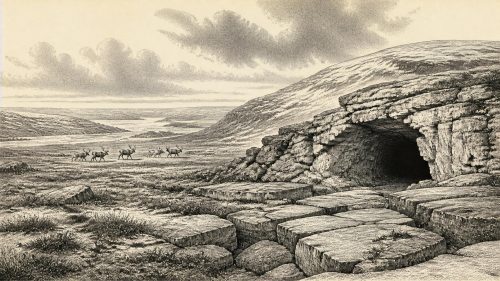
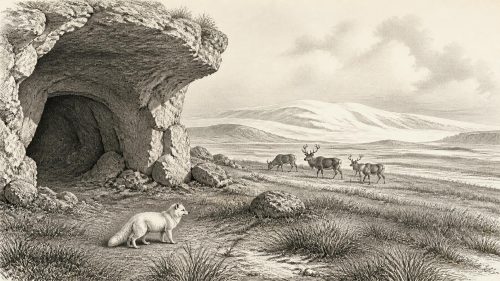
About 31,414 BCE, Ireland belonged to the unstable, cold later Pleistocene, not a historically datable nation. Calibrated evidence from Derryvree, County Fermanagh, indicates treeless tundra, wet hollows and shallow freshwater before renewed glaciation buried the deposits. Castlepook Cave, County Cork, preserves a time-mixed fauna including reindeer, mammoth, giant deer, hyena and Arctic fox, showing ecologically productive open country. A possibly cut-marked reindeer bone may indicate fleeting Upper Palaeolithic human activity in Ireland, but no settlement or associated tools are proven. Shifting ice, coasts and habitats governed survival, leaving evidence of landscapes and animals rather than societies, institutions or permanent communities.

Dateline
Modern calendar-year precision is not available for Ireland at this depth in time. “31,414 BCE” is a modern backward conversion, roughly 33,364 years before AD 1950, rather than a date on which an identifiable Irish event can be placed. No written record, settlement sequence or annually resolved archaeological layer permits a literal year-by-year history. The responsible setting is the later Pleistocene, within Marine Isotope Stage 3 and close to the transition towards the colder conditions conventionally grouped within the Late Midlandian or Late Devensian. The evidence consists chiefly of buried sediments, fossil plants, animal bone, cave stratigraphy and scientific dating. It illuminates a changing landscape, not a named population or a political history.
A Date Within a Range
The conversion itself needs caution. Radiocarbon years are not the same as calendar years: atmospheric radiocarbon levels varied substantially in the distant past, and samples must be calibrated against independently constructed curves. At ages beyond 30,000 years, the resulting ranges are broad and may be refined as calibration datasets and laboratory methods improve. The closest especially useful Irish environmental sequence, at Derryvree near Maguiresbridge in County Fermanagh, produced an original radiocarbon determination of 30,500 ± 1,100 radiocarbon years BP from organic sediment. In calibrated terms, this represents a broad interval spanning parts of roughly 35,000–33,000 calendar years BP, rather than a single moment. It can therefore responsibly inform conditions around 31,414 BCE, but cannot prove what occurred in that numbered year.
Nor did “Ireland” then have the fixed coast, political meaning or insular certainty the word carries today. Sea level, ice loading and shorelines differed sharply from the present. The British–Irish Ice Sheet was growing and changing, while local ice margins and areas of open ground could shift over long timescales. Recent ice-sheet reconstructions begin at 31,000 years ago precisely because older margin evidence is sparse and uncertain. They indicate ice accumulation in northern Ireland at that point, but they do not justify a simple map in which the entire island was either continuously ice-covered or uniformly habitable. Ireland was an unstable north-western edge of a wider European cold-world.
Wet Ground Beneath Later Ice
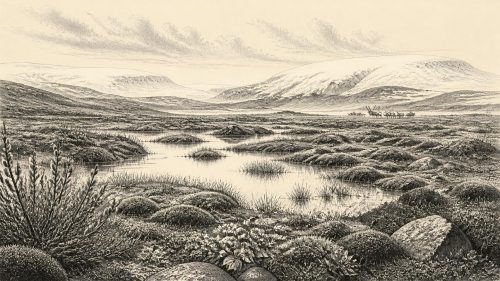
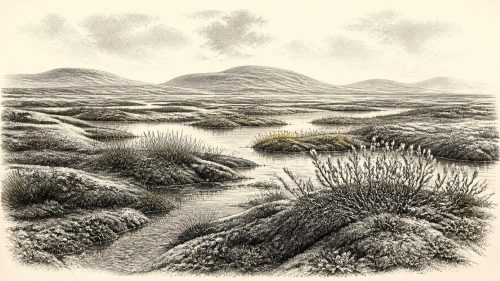
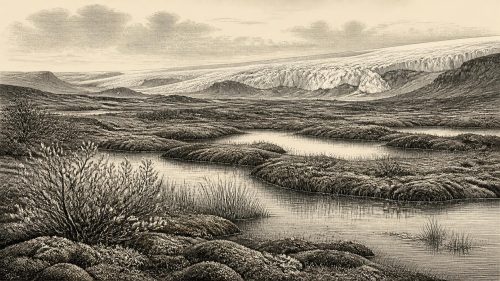
Derryvree is valuable because later glacial deposits sealed a freshwater and wetland sequence between two tills: dense sediments laid down by or beneath moving ice. Road works exposed the deposit in the late 1960s, allowing its pollen, plant macrofossils, mosses and invertebrate remains to be studied. The site does not supply a picture of all Ireland, still less a snapshot of a precise year. It does demonstrate that before a later ice advance this part of Fermanagh held shallow or sluggish freshwater, waterlogged ground and a treeless, periglacial environment.
The botanical evidence is unusually eloquent. Fossils and microfossils include bogbean, dwarf willow, mountain avens, alternate water-milfoil and lesser clubmoss. Sedges and mosses accompanied them. Together these remains point to open tundra-like vegetation rather than forest: low plants able to endure short growing seasons, frozen or seasonally frozen ground, wind exposure and severe winters. Bogbean and water-milfoil also show that the landscape was not merely a dry plain of frost-shattered stone. Pools, wet hollows and shallow freshwater supported aquatic and marginal vegetation. Such habitats would have changed seasonally and perhaps rapidly as sediment, snowmelt, water level and temperature altered.
This is evidence, not a complete reconstruction. Pollen may travel beyond its immediate source, while plant remains generally record conditions close to where they were deposited. Nevertheless, Derryvree makes one conclusion secure: at least one inland district that later lay beneath glacial sediment supported life during a cold interval. The landscape was open, patchy and productive in its brief summer season, not empty. It was also vulnerable. The very position of the organic beds between tills records the larger rhythm that governed life: phases in which wetland developed, followed by renewed ice movement that buried and preserved it.
Hyenahall and the Animal Record
Nearly 300 kilometres to the south-west, Castlepook Cave near Doneraile, County Cork, preserves Ireland’s richest known Pleistocene vertebrate assemblage. Its galleries received evocative names during early twentieth-century exploration, including Hyenahall and Elephant Hall. More than 2,000 bones have been recovered. Individually dated specimens cover a long and uneven span, approximately 45,700 to 19,950 years BP. This is a cave repository accumulated over many millennia, not a sealed deposit representing one animal community or one visit.
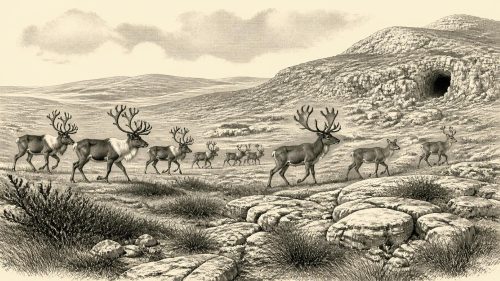
Even so, its fauna establishes the kinds of large mammals that could occupy parts of Ireland during the broader pre-Last Glacial Maximum world. The recorded assemblage includes woolly mammoth, giant deer, reindeer, brown bear, spotted hyena, wolf, Arctic fox and lemmings. Reindeer and mammoth are especially appropriate reminders that this was a cold, open landscape; hyenas indicate that carnivores as well as herbivores moved through the same broader system. Bones reached caves through several routes. Carnivores could drag in prey, animals might die near entrances, flowing water could disturb deposits, and excavators removed much material before modern recording standards existed. A bone found in Hyenahall cannot automatically be made contemporary with another from Elephant Hall, or with Derryvree in Fermanagh.
The animal evidence nevertheless suggests seasonal movement across a fragmented landscape of open ground, wetland, rocky shelter and ice margins. Herbivores required forage; predators followed opportunities created by living prey and carrion. That is an ecological interpretation, firmly grounded in the species present but unable to identify particular migration paths. There is no evidence for managed herds, domestication or animal ownership. Reindeer were wild animals in a glacial ecosystem, not the livestock of an Irish community.
The Human Question
A reindeer femur from Castlepook has brought this period into Irish archaeological debate. Re-examination has identified a deep mark interpreted by zooarchaeologist Ruth Carden as potentially consistent with a sharp stone implement used on fresh bone. Media reporting and County Cork heritage material have associated the specimen with an age of about 33,000 years ago. If the mark was made by people soon after the animal died, it would be important evidence for a brief Upper Palaeolithic human presence in Ireland, far earlier than the formerly accepted post-glacial settlement record.
That conclusion remains provisional. A radiocarbon measurement dates the animal tissue sampled, not necessarily the making of a surface mark; a cave’s disturbed deposits complicate association; and one modified bone does not establish a camp, population, route or duration of residence. No securely associated stone-tool assemblage, hearth, dwelling floor, burial or repeated occupation horizon is presently available for Ireland around this date. The strongest formulation is therefore modest: mobile hunter-gatherers may have entered parts of Ireland and processed a reindeer, but persistent settlement has not been demonstrated.
Comparison with Upper Palaeolithic communities elsewhere in north-west Europe can suggest possibilities, not facts about Ireland. Small groups in comparable environments made stone tools, shared food, planned movement and possessed rich social lives. Yet those general observations cannot identify an Irish language, kin group, artistic tradition or religious practice. There is no responsible evidence for chiefs, territories, diplomacy, alliances, warfare, formal learning, trade networks or exchange goods in Ireland at 31,414 BCE. Nor can modern ancestry be projected backwards from such a slender record. Later glaciation destroyed, displaced or buried much of the relevant landscape, so absence of evidence is not proof that no people ever arrived; it is, however, decisive against elaborate claims.
Life Without a Recorded Society
The principal development around this point in Irish deep history was environmental. Cold, strongly seasonal conditions structured every possibility for plants, animals and any passing people. Derryvree’s shallow waters and tundra flora show that life persisted in sheltered wet ground; Castlepook’s bones show a fauna able to exploit open country and cave refuges. The advancing and retreating ice system repeatedly altered access, coastlines, freshwater and pasture. In such a world, mobility mattered more than permanent architecture, and survival depended on weather, animal movements and the availability of protected ground.
There is no basis for describing villages, houses, farming, cultivation, mining, boats, ritual sites, monuments or commerce. Agriculture, pottery, metalworking and writing lay tens of millennia in the future. The most vivid historically defensible scene is therefore not a lost kingdom but a living, precarious landscape: low Arctic-alpine plants around wet hollows, large grazing animals in open country, predators using limestone caves, and ice whose next advance could erase the surface traces of all of them. That is why the buried wetland at Derryvree and the mixed bone archive at Castlepook matter so greatly. They preserve scarce evidence from an Ireland that was ecologically active, geographically unstable and almost beyond the reach of conventional history.
Primary Sources
- New Insights on the Fauna of Ireland’s Younger Dryas and Early Holocene from Alice & Gwendoline Cave
- Castlepook Cave, County Geological Site Report
- Dublin Radiocarbon Dates II
- The IntCal20 Northern Hemisphere Radiocarbon Age Calibration Curve (0–55 cal kBP)
- IntCal Publications
- Growth and Retreat of the Last British–Irish Ice Sheet, 31,000 to 15,000 Years Ago: the BRITICE-CHRONO Reconstruction
- Growth and Retreat of the Last British–Irish Ice Sheet, 31,000 to 15,000 Years Ago: the BRITICE-CHRONO Reconstruction (PDF)
- The Timing and Magnitude of the British–Irish Ice Sheet Between Marine Isotope Stages 5d and 2
- Pattern and Timing of Retreat of the Last British-Irish Ice Sheet
- Timing, Pace and Controls on Ice Sheet Retreat: an Introduction to the BRITICE-CHRONO Transect Reconstructions of the British–Irish Ice Sheet
- New Data for the Last Glacial Maximum in Great Britain and Ireland
- Maximum Extent and Dynamic Behaviour of the Last British–Irish Ice Sheet West of Ireland
- Figure 6—The Subdivision of the Quaternary Period in Ireland
- Soils of County Waterford
- BSBI: Menyanthes trifoliata
- BSBI: Salix herbacea
- BSBI: Dryas octopetala
- BSBI: Myriophyllum alterniflorum
- BSBI: Selaginella selaginoides
- The Antiquity of Man in Ireland
- Ireland Before 3000 B.C.
- The History of Red Deer (Cervus elaphus) in Ireland
- Heritage Artefacts of County Cork
- A Stratigraphical Basis for the Last Glacial Maximum (LGM)
- A Stratigraphic Framework for Abrupt Climatic Changes During the Last Glacial Period Based on Three Synchronized Greenland Ice-Core Records