
The Mammoth and the Cutmark31455 BCE
31,455 BCE is a modern label rather than a recoverable Irish date. Environmental evidence from Derryvree in Fermanagh indicates cold, treeless tundra wetlands during Marine Isotope Stage 3, when parts of Ireland remained ice-free before major later glaciation. Castlepook Cave, County Cork, preserves a disturbed but important pre-Last Glacial Maximum fauna, including mammoth, reindeer, lemmings, hyaena and Arctic fox. Ancient DNA suggests links with Eurasian populations, though routes remain uncertain. A cut-marked reindeer femur may indicate brief human carcass processing, but cannot prove settlement. No securely associated tools, hearths, dwellings or human remains establish sustained occupation, political life, or culture.
Dateline
31,455 BCE is a useful modern label, not a date that can be recovered from the Irish archaeological record. No inscription, settlement layer or calendar fixes an event to this year. In archaeological terms it falls roughly 33,400 calendar years before present (where “present” conventionally means AD 1950), during the Late Pleistocene and Marine Isotope Stage 3. Even that conversion must be treated cautiously. Radiocarbon results measure a laboratory age with uncertainty; calibration converts it into a probability range of calendar ages rather than a single historical moment. The responsible history of Ireland at this point is therefore a history of landscapes, animal remains and a very small, contested trace of possible human activity.
The most relevant place is Castlepook Cave, near Doneraile in north County Cork, long known as Mammoth Cave. Its nineteenth- and early twentieth-century excavations produced Ireland’s richest pre-Last Glacial Maximum animal assemblage. The cave is the reason that a year in the early 31st millennium BCE can be discussed at all. But it is not a prehistoric town, nor a neatly sealed archaeological deposit. Bones, sands, stalagmite floors, carnivore activity, water movement and antiquarian digging accumulated and disturbed material across long periods. Castlepook is an exceptional archive, yet it cannot supply the narrative precision that its dramatic fauna may seem to promise.
A Date Range, Not a Moment
The closest securely dated environmental evidence comes from Derryvree, near Maguiresbridge in County Fermanagh. Roadworks in 1969 exposed freshwater silts and fine sands between two tills in a drumlin. The organic deposits returned a conventional radiocarbon determination of 30,500 +1,170/−1,030 radiocarbon years BP. A published calibration places that result broadly at 36.9–31.7 thousand calendar years BP. The range spans the notional date represented here, but it does not demonstrate that Derryvree’s wetland existed in precisely 31,455 BCE, or that conditions there applied uniformly across Ireland.
Its importance lies in what the sediments preserve. Plant and animal remains indicate open tundra and a periglacial climate: land shaped by severe frost, sparse vegetation and short growing seasons, rather than by woodland or familiar Irish pasture. Mosses, sedges, grasses, herbs, juniper and aquatic plants record a patchwork of wet ground, shallow water and exposed mineral soils. A bogbean seed is particularly eloquent evidence for freshwater habitat, but not for a lush bog in the modern sense. This was a cold, treeless muskeg landscape. In summer, meltwater and ponds could sustain vegetation; in winter, frozen ground and strong seasonality imposed hard limits on life.
Derryvree also gives an essential corrective to the popular image of an Ireland simply buried beneath an unbroken ice cap throughout the Ice Age. The last British–Irish Ice Sheet did later cover most of the island at its maximum, but its growth was neither instantaneous nor geographically uniform. Recent syntheses suggest that large-scale ice build-up over Ireland occurred after this broad interval, with the greatest expansion and marine ice-stream activity concentrated much later, particularly from about 27,000 to 23,000 years ago. Geological reconstructions remain subject to revision, but the Derryvree and Greenagho deposits support the conclusion that north-central Ireland had ice-free terrain until at least about 34,000 calendar years ago. At the date in question, therefore, cold open country and wetlands are better supported than an assumption of island-wide glacier ice.
Castlepook’s Cold-Climate Fauna
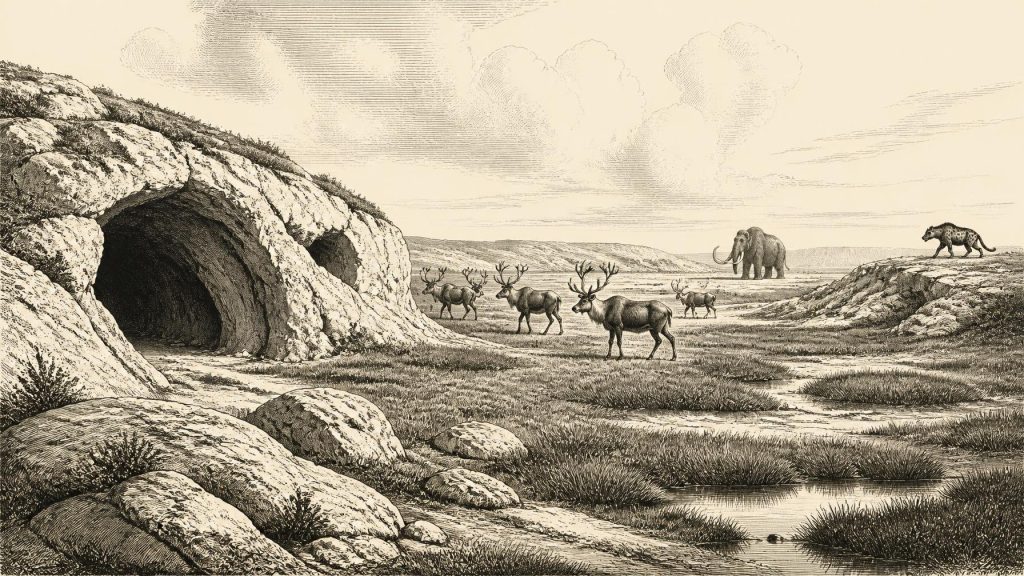
Castlepook offers complementary, though more complicated, evidence from the south. Its animal collection includes reindeer, woolly mammoth, giant deer, cave hyaena, wolf, fox, Arctic fox, mountain hare, stoat, collared lemming and Norway lemming, alongside bear remains. Not every specimen need belong to one episode, and the old excavations did not meet modern standards of stratigraphic recording. Still, the assemblage establishes that an Ice Age animal community reached Ireland before the Last Glacial Maximum. Newer radiocarbon work has shown that several older measurements from Castlepook underestimated the antiquity of the bones, in some cases by thousands of radiocarbon years.
Woolly mammoths and reindeer did not make Ireland a uniform grassland. They indicate a wider mosaic of open, productive habitats within a cold climate: grazing areas, herbs and grasses, wetter hollows and sheltered ground. The lemmings and Arctic fox point strongly towards cold conditions; hyaenas, wolves and bears reveal a predator and scavenger guild capable of carrying carcasses into caves. Castlepook’s reindeer bones are accordingly not straightforward evidence that reindeer died inside the cavern. Earlier zoological study observed extensive carnivore gnawing and reasonably inferred that carnivores had dragged limbs and bodies in to feed. Cave bone collections record animal behaviour as much as they record the outside landscape.
Recent sedimentary ancient-DNA research at Castlepook, currently available as a preprint rather than a final peer-reviewed publication, strengthens the picture of faunal links with Eurasia. It reports mitochondrial DNA from woolly mammoth and cave hyaena, as well as several other taxa. The result is significant as evidence of biogeographical connectivity at Europe’s north-western edge before the Last Glacial Maximum. It does not, however, reveal an open, permanent land route, and it should not be translated into a simple claim that Ireland was joined to Britain by a walkable land bridge. Lower sea levels exposed extensive shelves, but ice, channels, changing shorelines and local topography made access variable. The exact routes taken by animals remain unresolved.
The Reindeer Femur
The most arresting, and most limited, possible human evidence is a Castlepook reindeer femur with a deep mark interpreted by zooarchaeologist Ruth Carden as having been made on fresh bone by a sharp stone tool. Heritage accounts have associated the specimen with an age of around 31,000 BCE. If the modification is confirmed as anthropogenic, it could represent the earliest known indication that people handled an animal in Ireland, vastly earlier than the sustained post-glacial settlement visible in the Mesolithic record.
The distinction between the evidence and its interpretation is crucial. The date belongs to the animal bone, within a laboratory uncertainty range; it does not date a particular hunt, season or person. Identifying a mark as a tool cut requires specialist comparison with tooth scores, trampling damage, breakage and excavation damage. Nor can a cut-marked femur reveal whether people killed the reindeer, found a carcass, removed meat, hide or sinew, or processed it elsewhere before the bone entered the cave. Castlepook has not yielded a securely associated hearth, stone-tool assemblage, dwelling floor, burial, human bone or repeatedly occupied campsite of this age.
For that reason, it would be irresponsible to call Castlepook proof of a settled Irish population in 31,455 BCE. The most restrained conclusion is also the most important: one bone may preserve evidence of a brief Upper Palaeolithic incursion or episode of carcass processing. It invites further work, not historical certainty. Modern excavations and surveys at the cave have sought undisturbed deposits, but early results demonstrate how difficult it is to separate Pleistocene material from later contamination. Some charcoal recovered in recent work proved modern or medieval. That is not a failure; it is exactly why careful excavation, dating and micromorphological analysis are necessary.
People Beyond the Evidence
If people did reach Ireland in this interval, they would have entered an exacting environment in which movement, weather and animal availability mattered more than political borders. Across north-west Europe, Upper Palaeolithic communities used sophisticated stone technologies and possessed the capacity for tailored clothing, shelters, ornaments, art and long-distance social contacts. Those continental and British comparisons make a short visit to Ireland conceivable. They cannot supply missing Irish evidence. No Irish object of this age can demonstrate a particular tool tradition, language, family group, ritual practice, artistic style or system of learning.
Accordingly, there is no basis for describing political affairs, leaders, alliances, warfare or diplomacy in Ireland at this date. Nor is there direct evidence for religion, formal burial, monuments, music, trade goods or organised exchange. Even the word “trade” is too strong for the animal and genetic evidence. Faunal connection shows that mammals moved through a wider north-west European zone; it does not show people exchanging materials or maintaining regular sea crossings. The archaeological silence is not proof that all social life was absent, but it is a firm limit on what history can responsibly claim.
Settlement Without Settlements
There were no farms, villages or permanent built settlements known from Ireland around this time. If the Castlepook incision represents human action, the likely scale was small and mobile: a party able to exploit an animal resource in a cold landscape, not a community whose population, territory or seasonal round can be mapped. Reindeer could provide food, marrow, hides, sinew, antler and bone, but the single surviving mark cannot identify which of these mattered. Mammoths, giant deer and carnivores belonged to the same ecological world, yet no human association with their remains at Castlepook has been securely established.
The decisive regional development was environmental rather than political. Ireland lay within a changing Ice Age frontier, with ice-free or lightly glaciated country in some regions, expanding ice elsewhere and sea levels far below those of today. Over the following millennia the British–Irish Ice Sheet would grow, reshaping terrain and probably destroying or burying many earlier surfaces. That later glacial history helps explain why the evidence is so fragmentary. At 31,455 BCE, Ireland’s story is not of named inhabitants or dated events. It is of tundra wetlands in Fermanagh, cold-adapted animals in Cork, and one reindeer bone whose mark keeps open the possibility of people at the far western edge of Upper Palaeolithic Europe.
Primary Sources
- A Middle Midlandian Freshwater Series at Derryvree, Maguiresbridge, County Fermanagh, Northern Ireland
- A Reconsideration of the Radiocarbon Dating of the Marine Isotope Stage 3 Fauna from Southern Ireland
- Trimlines, Blockfields and the Vertical Extent of the Last Ice Sheet in Southern Ireland
- Growth and Retreat of the Last British–Irish Ice Sheet, 31,000 to 15,000 Years Ago: The BRITICE-CHRONO Reconstruction
- First Evidence of a Late Upper Palaeolithic Human Presence in Ireland
- New Insights on the Fauna of Ireland's Younger Dryas and Early Holocene from Alice & Gwendoline Cave
- Sedimentary Ancient DNA Reveals Late Pleistocene Faunal Connectivity Between Ireland and Eurasia
- Archaeology Research Excavation Grant 2022: Castlepook Caves Project
- 2022:564 – Castlepook Cave, Castlepook South, Cork
- The Irish Quaternary Fauna Project
- Pleistocene Vertebrates in the British Isles
- Occurrence of Mammalia Relicts at Site Castlepook Cave
- Early Midlandian–Middle Midlandian, Pleistocene, Northern Ireland
- Palaeoecology
- The Subdivision of the Quaternary Period in Ireland
- The IntCal20 Northern Hemisphere Radiocarbon Age Calibration Curve (0–55 cal kBP)
- The Problem of a Late Quaternary Landbridge Between Britain and Ireland
- The Island of Ireland: Drowning the Myth of an Irish Land-Bridge?
- Radiocarbon Constraints on the Age of the Maximum Advance of the British–Irish Ice Sheet in the Celtic Sea
- Exposure-Age Constraints on the Extent, Timing and Rate of Retreat of the Last Irish Sea Ice Stream
- Advance and Retreat of the Marine-Terminating Irish Sea Ice Stream into the Celtic Sea During the Last Glacial: Timing and Maximum Extent
- Oscillating Retreat of the Last British-Irish Ice Sheet on the Continental Shelf Offshore Galway Bay, Western Ireland
- Dimensions and Chronology of the Last Ice Sheet in Western Ireland