
The Drumlin’s Freshwater Core31456 BCE
31,456 BCE is not a precise Irish historical date but falls within a broad MIS 3 interval. At Derryvree, County Fermanagh, organic sediments between glacial tills record an ice-free phase, dated roughly 36,900–31,700 calibrated years BP, with cold, treeless freshwater wetlands. Castlepook Cave, County Cork, preserves diverse open-country fauna, including mammoth, reindeer, giant deer, hyaena and Arctic fox, accumulated across multiple periods. A marked reindeer femur may indicate human butchery around 31,000 BC, but cannot prove settlement or continuity. No evidence supports prehistoric polities or culture. Later ice expansion destroyed much evidence, leaving ecological archive and possibilities of human presence.
Dateline
“31,456 BCE” is a modern chronological label, not a year that anyone in prehistoric Ireland could have recorded, named or remembered. It corresponds approximately to 33,405 years before 1950, the conventional reference point used in radiocarbon reporting. No Irish deposit can responsibly be dated to that individual calendar year. The evidence instead concerns a broad part of the Late Pleistocene, within Marine Isotope Stage 3 (MIS 3), and must be expressed through calibrated ranges, fossil assemblages and geological sequences. Around this point in deep time, Ireland was a cold, changing north-western edge of Europe: not the later green, wooded island, but neither demonstrably a single, uniform sheet of ice.
A Date Within a Long Interval
The most useful Irish evidence lies far apart in both geography and type. At Derryvree near Maguiresbridge, County Fermanagh, roadworks exposed organic silts and fine sands sandwiched between two tills: dense, unsorted sediments deposited by glacier ice. The ordering matters. An earlier ice advance laid down the lower till; then freshwater and organic material accumulated in an ice-free interval; a later advance overrode and sealed the deposit beneath the upper till. Organic material from the middle bed produced a conventional radiocarbon determination of about 30,500 years BP. Modern calibration has been reported as a broad interval of roughly 36,900–31,700 calibrated years BP. The nominal date 31,456 BCE falls within that range, but it does not identify a particular season, generation or event at Derryvree.
That distinction is central. A calibrated range is a statistical expression derived from a measurement and an internationally maintained calibration curve; it is not a diary. At these ages, calibration depends on linked records from such sources as tree rings, corals, lake sediments and cave deposits rather than an uninterrupted Irish chronology. Nor should a Fermanagh wetland be treated as a weather station for all of Ireland. Derryvree establishes that north-eastern Ireland contained an open freshwater and periglacial environment during part of this long interval. It cannot tell us the exact temperature on a day in 31,456 BCE, nor prove that County Cork, the west coast and Ulster all had identical conditions at once.
Water Beneath the Ice
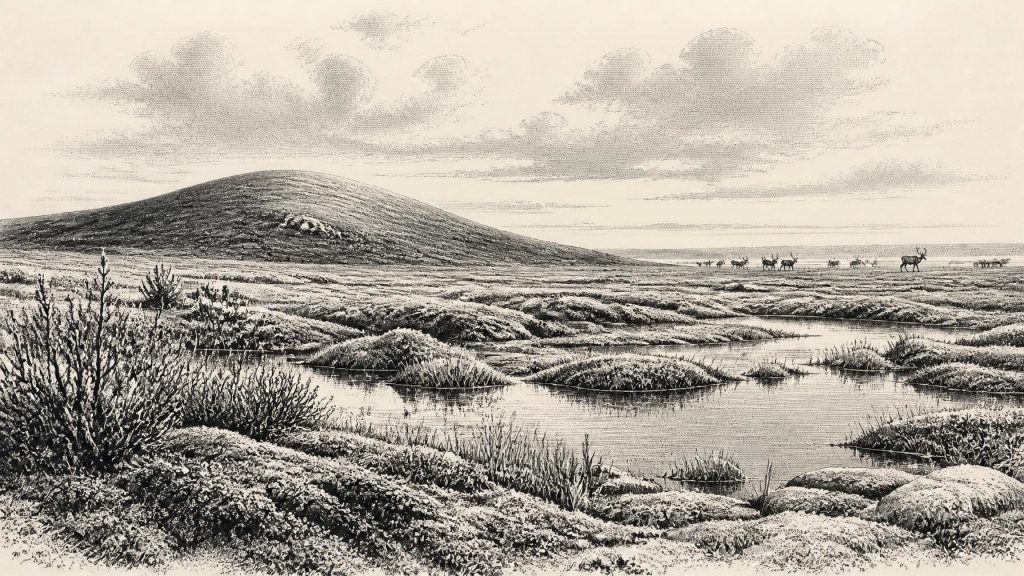
The Derryvree plant and animal traces nevertheless give unusual substance to the landscape. They indicate treeless, cold-country vegetation and wet ground: sedges, mosses, herbs, low shrubs and aquatic plants around shallow water, channels and muddy margins. Earlier writers used the word “muskeg” for such a moss-rich, waterlogged setting. It should not conjure a modern peat bog unchanged through time. Rather, it conveys an uneven terrain in which standing water, saturated sediment, seasonal frost and short growing seasons existed side by side. Summer light could produce a brief but productive flush of plant growth; winter freezing and exposed winds imposed severe limits.
This was a landscape of margins. Freshwater pools and sedge beds could support insects and grazing animals, while bare mineral ground and frost-disturbed soils lay nearby. The botanical record rules out a dense forest like that which covered much of Ireland after the last Ice Age. It does not mean an utterly lifeless white desert. The value of the deposit is precisely that it preserves organisms normally lost from the Irish record, much of which was later scoured, buried or rearranged by glacier ice. Derryvree is therefore evidence for a real ecological opening between ice advances, but it is also a reminder of how exceptional survival is. Most comparable surfaces have probably not survived.
Castlepook and the Animal World
Southern Ireland offers a different window. Castlepook Cave, also known as Mammoth Cave, near Doneraile in north County Cork, lies in limestone country between the Awbeg valley and the Ballyhoura foothills. Excavations begun by Richard J. Ussher in 1904 recovered a remarkably large but complicated collection of animal bones. Reassessment and radiocarbon dating have made the cave Ireland’s most important archive for pre-Last Glacial Maximum fauna. Its remains include woolly mammoth, reindeer, giant deer, brown bear, wolf, Arctic fox, mountain hare, stoat, lemmings and spotted hyaena. These animals did not necessarily all live together at one moment, and the cave’s deposits incorporate more than one period. Even so, the assemblage demonstrates the repeated presence in Ireland of a cold-adapted, open-country fauna during the wider Late Pleistocene.
The fauna should not be imagined as an orderly herd list. Caves collect bones through many processes: animals die in or near them; carnivores drag in prey; water moves material; roof falls disturb layers; and excavators remove sediment. At Castlepook, spotted hyaena is especially important. Hyenas can accumulate bones in dens, gnawing, breaking and transporting carcass parts. A bone found in a cave may therefore record an animal killed or scavenged elsewhere, not an animal standing in the cave chamber. The mammoth, reindeer and giant deer of Castlepook point towards open grass-herb and tundra-like habitats, but they cannot furnish a complete local food web, population count or map of seasonal migration.
The Reindeer Femur Question
A reindeer femur from Castlepook brings the question of people closest to this remote date. Ruth Carden’s examination identified a deep mark interpreted as damage made by a sharp stone tool during butchery. County Cork heritage publications have placed the bone at about 31,000 BC. If that interpretation and broad dating are sustained, the object is potentially Ireland’s earliest evidence that people handled an animal: a striking possibility more than 20,000 years older than the long-established post-glacial evidence for human activity on the island.
Yet the wording must remain careful. The bone is evidence for an action on an animal, not for a permanent settlement. It does not establish that hunters killed the reindeer at Castlepook, lived in the cave, returned there regularly, or formed a continuous Irish population. No securely associated hearth, dwelling surface, stone-tool assemblage, burial, artwork or food store has been recovered that can define a camp of this age. Modern excavations at Castlepook have sought surviving Pleistocene deposits, but the 2022 work recovered no cultural artefacts. The cave had also been heavily excavated in the early twentieth century, when recording standards could not meet modern stratigraphic expectations. The femur is consequential evidence, but it remains a single and much-debated line of evidence.
People Without a Demonstrable Polity
Accordingly, there is no basis for describing an Irish tribe, chiefdom, territory, language, political system or diplomatic relationship in 31,456 BCE. If people reached Ireland, they may have been small, mobile Upper Palaeolithic hunting groups moving through wider north-west European landscapes. That is an interpretation drawn from the wider European archaeological context and the possible butchered reindeer bone, not a fact demonstrated by an Irish settlement. Nor can the record show whether any visitors crossed from Britain, followed an exposed coastal route, travelled over seasonal ice, or arrived by another means. Lower sea level altered the geography around Ireland, but it did not automatically create a simple, permanent land route that can be assumed for every phase of the Ice Age.
Conflict and diplomacy are equally beyond the evidence. Predation and competition certainly shaped the animal world: hyaenas, wolves and humans, if present, could all have sought meat and carcasses. But animal bone cannot reveal a quarrel, alliance or boundary between human groups. Likewise, reindeer would have offered meat, marrow, hide, sinew, antler and bone to knowledgeable hunters, but Castlepook cannot demonstrate precisely which resources were taken from this individual animal. There is no evidence for Irish trade networks, exchanged prestige goods, farming, metalworking or organised maritime commerce. These are absences in the present record, not proof that people lacked skill, memory, language or social lives.
Culture Beyond Recovery
Religion, art and learning are also unrecoverable for Ireland at this date. There is no cave art securely assigned to this interval, no decorated object, ritual deposit or human grave. It would be mistaken to infer cultural emptiness from this silence. Upper Palaeolithic communities elsewhere in Europe possessed sophisticated knowledge of animals, raw materials, landscapes and seasons, and sometimes made art of great technical power. But Ireland has not yielded evidence tying any particular Irish visitor or population to a named tool tradition, artistic style or belief system. A responsible account must therefore separate the known ecological setting from attractive but unproven reconstructions of camp life.
Environmental change supplies the larger story. MIS 3 was marked by abrupt switches between colder stadials and relatively milder interstadials across the North Atlantic world. Derryvree belongs within this volatile setting, often cautiously discussed alongside the wider Denekamp interstadial complex. Such labels are useful for comparison, but correlations between scattered deposits are not exact identities. Soon after the broad period represented at Derryvree and Castlepook, the British–Irish Ice Sheet expanded markedly. By the Last Glacial Maximum, broadly around 26,000 years ago, much of Ireland had been engulfed by ice. Any fragile evidence of earlier landscapes, animals and people was vulnerable to destruction or redeposition.
An Archive of Possibilities
The Ireland of 31,456 BCE is therefore best approached not as a conventional historical year, but as an archaeological threshold. Beneath a Fermanagh drumlin, freshwater silts preserve a cold wetland that existed between glacial episodes. In a north Cork cave, bones preserve evidence of mammoths, reindeer, carnivores and other animals adapted to open, severe country. One marked reindeer femur raises the possibility that people processed game in Ireland during the Upper Palaeolithic. It does not yet give us a village, a polity or a calendar date. The great achievement of the evidence is more modest and more important: it restores Ireland to the changing ecological and possible human geography of Ice-Age Europe, while showing just how much of that early history remains to be discovered.
Primary Sources
- A Middle Midlandian Freshwater Series at Derryvree, Maguiresbridge, County Fermanagh, Northern Ireland
- The Irish Quaternary Fauna Project
- Trimlines, Blockfields and the Vertical Extent of the Last Ice Sheet in Southern Ireland
- Growth and Retreat of the Last British–Irish Ice Sheet, 31,000 to 15,000 Years Ago: The BRITICE-CHRONO Reconstruction
- Pattern and Timing of Retreat of the Last British-Irish Ice Sheet
- Maximum Extent and Dynamic Behaviour of the Last British–Irish Ice Sheet West of Ireland
- Maximum Extent and Readvance Dynamics of the Irish Sea Ice Stream and Irish Sea Glacier Since the Last Glacial Maximum
- The Island of Ireland: Drowning the Myth of an Irish Land-Bridge?
- The IntCal20 Northern Hemisphere Radiocarbon Age Calibration Curve (0–55 cal kBP)
- A 1.5-Million-Year Record of Orbital and Millennial Climate Variability in the North Atlantic
- Dansgaard–Oeschger Events in Climate Models: Review and Baseline Marine Isotope Stage 3 Protocol
- The Tolsta Interstadial, Scotland: Correlation with D–O Cycles GI-8 to GI-5?
- Figure 6: The Subdivision of the Quaternary Period in Ireland
- Quaternary Geology of Ireland
- The Exploration of Castlepook Cave, County Cork
- The Exploration of Castlepook Cave, Co. Cork. With 3 Plates.
- Spotted Hyena Skull
- 2022:564 – Castlepook Cave, Castlepook South, Cork
- Archaeology Research Excavation Grant Report: Castlepook Cave Project
- Heritage Artefacts of County Cork
- The Archaeological Heritage of County Cork
- New Insights on the Fauna of Ireland’s Younger Dryas and Early Holocene from Alice & Gwendoline Cave
- The Mesolithic in Ireland: When Was It?
- International Chronostratigraphic Chart