BIRM-166’s Radiocarbon Interval31247 BCE
Around 31,247 BCE, Ireland lay within the climatically unstable Late Pleistocene MIS 3, although this date represents a broad calibrated radiocarbon range rather than a precise year. Derryvree, County Fermanagh, preserves freshwater sediments beneath a drumlin, revealing ice-free periglacial tundra with pools, mosses, sedges, dwarf shrubs and cold-adapted insects. Castlepook Cave, County Cork, contains MIS 3 fauna including mammoth, reindeer, giant deer, predators and lemmings, indicating ecological connectivity. Ice-sheet growth was underway but maximum glaciation followed later. No secure settlement evidence exists. A possibly butchered reindeer bone suggests only tentative human presence. Evidence supports dynamic ecosystems, not societies or chronologies.
Dateline
Modern calendar-year precision is not available for Ireland at this depth of time. “31,247 BCE” is a modern back-calculation, equivalent to roughly 33,197 calendar years before AD 1950, not a year that anyone in Ireland recorded or that archaeology can isolate. The responsible subject is therefore a broad Late Pleistocene interval within Marine Isotope Stage 3 (MIS 3), when climate repeatedly changed between relatively milder interstadials and severe cold phases. Radiocarbon determinations, sediment layers and fossil assemblages can locate Irish evidence within ranges of centuries or millennia; they cannot identify an event on a particular day, season or calendar year.
A Date Within a Cold Phase
The most informative Irish evidence near this notional date comes from Derryvree, near Maguiresbridge in County Fermanagh. Roadworks in 1969 cut through a drumlin and exposed an exceptional sequence: one mass of glacial till below, freshwater silts and fine sands with organic material in the middle, and a second till above. This was not a settlement layer. It was a natural archive, formed when an earlier ice advance had retreated or ceased to dominate locally, allowing water, sediment, plants and insects to gather in a wet hollow before a later glacier buried the deposit.
Organic material from the freshwater bed returned the radiocarbon determination BIRM-166, conventionally dated to 30,500 radiocarbon years before present, with a substantial uncertainty of approximately a millennium either way. Radiocarbon years are not calendar years: the amount of atmospheric carbon-14 has altered through time, and measurements must be calibrated against independently constructed curves. Published calibrations place the Derryvree evidence broadly in the later part of MIS 3, with ranges extending across the general vicinity of this article’s modern numerical label. That overlap is important, but limited. It permits Derryvree to illuminate the landscape around 31,247 BCE; it does not prove that every plant, beetle or pool survived in that exact year.
The terminology itself needs care. Earlier Irish Quaternary schemes called this interval the Derryvree Cold Phase or placed it within the Midlandian glaciation. Current research commonly uses the international MIS framework and increasingly tests older regional models against improved ice-sheet chronologies. The central conclusion remains secure: parts of Ireland could be ice-free during phases before the Last Glacial Maximum, but conditions were cold, unstable and increasingly shaped by the growth of the British–Irish Ice Sheet. The later maximum, reached after this period, was far more extensive and reworked or removed much older evidence.
Wet Tundra Beneath the Drumlin
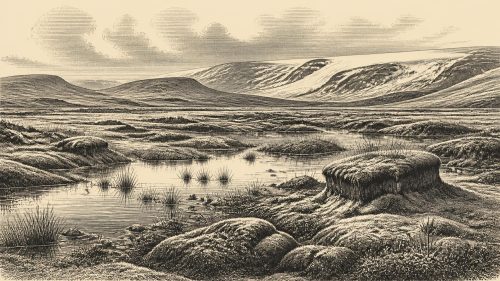
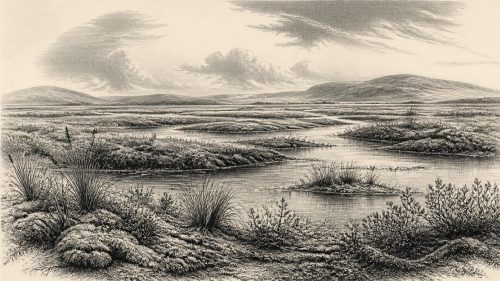
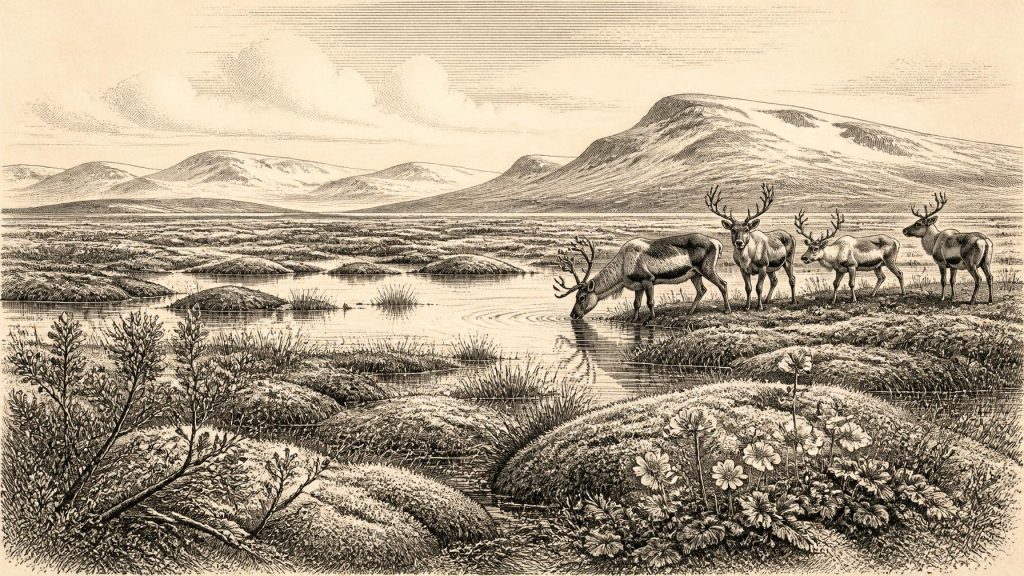
Derryvree gives an unusually detailed environmental picture. The silts, sands, pollen, plant macrofossils, mosses and insects indicate open tundra rather than woodland. Grasses, sedges, herbs, juniper and cold-adapted plants grew in a landscape with sparse dry-ground cover. Mossy ground surrounded shallow freshwater pools rich in decaying plant material. Finds including mountain-avens, dwarf willow and bogbean demonstrate that this was not a lifeless frozen waste. It was a patchwork of wetland, exposed mineral ground and low vegetation, productive during the brief growing season but subject to long, hard winters and periglacial processes.
Such evidence also corrects misleading modern images of Ireland. There were no blanket oak woods, enclosed green fields, peat-cuttings, towns or familiar coastlines. A drumlin did not yet have its modern agricultural setting; it was part of an active glacial and periglacial terrain. Frost action could disturb soil, seasonal thaw could feed pools and small watercourses, and wind could move sediment across sparsely vegetated ground. The local freshwater record establishes that liquid water and plant life existed at Derryvree during its depositional interval. It cannot, by itself, map every valley, coast or upland across the island.
Nor should an ice-free Fermanagh be mistaken for a warm or stable Ireland. Ice-sheet reconstruction is difficult because advancing ice erodes earlier deposits and because evidence from different districts has different precision. Recent syntheses indicate that ice-sheet growth was under way across the British–Irish region around 31,000 years ago, while the maximum Irish expansion occurred later, principally around 26,000–23,000 years ago. Around the date considered here, Ireland was therefore best understood as environmentally varied and vulnerable to rapid climatic shifts, not as uniformly engulfed by ice or uniformly open country.
The Castlepook Fauna
In north County Cork, Castlepook Cave near Doneraile—also known as Mammoth Cave—supplies the principal animal record for this broad pre-Last Glacial Maximum world. Antiquarian excavations recovered a remarkable but complicated collection of bones from cave sands, breccias and stalagmite-associated deposits. Later radiocarbon work demonstrated that some fauna belonged to MIS 3, though the old excavations and disturbed cave contexts mean that individual finds cannot automatically be treated as one simultaneous assemblage.
The securely significant picture is nevertheless striking. Castlepook yielded remains attributed to woolly mammoth, reindeer, giant deer, brown bear, wolf, Arctic fox, mountain hare, collared and Norwegian lemmings, and spotted hyena. The presence of hyena is especially consequential: it indicates a carnivore range now unimaginable in Ireland and suggests that caves could be used or entered by animals as dens, feeding places, traps or shelters. Mammoth and reindeer point to open, cold-country habitats, but their bones do not demonstrate that every species shared the same patch of ground at the same moment. Cave deposits accumulate over long periods, and scavenging, trampling and later disturbance complicate their history.
This fauna makes the island’s ecological isolation a question rather than a simple assumption. Large mammals had reached Ireland during portions of the Late Pleistocene, presumably through changing routes and seaways across the wider north-west European landscape. Yet precise connections between Ireland, Britain and the continent changed with sea level, ice margins and local geography. The evidence supports animal movement and ecological connectivity; it does not allow a confident reconstruction of a particular migration route at 31,247 BCE.
The Human Question
No hearth, stone-tool assemblage, built shelter, burial, human bone, repeatedly occupied floor or food-processing area has been securely dated in Ireland to this interval. Consequently, there is no basis for narrating a resident Irish population, named communities or a continuous Palaeolithic occupation in the 31,240s BCE. The much firmer evidence for people in Ireland belongs to the terminal Pleistocene, many millennia later, including cut-marked animal bone from Alice and Gwendoline Cave in County Clare.
Castlepook has, however, reopened the question. A reindeer femur from the cave has been reported as bearing a deep linear mark interpreted as damage made by a stone tool during fresh-bone butchery, and the bone has been publicised as approximately 33,000 years old. If that interpretation and chronology remain robust, it would be an important indication that people reached Ireland during MIS 3. It would still be only an indication of human handling of one carcass, not proof of permanent settlement, population size, ancestry, language, route of travel or social organisation.
The distinction matters because continental Upper Palaeolithic evidence is rich enough to tempt easy storytelling. Hunter-gatherers elsewhere in Europe made sophisticated tools, organised movement across large territories and maintained varied social and symbolic practices. None of those facts can be transferred wholesale to Ireland without Irish artefacts or occupation deposits. The most that can responsibly be said is conditional: if people visited the island in this period, they would have encountered a difficult northern environment and animal communities that offered both resources and danger. Their actual numbers, duration of stay and cultural affiliations remain unknown.
No Polities, No Chronicle
Political affairs, diplomacy and warfare leave no identifiable Irish evidence at this date. There were no demonstrable kingdoms, borders, monuments, farms, mines, markets or trading ports. Likewise, religion, art and learning cannot be recovered from the Derryvree wetland or the Castlepook bone collection. A cave used by hyenas is not a shrine; a reindeer bone is not proof of hunting ritual; and open tundra does not reveal human belief.
Economy and everyday life can therefore be discussed only through ecology. Plants fixed themselves in wet soils and pool margins; herbivores browsed, grazed or ranged through open country; predators and scavengers followed animal concentrations and carcasses. Seasonal productivity was probably crucial to every creature able to live there. For hypothetical human visitors, the possible economic opportunities were animal meat, hide, bone and antler, but these remain general inferences from the wider European Palaeolithic rather than documented Irish practices.
What the Evidence Can Say
Ireland around this point in deep time was a changing Late Pleistocene landscape, not an empty page but not yet a historical society. Derryvree preserves an ice-free, periglacial wetland interval with tundra vegetation and freshwater life; Castlepook preserves evidence of a distinctive cold-stage fauna in the south. Together they show that parts of the island supported complex ecosystems before the Last Glacial Maximum reshaped the land. They also show why restraint is necessary. The material record is fragmentary, dates are ranges, and the early human signal is not yet an excavated settlement. For 31,247 BCE, Ireland’s most defensible story is one of mossy pools, sedges, frost, shifting ice and the animals whose remains endured where almost all other traces were destroyed.
Primary Sources
- A Middle Midlandian Freshwater Series at Derryvree, Maguiresbridge, County Fermanagh, Northern Ireland
- Irish Pleistocene Biostratigraphy
- The Irish Quaternary Fauna Project
- A Reconsideration of the Radiocarbon Dating of the Marine Isotope Stage 3 Fauna from Southern Ireland
- Occurrence of Mammalia Relicts at Site Castlepook Cave
- On the Cave of Castlepook, Near Doneraile, Co. Cork
- Castlepook Cave: County Geological Site Report CK032
- 2022:564 – Castlepook Cave, Castlepook South, Cork
- Archaeology Research Excavation Grant Report: Castlepook Cave Geophysical Survey
- Figure 6—The Subdivision of the Quaternary Period in Ireland
- Palaeoecology
- Soils of County Waterford
- Introduction to the Late Quaternary and Holocene of Northern Ireland
- Trimlines, Blockfields and the Vertical Extent of the Last Ice Sheet in Southern Ireland
- Growth and Retreat of the Last British–Irish Ice Sheet, 31,000 to 15,000 Years Ago: the BRITICE-CHRONO Reconstruction
- Pattern and Timing of Retreat of the Last British-Irish Ice Sheet
- Stratigraphic and Palaeo-geomorphological Evidence for the Glacial-deglacial History of the Last British-Irish Ice Sheet in the North-western Irish Sea
- Early Deglaciation of the British-Irish Ice Sheet on the Atlantic Shelf Northwest of Ireland Driven by Glacioisostatic Depression and High Relative Sea Level
- The Timing and Magnitude of the British–Irish Ice Sheet Between Marine Isotope Stages 5d and 2
- Spatio-temporal Dynamics of Speleothem Growth and Glaciation in the British Isles
- The IntCal20 Northern Hemisphere Radiocarbon Age Calibration Curve (0–55 cal kBP)
- IntCal Publications
- First Evidence of a Late Upper Palaeolithic Human Presence in Ireland
- New Insights on the Fauna of Ireland’s Younger Dryas and Early Holocene from Alice & Gwendoline Cave