Castlepook’s Closing Corridor31274 BCE
Around 31,274 BCE, Ireland experienced late Marine Isotope Stage 3 climatic deterioration before the Last Glacial Maximum. Open, treeless tundra, freshwater pools and periglacial conditions are evidenced at Derryvree, County Fermanagh. Castlepook Cave, County Cork, preserves remains of reindeer, mammoth, giant deer, brown bear, wolf and spotted hyaena, indicating intermittent animal movement through changing Ice Age landscapes. A marked reindeer bone may suggest early human butchery, but remains insufficient proof of occupation. Later ice advances destroyed or buried much evidence. This period therefore represents an uncertain environmental horizon, reconstructed through caves, sediments and re-dated animal remains rather than human history.
Dateline
“31,274 BCE” is a useful modern label, not a date at which Ireland’s inhabitants recorded an event. At this depth of time, calendar-year precision is unavailable. Converting the label conventionally places it at about 33,200 calibrated years before present (cal BP, with “present” fixed at AD 1950), within the later part of Marine Isotope Stage 3, or MIS 3. Dates for this period come as ranges, often with substantial uncertainties, and Ireland’s evidence is especially fragmentary. The responsible history of this moment is therefore not one of named rulers, battles or settlements, but of a changing cold-world landscape, cave deposits and animal bones.
A Late MIS 3 Landscape
Ireland lay on the north-western edge of Europe’s inhabited and changing Ice Age world. MIS 3, broadly c. 57,000–29,000 years ago, was not one uniform freeze. Greenland ice-core records and European environmental archives show abrupt swings between comparatively milder interstadials and colder stadials. Such shifts altered vegetation, snow cover, river behaviour and the practical routes available to animals and people. The numbered year in this article falls during the long climatic deterioration that preceded the fullest development of the last British–Irish Ice Sheet.
This was not yet the Last Glacial Maximum in its conventional sense. The British–Irish Ice Sheet reached its greatest overall extent later, with major advances and changing sectoral maxima broadly between c. 30,000 and 22,000 years before present; the wider global glacial maximum belongs mainly to c. 26,500–19,000 years ago. Nevertheless, ice was already an active and consequential force. It was growing in the mountains and across surrounding seas, and its future expansion would remove, bury or rework much of the terrestrial evidence from this earlier interval.
That later destruction is central to the difficulty of writing Ireland’s deep prehistory. A landscape repeatedly overridden by ice does not preserve campsites, hearths or footprints easily. The surviving record is uneven: protected caves, sediment trapped beneath glacial deposits, offshore cores, pollen, plant macrofossils, insects, animal remains and the landforms left when ice finally retreated. Each source records a different duration and place. None can securely describe an exact day, season or political community in 31,274 BCE.
Open Ground, Pools and Wind
The best Irish evidence for a cold late-MIS-3 environment comes from scattered natural archives rather than a single landscape preserved intact. At Derryvree near Maguiresbridge in County Fermanagh, roadworks exposed freshwater silts and fine sands between two tills in a drumlin. Radiocarbon results from the organic deposit gave 30,500 +1,170/−1,030 radiocarbon years BP, a measurement which must not be treated as an exact equivalent of the article’s BCE label. Yet it belongs to the same broad Late Pleistocene setting and offers Ireland’s most revealing local environmental comparison.
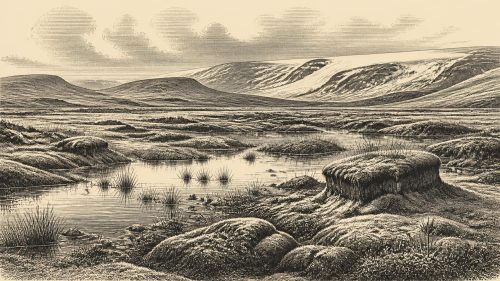
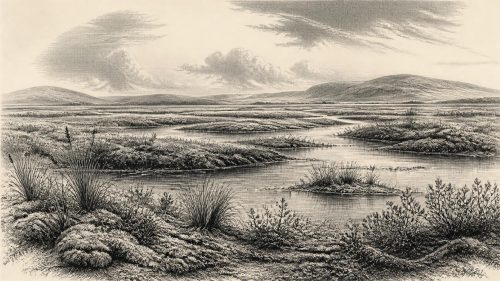
Derryvree’s pollen, mosses, seeds and animal remains point to open tundra vegetation and periglacial conditions. Sedges, mosses and cold-adapted herbaceous plants occurred around shallow freshwater habitats. Plants such as mountain-avens, Arctic willow, dwarf birch, bogbean and water-milfoil have been identified from the wider inter-till record. The evidence does not recreate a continuous carpet of vegetation across all Ireland; indeed, sparse cover is likely in exposed ground. It does show that, where water and sheltered sedimentary basins permitted, a low, treeless mosaic of wet ground, pools and tundra plants could persist.
Such terrain should not be imagined as lifeless white desert. In summer, short growing seasons could produce grasses, herbs, mosses and insect activity; in winter, frost, snow and wind would have imposed severe constraints. Rivers and temporary ponds shifted with meltwater and freezing. The familiar outlines of modern Irish farming country, woodland and bog had not yet formed. Nor did the modern shoreline exist. Lower global sea levels exposed broad shelves, although ice, shifting coasts, water crossings and local topography determined whether particular routes were usable at any given time.
Castlepook’s Faunal Archive
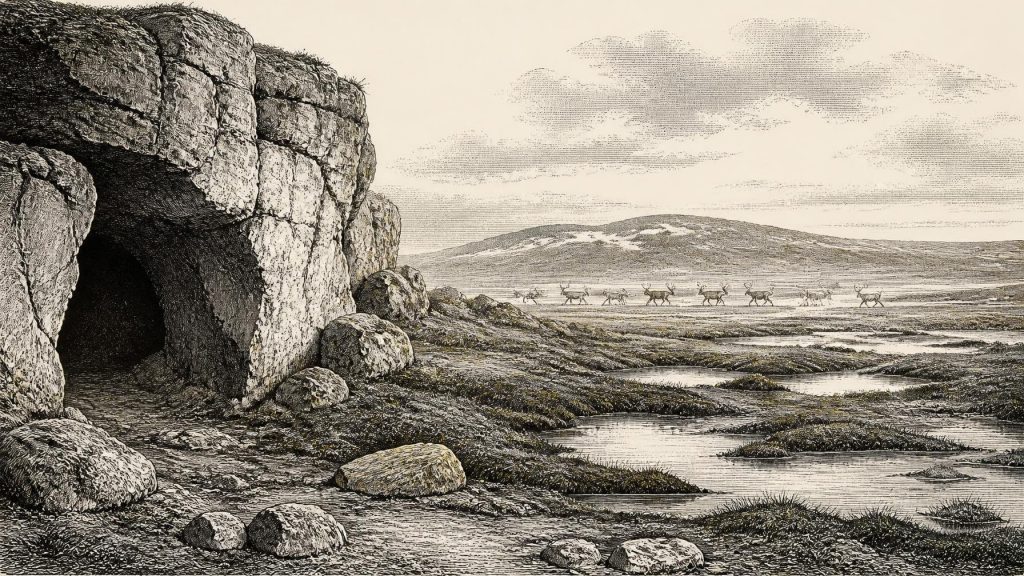
The principal Irish cave archive for this interval is Castlepook Cave, also known as Mammoth Cave, near Doneraile in north County Cork. Excavations undertaken between 1904 and 1908 produced a remarkable collection, now substantially held by the National Museum of Ireland. It includes reindeer, brown bear, wolf, fox, mountain hare, lemmings, giant deer, woolly mammoth and spotted hyaena. Not every species necessarily lived together at one moment, and antiquarian excavation methods did not recover the contextual detail expected today. Still, modern re-dating has confirmed that Castlepook contains important fauna from before as well as after the Last Glacial Maximum.
Spotted hyaena is particularly evocative. Its presence is firm evidence that carnivores characteristic of Pleistocene north-west Europe reached Ireland during parts of this cold stage. Hyenas could carry prey remains into caves, scatter and chew bones, and create deposits that resemble a human food discard only superficially. Brown bears may have used caves differently, including as shelter or dens. Reindeer suggest open grazing country, while lemmings and mountain hare reinforce the picture of cold-adapted habitats. Mammoth and giant-deer remains demonstrate that large herbivores entered Ireland at some points in the Late Pleistocene, but their bones do not license a claim that they were common, permanent or all contemporaneous around 31,274 BCE.
Recent work has made the chronology more secure and, at the same time, more cautious. Improved accelerator mass spectrometry and chemical pretreatment produced dates for several southern Irish cave bones thousands of radiocarbon years older than earlier determinations. The revision indicates that some animals, including giant deer and spotted hyaena, were present in Ireland during MIS 3 and may have disappeared locally before the Last Glacial Maximum. It also demonstrates why old dates and old collections must be revisited rather than repeated as settled fact.
The Reindeer Bone Question
Castlepook matters to human history because a reindeer femur, recovered in 1972 and subsequently dated to roughly 33,000 years ago, bears a single deep linear mark. Zooarchaeologist Ruth Carden has interpreted the incision as potentially made by a sharp stone tool during butchery. If that interpretation is sustained by further microscopic study, comparison and securely stratified finds, it would be evidence for a fleeting human presence in Ireland far earlier than the long-accepted terminal-Pleistocene record.
But the conditional is essential. One modified bone is not a settlement, a toolkit, a hearth, a burial or proof of a resident population. The bone lacks the secure excavated context that would allow archaeologists to link it confidently to a particular occupation surface. Carnivore damage, sediment movement, excavation history and the limited nature of the mark all require scrutiny. The National Museum of Ireland still rightly describes Palaeolithic human presence in Ireland as unproven, while acknowledging that the island’s Pleistocene faunas are scientifically important. The best securely dated published evidence for human activity remains much later: a butchered brown-bear patella from Alice and Gwendoline Cave in County Clare, dated to c. 12,810–12,590 cal BP.
Accordingly, no political affairs, diplomacy, conflict, religion, language, art or learning can responsibly be assigned to Ireland in this year. There are no known Irish communities from which to infer leadership, territory or belief. If people did reach the island during late MIS 3, they would have been mobile Upper Palaeolithic hunter-gatherers operating within wider north-west European networks. They might have travelled in small groups, used perishable equipment and sought animal resources, shelter and workable stone. That is a regional archaeological inference, not an established account of Irish life.
Connections Without States
Economic “trade” and diplomacy are equally inappropriate in their later historical meanings. There is no evidence for exchange institutions or enduring political entities in Ireland at this time. What can be discussed is ecological connectivity. Animals reached the island when conditions, sea level and ice geometry allowed. Their movements imply that Ireland was not always biologically isolated, although the routes and timings remain debated. The narrow seas were landscapes in transition, not fixed modern barriers; low sea level did not automatically create a simple, dry and safe land bridge.
Any human visit, should the Castlepook mark eventually be verified, would belong to this same geography of movement. A crossing to Ireland would have demanded knowledge, planning and favourable conditions, whether by a terrestrial corridor, a short water passage or some combination of routes changing through time. Yet the archaeological silence after the possible trace is as significant as the trace itself. There is no demonstrated continuous occupation through the advancing ice. The later ice sheet would have made much of Ireland profoundly inhospitable and would have erased or concealed evidence of earlier visits.
What This Year Can Mean
For Ireland, 31,274 BCE is best understood as an evidence horizon at the edge of a major glacial transformation. Cold, largely open environments supported mobile animal populations in at least some regions. Castlepook Cave preserves the most powerful reminder: Ireland’s Ice Age fauna included creatures now absent from the island, among them reindeer and spotted hyaena. Derryvree preserves a complementary environmental record of tundra plants and freshwater habitats beneath later glacial deposits.
The period has no recoverable Irish state, tribe or calendar, and perhaps no demonstrable human population. Its importance lies elsewhere. It establishes the deep environmental preconditions from which Ireland’s later human history emerged, and it shows how scientific knowledge advances: not by filling silence with stories, but by testing bones, recalibrating dates, excavating surviving deposits and allowing a single promising mark to remain a question until the evidence is strong enough to answer it.
Primary Sources
- A reconsideration of the radiocarbon dating of the Marine Isotope Stage 3 fauna from southern Ireland
- The Irish quaternary fauna project
- First evidence of a Late Upper Palaeolithic human presence in Ireland
- New insights on the fauna of Ireland's Younger Dryas and Early Holocene from Alice & Gwendoline Cave
- 2022:564 – Castlepook Cave, Castlepook South, Cork
- Spotted Hyena Skull
- Prehistoric Details: Mell Flint Flake
- Archaeological Heritage of County Cork
- Heritage Artefacts of County Cork
- Palaeoecology: Guide No. 16
- Growth and retreat of the last British–Irish Ice Sheet, 31,000 to 15,000 years ago: the BRITICE-CHRONO reconstruction
- Pattern and timing of retreat of the last British-Irish Ice Sheet
- Early deglaciation of the British-Irish Ice Sheet on the Atlantic shelf northwest of Ireland driven by glacioisostatic depression and high relative sea level
- Dimensions and chronology of the last ice sheet in Western Ireland
- Extent and deglacial chronology of the last British–Irish Ice Sheet: implications of exposure dating using cosmogenic isotopes
- New data for the Last Glacial Maximum in Great Britain and Ireland
- Radiocarbon constraints on the age of the maximum advance of the British-Irish Ice Sheet in the Celtic Sea
- The IntCal20 Northern Hemisphere radiocarbon age calibration curve (0–55 cal kBP)
- IntCal20 Publications
- The nature of MIS 3 stadial–interstadial transitions in Europe: New insights from model–data comparisons
- European vegetation during Marine Oxygen Isotope Stage-3
- Oxygen isotope stage 3 fluvial and eolian successions in Europe compared with climate model results