Castlepook’s Reindeer Margin31275 BCE
Around 33,224 calibrated years before present, Ireland occupied a volatile Late Pleistocene landscape of low seas, changing ice margins and largely treeless steppe-tundra. Its precise ice cover and connections to neighbouring lands remain uncertain. Castlepook Cave in north Cork preserves re-dated Marine Isotope Stage 3 remains of mammoth, reindeer, giant deer, carnivores and cold-adapted small mammals, though disturbed cave deposits cannot show they lived together. A marked reindeer femur may indicate human butchery around 33,000 years ago, but lacks secure archaeological context. No evidence supports settled population or social detail. Castlepook instead underscores cautious dating, taphonomic study and renewed excavation.
Dateline
The modern label 31,275 BCE is useful for placing this article in a long sequence, but it must not be mistaken for a date that archaeology can resolve in Ireland. No calendar, written record or year-specific event survives from this depth of time. In archaeological terms, the point is approximately 33,224 calibrated years before present (cal BP, where “present” is conventionally 1950), within the Late Pleistocene and Marine Isotope Stage 3. Radiocarbon results are reported as probability ranges, not as single historical days or years; deposits can also mix material accumulated at different times. What can responsibly be described is therefore Ireland’s changing Ice Age setting around the early thirties of thousands of years ago, and the unusually important but fragile evidence from a limestone cave near Doneraile in north County Cork.
A Date Before the Ice Maximum
This was not yet the Last Glacial Maximum, the interval of greatest global ice volume generally placed between about 26,500 and 19,000 years ago. Yet it was plainly a glacial world. Across the wider British–Irish region, ice sheets were advancing and retreating asynchronously, responding to shifts in temperature, snowfall, sea level and the behaviour of fast-flowing ice streams. Reconstructions of the British–Irish Ice Sheet now show that different sectors reached their maxima at different times, broadly between 30,000 and 22,000 years ago. That result is an important warning against imagining a single, uniform Irish ice front on a particular modern-calendar year.
For about 33,000 cal BP, the exact distribution of ice in Ireland remains less secure than its later maximum extent. Geological evidence demonstrates that the island was profoundly reshaped by repeated glaciations, but it does not permit a confidently drawn map for 31,275 BCE. Southern Ireland, including the limestone country of north Cork, may have contained exposed ground during part of this earlier interval, even as ice expanded elsewhere or lay nearby. Later ice advance, erosion, frost action and meltwater removed or buried much evidence that might once have recorded the landscape more clearly. The absence of a site is consequently not proof that no animal or person ever entered an area.
Land, Sea and Open Country
Ireland was not then the sea-bounded island familiar today. Global sea level stood far lower than at present because vast quantities of water were locked in continental ice. The Irish Sea basin and surrounding shelves were correspondingly altered, and Ireland belonged to a wider north-west European land-and-coastscape whose routes changed with sea level and ice. This does not mean that every journey was easy, or that a continuous dry passage existed at every moment. Rivers, marshes, proglacial lakes, ice margins and unstable coastlines could make travel hazardous. But the geographical separation that later constrained Ireland’s fauna and human settlement had not yet assumed its modern form.
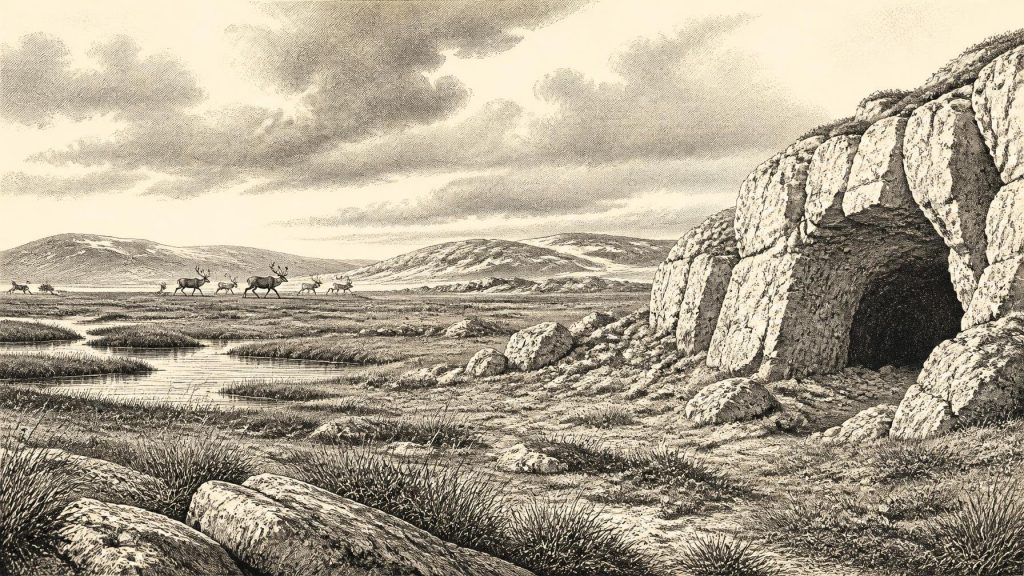
The most defensible environmental picture is of a cold, largely treeless mosaic rather than an unbroken white desert. Wind-exposed grassland, herb-rich steppe-tundra, patches of dwarf shrub, bare mineral ground, seasonal pools and sheltered valleys could each have existed in differing proportions. Plant macrofossils, pollen, insects, animal bones and sediments are the means by which such landscapes are reconstructed; none supplies a photograph of one particular year. Conditions also varied sharply over centuries and millennia. A short warm pulse might encourage vegetation and grazing animals, while renewed cooling could reduce food, deepen permafrost and alter the accessibility of whole regions.
The Castlepook Faunal Archive
Castlepook Cave, also known as Mammoth Cave or Doneraile Cave, is central to any account of this period. Early twentieth-century excavators recovered a remarkable collection from its passages: remains attributed to woolly mammoth, reindeer, giant deer, brown bear, wolf, red fox, Arctic fox, mountain hare, collared lemming, Norwegian lemming and spotted hyaena. Re-dating has transformed understanding of this material. Improved pretreatment of bone collagen showed that several results obtained in the 1990s were too young, with Castlepook specimens yielding dates thousands of radiocarbon years older on re-analysis. The assemblage belongs substantially to Marine Isotope Stage 3, rather than forming a simple late-glacial animal list.
These animals are evidence for the presence of species in Ireland over broad spans of time, not proof that all stood together in one herd or shared one season. Cave deposits are especially difficult archives. A hyaena may have dragged in bones; carnivores may have chewed or scattered them; water, sediment movement, later animals and human excavation can redistribute them. Castlepook’s original excavation between 1904 and 1913 was invaluable in rescuing bones but took place before modern recovery, recording and dating standards. Recent work has sought surviving deposits and has confirmed their research potential, but a 2022 excavation did not identify cultural artefacts and found that many sediments had been disturbed or were recent. The cave is a major palaeontological archive, not a securely excavated Palaeolithic campsite.
Reindeer and a Possible Human Trace
A reindeer femur from Castlepook gives this otherwise remote date special historical interest. County Cork heritage interpretation has described a deep mark on the bone as consistent with processing by a sharp stone implement, and has associated the specimen with an age of roughly 33,000 years ago. If that interpretation is sustained by further microscopic and contextual work, it may record a brief human encounter with a reindeer carcass during the Middle Upper Palaeolithic. It would be immensely significant: a hint that people reached what is now Ireland long before the better-known post-glacial settlement of the island.
That possibility must be kept distinct from what the evidence proves. A radiocarbon measurement dates the animal’s death within a range; it does not, by itself, date the making of a surface mark or establish who made it. Nor has Castlepook produced a securely associated hearth, stone-tool assemblage, dwelling floor, burial, repeated butchery area or occupation layer of comparable age. One modified bone cannot tell us how many people may have been present, whether they lived locally, what language they spoke, or whether any visit led to continued occupation. It cannot support an invented hunting party, a named ‘first settler’, or a claim that Ireland possessed a settled population in 31,275 BCE.
There is a useful comparison in the later Irish record. At Alice and Gwendoline Cave in County Clare, a brown-bear kneecap bearing cut marks has been directly dated to calibrated ranges of roughly 12,890–12,678 cal BP and 12,680–12,252 cal BP. That terminal-Pleistocene find has been published as evidence of human activity, while its cave context and implications have also been debated. Subsequent excavation showed that much of the cave sediment had arrived through natural processes. The lesson applies even more strongly to Castlepook: old bones can illuminate possibilities, but rigorous interpretation depends on taphonomy, independent dating, secure stratigraphy and reproducible study.
Society Beyond Recovery
There is no evidence from Ireland around this point for political communities, rulers, territorial states, diplomacy or organised warfare. Equally, there is no Irish evidence for houses, clothing, family structure, burial practice, ritual sites, art, music, language, teaching, exchange networks or formal religion. These are not neglected subjects; they are questions for which the surviving Irish record currently has no dependable answer. A cave bone with a possible cut mark may imply the use of a sharp tool and knowledge of carcass processing, but it does not disclose a social system.
Across north-western Europe, Homo sapiens groups of the Upper Palaeolithic did make sophisticated stone tools, hunt and scavenge large animals, maintain social ties across landscapes, and in some places create ornaments and cave art. Those wider comparisons establish what humans were capable of, not what occurred in Ireland. It is reasonable to infer that any visitors capable of processing a reindeer would have needed practical knowledge, co-operation and mobility. It is not reasonable to transfer the settlements, art traditions or political relationships of France, Britain or continental Europe directly to County Cork without Irish finds.
Economy, Movement and Risk
If people did reach Ireland in this period, their economy would have been one of mobile foraging rather than farming. There were no crops, domestic livestock, pottery villages, metal tools or trade ports. Reindeer could have offered meat, fat, hides, sinew, antler and bone; large herbivores may have been important resources but also difficult and dangerous targets. Carnivores mattered as competitors as well as scavengers. Spotted hyaenas at Castlepook are particularly revealing: caves could serve as carnivore dens and bone accumulators, making them attractive archives for modern researchers but risky shelters for humans.
Seasonality was probably decisive. Animal movements, snow cover, access to freshwater and the availability of fuel and plant foods would all have shaped where small groups could travel and how long they could remain. The apparent richness of Castlepook’s fauna should not be confused with abundance everywhere or throughout the year. Ice Age ecosystems could be productive in brief summers yet punishingly exposed in winter. The later expansion of ice during the Last Glacial Maximum probably erased many routes, habitats and traces of earlier activity, helping explain why Ireland’s record for this era is so sparse.
What This Year Can Mean
For Ireland, 31,275 BCE is best understood not as an anniversary but as a carefully bounded horizon of inquiry. Around 33,224 cal BP, Ireland lay within a volatile pre-maximum Ice Age world connected to wider European environments by lowered seas and changing terrain. Castlepook Cave demonstrates that cold-adapted mammals, including reindeer and spotted hyaena, reached this western edge of Europe. Its reindeer femur raises the consequential possibility of human handling. At present, however, it remains a possible trace rather than a foundation for a detailed national prehistory. The most important development is therefore methodological as much as historical: re-dating old collections, re-excavating surviving deposits and resisting the temptation to convert one compelling bone into a fully peopled past.
Primary Sources
- A reconsideration of the radiocarbon dating of the Marine Isotope Stage 3 fauna from southern Ireland
- The Irish quaternary fauna project
- First evidence of a Late Upper Palaeolithic human presence in Ireland
- New insights on the fauna of Ireland's Younger Dryas and Early Holocene from Alice & Gwendoline Cave
- Growth and retreat of the last British–Irish Ice Sheet, 31 000 to 15 000 years ago: the BRITICE-CHRONO reconstruction
- Late Pleistocene chronostratigraphy and ice sheet limits, southern Ireland
- Maximum extent and dynamic behaviour of the last British–Irish Ice Sheet west of Ireland
- Timing and pace of ice-sheet withdrawal across the marine–terrestrial transition west of Ireland during the last glaciation
- Trimlines, blockfields and the vertical extent of the last ice sheet in southern Ireland
- Dating constraints on the last British-Irish Ice Sheet: a map and database
- Reconstruction and 36Cl based geochronology of the deglaciation of central Ireland
- The exploration of Castlepook Cave, County Cork
- Occurrence of mammalia relicts at site Castlepook Cave
- 2022:564 – Castlepook Cave, Castlepook South, Cork
- Heritage Artefacts of County Cork
- Archaeological Heritage of County Cork
- Irish Caves Database: Mammoth Cave
- The Irish Quaternary Fauna Project
- Pleistocene vertebrates in the British Isles
- A 60,000 year Greenland stratigraphic ice core chronology
- Quality assurance of ultrafiltered bone dating
- AMS radiocarbon dating of ancient bone using ultrafiltration
- Removing contaminants: a restatement of the value of isolating single compounds for AMS dating
- Ireland's Palaeolithic Archaeology – Fleeting Footprints in a Frozen Land