Castlepook at the Ice Threshold31155 BCE
31,155 BCE is an imprecise modern label for a late Marine Isotope Stage 3 interval, rather than a date with recorded events. Derryvree in Fermanagh preserves freshwater sediments, tundra plants and evidence of ice-free conditions within a cold, unstable landscape later overridden by glaciers. Castlepook Cave, County Cork, contains a complex, redated fauna including reindeer, mammoth, giant deer, predators and cold-adapted species, demonstrating changing ecological links with north-west Europe. A possibly cut-marked reindeer bone may indicate transient human activity, but no settlement is proven. Ireland was environmentally diverse, intermittently habitable and moving towards extensive glaciation over the following several millennia.
Dateline
31,155 BCE is a modern label placed on a stretch of deep prehistory, not a year anyone in Ireland could have named, recorded or experienced as a date. There is no annual chronicle for this period, no king, community or event that can responsibly be assigned to that precise year. In radiocarbon convention, the label falls around 33,100 calendar years before present (where “present” is AD 1950), but that conversion must not be mistaken for calendar-year precision. At this depth in time, even well-dated evidence normally produces ranges of centuries or millennia. The most useful question is therefore not what happened in Ireland in one imagined year, but what the archaeological and environmental record can securely say about Ireland around the later part of Marine Isotope Stage 3, before the Last Glacial Maximum.
A Date Within a Range
The closest important Irish chronological anchor is not a settlement but a buried wetland at Derryvree, near Maguiresbridge in County Fermanagh. Roadworks exposed organic freshwater silts and fine sands enclosed between two layers of glacial till in a drumlin. Organic material from this deposit returned a conventional radiocarbon age of about 30,500 radiocarbon years BP, with a large uncertainty; calibration has been expressed as a broad range of roughly 36,900–31,700 calendar years BP. That range overlaps the notional date represented by 31,155 BCE. It does not mean that the Derryvree bed was laid down in that exact year. Rather, it shows that north-central Ireland contained an ice-free freshwater environment during part of this long interval before a later advance of glacier ice sealed it beneath till.
Such a distinction matters. Radiocarbon ages are measurements with error margins, and their conversion into calendar ages depends on calibration curves that are themselves refined as new evidence becomes available. Beyond the reach of securely dated tree rings, calibration relies on combined evidence from floating tree-ring sequences, lake sediments, marine sediments, cave deposits and corals. A numbered BCE year is thus useful as an index entry, but it is not a licence to make precise claims about weather, migration or human action on a particular day or season.
A Patchwork Before Maximum Glaciation
Ireland was moving towards the great expansion of the last British–Irish Ice Sheet, but it was not yet uniformly the ice-covered land of the later Last Glacial Maximum. The island’s glacial history was regionally varied and remains actively reconstructed from landforms, sediments, offshore cores and numerical modelling. The Derryvree organic bed, alongside comparable evidence at Greenagho in Fermanagh and evidence for open water off the west coast, demonstrates that simple pictures of an Ireland continuously buried beneath ice are wrong.
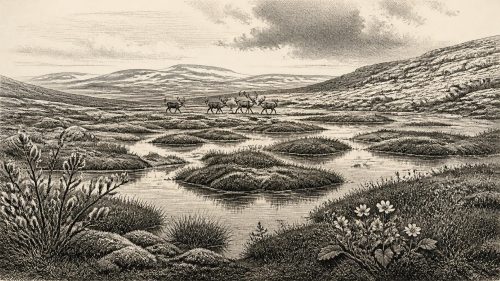
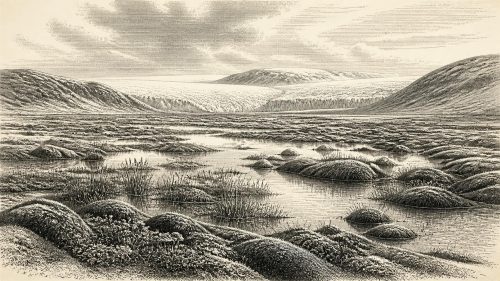
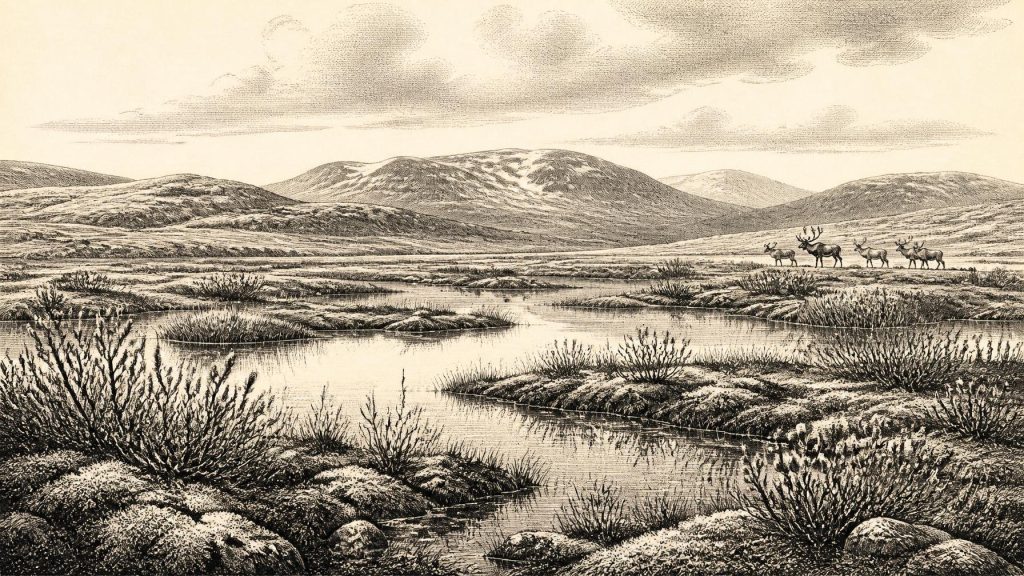
At about this time, conditions were cold, open and unstable by modern standards. The vegetation indicated by Derryvree’s plant remains and pollen was not woodland. It included mosses and herbaceous tundra plants, with species capable of living in wet, exposed, periglacial ground. Sedges, dwarf willow, mountain-avens, bogbean and aquatic plants such as water-milfoil have been identified in the wider Fermanagh inter-till record. The combination suggests shallow freshwater, marshy margins and open ground within a cold landscape, rather than a single unchanging plain of snow. It also indicates summer thaw, liquid water and enough growing season for specialised plants, even while prolonged frost and sparse vegetation constrained life.
These deposits illuminate an environmental window, not the whole island at once. A wet basin in Fermanagh cannot tell us the precise state of a limestone valley in Cork, a mountain in Wicklow or the Irish Sea floor. Nor can plant fossils alone supply annual temperatures. They do, however, establish a central fact: parts of Ireland could sustain freshwater ecosystems and tundra vegetation before renewed glaciation overran and preserved them. Later ice was an agent of destruction as well as preservation, eroding or burying older landscapes and greatly limiting what survives for archaeologists to find.
North Cork’s Cave Fauna
For animals, the richest directly relevant archive lies far to the south-west at Castlepook Cave—also called Mammoth Cave or Doneraile Cave—near Doneraile in north County Cork. Early twentieth-century digging recovered a large but complicated collection of Pleistocene bones from its passages. The assemblage has included reindeer, giant deer, red deer, brown bear, wolf, Arctic fox, mountain hare, lemmings, woolly mammoth and spotted hyaena. It presents a striking image of Ireland as part of a wider north-west European cold-stage ecosystem, visited or occupied at different times by grazing animals, predators and scavengers.
That image must be handled cautiously. A cave bone is evidence that an animal, or an animal’s remains, reached the cave; it is not automatically evidence that all species lived together, or even in the same millennium. Castlepook’s deposits were excavated long ago, were affected by complex cave processes, and include material from more than one phase. The Irish Quaternary Fauna Project showed why direct dating was essential, while later ultrafiltration dating demonstrated that some 1990s radiocarbon determinations from Castlepook were substantially too young. Re-dating pushed some specimens back by approximately 5,000 to 12,000 radiocarbon years and strengthened the conclusion that elements of the fauna belonged to Marine Isotope Stage 3.
For a point around 33,100 calendar years BP, Castlepook therefore supports a broad, not a year-specific, conclusion: cold-adapted and open-country mammals reached Ireland during the pre-maximum phase of the last glaciation. Reindeer are especially evocative, but they should not be used to turn all of Ireland into a uniform “reindeer steppe”. Their remains, and those of Arctic fox and lemmings, show northern ecological connections; giant deer, bears and hyaenas show that the faunal world was varied and changed through time. Carnivores could drag carcass parts into caves, while water, collapse and excavation could mix them further.
The Human Question
A reindeer femur from Castlepook has attracted particular attention because one mark on it has been interpreted as a cut or chop made by a sharp stone tool while the bone was fresh. Public heritage accounts have associated the object broadly with about 31,000 BC, raising the possibility that people processed a reindeer in Ireland far earlier than the long-accepted post-glacial settlement of the island. If that interpretation is sustained, it would be extremely important: it would indicate a brief Upper Palaeolithic human presence or visit during a cold-stage interval when Ireland was connected ecologically with Britain and continental Europe.
But the evidence does not yet justify a detailed story of hunters, a camp or a migration route. No securely associated stone-tool assemblage, hearth, dwelling surface, burial or human bone of comparable age has been recovered at Castlepook. The femur derives from an old collection rather than a modern excavation of a sealed occupation layer. A single possible butchery mark can support the proposition that human handling is plausible; it cannot demonstrate that the animal was hunted locally, that people lived in the cave, or that there was a permanent population. Recent excavation has sought to improve the cave’s archaeological context, but Castlepook remains a research problem rather than an established Palaeolithic settlement.
This is also why political affairs, diplomacy and warfare cannot responsibly be reconstructed for Ireland around this date. There is no evidence for polities, territorial institutions, named communities, formal leadership or organised conflict. If humans did enter Ireland, they may have belonged to small, mobile hunter-gatherer groups whose social relationships left no identifiable record here. That is an inference from the wider Upper Palaeolithic world, not a demonstrated fact about an Irish group in 31,155 BCE.
Livelihood Without an Economy
Neither farming nor trade can be documented. Fields, livestock, pottery, metal, monuments and settled villages all belong to immensely later Irish prehistory. The only possible economic activity near this date is the processing of animal carcasses suggested by the Castlepook femur, and even that remains contingent on the cut-mark interpretation. Reindeer, giant deer and other herbivores could have been resources for meat, hides, sinew, bone and antler if people were present. Yet no Irish artefact assemblage demonstrates those practices for this interval.
Likewise, there is no Irish evidence for shrines, graves, art, formal learning or religion. Caves can easily encourage imaginative stories, but Castlepook’s known significance is palaeontological and geological. Its animal assemblage reveals a changing ecosystem; it does not establish ritual use. Culture is visible here chiefly in the discipline of modern research: excavation records, faunal identification, taphonomic study, radiocarbon measurement and repeated reassessment of old collections.
An Island in Transition
The principal development around this notional date was environmental transition. Ireland was not yet at the last ice sheet’s maximum extent, which came thousands of years later, but the climatic trajectory was towards more extensive glaciation. Recent British–Irish Ice Sheet reconstructions begin at 31,000 years BP—later than the BCE label used here—and model rapidly accumulating ice, including a northern Irish centre, after that point. Their value is not to provide a photograph of Ireland in 31,155 BCE, but to show how quickly the setting recorded at Derryvree could be overtaken by expanding ice.
Thus the responsible portrait is neither of a blank, lifeless Ireland nor of a populated prehistoric nation. It is of an intermittently habitable, cold and environmentally diverse island on Europe’s north-western edge: wet tundra basins in Fermanagh; cave corridors in north Cork accumulating the remains of animals; and changing sea, ice and land routes that permitted some species to arrive while making survival precarious. The named year is unknowable. The evidence instead preserves a longer story of freshwater life, open-country fauna and an approaching ice surge.
Primary Sources
- A reconsideration of the radiocarbon dating of the Marine Isotope Stage 3 fauna from southern Ireland
- The Irish Quaternary Fauna Project
- Growth and retreat of the last British–Irish Ice Sheet, 31,000 to 15,000 years ago: the BRITICE-CHRONO reconstruction
- Growth and retreat of the last British–Irish ice sheet, 31 000 to 15 000 years ago: the BRITICE-CHRONO reconstruction
- Trimlines, blockfields and the vertical extent of the last ice sheet in southern Ireland
- Palaeoecology
- The Quaternary of Northern Ireland: Field Guide
- The IntCal20 Northern Hemisphere Radiocarbon Age Calibration Curve (0–55 cal kBP)
- Marine20—The Marine Radiocarbon Age Calibration Curve (0–55,000 cal BP)
- New insights on the fauna of Ireland's Younger Dryas and Early Holocene from Alice & Gwendoline Cave
- New insights on the fauna of Ireland's Younger Dryas and Early Holocene from Alice & Gwendoline Cave
- Castlepook Cave, Castlepook South, Cork: 2022 excavation report
- Heritage Artefacts of County Cork
- Archaeological Heritage of County Cork
- Phylogeographic, ancient DNA, fossil and morphometric analyses reveal ancient and modern introductions of a large mammal: the complex case of red deer in Ireland
- Mammoth Cave
- On the Cave of Castlepook, Near Doneraile, Co. Cork
- Occurrence of mammalia relicts at site Castlepook Cave
- Response of the Irish Ice Sheet to abrupt climate change during the last deglaciation
- Reconstructing the last Irish Ice Sheet 2: a geomorphologically-driven model of ice sheet growth, retreat and dynamics