Derryvree’s Waterlogged Witness31154 BCE
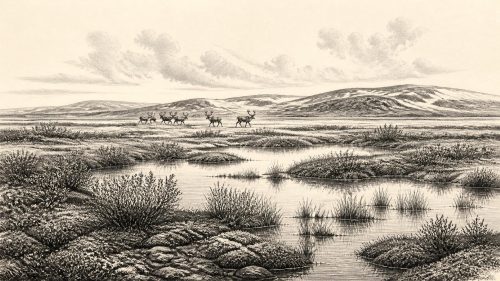
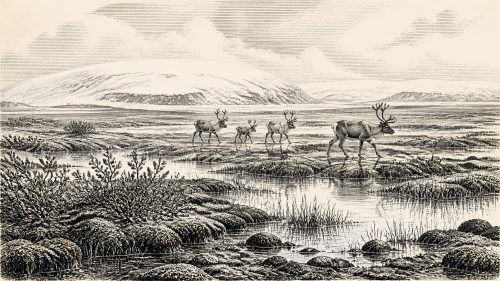
Around 31,154 BCE, Ireland lay within a climatically unstable Late Pleistocene interval, not a precisely recoverable historical year. Derryvree, County Fermanagh, preserves freshwater sediments between glacial tills, showing locally ice-free, cold wetland conditions with pools, mosses and tundra vegetation. Radiocarbon evidence dates this interval broadly, rather than annually. Ireland was approaching renewed extensive glaciation, amid abrupt climatic shifts. Castlepook Cave, County Cork, contains a diverse cold-stage fauna, including mammoth, reindeer, giant deer and predators. A marked reindeer bone may indicate human activity, but cannot demonstrate settlement, permanence or social organisation. Evidence remains fragmentary, local and ecologically rather than politically informative.
Dateline
“31,154 BCE” is a modern calendar label, not a year that can be recovered with annual precision from Ireland’s Late Pleistocene record. No written chronology, settlement sequence or archaeological layer can be assigned to that exact year. In conventional archaeological terms, the date falls roughly 33,100 calendar years before AD 1950, within Marine Isotope Stage 3, a long and climatically volatile part of the last Ice Age. The most responsible account of Ireland at this point is therefore not a narrative of named people or events, but a reconstruction from caves, buried wetland sediments, fossil bones, pollen, insects and the landforms left by advancing ice.
A Date Within a Broad Window
The most informative evidence close to this notional date comes from Derryvree, near Maguiresbridge in County Fermanagh. Road works in 1969 cut through a drumlin and exposed an unusual sequence: organic freshwater silts and fine sands enclosed between two thick sheets of glacial till. The lower till recorded an earlier episode of ice deposition; the organic bed recorded a period in which this particular locality was free of overriding glacier ice; the upper till showed that ice later returned. The deposit produced the conventional radiocarbon determination Birm-166, 30,500 radiocarbon years before present, with a substantial published uncertainty of +1,170 and −1,030 years.
Radiocarbon years are not calendar years. When calibrated, the Derryvree result has been placed broadly between about 36,900 and 31,700 calibrated years before present. The modern label 31,154 BCE lies within that wide range, but it cannot identify the beginning or end of the marsh, a particular season, or the life of a particular animal. The deposit is best understood as evidence for a span of time in the later Middle Midlandian, rather than an annual diary. It is also local evidence: Derryvree demonstrates ice-free freshwater conditions near Maguiresbridge during the interval represented by its sediments; it does not prove that every part of Ireland was ice-free at once.
A Marsh in a Cold Landscape
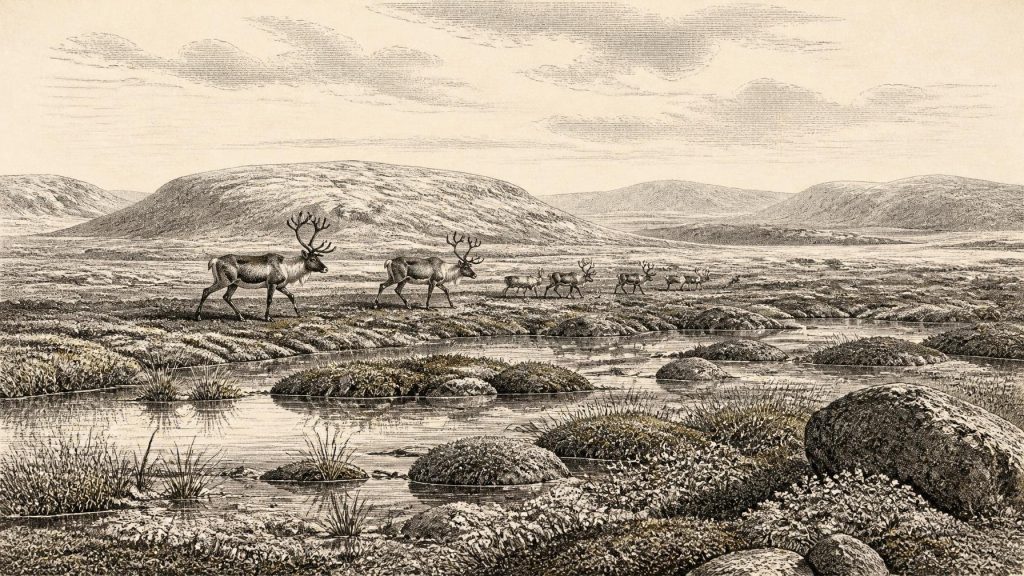
Derryvree’s organic bed offers a rare view of an Irish landscape that was cold, open and alive. Its plant and animal remains indicate tundra-like vegetation and a periglacial regime, meaning a climate shaped by severe freezing and thawing close to the margins of ice. Mosses, herb pollen, aquatic plants and insect remains point to a wet mosaic rather than a featureless frozen plain. There were shallow pools and waterlogged ground rich in plant matter, with mossy margins and low vegetation around them. The environment has been described as muskeg-like: a cold, wet peat-forming terrain, broken by standing water and patches of sedge or herb-rich ground.
Some of the fossils are especially useful because they have narrow ecological requirements. Finds associated with the Derryvree deposit include mountain-avens, bogbean and alpine clubmoss, plants that support the reconstruction of open, cold-climate habitats. Their presence does not mean that the whole island resembled a modern Arctic upland, nor that every plant grew together in one square metre. Fossil assemblages accumulate over time and across small habitats. Nevertheless, the combined evidence strongly supports sparse tree cover, exposed ground, freshwater pools and vegetation adapted to short growing seasons. The few tree pollen grains reported in the sequence are not secure proof of woodland: such grains can travel far on the wind or be reworked from older sediments.
Before the Last Ice Maximum
This was an Ice Age landscape, but not yet the best-established maximum of the last Irish ice sheet. Later in the glacial cycle, ice expanded across much of Ireland and onto the surrounding continental shelf. Reconstructions differ in detail because ice margins were dynamic and dating evidence is uneven, but major offshore advances occurred considerably later than the Derryvree freshwater interval, with shelf-edge glaciation in western sectors around 27,000 years ago. At roughly 33,100 calibrated years before present, Ireland was approaching a more extensive glacial phase, not uniformly buried beneath the final maximum ice cover.
The sequence at Derryvree makes this regional change tangible. It preserves an interval of open water and vegetation between episodes of glacial deposition, then records the loss of that environment beneath renewed ice. Farther west, cave formations at Crag Cave in County Kerry preserve another kind of climatic evidence. Speleothems grow only when liquid water can percolate through rock, and their interrupted growth during the last glacial cycle shows that milder interstadial conditions were episodic rather than permanent. Ireland’s climate at this scale did not move steadily from mild to cold. It altered abruptly and repeatedly, with local landscapes responding to shifts in temperature, precipitation, snow cover and ice extent.
Animals at Castlepook
County Cork provides a complementary, though differently complicated, archive. Castlepook Cave, also known as Mammoth Cave or Doneraile Cave, near Doneraile contains Ireland’s richest known pre-Last Glacial Maximum vertebrate assemblage. Excavations in the early twentieth century recovered more than 2,000 bones from cave deposits disturbed and accumulated over long periods. The recorded fauna includes woolly mammoth, giant deer, reindeer, brown bear, spotted hyaena, wolf, Arctic fox and both collared and Norwegian lemmings. Such a list establishes that parts of Ireland could support, or at least receive, a diverse cold-stage fauna during Marine Isotope Stage 3.
It does not produce a simple scene from one day in 31,154 BCE. Cave deposits can mix material carried in by predators, water, scavengers and later disturbance; bones of different ages may lie close together. A mammoth bone from Castlepook once returned a conventional radiocarbon age of 33,400 ± 1,200 years before present, helping to place part of the assemblage broadly near this period. The fauna nevertheless illuminates real ecological relationships. Reindeer and giant deer required grazing or browsing country; lemmings are consistent with open cold habitats; large carnivores show that carcasses and prey formed part of a functioning food web. Spotted hyaenas may have brought bones into the cave, so the assemblage is not a direct inventory of animals killed at its entrance.
The Human Question
The most consequential, and most limited, evidence for people is a reindeer femur from Castlepook reported to bear a deep mark interpreted as a cut or chop made on fresh bone with a sharp stone implement. The bone has been publicised as dating to roughly 33,000 years ago. If that interpretation and dating relationship are sustained, it indicates that a human or small party processed a reindeer in Ireland during the Late Pleistocene, far earlier than the island’s well-attested Mesolithic settlement. It would be evidence of activity, however, not of a village, a permanent population or a continuous line of descent to later inhabitants.
There are no securely contemporary houses, hearths, stone-tool assemblages, human burials or human skeletal remains from Ireland that permit a fuller account of those possible visitors. Nor can the femur identify whether people hunted the animal, encountered a carcass already killed by predators, or came from a group based elsewhere. Stone-tool marks are valuable evidence, but a single modified bone cannot reveal language, kinship, clothing, group size or the length of a stay. Later Upper Palaeolithic groups elsewhere in north-western Europe used stone, bone, wood, hides and animal sinew, but applying their practices wholesale to Ireland would be interpretation, not direct Irish evidence.
No Politics, No Trade Network
For that reason, it would be misleading to invent political affairs, warfare, diplomacy, trade routes or religious institutions for Ireland in this year. No chiefs, territories, alliances, shrines, graves or ceremonial monuments are known from the Irish record at this horizon. Predators competed for carcasses; that is ecology, not evidence of human conflict. Likewise, reindeer hide, meat, marrow and sinew would have been useful resources if people were present, but no Irish assemblage of this age demonstrates an economy, exchange system or regular hunting territory. Agriculture, livestock, pottery, metalworking and monumental building lay tens of millennia in the future.
What can be said is both narrower and more remarkable. Around the broad period represented by 31,154 BCE, parts of Ireland were not an empty abstraction beneath unbroken ice. At Derryvree, freshwater pools, mosses and cold-adapted plants survived between glacial episodes. At Castlepook, a varied large-mammal fauna occupied or passed through southern Ireland’s open country. A single marked reindeer bone raises the possibility that humans entered this demanding world. The enduring lesson is one of caution: Ireland’s earliest history is preserved not in a calendar of events, but in fragile fragments that reveal a changing island at the edge of ice.
Primary Sources
- A Middle Midlandian Freshwater Series at Derryvree, Maguiresbridge, County Fermanagh, Northern Ireland
- Exploring controls of the early and stepped deglaciation on the western margin of the British-Irish Ice Sheet
- Episodic Speleothem Deposition Tracks the Terrestrial Impact of Millennial-Scale Last Glacial Climate Variability in SW Ireland
- Castlepook Cave: Cork County Geological Site Report
- The Subdivision of the Quaternary Period in Ireland
- Palaeoecology
- Occurrence of Mammalia Relicts at Site Castlepook Cave
- Pleistocene Vertebrates in the British Isles
- Pattern and Timing of Retreat of the Last British-Irish Ice Sheet
- Trimlines, Blockfields and the Vertical Extent of the Last Ice Sheet in Southern Ireland
- The Deglaciation of the Western Sector of the Irish Ice Sheet from the Inner Continental Shelf to its Terrestrial Margin
- First Evidence of a Late Upper Palaeolithic Human Presence in Ireland
- First Evidence of a Late Upper Palaeolithic Human Presence in Ireland
- The Colonization of Ireland: A Human Ecology Perspective
- The Colonization of Ireland: A Human Ecology Perspective
- New Insights on the Fauna of Ireland's Younger Dryas and Early Holocene from Alice & Gwendoline Cave
- Archaeology Research Excavation Grant 2022: Final Report
- Archaeological Heritage of County Cork
- Prehistoric Details
- Castlepook Caves
- Historic Environment Viewer for Archaeological and Architectural Heritage
- Archaeological Survey