Derryvree’s Sedge Horizon31161 BCE
31,161 BCE is a label for a Late Pleistocene interval, not a recoverable Irish year. At Derryvree, County Fermanagh, freshwater sediments between glacial tills record a cold, open wetland of sedges, mosses and insects during an ice-free episode within Marine Isotope Stage 3. Other deposits confirm fluctuating glacial conditions, while ice-sheet extent and crossings remained variable. Castlepook Cave in County Cork preserves MIS 3 fauna, including reindeer, mammoth, hyena and lemmings, although its disturbed deposits require caution. A cut-marked reindeer bone may indicate Upper Palaeolithic human activity, but proves neither settlement nor society. Together, these archives document environments, not institutions.
Dateline
“31,161 BCE” is a modern chronological label, not a year that can be recovered from an Irish record. No calendar, written testimony, named community or datable event survives from this depth of time. In radiocarbon convention it lies approximately 33,110 years before AD 1950, but that conversion should not suggest annual precision. The responsible scale is a broad calibrated interval of millennia. Around this notional point, Ireland belonged to the Late Pleistocene, within Marine Isotope Stage 3: a climatically unstable part of the last Ice Age, before the fullest expansion of the last British–Irish Ice Sheet.
The closest Irish environmental evidence comes not from a settlement but from a buried wetland at Derryvree, near Maguiresbridge in County Fermanagh. Roadworks in 1969 cut through a drumlin and exposed silts, fine sands and organic layers trapped between two distinct sheets of glacial till. The deposit was therefore formed after an earlier ice advance and before later ice covered the site again. Its conventional radiocarbon determination, roughly 30,500 radiocarbon years BP with a substantial uncertainty, has been calibrated broadly to about 36,900–31,700 years ago. That range overlaps the date in question, though it cannot identify conditions in one particular season, decade or year.
A Wetland Between Ice Advances
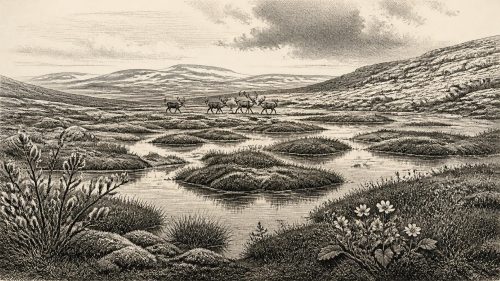
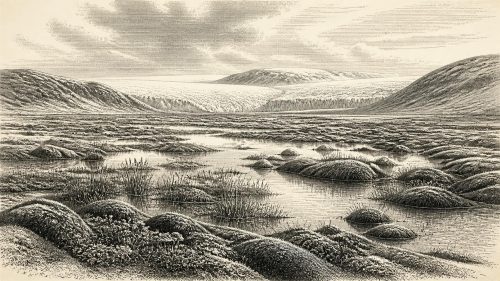
Derryvree is exceptionally valuable precisely because later ice and erosion have destroyed or disturbed so much of Ireland’s older Pleistocene evidence. It preserves a small, local episode when liquid fresh water, sediment and plant matter accumulated in a low-lying basin. Mosses, sedges and other freshwater or wet-ground plants, along with insect remains indicating cold northern conditions, show that this was not a forested or cultivated countryside. It was a cold, open environment with shallow water, marshy margins and short growing seasons. The evidence supports a mosaic of wetland and sparse tundra-like vegetation; it does not support a detailed national map, an exact annual temperature or a claim that all of Ireland looked alike.
Other Fermanagh deposits, at Hollymount and Greenagho, also indicate intervals of cold but non-glacial conditions during the Midlandian, the Irish name commonly used for the last glacial cycle. Their ages and correlations are imperfect, and individual measurements have different degrees of reliability. Taken together, however, they demonstrate an important point: Ireland’s Ice-Age history was not a single, uninterrupted freeze. Ice margins shifted, local water bodies formed and vanished, and ecological opportunities opened briefly before renewed glaciation sealed or removed much of the record.
That changing landscape is the principal “political geography” available for this article. There were no states, chiefs, boundaries, diplomatic missions or warfare attested in Ireland. To write of territorial control, alliances or raids would be invention. The forces organising life were instead ice, wind, meltwater, vegetation, animal movement and access across a north-west European landscape whose coastlines and sea levels differed greatly from those of today.
The Approaching Ice Sheet
The date falls during a difficult phase in reconstructing the British–Irish Ice Sheet. Research published in recent years has shown that its growth was neither simple nor synchronous. Some sectors had ice earlier than others; upland ice caps, marine margins and regional glaciers could advance or retreat on different schedules. By about 31,000 years ago, a substantial Scottish ice sheet was developing, and rapid expansion followed in the wider British–Irish system. Yet the precise extent, thickness and timing of ice over every part of Ireland at approximately 33,100 calibrated years ago remain uncertain.
Derryvree’s inter-till wetland proves that its own Fermanagh locality was ice-free long enough for freshwater sediments and organic material to build up before a later glacier overrode it. It does not prove that the whole island was ice-free at the same time. Conversely, evidence for growing ice in northern and western sectors cannot be used to declare the entire island uniformly ice-covered. The most defensible picture is regional change: areas of exposed ground and wetland existed amid a broader glacial world in which routes, habitats and coastlines could alter rapidly.
Sea level was lower than today because large volumes of water were stored in continental ice sheets. Much of the modern shelf around Ireland was exposed or shallower, but this fact alone does not demonstrate a continuous, walkable land bridge to Britain or continental Europe at this particular moment. The configuration of marine channels, ice fronts, lowlands and possible crossings changed over time. Mammal movement shows that Irish environments were not biologically isolated throughout MIS 3, but it cannot identify a single route or establish how often animals, let alone people, crossed.
Reindeer, Hyenas and Cave Archives
Southern Irish caves provide a second, striking body of evidence. Castlepook Cave, near Doneraile in north County Cork, produced Ireland’s richest known assemblage of pre-Last Glacial Maximum mammals. Its Ice-Age bones include reindeer, woolly mammoth, giant deer, brown bear, wolf, Arctic fox, mountain hare, lemmings and spotted hyena. Such a list should not be treated as a census from one day. The cave was excavated principally in the late nineteenth and early twentieth centuries, before modern stratigraphic methods, and its deposits accumulated over long periods. Carnivores could drag prey into chambers; water, frost and earlier digging could also mix material.
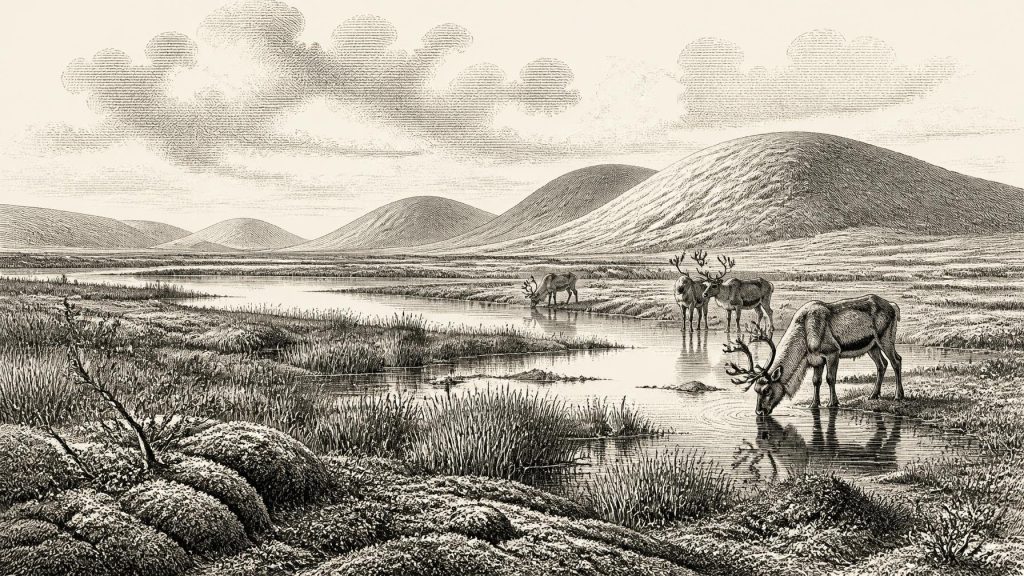
Nonetheless, the fauna establishes that cold-adapted and open-country animals reached Ireland during MIS 3. Reindeer and lemmings are especially consistent with exposed, cold environments, while the large herbivores indicate that enough forage existed, at least seasonally, to support substantial animals. Spotted hyenas are important not because they make Castlepook an African-like landscape, but because Pleistocene cave hyenas were northern Eurasian predators and scavengers capable of accumulating bone assemblages in caves. Tooth-marked and chewed bones accordingly warn against assuming that every carcass was killed, butchered or eaten by people.
Improved radiocarbon pretreatment has significantly revised the chronology of the Castlepook material. Dates once thought younger have proved to be between roughly 5,000 and 12,000 radiocarbon years older, placing much of the key fauna securely in MIS 3. This is a major methodological lesson for the year under review: old museum collections can acquire new historical importance when specimens are re-examined, directly dated and compared with revised glacial chronologies. But it is also a reason for restraint. A cave bone may securely date an animal’s death without securely dating its deposition, its modification or an associated human visit.
The Human Question
A reindeer femur from Castlepook has made this period especially significant for Irish prehistory. Zooarchaeologist Ruth Carden identified a deep incision interpreted as damage made by a sharp stone implement on fresh bone. Public heritage accounts have associated the specimen with a date of around 33,000 years ago and have presented it as evidence for very early human activity in Ireland. If the interpretation is confirmed, it would indicate that somebody processed a reindeer carcass in Ireland during the Upper Palaeolithic, far earlier than the formerly accepted record of human presence.
The claim must be framed exactly. It is evidence for a possible act of carcass processing, not proof of a permanent settlement, a named people, a hunting territory or a continuous population. No securely associated hearth, stone-tool assemblage, dwelling floor, burial, artwork or stratified camp has yet been recovered from Castlepook for this period. The direct date concerns the bone, rather than the exact moment at which the incision was made. Nor can a single modified bone resolve whether people arrived by a land route, crossed water, visited briefly, hunted locally or scavenged an animal already brought into the cave by predators.
For 31,161 BCE specifically, the find is relevant as part of a broader MIS 3 horizon rather than as an event dated to that year. It is responsible to say that Ireland may have been visited by Upper Palaeolithic people in the wider period represented by Castlepook. It is not responsible to populate the island with a settled hunting community at this exact date. The absence of evidence is partly a preservation problem: later glaciers scoured landscapes, while caves preserve selective and often disturbed traces. Even so, archaeology must distinguish what later loss makes possible from what surviving evidence actually demonstrates.
Life Without Institutions
Nothing supports discussion of government, diplomacy, religion, formal learning, trade networks, farming or domestic life in Ireland at this date. There were no fields, livestock, pottery, metalwork, monuments or houses known from the island. There is no evidence for ritual use of Castlepook Cave, despite the importance of caves in Palaeolithic art elsewhere in Europe. Neither should sophisticated Upper Palaeolithic cultures documented on the continent be automatically projected across the Irish Sea. Similar climate zones and animal communities do not themselves prove shared language, identity, technology or belief.
Economy, if people were present at all, can only be discussed at the most elementary level: the possible acquisition and processing of animal food, hide, sinew, bone or antler. Even this remains an inference from one modified reindeer bone, not a demonstrated subsistence system. Animal populations themselves were shaped by seasonal forage, predation and changing access to open ground. Wetlands such as Derryvree may have provided water, sedges and sheltered microhabitats, while surrounding open terrain supported grazing animals. These are ecological possibilities grounded in the deposits, not evidence for planned human resource management.
The year’s real historical subject is therefore not an episode in a national narrative but a fragile archive. Derryvree’s sedge-rich freshwater horizon captures an interval of life between ice advances in Fermanagh. Castlepook preserves a separate southern record of Ice-Age animals and a tantalising possible human action. Together they reveal an Ireland that was environmentally dynamic, locally habitable for specialised plants and animals, and perhaps briefly accessible to people. They do not yet reveal a society. That distinction is what makes the evidence both limited and extraordinary.
Primary Sources
- A Middle Midlandian Freshwater Series at Derryvree, Maguiresbridge, County Fermanagh, Northern Ireland
- Middle Midlandian Interstadial Deposits at Greenagho, Near Belcoo, County Fermanagh, Northern Ireland
- Early Midlandian–Middle Midlandian, Pleistocene, Northern Ireland
- Freshwater Organic Deposits and Stratified Sediments Between Early and Late Midlandian (Devensian) Till Sheets, at Aghnadarragh, County Antrim, Northern Ireland
- The Irish Quaternary Fauna Project
- A Reconsideration of the Radiocarbon Dating of the Marine Isotope Stage 3 Fauna from Southern Ireland
- Growth and Retreat of the Last British–Irish Ice Sheet, 31,000 to 15,000 Years Ago: the BRITICE-CHRONO Reconstruction
- The Timing and Magnitude of the British–Irish Ice Sheet Between Marine Isotope Stages 5d and 2: Implications for Glacio-Isostatic Adjustment, High Relative Sea Levels and ‘Giant Erratic’ Emplacement
- Pattern, Style and Timing of British–Irish Ice Sheet Advance and Retreat Over the Last 45,000 Years: Evidence from NW Scotland and the Adjacent Continental Shelf
- Behavioural Tendencies of the Last British–Irish Ice Sheet Revealed by Data–Model Comparison
- Pattern and Timing of Retreat of the Last British-Irish Ice Sheet
- Growth, Dynamics and Deglaciation of the Last British-Irish Ice Sheet: the Deep-Sea Ice-Rafted Detritus Record
- The Subdivision of the Quaternary Period in Ireland
- The Geological Heritage of County Leitrim
- Pleistocene Vertebrates in the British Isles
- European Vegetation During Marine Oxygen Isotope Stage 3
- Castlepook Cave, Castlepook South, Cork: 2022 Excavation Report
- Archaeology Research Excavation Grant 2022: Castlepook Cave Final Report
- Heritage Artefacts of County Cork 2021
- First Evidence of a Late Upper Palaeolithic Human Presence in Ireland
- New Insights on the Fauna of Ireland's Younger Dryas and Early Holocene from Alice & Gwendoline Cave
- Could Brown Bears (Ursus arctos) Have Survived in Ireland During the Last Glacial Maximum?