Castlepook’s Growing Ice Margin31018 BCE
31,018 BCE marks a poorly dated Late Pleistocene interval, not a recorded Irish event. Ireland was experiencing unstable cold conditions as the British–Irish Ice Sheet expanded towards its later maximum, though coverage remained uneven. Castlepook Cave in County Cork preserves diverse pre-maximum fauna, including mammoth, reindeer, giant deer, bear, wolves, foxes, lemmings and hyena, indicating open tundra-steppe habitats and continental connections. Buried Fermanagh deposits demonstrate cold but biologically active wetlands during less glaciated phases. A possibly tool-marked reindeer bone raises an unconfirmed possibility of human presence, but no secure settlement evidence exists. Bones, sediments and landforms instead reveal fragmentary environments.
Dateline
31,018 BCE is not a date at which Ireland can be described through an event, a ruler or a named community. It is a modern calendar label imposed on a period far beyond written memory. In archaeological terms it corresponds very approximately to 32,967 years before AD 1950, the reference point used for “before present” dating. Such arithmetic must not be mistaken for chronological precision: radiocarbon ages require calibration, and the useful evidence belongs to broad ranges measured in centuries or millennia. Around this notional point, Ireland stood within the Late Pleistocene, during Marine Isotope Stage 3 and the early build-up towards the Last Glacial Maximum.
The evidence is unusually thin but important. It comes chiefly from animal bones in caves, pollen and plant remains in buried sediments, glacial landforms, and modern reconstructions of ice-sheet growth. These sources illuminate changing environments and animal ranges far better than they reveal human lives. There were no states, political institutions, diplomatic contacts or recorded conflicts in Ireland in any sense that can be responsibly recovered. Whether people entered the island at all around this time remains an open archaeological question, not an established chapter of settlement.
A Date Without a Chronicle
Modern calendar-year precision is unavailable for 31,018 BCE. The date lies close to 33,000 years before present in simple numerical terms, but neither a radiocarbon determination nor an environmental sequence can identify what happened in a particular calendar year. A dated bone records, at best, when an animal died within a probability range; it does not automatically date a human action, a cave visit, or a settlement. Equally, a buried bed of plant-rich silt may represent years or centuries of deposition rather than a single episode.
The appropriate historical frame is therefore an interval: roughly the later part of Marine Isotope Stage 3, before the coldest and most extensive phase of the last British–Irish Ice Sheet. The Last Glacial Maximum is generally placed later, broadly between about 27,000 and 20,000 years ago, although ice-sheet margins did not reach their greatest extent everywhere at the same time. At about 33,000 years ago, climatic conditions were cold and unstable, while the ice system affecting Ireland was expanding unevenly. This was not yet a uniform white island sealed beneath maximum ice, but neither was it a familiar green landscape.
Ice Was Advancing, Not Yet at Its Peak
Recent reconstructions of the British–Irish Ice Sheet begin at 31,000 years before present because earlier margin evidence is sparse. They suggest centres of ice accumulation in Northern Ireland and Scotland, with smaller ice masses in south-west Ireland, including areas near Kerry and Cork. By about 29,000 years ago the ice sheet had expanded markedly; by around 28,000 years ago reconstructions depict ice covering almost all of Ireland. These are carefully modelled regional reconstructions, not a photograph of a single year, and their uncertainties matter greatly for a date around 31,018 BCE.
The broad implication is clear. Ireland was entering a severe phase of glacial growth. Snow surviving successive summers accumulated in uplands, glaciers flowed through valleys and across lowlands, and the sea level was much lower than today because immense quantities of water were held in global ice sheets. Coastlines lay far beyond their present positions on parts of the continental shelf. Yet low sea level did not create a simple, universally accepted land bridge between Ireland and Britain. The Irish Sea basin retained significant marine barriers, and the routes by which animals reached Ireland in different Pleistocene phases remain debated.
Glaciation also helps explain the poverty of the archaeological record. Ice erodes and redistributes sediments, while later meltwater and soil formation can obscure older surfaces. Any small open-air camp, hearth or scatter of stone tools from this period would have had little prospect of surviving intact. Caves and protected sediment traps offer better chances, but they too may contain material moved by water, carnivores, excavation or later human disturbance. Absence of evidence cannot demonstrate that no person ever set foot in Ireland; it does mean that claims of occupation must meet a very high evidential standard.
Castlepook and the Animal Record
The most revealing Irish locality for this broad period is Castlepook Cave, also called Mammoth Cave, near Doneraile in north County Cork. Excavations in the late nineteenth and early twentieth centuries, followed by later investigation and radiocarbon dating, produced Ireland’s richest known pre-Last-Glacial-Maximum vertebrate assemblage. Its importance lies not in a neatly sealed occupation layer, but in the range of animals represented and in the possibility of refining their separate histories through direct dating.
Finds attributed to the broader Castlepook assemblage include woolly mammoth, giant deer, reindeer, brown bear, wolf, foxes, mountain hare, collared and Norwegian lemmings, and spotted hyena. Not all these animals necessarily lived together, and they cannot all be assigned to 31,018 BCE. Cave deposits accumulated across different episodes; some bones were introduced by carnivores, some may have been moved by water, and older excavations did not record contexts to modern standards. The responsible conclusion is that, during parts of the interval before the ice maximum, Ireland supported or was visited by a strikingly varied cold-stage fauna.
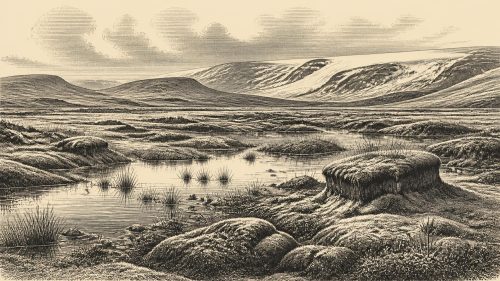
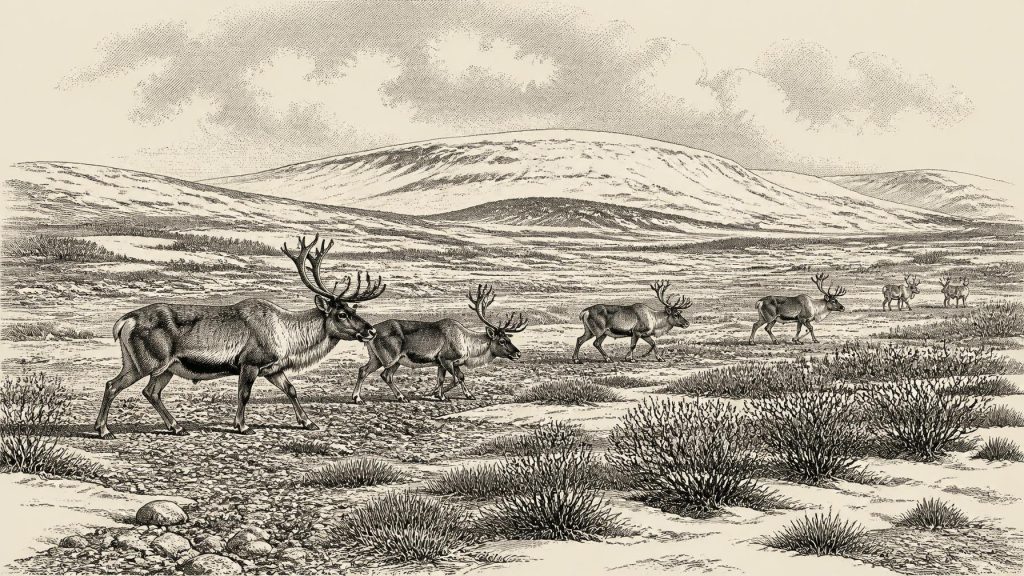
That fauna points to open habitats rather than dense forest. Reindeer, lemmings and Arctic fox indicate cold conditions; mammoth, giant deer and horse records elsewhere in southern Ireland evoke extensive grass- and herb-rich ground within a varied tundra-steppe mosaic. The term “mammoth steppe” is useful only as a broad ecological comparison. Ireland’s terrain, rainfall, maritime exposure and shifting ice margins would have created local mixtures of exposed mineral ground, grasses, sedges, dwarf shrubs, wet hollows, river margins and seasonal snow cover rather than one continuous biome.
Spotted hyena is especially significant. Its remains at Castlepook demonstrate that a large social carnivore associated with continental Pleistocene faunas reached Ireland in at least one pre-maximum phase. Hyenas could drag bones into caves and heavily modify carcasses. Their presence is therefore both a clue to the wider food web and a warning against assuming that every broken or marked bone records human behaviour. The cave was a place in animal landscapes: a possible den, shelter, trap or repository over long stretches of time, not automatically a human dwelling.
Wetlands Beneath Later Glacial Sediment
In County Fermanagh, buried organic deposits at Derryvree and Maguiresbridge offer a different kind of evidence. There, silts and plant remains lie between layers of glacial sediment. Their preservation shows that, before renewed ice overran the area, freshwater pools, wet ground and sedge-rich or moss-rich habitats existed within a cold landscape. Fossil plant records include taxa suited to severe northern conditions, such as mountain-avens, dwarf willow, clubmosses and bogbean. They reveal environments that were biologically active, not a lifeless polar desert.
These Fermanagh beds cannot be pinned securely to the modern year 31,018 BCE, and their dating and correlation have long been discussed by Quaternary researchers. Their value is contextual. They show that ice advance and retreat were punctuated by ice-free or less glaciated intervals in which water, vegetation and animals could occupy parts of Ireland. They also warn against portraying the Late Pleistocene as a single, unchanging “Ice Age”. Climate oscillated; local conditions depended on elevation, drainage, proximity to ice, season and the shifting paths of storm systems over the North Atlantic.
The Human Question
A reindeer femur from Castlepook has brought 31,018 BCE into discussions of Ireland’s earliest possible human past. It has been reported as carrying a linear mark interpreted by some researchers as a fresh-bone cut or chop made with a sharp stone tool, and it has been associated in public heritage interpretation with an age of roughly 33,000 radiocarbon years. If that interpretation is sustained by further analysis, it could indicate that an Upper Palaeolithic person processed a reindeer in Ireland far earlier than the island’s securely documented later prehistoric settlement.
But the inference must remain limited. A radiocarbon result dates the animal bone, not necessarily the moment when a surface mark was made. A single marked specimen does not establish a camp, a resident population, a hunting territory, a migration route or a social group. Castlepook has not produced a securely associated stone-tool assemblage, hearth, house floor, human bone or undisturbed butchery site of comparable antiquity. Carnivore damage, sediment movement and the complex collecting history of the cave all require rigorous taphonomic testing.
Accordingly, it is not responsible to describe an Irish society, economy, religion, art, learning, trade network or warfare for this year. If people did reach Ireland, they may have been highly mobile Upper Palaeolithic hunter-gatherers operating at the far north-western edge of wider European worlds. That is an interpretation drawn from the European context, not a demonstrated description of an Irish community. We do not know whether a visit was seasonal or accidental, whether it involved one person or many, or whether it left any descendants on the island.
What Can Be Said of Life?
The animal and environmental evidence nevertheless permits a restrained picture of everyday ecological reality. Large herbivores would have moved through open country in search of forage; predators and scavengers followed them; caves and rock shelters could serve as refuges or dens. In the wetland basins of the north, plants, insects and aquatic organisms persisted in cold freshwater settings. In the south, limestone caves preserved remains from episodes otherwise almost erased from the landscape. These were dynamic habitats, shaped as much by ice, thaw, water and wind as by living creatures.
For Ireland, 31,018 BCE is thus best understood not as the year of a known human event but as a threshold within deep time. Ice was building towards a far more extensive cover; the animal record proves intermittent connections with broader European faunas; and Castlepook preserves a tantalising but unconfirmed possibility of human intervention. The central historical lesson is one of evidential discipline. Ireland’s deep past is not empty, but it is fragmentary. Its surviving bones, sediments and landforms deserve to be read as traces of changing worlds, rather than forced into a calendar chronicle they cannot support.
Primary Sources
- Growth and retreat of the last British–Irish Ice Sheet, 31,000 to 15,000 years ago: the BRITICE-CHRONO reconstruction
- A reconsideration of the radiocarbon dating of the Marine Isotope Stage 3 fauna from southern Ireland
- The Irish Quaternary Fauna Project
- First evidence of a Late Upper Palaeolithic human presence in Ireland
- New insights on the fauna of Ireland's Younger Dryas and Early Holocene from Alice & Gwendoline Cave
- Prehistoric Details
- Castlepook Cave
- Heritage Artefacts of County Cork
- The Quaternary of Fermanagh and Tyrone
- Regional Pleistocene Geology
- The Quaternary of the Midlands
- Castlepook Cave, Castlepook South, Cork: Excavation Report 2022:564
- Mammoth Cave
- Pleistocene Vertebrates in the British Isles
- Proceedings of the Royal Irish Academy: The Pleistocene Fauna of Castlepook Cave
- The Last Glacial Maximum British–Irish Ice Sheet: a reconstruction using digital terrain mapping
- The deglaciation of the western sector of the Irish Ice Sheet from the inner continental shelf to its terrestrial margin
- Pattern, style and timing of British–Irish Ice Sheet retreat: Shetland and northern North Sea sector
- Map and GIS database of glacial landforms and features related to the last British Ice Sheet
- Ireland: Submerged Prehistoric Sites and Landscapes
- The Mesolithic in Ireland: when was it?
- Studies on the Early Settlement of Scotland and Ireland