Muskeg at Maguiresbridge31107 BCE
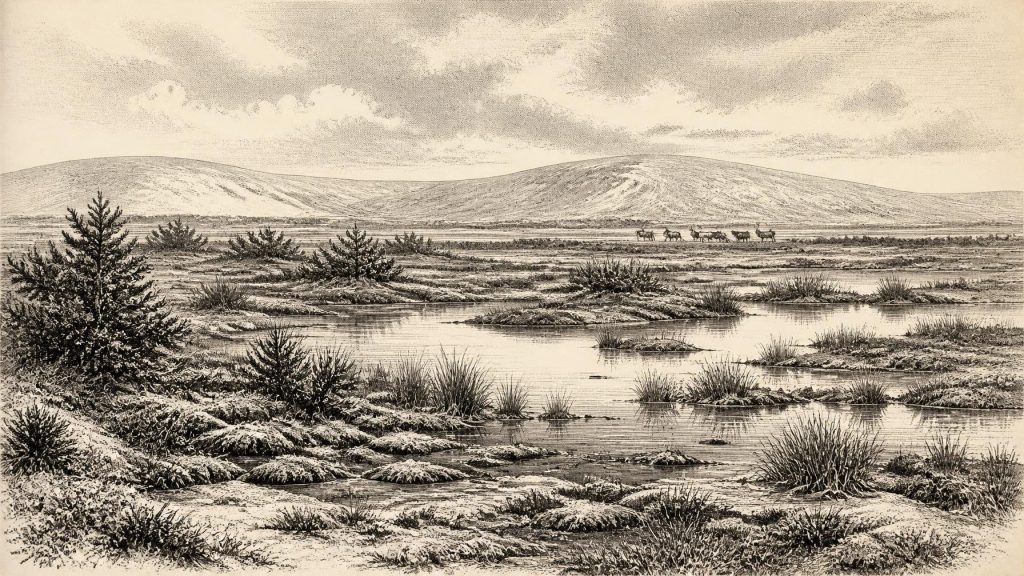
At the nominal date of 31,107 BCE, Ireland’s history is reconstructed from fragmentary Pleistocene evidence rather than annual records. Derryvree, County Fermanagh, preserves freshwater sediments between tills, dating broadly to this interval and indicating a cold, open, waterlogged tundra or muskeg during local ice retreat. Castlepook Cave, County Cork, records cold-stage fauna including mammoth, reindeer, giant deer, predators and smaller Arctic-adapted animals, though not a single contemporaneous community. Lower sea levels did not necessarily create a land bridge to Britain. A modified reindeer bone may suggest early human activity, but no settlement is proven. Later glaciation subsequently erased much evidence.
Dateline
Modern calendar-year precision is not available for Ireland in 31,107 BCE. The label is a retrospective convenience, roughly 33.1 thousand years before AD 1950, the reference point used in ‘BP’ dating. It belongs to the Late Pleistocene, within Marine Isotope Stage 3 (MIS 3): a long, climatically unstable part of the last glacial cycle. No Irish document, settlement sequence or archaeological layer can be assigned to this particular numbered year. The responsible history is therefore a reconstruction of a broad interval, based on buried sediments, fossil animals, glacial landforms and a small number of disputed traces of human action.
The closest unusually informative evidence comes from Derryvree, near Maguiresbridge in County Fermanagh. There, roadworks in 1969 exposed freshwater silts and fine sands sealed between two thick layers of till, the unsorted debris deposited by glacier ice. Organic material from the intervening beds produced a conventional radiocarbon result of 30,500 +1,170/−1,030 years BP (Birm-166). Calibration gives a wide calendar range, broadly about 36,900–31,700 calibrated years BP. The requested date falls within that range, but not at a recoverable point inside it. Derryvree can illuminate the kind of Irish environment that existed during part of this interval; it cannot tell us what happened in a single year.
A Wetland Between Ice Advances
Derryvree is important because it preserves a break in a glacial sequence. The lower till indicates that ice had previously reached the locality. Above it, freshwater sediments accumulated in an ice-free or at least locally deglaciated landscape. The upper till shows that glacier ice later returned. This is powerful evidence against any simple picture of Ireland as continuously buried under one uniform ice sheet throughout the later Ice Age. It also does not establish that the whole island was open at once. Ireland’s ice margins, uplands, lowlands and western marine approaches changed at different times, while later ice erosion destroyed much of the evidence that might have clarified the pattern.
The fossils from the Derryvree deposits indicate open, treeless tundra or muskeg: wet, cold ground with standing pools, saturated mossy surfaces and seasonally thawed sediment. Pollen, seeds, mosses and insect remains point to sedges and grasses, dwarf shrubs, juniper and herb-rich vegetation rather than forest. Botanical evidence includes plants capable of enduring short growing seasons and severe winters. It is a landscape better imagined as a patchwork of shallow water, peat-forming hollows, frost-disturbed soil and sparse cover than as an uninterrupted snowfield. Summer growth could be locally vigorous in wet ground, but the annual regime was harsh and highly seasonal.
The word ‘muskeg’ should not imply a modern bog transferred unchanged into the past. It is shorthand for the ecological interpretation of the deposits: cold, waterlogged ground rich in mosses and sedges, with open water and organic matter. The evidence is direct for plants and invertebrates found in the deposit; the wider reconstruction of temperature, precipitation and seasonality is interpretation, supported by comparisons with cold-climate environments and by the periglacial character of the sediments. It is not possible to extract a precise mean temperature, a particular winter’s snowfall or an annual sequence of floods from this record.
An Island at the Edge of Europe
At this depth of time, ‘Ireland’ means the landmass now occupied by the island, not a country, people or political territory. There were no known states, chiefs, boundaries, assemblies or diplomatic contacts here. Nor is there evidence for settlements, farms, houses, graves, monuments, language or ritual practice. The categories that dominate later Irish history—kingship, warfare, trade, religion and learned culture—have no securely documented equivalents in the surviving evidence from around 33,100 years ago.
Sea level was far lower than today because large volumes of water were held in northern ice sheets. The Irish Sea basin and coastal shelves consequently looked very different, with more exposed land around the margins. Yet lower sea level should not automatically be turned into a convenient land bridge. Recent syntheses argue that Ireland remained insular during the Pleistocene and that a terrestrial connection to Britain has not been demonstrated. The precise configuration of coasts, straits, sea ice and local ice margins at this early date remains difficult to model. What can responsibly be said is that Ireland lay on north-west Europe’s Atlantic edge, and that movement of animals or people cannot simply be assumed from the later map of the islands.
That insular position matters for ecology. Plant and animal populations had to reach, survive in and sometimes disappear from a changing landscape affected by cold, ice expansion and marine barriers. The relatively sparse Irish fossil record reflects both those ecological filters and a geological one: subsequent glaciation scoured or buried many deposits. Caves and unusual sediment traps are therefore disproportionately important. Their survival does not make them complete samples of the island’s wildlife.
Castlepook’s Animal Evidence
Nearly 400 kilometres south of Derryvree, Castlepook Cave—also called Mammoth Cave—near Doneraile in north County Cork provides the principal Irish vertebrate archive relevant to this broad phase. Excavations and older collections produced bones of cold-stage mammals including woolly mammoth, reindeer, giant deer, brown bear, wolf, Arctic fox, hare, lemmings and spotted hyaena. Reassessment of the cave’s radiocarbon chronology has been necessary because many older dates and collections have limited contextual information. The cave assemblage should therefore not be treated as a census of animals alive together in one moment, still less in 31,107 BCE.
Nonetheless, Castlepook demonstrates that, during portions of MIS 3 before the Last Glacial Maximum, Ireland could support or receive a distinctive cold-climate fauna. Reindeer and hare fit an open landscape; lemmings and Arctic fox underline the severity of at least some conditions. Mammoth, giant deer, wolves and hyaenas reveal a food web more varied than the Derryvree wetland alone could show. Carnivores may have carried carcass parts into caves, while flooding, scavenging and earlier excavation methods could mix remains. Bones are evidence of species presence and taphonomic processes, not straightforward proof of a stable local animal community.
The coming ice maximum is the larger environmental story. Modern reconstructions of the last British–Irish Ice Sheet place major growth and changing ice-sheet behaviour across the period beginning around 31,000 years BP, with maximum expansion later, broadly during the interval around 27,000–23,000 calibrated years BP in Irish offshore records. The Derryvree sequence preserves one earlier cold but ice-free episode at that locality before renewed ice advance. Around the nominal date, then, environmental instability—not a settled and unchanging ‘Ice Age landscape’—is the central historical fact.
The Human Question
The possibility of very early human presence makes this period especially significant, but it must be stated cautiously. A reindeer bone from Castlepook has been redated to around 33,000 years old and bears a deep modification interpreted by zooarchaeologist Ruth Carden as potentially resulting from a sharp tool used on fresh bone. If that interpretation is confirmed, it could indicate a brief episode of human carcass processing in Ireland far earlier than the previously accepted evidence for human activity.
It is not, however, proof of a population, camp, journey, technology or society. No securely associated stone-tool assemblage, hearth, dwelling surface, human remains or stratified occupation deposit has yet established an Upper Palaeolithic settlement in Ireland at this date. The mark itself requires continued microscopic, experimental and contextual assessment, because bone surfaces can be modified by carnivores, trampling, sediment movement, excavation damage and other processes. Current Castlepook investigations are valuable precisely because they seek undisturbed deposits in which faunal remains, sediments and any cultural material can be assessed together.
For perspective, the published and more securely contextualised evidence for Late Upper Palaeolithic people in Ireland is much later: cut marks on a brown-bear patella from Alice and Gwendoline Cave, County Clare, dated to about 12,800–12,600 calibrated years BP. That later discovery does not disprove earlier visits. It does show why a cautious distinction is essential between an intriguing possible signal and an established occupation record.
What Cannot Be Written
There is no responsible basis for describing political affairs, conflict, diplomacy, trade routes, religious ceremonies or cultural learning in Ireland in 31,107 BCE. Nor can an economy be reconstructed in the normal historical sense. If people did reach the island, they may have sought animal resources or shelter, but that is an inference from the ecological setting, not an Irish archaeological fact. It would be equally unwarranted to assign them a named continental archaeological culture merely because broadly contemporary Upper Palaeolithic traditions existed elsewhere in Europe.
The strongest account of this date is therefore modest but substantial. Parts of the island experienced a cold, open and watery periglacial environment, documented most clearly by the Derryvree freshwater series beneath a Fermanagh drumlin. Cold-adapted mammals inhabited or intermittently reached Ireland, as the Castlepook cave fauna shows. Ice would later expand dramatically and erase much of the evidence. At the edge of this changing world lies an unresolved human question: perhaps a fleeting encounter with a reindeer carcass, but not yet a demonstrable Irish community. The history of this year is not a chronicle of events. It is the survival of mud, pollen, moss, insect remains and bone across more than thirty-three millennia.
Primary Sources
- A Middle Midlandian Freshwater Series at Derryvree, Maguiresbridge, County Fermanagh, Northern Ireland
- Irish Pleistocene Biostratigraphy
- The Subdivision of the Quaternary Period in Ireland
- A Reconsideration of the Radiocarbon Dating of the Marine Isotope Stage 3 Fauna from Southern Ireland
- The Irish Quaternary Fauna Project
- Irish Quaternary Vertebrates
- Pleistocene Mammals in Ireland (pre-10,000 Years B.P.)
- Growth and Retreat of the Last British–Irish Ice Sheet, 31,000 to 15,000 Years Ago: the BRITICE-CHRONO Reconstruction
- Maximum Extent and Dynamic Behaviour of the Last British–Irish Ice Sheet West of Ireland
- New Data for the Last Glacial Maximum in Great Britain and Ireland
- Dimensions and Chronology of the Last Ice Sheet in Western Ireland
- Trimlines, Blockfields and the Vertical Extent of the Last Ice Sheet in Southern Ireland
- Sedimentary and Foraminiferal Records of Late Quaternary Environmental Change West of Ireland and Implications for the Last British–Irish Ice Sheet
- Ireland: Submerged Prehistoric Sites and Landscapes
- The Colonization of Ireland: A Human Ecology Perspective
- First Evidence of a Late Upper Palaeolithic Human Presence in Ireland
- Archaeology Research Excavation Grant 2022: Final Report
- Castlepook Cave, County Cork, 2022 Excavation Report
- Advances in Irish Quaternary Studies