Awbeg Valley Faunal Threshold30920 BCE
Although 30,920 BCE is a modern label rather than a recoverable Irish date, evidence places it within variable MIS 3 conditions. Derryvree, Fermanagh, preserves freshwater organic sediments indicating cold, treeless tundra wetlands before renewed glaciation. Castlepook Cave, County Cork, documents diverse fauna, including mammoth, giant deer, reindeer, hyaena, bear, wolf and Arctic species, but its disturbed deposits cannot represent one moment or habitat. A possibly cut-marked reindeer bone may indicate Upper Palaeolithic carcass processing, yet remains unconfirmed and proves neither settlement nor society. Ice-sheet expansion after about 29,000 BP transformed habitats and destroyed evidence, leaving a fragile, predominantly ecological record.

Dateline
A Date Measured in Millennia
“30,920 BCE” is a modern calendar label, not a year that can be recovered from Ireland’s archaeological record. No Irish community recorded seasons, rulers or events at this depth in time, and there is no excavated settlement whose occupation can responsibly be assigned to that precise year. In conventional archaeological terms, the label falls roughly 32,900 years before 1950, within Marine Isotope Stage 3 (MIS 3), a long, climatically variable phase of the Late Pleistocene. Radiocarbon results from this era are reported as probabilities and must be calibrated against changing atmospheric carbon levels. They provide ranges, not an annalistic date.
The best responsible account of Ireland at this point is therefore one of landscapes, animal remains, sediments and ice-sheet history. Around the time indicated, parts of the island supported a cold, open environment and substantial mammals, while the wider British–Irish Ice Sheet was beginning an expansion that would soon transform Ireland. The evidence is uneven. North-western Fermanagh preserves an organic sediment sequence that offers a rare glimpse of vegetation and water; Castlepook Cave near Doneraile in north County Cork preserves an exceptional but complicated animal-bone archive. Neither site is a complete portrait of the entire island, and neither permits a story of named people or events.
Wetland Evidence at Derryvree
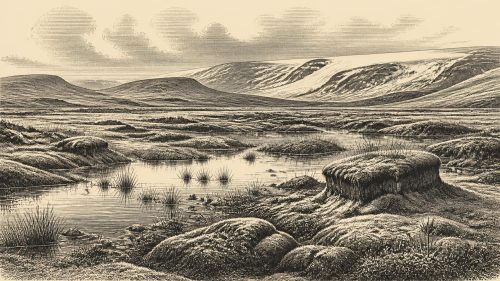
At Derryvree, near Maguiresbridge in County Fermanagh, organic-rich freshwater deposits lie between glacial tills. This stratigraphic position is crucial: the sediments accumulated during an interval when local ground was not overridden by ice, then were buried as ice returned. Pollen, plant macrofossils and other biological remains indicate a treeless, cold-stage landscape with wet ground and shallow freshwater. Sedges, mosses and small hardy plants were central components of this environment; aquatic and wetland taxa demonstrate that the deposits record real standing or slowly moving water, rather than merely wind-blown dust on frozen ground.
A radiocarbon determination from the Derryvree organic silts, 30.5 ± 1.2 thousand radiocarbon years BP, has been calibrated to approximately 36.9–31.7 thousand calendar years BP. The modern date-label 30,920 BCE falls within that broad calibrated range. That does not mean the Derryvree pool can be dated to this particular notional year, nor that all Ireland shared its precise vegetation. It does mean that this Fermanagh evidence is directly relevant to the broad period: before the island’s later, more extensive ice cover, some places contained cold freshwater habitats capable of supporting a sparse tundra-wetland flora.
Such evidence changes the usual image of an Ice Age Ireland as simply a white wilderness. Conditions were severe and highly seasonal, but there were mosaics of water, sedge-rich ground, exposed mineral soils and low vegetation. The term “mammoth-steppe” is useful only with caution here. It describes a broad Eurasian assemblage of open, productive cold-environment habitats, not a uniform Irish biome. Derryvree records one local wetland, while the composition of vegetation varied with drainage, altitude, latitude and proximity to ice.
An Island Approaching Glaciation
Ireland was moving towards a major environmental threshold. Recent reconstructions of the British–Irish Ice Sheet place substantial expansion over Ireland around 29,000 years BP, with much of the island covered by about 28,000 BP; the ice sheet reached its greatest overall volume later, around 23,000 BP. These reconstructions are necessarily regional: advance was not a single wall of ice arriving everywhere on one date. Nevertheless, they make clear that the relatively habitable conditions represented by MIS 3 deposits would not last. Ice, permafrost processes, meltwater, changing sea levels and the disruption of plant and animal ranges remade the landscape.
For 30,920 BCE, the important point is transition rather than culmination. The Last Glacial Maximum had not yet reached its full extent, but Ireland was already part of a north-west European world of marked climatic instability. The island’s later glaciation also explains why the evidence is so fragmentary. Advancing ice eroded, redeposited or buried older surfaces; rivers and cave processes mixed deposits; coastlines that might once have held evidence are now drowned or altered. Absence of a site is not proof that animals, or people, were absent.
Castlepook and the Animal Record
Castlepook Cave, also called Mammoth Cave or Doneraile Cave, lies in the limestone country of the Awbeg Valley below the Ballyhoura Hills. It is Ireland’s richest known cave archive for vertebrate life before the Last Glacial Maximum. Excavations, chiefly undertaken in the early twentieth century, recovered many thousands of bone fragments, although only a portion of the original collection survives. Modern reassessment, radiocarbon dating and renewed excavation have made the site more informative, while also exposing the limitations of its antiquarian recovery.
The cave’s fauna includes woolly mammoth, giant deer, reindeer, brown bear and spotted hyaena, with wolf, Arctic fox, mountain hare and lemmings also represented. These species did not necessarily all live side by side at the same moment, nor do their bones all describe one landscape. Castlepook accumulated material across a long period, and water movement, carnivore activity and later disturbance complicate associations between finds. Yet the assemblage securely establishes that animals adapted to cold, open country used, crossed or were brought into Ireland during the wider MIS 3 interval.
Spotted hyaenas are particularly revealing. Castlepook appears to have functioned, at least in part, as a carnivore den or feeding place. Hyaenas could carry prey and bones into underground chambers, gnaw them, and leave dung and skeletal debris behind. A cave bone is therefore not automatically proof that an animal died at the entrance, much less proof of human hunting. The mammoth and reindeer remains evoke a landscape with large herbivores, but their presence at Castlepook is evidence of animal ecology and cave taphonomy before it is evidence of any human economy.
The Uncertain Human Trace
A reindeer femur from Castlepook has been reported as bearing a deep modification interpreted as a cut or chop made by a sharp stone tool, and the bone has been presented as dating to roughly 33,000 years ago. If microscopic study and contextual research ultimately confirm that interpretation, it would be a remarkable indication that one or more Upper Palaeolithic people processed a reindeer in Ireland during the wider pre-maximum glacial period. It would not, however, establish a village, a permanent population or a continuous Irish settlement.
That distinction is essential. The bone dates the death of an animal within a scientific range; it does not on its own date the mark to an exact moment. Nor is the bone from a securely excavated, single-event living floor with an associated hearth, stone-tool assemblage, shelter, burial or repeated food-processing area. Castlepook’s old collections were made before modern standards of stratigraphic recording, and the cave’s deposits have experienced natural disturbance. The suggested modification is important evidence under investigation, not a licence to invent hunters’ names, social groups or journeys.
Society Beyond the Evidence
There is no basis for describing political affairs, diplomacy, warfare, leadership, law, religion or learning in Ireland at this time. No houses, graves, ornaments, art, inscriptions, hearths or toolkits can presently be tied securely to 30,920 BCE. There is likewise no direct evidence for exchange networks, seafaring, trade goods, livestock, cultivation or a settled economy. Even if the Castlepook mark proves human-made, the most it would demonstrate is a moment of carcass processing by a small mobile party, not the structure of that party’s society.
Interpretation can go only a little further. Across Upper Palaeolithic Europe, people used stone tools, moved through seasonal landscapes and drew heavily on animal resources. Ireland lay at the far north-western edge of that wider world. It is reasonable to regard a possible Castlepook intervention as compatible with short-lived mobility through an open, cold landscape. It is not reasonable to transfer the rich artistic, ritual or settlement evidence of continental sites directly to Ireland. Those would remain analogies, not Irish evidence.
A Precarious Ecological World
Everyday life, if people were present at all, would have been constrained by weather, animal movements and the availability of sheltered places, fuel and workable stone. But the firmer story belongs to the non-human inhabitants. Reindeer could exploit open ground and seasonal forage; lemmings and Arctic fox point towards cold conditions; mammoth, giant deer, wolf, bear and hyaena show that Ireland’s Pleistocene fauna was once far more varied than its later historic fauna. Their ranges probably expanded and contracted as climates shifted, rather than forming an unchanging resident community.
The coming ice-sheet growth was the decisive regional change. It reduced and rearranged habitats, broke ecological connections and erased much of the physical record that might have survived. Ireland around this date should therefore be understood not as an early chapter of later Gaelic, medieval or modern society, but as a fragile environmental interval: cold wetlands in Fermanagh, large mammals in the Awbeg Valley, and a possible yet unproven human action at the edge of the European Upper Palaeolithic world.
Primary Sources
- A reconsideration of the radiocarbon dating of the Marine Isotope Stage 3 fauna from southern Ireland
- Castlepook Cave: Cork County Geological Site Report
- The Irish Quaternary Fauna Project
- A Middle Midlandian Freshwater Series at Derryvree, Maguiresbridge, County Fermanagh, Northern Ireland
- Growth and retreat of the last British–Irish Ice Sheet, 31,000 to 15,000 years ago: the BRITICE-CHRONO reconstruction
- Growth and retreat of the last British–Irish Ice Sheet, 31,000 to 15,000 years ago: the BRITICE-CHRONO reconstruction
- Late Pleistocene chronostratigraphy and ice sheet limits, southern Ireland
- Trimlines, blockfields and the vertical extent of the last ice sheet in southern Ireland
- Timing and pace of ice-sheet withdrawal across the marine–terrestrial transition west of Ireland during the last glaciation
- Maximum extent and readvance dynamics of the Irish Sea Ice Stream and Irish Sea Glacier since the Last Glacial Maximum
- The timing and magnitude of the British–Irish Ice Sheet between Marine Isotope Stages 5d and 2
- New insights on the fauna of Ireland's Younger Dryas and Early Holocene from Alice & Gwendoline Cave
- New insights on the fauna of Ireland's Younger Dryas and Early Holocene from Alice & Gwendoline Cave
- 2022:564 – Castlepook Cave, Castlepook South, Cork
- 2014:526 – Castlepook South, Cork
- The Archaeological Heritage of County Cork
- Heritage Artefacts of County Cork
- Castlepook Caves
- The mammoth caves of Castlepook, near Doneraile
- Quaternary Site Descriptions
- The subdivision of the Quaternary Period in Ireland
- Field Guides
- Outreach and Education Resources
- Ancient Hybridization and an Irish Origin for the Modern Polar Bear Matriline
- Ireland's Palaeolithic Archaeology – Fleeting Footprints in a Frozen Land