Castlepook Species31345 BCE
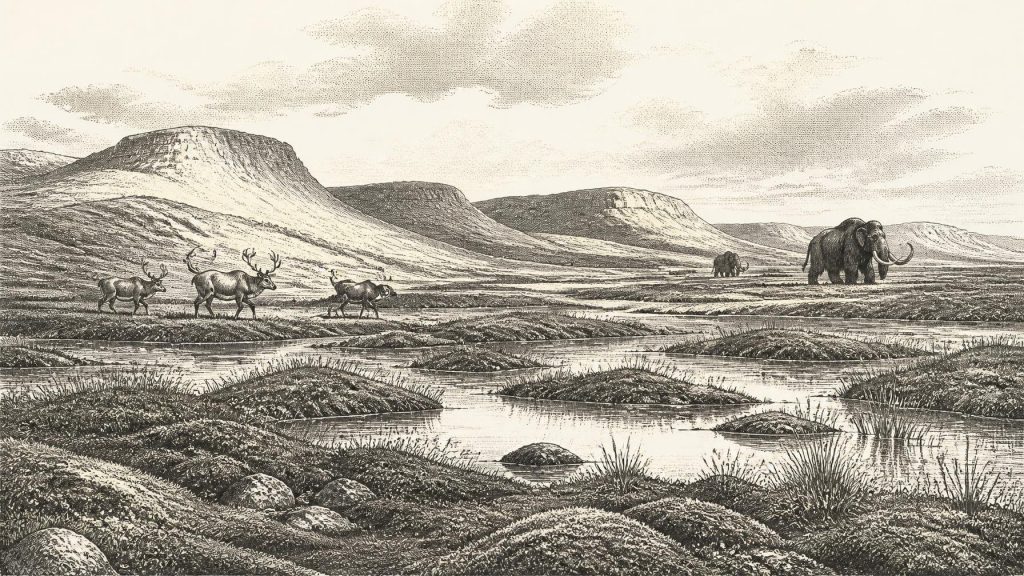
Around 31,345 BCE, Ireland experienced unstable Late Pleistocene conditions during the Midlandian glaciation. Derryvree, County Fermanagh, preserves sediments between tills, indicating cold, treeless wetlands during an ice-free interval broadly encompassing this date. The British–Irish Ice Sheet was expanding, although its precise Irish extent remains uncertain. Castlepook Cave, County Cork, contains remains of mammoth, reindeer, giant deer, bear, wolf, Arctic fox, lemmings and hyaena, demonstrating intermittent animal occupation. A modified reindeer femur may indicate Upper Palaeolithic butchery, yet cannot prove permanent human settlement. No contemporary Irish communities, polities, agriculture or cultural practices are securely evidenced. Later glaciation erased much surviving evidence.
Dateline
“31,345 BCE” is a modern chronological label, not a year that anyone in Ireland could have named or recorded. It corresponds approximately to 33,300 years before AD 1950, within the Late Pleistocene and Marine Isotope Stage 3 (MIS 3), a long and climatically unstable part of the last Ice Age. There is no annual chronicle for this point in time: no Irish writing, ruler, settlement sequence or event can be assigned to a particular twelve-month span. The responsible approach is to examine the dated ranges of fossils, sediments and ice-sheet evidence that illuminate Ireland in the broad interval around it.
The date falls within a period conventionally called the Midlandian glaciation in Irish Quaternary studies. Radiocarbon results at such antiquity are not calendar dates in themselves. They must be calibrated against changing atmospheric carbon-14 levels, and the resulting ranges are wide. The internationally maintained IntCal20 curve extends this work to 55,000 calendar years before present, but it does not transform an Ice Age deposit into a precise anniversary. Around 31,345 BCE, therefore, Ireland’s story is one of landscapes, animals and possible fleeting human contact, not of an identifiable Irish population acting in a known year.
Ground Between Ice Advances
The most informative environmental archive close to this broad horizon lies at Derryvree, near Maguiresbridge in County Fermanagh. A road cutting exposed freshwater sands, silts and organic material trapped between two layers of till, the unsorted sediment left by glacier ice. This sequence is important because its order records change: ice crossed the district and deposited the lower till; a period without overriding ice allowed water, mud and organic remains to gather; later ice buried the deposit beneath another till. Derryvree was consequently preserved as a rare fragment of an Ice Age landscape within terrain repeatedly altered by glaciers.
An organic sample from the deposit, BIRM-166, produced a conventional radiocarbon age of 30,500 ± 1,100 radiocarbon years BP. Its calibrated expression is necessarily broad—approximately 36,900–31,700 cal BP, or about 34,950–29,750 BCE—and should not be treated as the age of one pond, season or living community. The target date lies within that broad range, not at a proven moment within it. The original investigation and later syntheses identify Derryvree as evidence for a cold Middle Midlandian interval rather than as a neatly dated episode.
A Treeless Wetland World
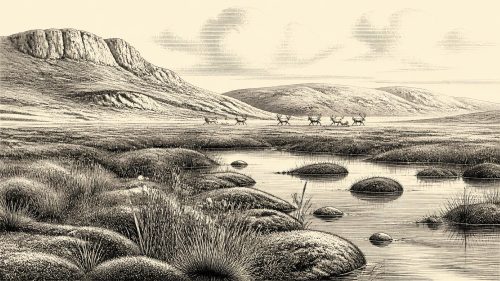
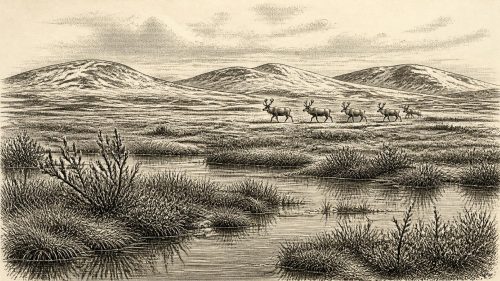
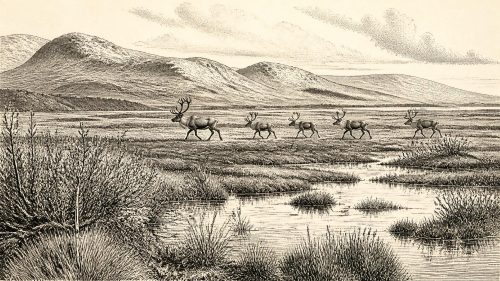
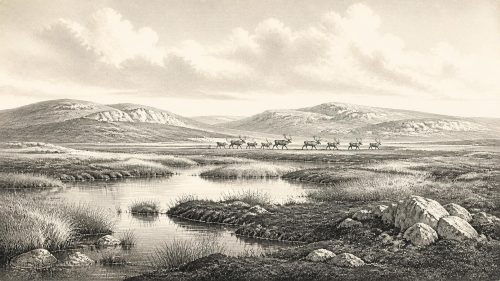
Derryvree’s pollen, plant remains and insects indicate open, cold country with wet hollows: a tundra or muskeg-like environment rather than a forested island. Mosses, grasses, sedges and hardy herbaceous plants could occupy damp ground around shallow water, while exposed surfaces supported sparse cover shaped by frost, wind and a short growing season. “Tundra” should not imply lifelessness. Water could hold aquatic plants; decaying vegetation sustained insects; and wet margins created small but productive habitats. Yet the evidence does not permit a detailed map of vegetation, nor does a stray grain of tree pollen prove woods growing beside the deposit. Long-distance transport and reworking must be considered.
This environmental evidence also cautions against imagining a uniform island. At 33,000 years ago, conditions varied between high ground, sheltered valleys, coastal lowlands, cave systems and ice margins, while climate changed on scales much longer than a human year but short in geological terms. Other Northern Irish organic deposits from the last glaciation show that relatively milder or at least less severe intervals occurred amid cold conditions. The island’s environmental record is patchy precisely because later ice erosion removed or disturbed so much of it.
An Advancing Ice-Sheet System
Ireland around this time was not simply either “ice-covered” or “ice-free”. The British–Irish Ice Sheet was a changing system of regional ice masses, advancing fronts and areas of exposed terrain. Recent BRITICE-CHRONO reconstructions place the wider ice sheet in a phase of rapid growth from about 31,000 years ago, but stress the limited direct constraints for the Irish sector at the beginning of that sequence. Their model allows ice accumulation in Northern Ireland and small ice caps in south-western uplands, while the precise extent over much of Ireland remains uncertain. This is a crucial distinction: an advancing glacial regime is well supported; a confident map of every Irish valley in 31,345 BCE is not.
Evidence from western Ireland indicates substantial ice-sheet loading and changing relative sea levels during the wider interval from roughly 40,000 to 19,000 cal BP. In the later Last Glacial Maximum, sea level was far lower than today, exposing areas of continental shelf. But it would be rash to turn that general fact into a mapped road from Britain to a particular Irish hunting ground at this date. Ice, sea level, the shape of exposed land and the passability of any route all changed. At most, the lowered sea and altered geography made movements of animals—and perhaps people—more plausible than in the modern archipelago.
Castlepook’s Bone Archive
The strongest direct evidence for animal life comes from Castlepook Cave, also called Mammoth Cave, overlooking the Awbeg Valley near Doneraile in north County Cork. The cave has yielded Ireland’s richest known assemblage of vertebrate remains from the last cold stage. Woolly mammoth, reindeer, giant deer, brown bear, wolf, Arctic fox, lemmings and spotted hyaena are among the identified fauna. This was a strikingly different animal world from modern Ireland, with large grazing and browsing mammals, small cold-adapted species and formidable scavengers or predators.
Nevertheless, Castlepook is not a single scene frozen in time. Much of its material was recovered in antiquarian excavations, its deposits were disturbed or reworked, and bones from different phases may have accumulated in the cave by several routes. Bears may have used caves as dens; carnivores could have dragged in carcass parts; animals might have fallen through openings; and water or later disturbance could redistribute remains. Modern redating has demonstrated that some southern Irish cave bones are appreciably older than previously believed, while also showing why old collections require renewed scrutiny.
The fauna nevertheless establishes an important regional fact. Ireland was not ecologically empty throughout MIS 3. Reindeer, mammoth and hyaena, among other mammals, entered or occupied suitable Irish landscapes during parts of the period before the Last Glacial Maximum. They did not necessarily coexist in one herd, one valley or one generation. Nor can their remains settle whether a particular animal was resident year-round, seasonal, or part of a population shifting through a wider north-west European range. Their presence is evidence; the reconstruction of a stable, complete “Irish mammoth-steppe” is interpretation.
The Reindeer Femur Question
A reindeer femur from Castlepook has made this period especially significant for Irish archaeology. The bone has been publicly reported as approximately 33,000 years old and bears a deep linear modification that zooarchaeological examination has interpreted as a cut or chop made with a sharp stone implement during carcass processing. If that interpretation is upheld, it is evidence that people handled a reindeer in Ireland during the Upper Palaeolithic, many millennia before the long-established Mesolithic record. County Cork heritage publications appropriately describe the find as opening an important possibility, while recent research excavations have sought intact Pleistocene deposits in the cave.
Its limits matter just as much. A dated bone gives the age of the animal, not a biography of the person who may have cut it. One mark cannot demonstrate a permanent settlement, a named cultural group, regular hunting territory, a sea crossing, language, ancestry or descendants. No securely associated stone-tool assemblage, hearth, built shelter, burial, art or occupation floor of this age has yet been recovered in Ireland. A small mobile party could have butchered a carcass, removed meat, hide or sinew, and left little that survived subsequent glaciation; but that is a plausible explanation, not a demonstrated narrative.
No Polities, No Proven Community
Political affairs, warfare and diplomacy cannot responsibly be reconstructed for Ireland around 31,345 BCE. There is no evidence for states, chiefs, territorial boundaries, formal alliances or organised conflict. The same applies to religion, learning and artistic practice: no Irish shrine, burial rite, image, ornament or teaching tradition can be attributed to this date. Upper Palaeolithic communities elsewhere in Europe created sophisticated tools, clothing, ornaments and art, but importing those achievements wholesale into Ireland would substitute continental analogy for Irish evidence.
Economically, the most that can be said is conditional. If the Castlepook cut mark records human action, it points to the use of a sharp stone edge in animal processing, an activity compatible with highly mobile hunter-gatherer subsistence. It does not prove that people killed the reindeer, nor that they hunted mammoth, managed herds, exchanged goods or maintained a camp in the Awbeg Valley. There was no agriculture, livestock husbandry, pottery, metalworking or village life evidenced in Ireland at this time. Settlement, if any occurred, was transient and archaeologically elusive.
A Frontier Preserved in Fragments
The most accurate picture is therefore one of a precarious frontier. Around the broad date represented by 31,345 BCE, parts of Ireland held cold, treeless wetland and open ground between episodes of glaciation. Large mammals and carnivores occupied at least some landscapes; cave deposits at Castlepook preserve their remains; and a marked reindeer bone offers a provocative but limited indication of human activity. The later expansion of ice would transform and erase much of this world. What survives is not a year in Irish history, but a demanding archive of silt, pollen, bone, ice and uncertainty.
Source References
Hover over a number to see the source. Select it to open the source.

- [1] A Middle Midlandian Freshwater Series at Derryvree, Maguiresbridge, County Fermanagh, Northern Ireland
- [2] Irish Pleistocene Biostratigraphy
- [3] The Irish Quaternary Fauna Project
- [4] A Reconsideration of the Radiocarbon Dating of the Marine Isotope Stage 3 Fauna from Southern Ireland
- [5] Growth and Retreat of the Last British–Irish Ice Sheet, 31,000 to 15,000 Years Ago: the BRITICE-CHRONO Reconstruction
- [6] Radiocarbon Constraints on the History of the Western Irish Ice Sheet Prior to the Last Glacial Maximum
- [7] The Island of Ireland: Drowning the Myth of an Irish Land-bridge?
- [8] The IntCal20 Northern Hemisphere Radiocarbon Age Calibration Curve (0–55 cal kBP)
- [9] IntCal Publications
- [10] Figure 6.— The Subdivision of the Quaternary Period in Ireland
- [11] Introduction to the Late Quaternary and Holocene of Northern Ireland
- [12] Castlepook Cave
- [13] Spotted Hyena Skull
- [14] 2022:564 – Castlepook Cave, Castlepook South, Cork
- [15] Archaeology Research Excavation Grant 2022: Final Report
- [16] Heritage Artefacts of County Cork 2021
- [17] Archaeological Heritage of County Cork
- [18] The Archaeology of Caves in Ireland
- [19] New Insights on the Fauna of Ireland’s Younger Dryas and Early Holocene from Alice & Gwendoline Cave
- [20] Occurrence of Mammalia Relicts at Site Castlepook Cave
Primary Sources
- A Middle Midlandian Freshwater Series at Derryvree, Maguiresbridge, County Fermanagh, Northern Ireland
- Irish Pleistocene Biostratigraphy
- The Irish Quaternary Fauna Project
- A Reconsideration of the Radiocarbon Dating of the Marine Isotope Stage 3 Fauna from Southern Ireland
- Growth and Retreat of the Last British–Irish Ice Sheet, 31,000 to 15,000 Years Ago: the BRITICE-CHRONO Reconstruction
- Radiocarbon Constraints on the History of the Western Irish Ice Sheet Prior to the Last Glacial Maximum
- The Island of Ireland: Drowning the Myth of an Irish Land-bridge?
- The IntCal20 Northern Hemisphere Radiocarbon Age Calibration Curve (0–55 cal kBP)
- IntCal Publications
- Figure 6.— The Subdivision of the Quaternary Period in Ireland
- Introduction to the Late Quaternary and Holocene of Northern Ireland
- Castlepook Cave
- Spotted Hyena Skull
- 2022:564 – Castlepook Cave, Castlepook South, Cork
- Archaeology Research Excavation Grant 2022: Final Report
- Heritage Artefacts of County Cork 2021
- Archaeological Heritage of County Cork
- The Archaeology of Caves in Ireland
- New Insights on the Fauna of Ireland’s Younger Dryas and Early Holocene from Alice & Gwendoline Cave
- Occurrence of Mammalia Relicts at Site Castlepook Cave