
Castlepook’s Mammoth Bones30987 BCE
Labelled 30,987 BCE, this period lies roughly 33,000 calibrated years before present, during the unstable Late Pleistocene rather than a precisely datable Irish year. Derryvree, County Fermanagh, preserves wetland sediments between glacial tills, revealing treeless, cold tundra vegetation, pools, insects, sedges and hardy plants during an ice-free interval. Castlepook Cave, County Cork, yielded mammoth, reindeer, giant deer, bear, wolf, Arctic fox, lemming and hyaena remains, indicating changing connections with wider Europe. A possibly tool-marked reindeer bone may suggest early human presence, but lacks secure context. No evidence confirms settlement, society, routes or island-wide conditions at this specific date with certainty.
Dateline
“30,987 BCE” is a modern chronological label, not a year in which an Irish event can be narrated. No calendar, written record, named people or datable political episode survives from this depth of time. In relation to the archaeological convention of “before present”, fixed at AD 1950, the label lies about 32,936 years ago. It belongs to the Late Pleistocene, within Marine Isotope Stage 3, a climatically unstable part of the last Ice Age. Modern calendar-year precision is unavailable: radiocarbon determinations must be calibrated, have uncertainties, and date particular organic remains rather than an entire landscape. The responsible subject is therefore Ireland in a broad interval around 33,000 calibrated years before present, not an invented occurrence on a particular day.
A Landscape Before Maximum Ice
This was not yet the fullest extent of the Last Glacial Maximum. The British–Irish Ice Sheet grew markedly after this period and reached its broad maximum later, roughly between 26,500 and 19,000 years ago, although timings differed between regions and ice lobes. Around the date represented by 30,987 BCE, parts of Ireland were ice-free, while others were affected by advancing ice, intense frost action and changing drainage. It would be misleading to picture the whole island either as a single ice cap or as a hospitable, continuous grassland. Conditions changed sharply through time and varied with altitude, latitude, proximity to ice and local topography.
The most useful Irish evidence close to this broad horizon comes from deposits which escaped later destruction only by unusual good fortune. At Derryvree, near Maguiresbridge in County Fermanagh, road works exposed freshwater silts and fine sands trapped between two layers of glacial till. The lower till records an earlier advance of ice; the organic sediments record an ice-free interval with standing or slow-moving water; the upper till shows that a later glacier again overran the district. That sequence is a powerful record of environmental change, but it is not a diary. Its radiocarbon age of 30,500 ± 1,100 radiocarbon years BP has been calibrated broadly to about 36,900–31,700 cal BP. The latter range overlaps the notional year, but cannot place a particular plant, animal or person in 30,987 BCE itself.
Derryvree’s Cold Wetland
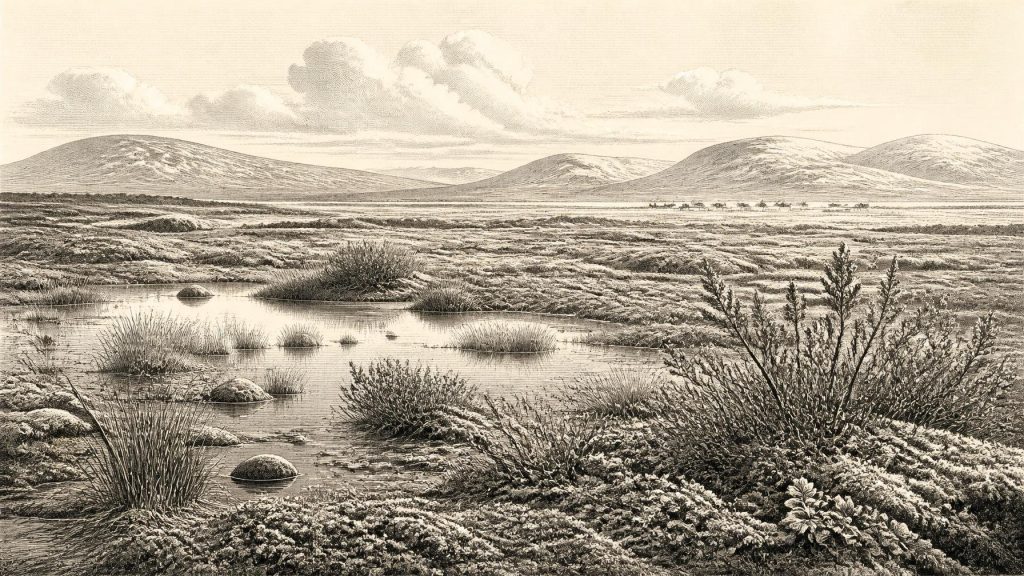
Derryvree supplies an unusually detailed image of an Irish environment during this pre-maximum cold phase. Fossil pollen, plant macrofossils and insects indicate open, treeless ground and a wet, moss-rich landscape often described as muskeg or tundra wetland. Sedges and grasses grew beside pools and waterlogged ground. Finds include mountain avens, dwarf willow or willow-type vegetation, juniper, clubmosses and the aquatic plant bogbean. Such a community was not a modern Irish bog transplanted into the past. It belonged to a cold, periglacial world, with long severe winters, short growing seasons and ground repeatedly affected by freezing and thawing.
Its significance lies partly in correcting an easy misconception. Ice-Age Ireland was not always featureless ice. In suitable ice-free intervals, freshwater habitats could sustain a varied small-scale ecology: aquatic plants in pools, mosses and sedges around their margins, insects feeding or breeding among decaying vegetation, and hardy herbs on better-drained ground. The evidence does not establish a uniform island-wide climate on a single date. It does demonstrate that northern Ireland contained, at some point within the Derryvree interval, a cold but biologically active wetland between glacial advances.
There was no humanly managed countryside. There were no fields, livestock, houses, roads or permanent settlements known from Ireland at this age. The familiar wooded appearance of later prehistoric and historic Ireland had not developed. Indeed, the Derryvree evidence is valuable precisely because later ice, erosion and sea-level change eliminated so much of the older record. The present terrain—its drumlins, soils, river courses and shorelines—cannot simply be projected backwards. A large part of the physical stage on which later Irish history unfolded was still being remade.
Castlepook’s Animal Record
Far to the south, Castlepook Cave, also called Mammoth Cave, near Doneraile in County Cork, preserves Ireland’s most important collection of pre-Last Glacial Maximum vertebrate remains. Excavations undertaken mainly between 1904 and 1908, followed by later investigation and dating, recovered a striking range of animals. The assemblage includes woolly mammoth, reindeer, giant deer, brown bear, wolf, Arctic fox, mountain hare, lemmings and spotted hyaena. Individual bones and deposits have different histories and dates; they do not represent a single herd, season or perfectly preserved ecosystem. Nonetheless, collectively they establish that Ireland was connected to wider north-west European faunal worlds during favourable phases of the Late Pleistocene.
Reindeer, lemmings and Arctic fox are strong indicators of open, cold habitats. Mammoth and giant deer show that substantial herbivores reached the island, while wolves and hyaenas reveal a food web with large predators and scavengers. Castlepook should not be imagined as a calm procession of animals through a cave. Hyaenas may have carried bones into its passages, gnawed them or disturbed them; water, sediment movement and later excavation also altered the deposits. A cave bone demonstrates that an animal, or material containing it, reached that location. It does not by itself reveal whether the species was abundant throughout Ireland, whether it was present in the same generation as another species, or how long it persisted.
Recent sedimentary ancient-DNA work at Castlepook has added genetic evidence for several taxa, including woolly mammoth and cave hyaena, and suggests links with wider Eurasian populations before the Last Glacial Maximum. This is an important developing line of research, though the 2026 study remains a preprint rather than a final peer-reviewed publication. Its main value for this date is cautious: it strengthens the case for repeated faunal connectivity, not a claim that a particular migration route or an exact animal population can be mapped in 30,987 BCE.
The Human Question
The greatest uncertainty concerns people. A reindeer femur from Castlepook has been reported as approximately 33,000 years old and as carrying a deep mark interpreted by zooarchaeologist Ruth Carden as damage made to fresh bone with a sharp stone implement. If that interpretation survives further study, it may be evidence that Upper Palaeolithic people butchered or otherwise processed reindeer in Ireland during a broadly comparable interval. It would be a major revision to the traditional chronology, which long placed the first direct evidence for people in Ireland much later, near the end of the Pleistocene.
Yet this is not proof of an established Irish population. The specimen originated in an old cave collection, excavated before modern stratigraphic methods and without a securely associated hearth, stone-tool assemblage, dwelling floor, burial or occupation surface. Radiocarbon dating establishes the age of the animal bone, not automatically the date or agent of every surface modification. Nor can one potentially cut-marked bone decide whether visitors stayed briefly, returned seasonally, travelled in a small party, or left descendants. Continuing work at the cave is searching for undisturbed deposits and directly associated evidence. Until such evidence is found, the most defensible conclusion is that an early human visit is possible and consequential, but unconfirmed as a settled community.
For that reason, political affairs, diplomacy and organised warfare cannot responsibly be described. There are no rulers, tribes, languages, territories or alliances known for Ireland at this date. Terms such as Gaelic, Celtic and Irish belong to immensely later contexts and should not be projected backwards. Equally, there is no direct Irish evidence for religion, ritual, art, formal learning or social rank. The absence of evidence does not mean Ice-Age people elsewhere lacked stories, beliefs, skills or complex relationships; it means that no surviving Irish material permits these to be specified here.
Mobility Without a Recorded Society
If people did reach Ireland in this era, their survival would have depended on mobility, close knowledge of seasonal animal movements, fire, clothing, shelters and tools, as among Upper Palaeolithic communities elsewhere in Europe. But this is an inference from neighbouring regions, not an excavated Irish way of life. No Irish flint-working site, camp refuse, hearth or built shelter currently demonstrates such activity around 33,000 cal BP. Economy and exchange therefore cannot be reconstructed as local institutions. The animal evidence does, however, show that the island formed part of a changing ecological zone in which large mammals could disperse when coastlines, sea levels, ice barriers and terrain allowed.
Lower global sea levels altered the geography of the Irish Sea region, but a simple, permanent “land bridge” is not an adequate explanation. Routes between Ireland, Britain and continental Europe shifted as sea level fell, ice margins advanced or retreated, and water or ice blocked different corridors. The exact route used by mammoths, hyaenas, reindeer—or any people—is unknown for this particular interval. Ireland’s prehistory at 30,987 BCE is thus not the beginning of a continuous national story. It is a brief window on a cold, dynamic frontier, preserved in Fermanagh wetland sediments and Cork cave bones, and framed by large uncertainties that are themselves central to the history.
Primary Sources
- Figure 6.— The Subdivision of the Quaternary Period in Ireland
- Introduction: The Quaternary of Fermanagh
- Trimlines, Blockfields and the Vertical Extent of the Last Ice Sheet in Southern Ireland
- Growth and Retreat of the Last British–Irish Ice Sheet, 31,000 to 15,000 Years Ago: The BRITICE-CHRONO Reconstruction
- The Timing and Magnitude of the British–Irish Ice Sheet Between Marine Isotope Stages 5d and 2
- Maximum Extent and Dynamic Behaviour of the Last British–Irish Ice Sheet West of Ireland
- Oscillating Retreat of the Last British-Irish Ice Sheet on the Continental Shelf Offshore Galway Bay, Western Ireland
- The Deglaciation of the Western Sector of the Irish Ice Sheet From the Inner Continental Shelf to its Terrestrial Margin
- Timing and Pace of Ice-Sheet Withdrawal Across the Marine–Terrestrial Transition West of Ireland During the Last Glaciation
- Sedimentology and Chronology of the Advance and Retreat of the Last British-Irish Ice Sheet on the Continental Shelf West of Ireland
- Irish Pleistocene Biostratigraphy
- The Irish Quaternary Fauna Project
- Spotted Hyena Skull
- 2022:564 – Castlepook Cave, Castlepook South, Cork
- Archaeology Research Excavation Grant 2022
- Sedimentary Ancient DNA Reveals Late Pleistocene Faunal Connectivity Between Ireland and Eurasia
- New Insights on the Fauna of Ireland's Younger Dryas and Early Holocene From Alice & Gwendoline Cave
- New Insights on the Fauna of Ireland's Younger Dryas and Early Holocene From Alice & Gwendoline Cave
- Mammoth Cave
- BSBI: Dryas octopetala
- BSBI: Menyanthes trifoliata
- Proceedings of the Royal Irish Academy
- The Mesolithic in Ireland: When Was It?