Hyaena Hall and Derryvree30988 BCE
Ireland around 30,988 BCE is understood only through imprecisely dated Late Pleistocene evidence, not annual history. Derryvree, County Fermanagh, preserves freshwater sediments between glacial tills, indicating an ice-free interval with treeless tundra, wetlands and cold-adapted vegetation. Castlepook Cave, County Cork, contains a complex, long-accumulated fauna including mammoth, giant deer, reindeer, brown bear and spotted hyaena, demonstrating open habitats and active predators. A possibly cut-marked reindeer femur may indicate exceptionally early human contact, but cannot prove settlement. Shifting ice, water and climate repeatedly altered landscapes and survival evidence. No secure contemporary camps, tools, societies or cultural traditions are known there either.
Dateline
30,988 BCE is not a year that can be recovered from an Irish annal, settlement sequence or historical calendar. It is a modern retrospective label, roughly 32,937 years before AD 1950, imposed upon a much less precise prehistoric record. No evidence can identify an event, individual, community or seasonal occurrence in Ireland in this particular numbered year. The responsible subject is instead a broad interval of the Late Pleistocene, within Marine Isotope Stage 3, when climates fluctuated sharply, glaciers advanced and retreated, and the landscapes available to animals – and perhaps occasionally to people – changed dramatically.
Radiocarbon dates provide ranges rather than historical timestamps, and their conversion into calendar ages depends on calibration curves. This is particularly important beyond 30,000 years ago, when the relationship between radiocarbon years and calendar years is neither simple nor exact. Ireland around this point is therefore illuminated by deposits and bones dated across centuries or millennia. The evidence is geographically patchy: an exceptional freshwater deposit at Derryvree, near Maguiresbridge in County Fermanagh, and a complex animal-bone archive at Castlepook Cave near Doneraile in north County Cork are especially significant. Neither should be mistaken for a record of the whole island on one day.
A Cold-Stage Ireland
The period belonged to the Midlandian, Ireland’s last major glacial cycle. It preceded the fullest expansion of the Last Glacial Maximum, when the British–Irish Ice Sheet reached its greatest known extent around 23,000 years ago. That later maximum should not be projected uncritically backwards. Evidence now suggests a more dynamic history: ice existed and grew during earlier cold phases, but its precise limits during Marine Isotope Stage 3 remain debated. At approximately 31,000 BCE, some regions may have been ice-covered or affected by nearby ice margins while others retained exposed ground, wetlands and animal habitat.
Such regional variation is crucial. Ireland was not uniformly a featureless white wilderness, nor can it be reconstructed as a continuously habitable open plain. The ice sheet, sea level, permafrost-like ground conditions, snow cover and vegetation changed over long intervals. Later glaciers also eroded or buried much of the evidence. The apparent scarcity of archaeological sites may therefore reflect a genuine scarcity of people, but it also reflects the destructive power of ice, water and time. What survives is a selective archive rather than a complete census of life.
Derryvree’s Freshwater Window
At Derryvree, roadworks in 1969 cut through a drumlin and exposed freshwater silts and fine sands sealed between two distinct tills, the unsorted deposits left by glacial ice. The organic layer produced the conventional radiocarbon determination BIRM-166, 30,500 +1,170/−1,030 radiocarbon years BP. That determination has a substantial uncertainty and requires calibration; it cannot responsibly be equated with 30,988 BCE. Yet it provides a rare, nearby environmental window onto the severe conditions of the wider period.
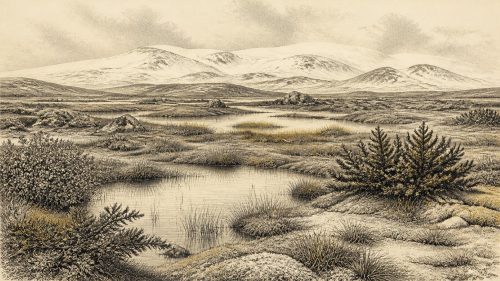
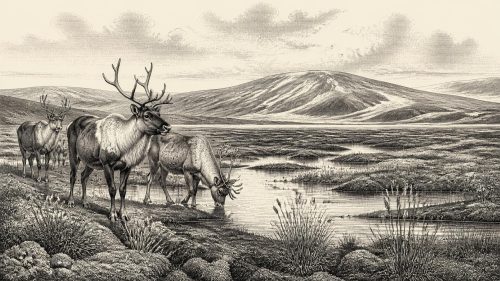
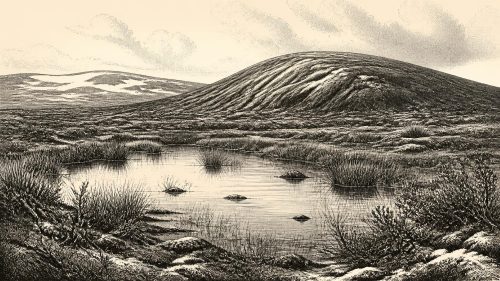
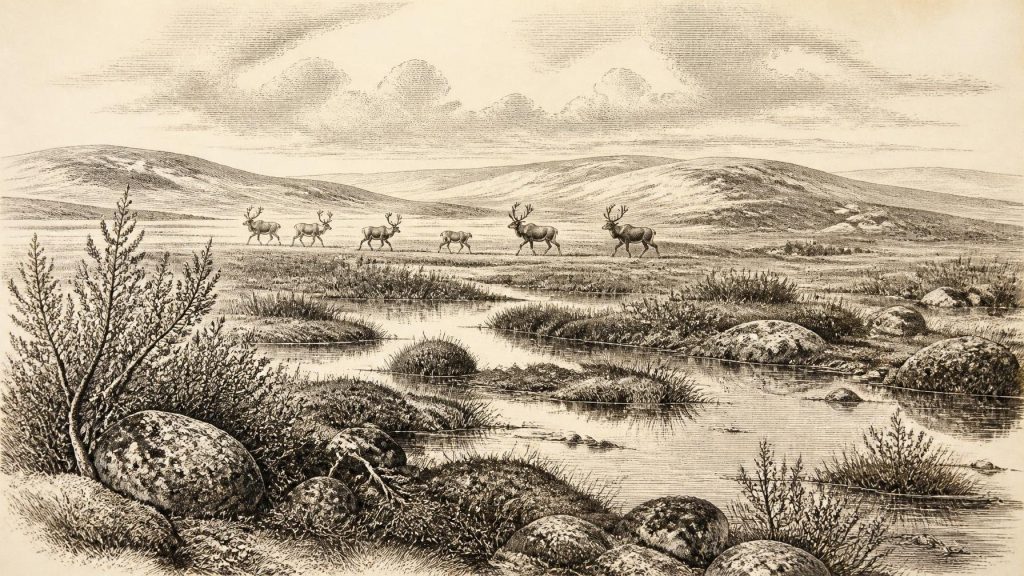
The fossil record at Derryvree indicates a cold, predominantly treeless tundra or muskeg environment. Pollen was poorly preserved, but herbaceous taxa, sedges and mosses were important. Plant macrofossils included bogbean and mountain-avens, while the wider assemblage also contained cold-adapted plants such as dwarf willow, rosy saxifrage and alpine clubmoss. These remains show that the ground was not simply sterile: summer thaw and shallow water supported specialised vegetation. At the same time, the assemblage offers no basis for imagining woodland, farming country or a settled human landscape.
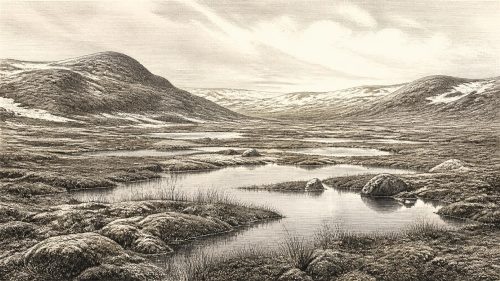
“Tundra” is useful shorthand but can conceal variety. Derryvree is better envisaged as a mosaic of wet sedge margins, mossy ground, shallow pools, slow-moving freshwater, sparsely vegetated mineral surfaces and patches of drier exposed terrain. Insects and plants point to harsh periglacial conditions, with a short growing season and long, severe winters. The organic bed establishes that south Fermanagh was ice-free at some point within its dated interval; it does not prove that every Irish region was simultaneously free of glacier ice, nor that the wetland persisted unchanged for millennia.
Ice, Water and Changing Ground
The two tills enclosing the Derryvree deposit make the wider story especially vivid. Before the freshwater sediments accumulated, ice had crossed the district. After vegetation and wetland conditions developed, ice returned and buried the landscape beneath further glacial sediment. This sequence demonstrates environmental change rather than a stable Ice Age equilibrium. In practical terms, a pool, animal corridor or plant community could be created, altered or erased as climate changed and ice margins shifted. The rolling drumlin landscapes familiar in parts of modern Ireland are later expressions of this powerful glacial remodelling.
For animals, accessible land and reliable water mattered more than any modern county boundary. The position of coastlines was also different because global sea level was lower during the cold stage, although the exact availability of routes between Ireland, Britain and continental Europe changed through time. The Irish evidence does not permit a map of a particular migration route in 30,988 BCE. It does show, however, that Ireland participated intermittently in the wider north-west European world of cold-adapted mammals and predators.
Castlepook’s Animal Archive
Castlepook Cave, also called Mammoth Cave, is the richest Irish site for vertebrate remains from the period leading towards the Last Glacial Maximum. Excavations begun in the early twentieth century recovered more than 2,000 bones from a cave system whose evocative chambers include Hyaena Hall and Elephant Hall. Its fauna includes woolly mammoth, giant deer, reindeer, brown bear and spotted hyaena; later cold-stage deposits also produced lemmings, Arctic fox and wolf. A spotted-hyaena skull from the cave is held by the National Museum of Ireland.
These animals do not necessarily represent a single local herd, one season or even one climate phase. Castlepook was a repository into which bones could arrive through carnivore activity, natural deaths, flowing water and disturbance over a long span. Modern redating has also shown that older radiocarbon determinations from Irish caves can require substantial revision when improved pretreatment methods are used. The cave’s value lies precisely in its long, complicated archive; its limitation is that it cannot be read as a neatly stratified hunting camp.
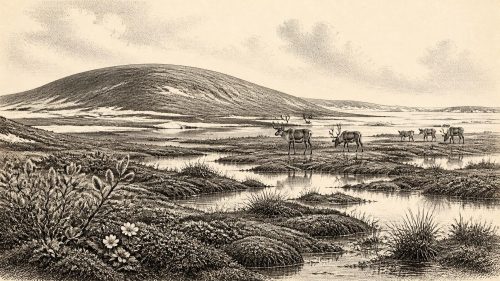
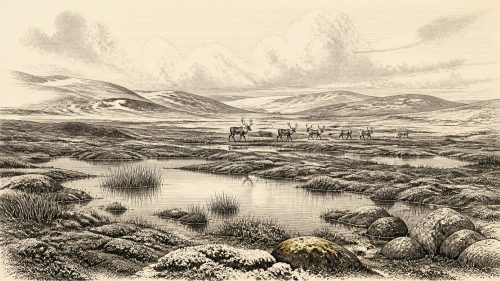
Nevertheless, the fauna firmly supports the existence of open-country habitats capable of sustaining large herbivores and their predators during parts of the period. Reindeer are especially suggestive of cold, seasonal landscapes, while mammoth and giant deer indicate substantial grazing resources somewhere within the wider region. Spotted hyaena adds an important corrective to romantic visions of an empty wilderness: large carnivores were active agents, transporting carcass parts and shaping what entered caves. Hyaena Hall was not a human monument; it was part of an ecological landscape in which predators, scavengers and water all affected the fossil record.
The Reindeer Femur Question
A reindeer femur from Castlepook has made this period unusually important for Irish prehistory. It has been reported as carrying a deep linear mark interpreted as a cut or chopping trace made by a sharp stone tool while the bone was fresh. County Cork’s heritage publication assigns the object broadly to about 31,000 BCE. If the interpretation of the mark is sustained, it would be striking evidence that a person handled and butchered a reindeer in Ireland far earlier than the traditionally accepted terminal-Pleistocene human evidence.
That conclusion must remain conditional. The date of a bone establishes when the animal died within a probability range; it does not automatically prove the exact moment when a surface modification was made. Nor does one marked bone establish a settlement, a population, a hunting territory or a repeated route. No securely associated hearth, stone-tool assemblage, dwelling floor, burial or excavated camp of comparable age has yet been published from Ireland. The most responsible reading is that Castlepook presents an important claim for early human activity, not proof of a resident Upper Palaeolithic society.
Society Without a Chronicle
Accordingly, political affairs, diplomacy, warfare, named leaders and institutions cannot be reconstructed for Ireland at this date. There are no texts, monuments or securely recognised settlements from which to infer a polity. It would be equally unsafe to assign language, ethnicity, religion or ancestry to any possible visitors. If people did reach the island, they may have travelled in small, mobile groups equipped to exploit a demanding seasonal environment; but this is an inference from broader Upper Palaeolithic patterns in Europe, not a demonstrated fact about an Irish community.
The same caution governs everyday life and economy. Hunting, scavenging and the use of animal resources are plausible activities in a landscape containing reindeer and other large mammals, and the proposed femur mark is relevant to carcass processing. Yet Ireland has yielded no securely dated toolkit, camp refuse, food store, shelter or clothing evidence from around this time. There is no evidence for agriculture, livestock, craft production, market exchange or long-distance trade networks based in Ireland. Mobility, rather than permanent settlement, is the only possibility suggested by the limited record, and even that cannot be quantified.
Religion, art and formal learning likewise leave no identifiable Irish trace from this horizon. The survival knowledge required in cold conditions – reading animal movement, weather, snow, water and fuel – would have been considerable if people were present, but it cannot be recovered as a documented tradition. Ireland’s cultural history at this date is therefore chiefly a history of landscapes and evidence: the ability of pollen, seeds, mosses, bones, cave sediments and radiocarbon samples to preserve fragments of a vanished world.
What Can Be Said Responsibly
Ireland around 30,988 BCE was part of a changing cold-stage environment, not a country with an annual political history. Derryvree shows that freshwater wetlands and treeless, cold-adapted vegetation could exist in Fermanagh between glacial episodes. Castlepook demonstrates that an imposing Ice Age fauna, including mammoth, reindeer and hyaena, occurred in Cork across a long and complex span. A cut-marked reindeer femur may point to an exceptionally early human encounter, but it cannot yet bear the weight of a story about settlement or society.
The most important development was environmental instability: ground became available, wetlands formed, animals moved through open habitats, and advancing ice later transformed the evidence. Continued excavation at Castlepook, improved radiocarbon pretreatment, new palaeoenvironmental studies and reassessment of museum collections may refine this picture. For now, the soundest history of this deep past remains deliberately modest – a cold, living Ireland known through a Fermanagh wetland, a Cork cave and the uncertainties that make their evidence valuable.
Primary Sources
- A Middle Midlandian Freshwater Series at Derryvree, Maguiresbridge, County Fermanagh, Northern Ireland
- Palaeoecology: The Middle Midlandian Palaeoenvironment of South Fermanagh
- A Reconsideration of the Radiocarbon Dating of the Marine Isotope Stage 3 Fauna from Southern Ireland
- Castlepook Cave: County Geological Site Report
- Spotted Hyena Skull
- 2022:564 — Castlepook Cave, Castlepook South, Cork
- Heritage Artefacts of County Cork 2021
- Growth and Retreat of the Last British–Irish Ice Sheet, 31,000 to 15,000 Years Ago: The BRITICE-CHRONO Reconstruction
- The Timing and Magnitude of the British–Irish Ice Sheet Between Marine Isotope Stages 5d and 2
- Trimlines, Blockfields and the Vertical Extent of the Last Ice Sheet in Southern Ireland
- Stratigraphic and Palaeo-Geomorphological Evidence for the Glacial-Deglacial History of the Last British-Irish Ice Sheet in the North-Western Irish Sea
- Quaternary
- Quaternary Geomorphology Map Service
- The IntCal20 Approach to Radiocarbon Calibration Curve Construction: A New Methodology Using Bayesian Splines and Errors-in-Variables
- IntCal
- Phylogeographic, Ancient DNA, Fossil and Morphometric Analyses Reveal Ancient and Modern Introductions of a Large Mammal: The Complex Case of Red Deer (Cervus elaphus) in Ireland
- New Insights on the Fauna of Ireland’s Younger Dryas
- The Irish Quaternary Fauna Project
- Pleistocene Vertebrates in the British Isles
- Mammoth Cave, County Cork