Doneraile’s Possible Palaeolithic30923 BCE
Labelled 30,923 BCE, this period belongs to climatically unstable Marine Isotope Stage 3 rather than a precisely datable Irish year. At Derryvree, County Fermanagh, organic deposits between glacial tills record a local ice-free interval, with cold, treeless freshwater wetland supporting tundra vegetation and insects. Ireland’s landscapes were being reshaped by uneven expansion of the British–Irish Ice Sheet. Castlepook Cave, County Cork, contains Late Pleistocene animal remains, including a reindeer femur dated about 33,000 years ago. Its possible stone-tool cut mark may indicate butchery and an early human visit, but cannot prove settlement, population, culture, routes, or sustained occupation in Ireland.
Dateline
30,923 BCE is a modern chronological label, not a year that anyone in Ireland recorded or could have recognised. It falls roughly 32,872 years before AD 1950, the reference point conventionally used for “before present” dating, but that arithmetic must not be mistaken for archaeological precision. No event, ruler, settlement or season can responsibly be assigned to this particular year. The appropriate setting is the Late Pleistocene, within Marine Isotope Stage 3 (MIS 3), a climatically unstable part of the last Ice Age.
Ireland at this remote point was not the familiar island of farms, forests, monuments and named peoples known from later prehistory. Its evidence survives in rare environmental deposits sealed beneath later glacial sediments, in cave bone assemblages, and in the landforms created or remodelled by ice. These materials provide a patchy view of landscapes and animals. They provide vastly less information about humans. The distinction is central: fossils and sediments are evidence; reconstructions of journeys, hunting and social life are carefully limited interpretations.
A Date Inside Broad Ranges
The closest Irish environmental sequence relevant to this date lies at Derryvree, near Maguiresbridge in County Fermanagh. There, roadworks exposed organic-rich freshwater silts and sands caught between two layers of glacial till. The sequence demonstrates a clear local order of events: glacier ice deposited the lower till; an interval without overriding ice allowed water, plants and organic sediment to gather; and a later ice advance covered the deposits with another till. It is an unusually valuable glimpse of a cold, ice-free interval, preserved because later ice sealed it.
Organic material from the Derryvree deposits returned a conventional radiocarbon age of about 30,500 ± 1,200 radiocarbon years before present. Calibration matters because radiocarbon years are not calendar years: atmospheric carbon-14 levels have varied through time. Modern calibration places the broad result at approximately 36,900–31,700 calibrated years BP, or about 34,950–29,750 BCE. The notional year 30,923 BCE lies within that wide interval, but cannot be pinned to a particular horizon in the silt, a particular generation of animals, or a particular episode of human activity.
Derryvree should not be treated as a weather station for the whole island. It shows that its part of Fermanagh was ice-free long enough for a freshwater wetland to develop. It does not establish that every region of Ireland was simultaneously free of ice, that conditions were identical in Cork, or that the ice margin stood still. MIS 3 climate changed abruptly and repeatedly across the North Atlantic world. The record instead offers a local window into environments that existed before the fullest development of the Last Glacial Maximum.
Wetland in a Treeless Country
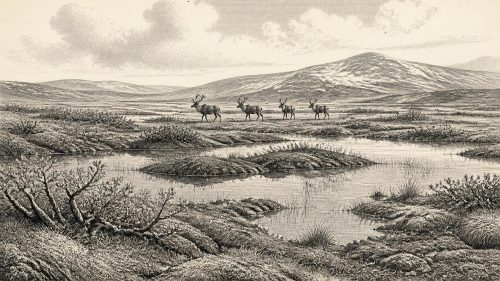
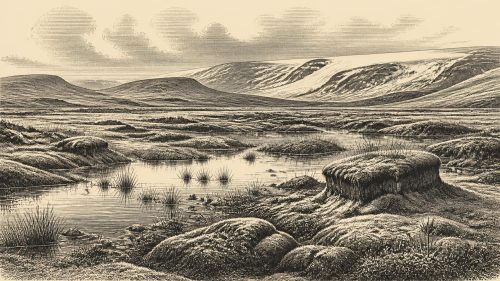
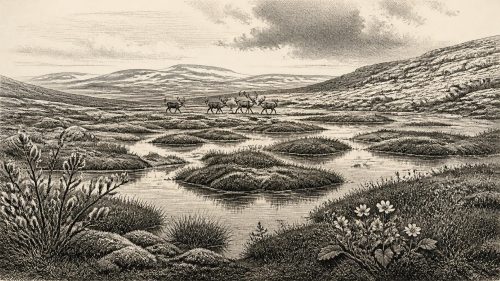
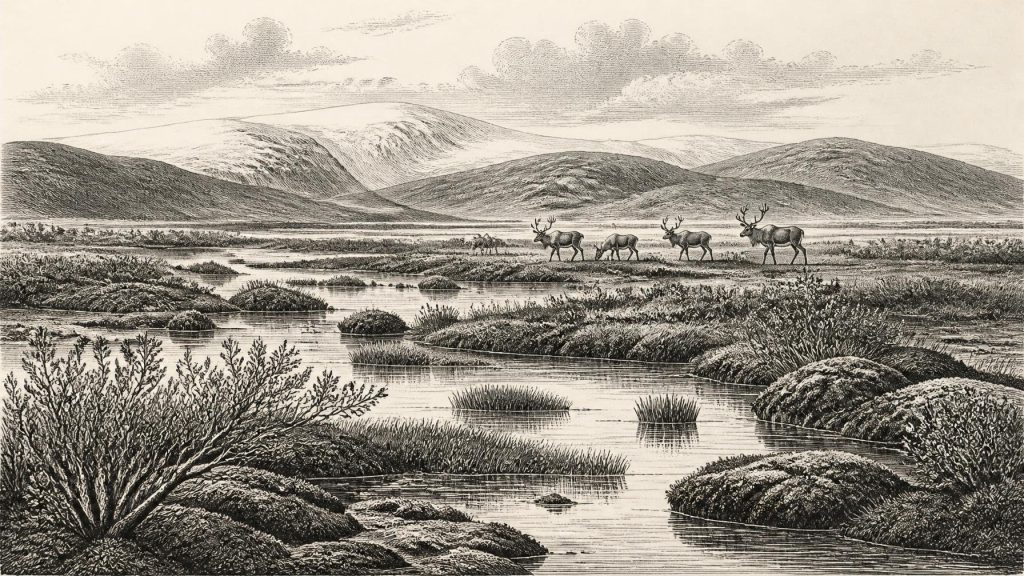
The Derryvree plant and insect evidence indicates a cold, open landscape rather than woodland. Mosses, sedges, bogbean, dwarf willow and mountain avens point towards wet ground and tundra-like or muskeg conditions, with shallow water, saturated soils and low vegetation. Such a setting could appear unexpectedly rich at close range: pools and marshy margins supported aquatic plants and invertebrates, while drier patches carried cold-tolerant herbs and shrubs. Yet it was not a gentle northern countryside. Long winters, frost action, exposed ground and strong seasonality shaped the possibilities for all living things.
Later Ireland’s deep soils and extensive Atlantic woodland did not yet exist in their familiar form. Vegetation cover was sparse to low and varied with drainage, exposure and changing temperature. This does not mean an entirely barren landscape. The important lesson from Derryvree is diversity at a small scale: freshwater, sedge-rich ground, mossy wetland and open mineral terrain could occur near one another. Such mosaics created resources for grazing animals and predators, but they were also vulnerable to climatic deterioration and advancing ice.
The wider ice-sheet history adds urgency to this picture. Recent reconstructions show that the British–Irish Ice Sheet grew rapidly around this broad period, though its expansion was regionally uneven rather than a single island-wide event. Ireland was entering an era in which ice, meltwater, sea level and drainage patterns would repeatedly alter access to habitats. Later glaciation would erode, bury or disperse many traces of the landscapes and any people that had preceded it. Absence of sites is therefore significant, but it is not simple proof that people never visited.
Castlepook and the Reindeer Femur
The most consequential possible human evidence comes from Castlepook Cave, also known as Mammoth Cave, near Doneraile in north County Cork. Cave excavations and old museum collections there produced a rich but complicated Late Pleistocene faunal record. Reindeer, mammoth, giant deer, brown bear, wolf and spotted hyaena are among the animals represented. They did not necessarily occupy the cave or surrounding country at the same time. Cave assemblages may accumulate over long periods through natural deaths, carnivore activity, water movement and earlier excavation practices; they are not a snapshot of one landscape.
One reindeer femur from the Castlepook collection is particularly important. It has been radiocarbon dated to roughly 33,000 years ago and carries a deep surface incision interpreted by zooarchaeologist Ruth Carden as a mark made by a sharp stone tool while the bone was fresh. County Cork heritage material presents it as evidence of Palaeolithic butchery, approximately around 31,000 BCE. If that interpretation is upheld, it would show that at least one person handled a reindeer carcass in Ireland during MIS 3, pushing the possible human story of Ireland much further back than the formerly accepted post-glacial evidence.
That is a major possibility, but it remains a narrow claim. The date establishes when the animal died, not necessarily the exact moment at which the mark was made. Identifying a cut mark is a specialist taphonomic judgement, separate from radiocarbon measurement. Moreover, the femur was recovered from an old cave collection rather than a modernly excavated, sealed occupation floor. No securely associated hearth, stone-tool assemblage, shelter, burial, human remains or repeated food-waste deposit of comparable age has been recovered in Ireland. The bone cannot demonstrate a permanent settlement, a population size, a language or a named cultural group.
What Human Presence Could Mean
If the Castlepook incision does record butchery, the most restrained inference is that one or more people possessed a sharp stone cutting edge and processed part of a reindeer carcass. They may have hunted the animal, encountered it after death, removed meat, hide, sinew or marrow, or worked elsewhere before the bone entered the cave deposit. Carnivores may also have carried remains into the cave. None of these alternatives can yet be distinguished with confidence.
It is reasonable to see any such visitors as highly mobile foragers operating in a demanding northern environment, but it would be irresponsible to turn that possibility into an imagined Irish tribe or village. No Irish evidence of this age identifies houses, family groups, campsites, seasonal territories, boats, exchange networks or regular routes between Ireland, Britain and continental Europe. The lower sea levels of the Ice Age altered coastlines, but archaeology has not supplied a mapped crossing route or evidence for trade. Nor do surviving materials show farming, herding, pottery, metalworking or monument building. These are all developments of much later millennia.
Politics, Belief and Learning Beyond the Evidence
Political affairs, warfare and diplomacy leave no identifiable record for Ireland around this point. There are no chiefs, boundaries, alliances, fortifications or weapons that can be dated to 30,923 BCE. Even if people visited, their numbers and relationships are unknown. Competition between carnivores and human hunters for animal resources is conceivable in an ecological sense, but no Irish evidence documents an encounter or conflict. The language of kingdoms, nations and Irish identity has no place in this period.
The same restraint applies to religion, culture and learning. Humans capable of travelling through Ice Age Europe undoubtedly had social knowledge, practical skills and probably rich symbolic lives. However, no Irish artwork, burial practice, ritual place, musical object or teaching tradition can be attributed to this horizon. The possible use of a stone tool would attest technological competence, not a recoverable cultural system. Silence in the archaeological record does not mean that people lacked beliefs or stories; it means that Ireland presently offers no evidence from which to describe them.
Economically, the strongest evidence concerns wild resources rather than a human economy. Reindeer and other large herbivores formed part of a cold-stage food web, while carnivores used caves and open landscapes in ways that helped create the bone record. At Derryvree, wetland plants and insects reveal the ecological base of that world. A possible human carcass-processing trace at Castlepook would suggest opportunistic or planned use of animal resources, but not regular provisioning, trade or an established settlement system.
An Island Before Its Recorded Past
The most important development illuminated by 30,923 BCE is therefore environmental, not political: Ireland was passing through an unstable late-Ice-Age phase before extensive later glaciation transformed much of the landscape. Derryvree preserves evidence of cold freshwater wetland in Fermanagh; Castlepook preserves a time-depth of animal life in Cork; the marked reindeer femur raises the possibility of a remarkably early human visit. Together they correct the old image of an Ireland that was either permanently empty or uniformly ice-covered.
They also impose discipline. The evidence does not permit an annual chronicle. Around the modern label 30,923 BCE, Ireland can be described as a changing, mostly treeless northern landscape inhabited by cold-adapted animals and threatened by expanding ice. It may also have been reached by people, perhaps briefly, as the Castlepook femur suggests. Whether that possibility represents a single visit or a wider but archaeologically elusive human presence remains one of the most important unanswered questions in Irish prehistory.
Primary Sources
- A reconsideration of the radiocarbon dating of the Marine Isotope Stage 3 fauna from southern Ireland
- The Irish Quaternary Fauna Project
- Growth and retreat of the last British–Irish Ice Sheet, 31,000 to 15,000 years ago: the BRITICE-CHRONO reconstruction
- The timing and magnitude of the British–Irish Ice Sheet between Marine Isotope Stages 5d and 2
- New insights on the fauna of Ireland’s Younger Dryas and Early Holocene from Alice & Gwendoline Cave
- The IntCal20 Northern Hemisphere Radiocarbon Age Calibration Curve (0–55 cal kBP)
- A stratigraphic framework for abrupt climatic changes during the Last Glacial period based on three synchronized Greenland ice-core records
- The last Eurasian ice sheets – a chronological database and time-slice reconstruction, DATED-1
- Pattern and timing of retreat of the last British-Irish Ice Sheet
- Maximum extent and dynamic behaviour of the last British–Irish Ice Sheet west of Ireland
- Last Glacial Maximum cirque glaciation in Ireland and implications for reconstructions of the Irish Ice Sheet
- The subdivision of the Quaternary Period in Ireland
- Quaternary Fermanagh: A Field Guide
- Soils of County Waterford
- Dryas octopetala
- Archaeological Heritage of County Cork
- Heritage Artefacts of County Cork
- Castlepook Cave, County Cork: Excavation Report 2022
- Red deer in Ireland: their historical, archaeological and biomolecular records
- The Mesolithic in Ireland: when was it?
- Reindeer bone found in Cork cave shows human activity in Ireland 33,000 years ago
- The Geological History of Ireland