The Fermanagh Silt Clock30922 BCE
Thirty thousand nine hundred and twenty-two BCE is a modern label within a broad Late Pleistocene interval, not a recoverable Irish historical year. At Derryvree, County Fermanagh, organic freshwater silts between glacial tills record locally ice-free, periglacial tundra wetlands, dated broadly to 36,900–31,700 calibrated years BP. Castlepook Cave, County Cork, preserves mixed remains of mammoth, reindeer, giant deer, bears, hyenas and other fauna, demonstrating links with wider north-west European ecosystems. A cut-marked reindeer bone may indicate human butchery, but lacks secure context and cannot prove settlement. Fluctuating climate preceded later ice-sheet expansion, which obscured much earlier evidence across Ireland generally.
Dateline
30,922 BCE is not a year that can be recovered from Irish prehistory in the ordinary historical sense. No community in Ireland recorded it, no ruler can be named, and no archaeological deposit can be assigned to a particular season or day within it. The number is a modern calendar label, approximately 32,871 years before AD 1950, the conventional reference point for “BP” dating. It falls in the Late Pleistocene, within Marine Isotope Stage 3, a climatically unstable part of the last Ice Age. The responsible approach is therefore to place it within dated ranges and to distinguish the physical evidence from the stories that may be built around it.
Between Two Glaciers
The most useful Irish evidence for this broad moment comes from Derryvree, near Maguiresbridge in County Fermanagh. Road works in 1969 cut through a drumlin and exposed a remarkable sequence: an older till laid down by ice, freshwater silts and fine sands containing organic material, then a second, later till. The order of these layers is secure. Ice had occupied the locality; afterwards, ice-free conditions allowed water, mineral silt, plants and animal remains to accumulate; later glacial activity sealed the deposit beneath fresh sediment.
The Derryvree organic bed, laboratory sample BIRM-166, produced a conventional radiocarbon determination of 30,500 +1,170/−1,030 radiocarbon years BP. Calibration has placed the deposit broadly at about 36,900–31,700 calibrated years BP. The modern date 30,922 BCE lies within that wide span, but it cannot be equated with a particular layer, organism or event in the bed. Calibration is necessary because atmospheric carbon-14 has varied over time, and uncertainty is considerable at this antiquity. Derryvree is consequently a window on an interval, not a diary entry for one numbered year.
A Cold Wetland Landscape
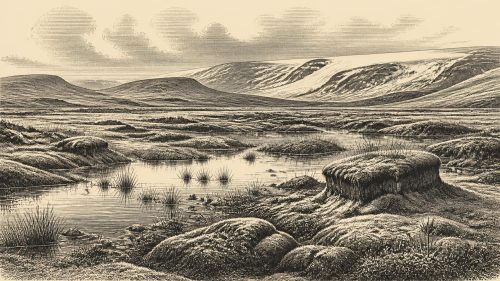
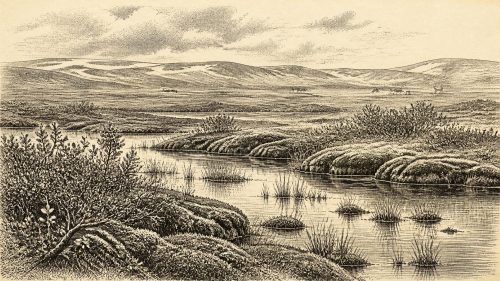
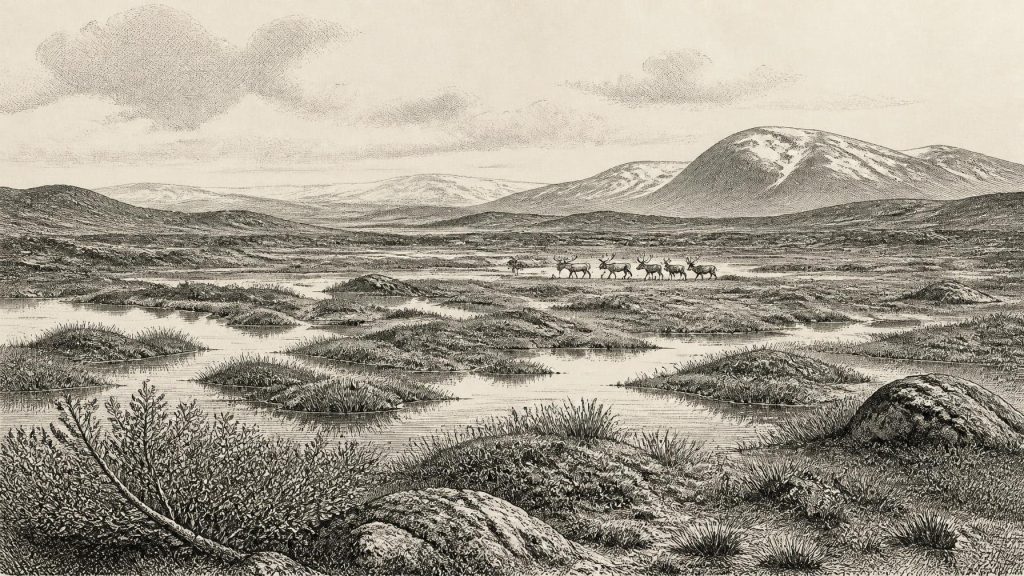
The Derryvree flora and fauna indicate open tundra vegetation and a periglacial climate: ground affected by severe cold and seasonal freezing, but not then buried beneath glacier ice. This was not a forested Ireland. Mosses, sedges and small cold-adapted flowering plants grew where the short summer permitted them, around shallow pools, saturated ground and slow-moving freshwater. Fossil evidence includes bogbean, mountain-avens, dwarf willow and lesser clubmoss. Insects and plant remains point to a muskeg-like mosaic of wet ground rich in decaying vegetation, open water and mossy margins.
Such a landscape should not be imagined as uniform. Exposure, drainage, snow cover, altitude and the proximity of ice all created local differences. Fermanagh’s drumlin country was a changing terrain of low ridges, basins and watercourses, while colder or drier patches may have supported more sparsely vegetated ground. The evidence supports a treeless, harsh setting with cold winters; it does not permit a precise reconstruction of annual temperatures, snow depth or the appearance of every valley. Nor does it show that all Ireland shared exactly the Derryvree conditions at once.
Cork’s Animal Archive
Castlepook Cave, near Doneraile in County Cork, supplies a different but complementary record. The limestone cave system, also called Mammoth Cave, has yielded more than 2,000 bones from deposits disturbed and accumulated over a long period. Geological Survey Ireland describes it as Ireland’s richest site for vertebrate fauna in the period leading towards the Last Glacial Maximum. Its Ice-Age fauna includes woolly mammoth, giant deer, reindeer, brown bear and spotted hyena; later material includes Arctic fox, wolf and lemmings. The cave was a repository, not a simple snapshot of one living community. Water movement, carnivore activity, early excavations and the mixing of deposits all complicate the record.
Nevertheless, Castlepook shows that Ireland was connected to wider north-west European animal worlds during favourable phases of the Ice Age. Reindeer and mammoth indicate open country capable of supporting large grazing mammals; hyenas and wolves indicate predators and scavengers within that ecosystem. Hyenas may also explain why some bones entered the cave: dens and feeding places can accumulate carcass parts brought in from elsewhere. It is therefore wrong to treat every species represented in the cave as proof that it stood outside the entrance in 30,922 BCE. The assemblage establishes broad regional possibilities, not a census for a single year.
The Human Question
One Castlepook reindeer femur makes this period especially important for Irish history. Ruth Carden’s examination identified a deep linear mark interpreted as damage made by a sharp stone tool while the bone was fresh. The bone has been publicly presented as approximately 33,000 years old and, if the interpretation and chronological association hold, it may indicate that a person processed a reindeer in Ireland during the Upper Palaeolithic. That would greatly extend the island’s human record beyond the terminal-Pleistocene evidence from Alice and Gwendoline Cave in County Clare.
The limits are as important as the possibility. A radiocarbon measurement dates the animal’s death, not necessarily the instant at which a surface mark was made. The old Castlepook collection lacks a securely excavated, undisturbed context for this individual bone. No stone-tool assemblage, hearth, dwelling floor, burial, repeated butchery deposit or human remains of comparable age has been recovered there. Recent work has also shown that some older Irish cave radiocarbon dates need reassessment under improved pretreatment methods. The femur is thus an intriguing possible trace of human action, not evidence for a known settlement or permanent population in Ireland in this particular year.
Society Without a Settlement
There is no evidence from Ireland at this date for political institutions, chiefs, borders, diplomacy, organised warfare, farming, villages, monuments, formal religion or literacy. Nor is there evidence for trade networks operating within Ireland. If people did reach the island during this broader interval, they were likely highly mobile hunter-gatherers moving through a challenging north-west European landscape, perhaps following seasonal opportunities associated with large mammals and open habitats. That is an interpretation drawn from wider Upper Palaeolithic lifeways and the possible Castlepook butchery trace; it is not a demonstrated description of an Irish community.
Everyday life, if human visitors were present, would have depended on shelter, fire, clothing, stone tools and close knowledge of animal behaviour and seasonal terrain. Yet none of these has been securely found in Ireland for 30,922 BCE. It would be misleading to import cave art, ritual practices, named cultures or detailed hunting customs from France, Iberia or mainland Britain and present them as Irish facts. Ireland’s evidence is too sparse. Its silence is historically meaningful: later ice advances and erosion removed, buried or disturbed many landscapes where ephemeral camps might once have stood.
Approaching the Ice Maximum
This was also a time of major environmental change rather than stability. Derryvree’s intertill deposit proves that north-central Ireland was locally ice-free during its formation. Other dated evidence has been used to argue that substantial parts of Ireland remained ice-free until at least about 34,000 years ago, before the principal build-up of the last Irish Ice Sheet. But the precise timing, extent and behaviour of earlier ice remain debated. Newer syntheses emphasise retreat–advance behaviour within Marine Isotope Stage 3 and caution against treating the later Last Glacial Maximum as a single, uncomplicated event.
The full Last Glacial Maximum came later, conventionally around 26,500–19,000 years ago, when the Irish Ice Sheet formed part of the much larger British–Irish Ice Sheet. Ice subsequently reshaped or concealed vast areas of the earlier landscape. That later destruction partly explains why the record for 30,922 BCE consists of a buried Fermanagh wetland, cave bones in Cork, speleothems, tills, landforms and laboratory dates rather than settlements. Crag Cave in County Kerry preserves episodic speleothem growth across parts of Marine Isotope Stage 3, independently underlining that climatic conditions fluctuated rather than declining in a simple straight line.
What Can Be Said Responsibly
Ireland around 30,922 BCE was not a political landscape but an Ice-Age environment in transition. The strongest direct evidence is environmental: an ice-free, cold freshwater wetland at Derryvree, preserved between separate glacial deposits. Castlepook adds a geographically distant animal archive showing that reindeer, mammoth, giant deer, bears, hyenas and other mammals formed part of Ireland’s wider Late Pleistocene story. A marked reindeer femur raises the prospect of a brief human encounter with that world, but cannot yet demonstrate a settlement, society or event in this exact year.
The Fermanagh silt clock therefore marks duration rather than an anniversary. It tells of water lying in a basin between glacial episodes; plants and insects surviving a severe climate; animals moving through changing habitats; and a landscape soon to be transformed again by expanding ice. That is enough to make this remote point in time part of Irish history, provided its uncertainties are kept visible.
Primary Sources
- A Middle Midlandian Freshwater Series at Derryvree, Maguiresbridge, County Fermanagh, Northern Ireland
- A Middle Midlandian Freshwater Series at Derryvree, Maguiresbridge, County Fermanagh, Northern Ireland
- Trimlines, Blockfields and the Vertical Extent of the Last Ice Sheet in Southern Ireland
- The Timing and Magnitude of the British–Irish Ice Sheet Between Marine Isotope Stages 5d and 2
- Exploring Controls of the Early and Stepped Deglaciation on the Western Margin of the British Irish Ice Sheet
- Episodic Speleothem Deposition Tracks the Terrestrial Impact of Millennial-Scale Last Glacial Climate Variability in SW Ireland
- The Irish Quaternary Fauna Project
- New Insights on the Fauna of Ireland’s Younger Dryas and Early Holocene from Alice & Gwendoline Cave
- The IntCal20 Northern Hemisphere Radiocarbon Age Calibration Curve (0–55 cal kBP)
- Castlepook Cave, County Geological Site Report
- Quaternary Data and Maps
- Figure 6.— The Subdivision of the Quaternary Period in Ireland
- Environmental Change in Northern Ireland: Deposits of the Last Glaciation
- Heritage Artefacts of County Cork
- Spotted Hyena Skull, Castlepook Cave
- 2022:564 – Castlepook Cave, Castlepook South, Cork
- The Exploration of Castlepook Cave, Co. Cork. With 3 Plates.
- Mammals: Natural History Collections
- Reindeer Bone Found in Cork Cave Shows Human Activity in Ireland 33,000 Years Ago
- Irish Quaternary Association: Publications