

The Derryvree Silt Archive30890 BCE
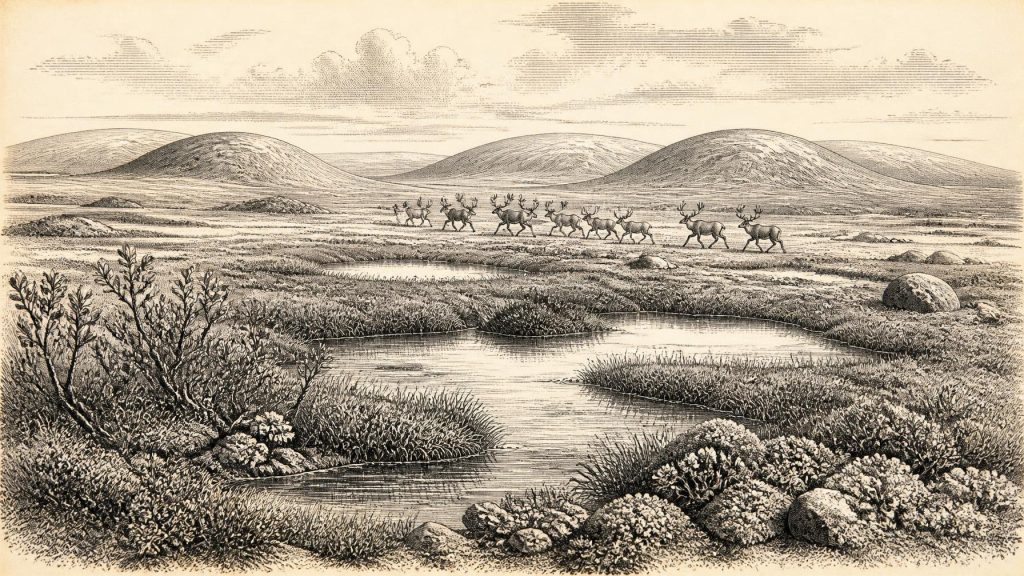
Nominally dated to 30,890 BCE, Ireland’s evidence belongs to a broad late Marine Isotope Stage 3 interval rather than a recoverable year. At Derryvree, County Fermanagh, freshwater silts between glacial tills record a temporary ice-free wetland, supporting tundra plants and aquatic life amid severe periglacial conditions. Later ice sealed the deposit as glaciation intensified before its maximum. Castlepook Cave, County Cork, preserves remains of reindeer, mammoth, giant deer and predators, demonstrating cold-stage ecosystems. A marked reindeer femur may indicate human butchery around 33,000 years ago, but lacks associated settlement evidence. Ireland’s earliest secure human trace is later, from County Clare.
Dateline
“30,890 BCE” is a modern calendar label, not a year that can be recovered from Ireland’s prehistoric record. No one in Ireland then wrote dates, named rulers or left an annual chronicle. Archaeologists instead work with radiocarbon determinations, calibrated ranges, sediment layers and the changing distribution of plants and animals. In the conventional radiocarbon system, this nominal date lies about 32,840 years before AD 1950. It falls within the later part of Marine Isotope Stage 3, a cold and unstable phase of the last Ice Age, before the British–Irish Ice Sheet reached its later maximum extent.
The most responsible way to approach Ireland at this point is therefore through a broad window rather than a supposed event. The principal local window is Derryvree, near Maguiresbridge in County Fermanagh, where a road cutting exposed freshwater silts and fine sands trapped between two separate layers of glacial till. The organic sediment returned a radiocarbon result of 30,500 +1,170/−1,030 radiocarbon years BP. Calibration produces a much broader calendar range, commonly placed at roughly 36,900–31,700 calibrated years BP. The requested date falls within that range, but cannot be matched to a particular season, household, animal death or historical occurrence.
A Wetland Between Ice Advances
Derryvree’s importance lies in its sequence. An earlier glacier laid down the lower till. At some later point, ice was absent from this particular lowland locality long enough for shallow freshwater and wetland sediments to accumulate. A subsequent ice advance deposited the upper till, sealing the older organic bed inside a drumlin. That order is direct geological evidence: glaciation, a non-glacial interval with standing or slowly moving water, then renewed glaciation. It does not prove that all Ireland was ice-free at the same time. Ice-sheet margins and upland glaciers were mobile, and conditions varied sharply between regions.
The plant and animal micro-remains in the Derryvree deposits point to an open, cold landscape under periglacial conditions. The record includes plants associated with treeless, tundra-like environments, among them dwarf willow, mountain-avens, lesser clubmoss and bogbean, alongside aquatic species such as alternate water-milfoil. Mosses, pollen, spores, seeds and insect remains do not yield a picturesque photograph of the landscape, but together they show that water and vegetation persisted in a severe climate. Around pools, fens and sedgy ground, low-growing herbs and shrubs found footholds during a period when woodland did not.
This was not the familiar green Ireland of later millennia. Trees were absent or extremely scarce in the local evidence. Wind would have crossed open ground with little shelter; winter frost, seasonal thaw and unstable soils shaped the terrain. Waterlogged hollows could nevertheless support a more varied plant community than the exposed surrounding surfaces. Derryvree is consequently best understood as an ecological refuge or wetland mosaic within a wider cold-stage landscape, not as proof of a uniformly lush or uniformly barren island.
Approaching the Last Glacial Maximum
At around 32,800 calibrated years BP, the Last Glacial Maximum still lay ahead. Scholarly reconstructions generally place the build-up of the last British–Irish Ice Sheet after about 35,000–32,000 years ago, with its broad maximum later, around 27,000–21,000 years ago. The precise timing differed across the Irish sector, and new marine, terrestrial and exposure-age evidence continues to refine the picture. What can safely be said is that Ireland was entering a time of intensifying glacial conditions, not standing at the island-wide maximum of the ice sheet.
This distinction matters. The very survival of Derryvree’s freshwater deposit demonstrates that northern Irish lowlands were not continuously smothered by ice throughout the preceding cold stage. Yet the upper till demonstrates that the wetland’s respite ended. Later ice altered landforms, eroded older surfaces and buried or destroyed many archaeological traces. Drumlins, moraines, outwash deposits and scoured bedrock visible in the modern Irish landscape are consequences of such repeated glacial action, but they cannot be read as a map of one single year.
Lower global sea levels changed coastlines and exposed wider coastal plains than exist today. Even so, it would be unsafe to imagine a simple dry land route linking Ireland permanently to Britain or continental Europe. The Irish Sea basin, local ice, changing sea level and the incomplete resolution of palaeogeography make any particular crossing route uncertain. Animals clearly reached Ireland during Pleistocene phases, but the mechanisms and timings of individual movements remain matters for investigation rather than certainty.
Castlepook’s Cold-Stage Fauna
County Cork provides another crucial, if very different, source of evidence. Castlepook Cave near Doneraile has produced an exceptional assemblage of Ice Age animal remains from antiquarian excavation and more recent fieldwork. Its fauna includes reindeer, woolly mammoth, giant deer, brown bear, wolf, Arctic fox, hare, lemmings and spotted hyaena. These remains establish that Ireland could support, at different moments during the Late Pleistocene, a cold-adapted animal community far removed from that of the historic island.
The cave was not necessarily a peaceful animal sanctuary. Carnivores could drag carcass parts into caves; animals might die naturally or be moved by water and sediment; excavators working more than a century ago did not record every find to modern standards. Castlepook’s deposits are therefore an accumulated bone archive, not a single instantaneous living landscape. Nevertheless, hyaena tooth damage on mammoth remains and the presence of predators and herbivores indicate ecological interactions across an open, cold country in which scavenging, hunting and seasonal movement mattered.
Reindeer are particularly significant. Herding animals capable of travelling over broad open terrain, they fit the wider image of a tundra or mammoth-steppe environment. Mammoth and giant deer point to substantial grazing resources, though their bones alone cannot measure population size, seasonality or the exact vegetation surrounding the cave. Nor should the word “Irish” in “Irish elk” mislead: giant deer were widespread across Eurasia, and the name reflects the abundance of later Irish finds rather than a species confined to Ireland.
A Single Bone and a Large Question
A reindeer femur from Castlepook has transformed discussion of possible human activity. The bone, held in the legacy cave collection, has been reported as about 33,000 years old and bears a deep linear mark interpreted by zooarchaeologist Ruth Carden as having been made on fresh bone with a sharp stone implement. If that interpretation is confirmed, it would be evidence that one or more people processed a reindeer carcass in Ireland during the Upper Palaeolithic, close to the broad period represented by this article.
That finding must be described with care. A radiocarbon measurement dates the animal bone, while identifying a surface modification as a stone-tool cut is a separate taphonomic judgement. Carnivore activity, trampling, sediment pressure, weathering, breakage and excavation damage can all mark bone. More importantly, Castlepook has not produced a securely associated camp floor of this age: there is no published hearth, stone-tool assemblage, dwelling, burial or repeated occupation sequence that can establish a resident community. A single possibly butchered bone supports the possibility of a brief human visit or carcass-processing episode; it does not support claims for settled population, named people, language, ethnicity or a continuous Irish ancestry.
The nearest securely dated evidence of human activity in Ireland remains much later: a butchered brown-bear patella from Alice and Gwendoline Cave, County Clare, dated to the late Upper Palaeolithic, around 12,800–12,600 calibrated BP. The contrast is instructive. Castlepook raises a serious and exciting possibility for a far earlier human presence, while Alice and Gwendoline offers clearer evidence in a later period. Responsible history keeps both the importance and the limitations of the earlier claim in view.
Life Beyond the Evidence
If people did reach Ireland around this broad interval, they were almost certainly highly mobile hunter-gatherers, using organic materials and stone tools that are now largely lost. They may have followed animal movements, exploited a carcass opportunistically or travelled in small groups. These are reasonable interpretations from the ecology of Upper Palaeolithic north-west Europe and the Castlepook femur; they are not facts demonstrated for a particular Irish group. There is no direct Irish evidence here for houses, clothing, boats, cooking practices, kinship rules or the number of visitors.
Nor is there evidence for political affairs, diplomacy, formal warfare, farming, trade networks, permanent settlements, organised religion, art or literacy in Ireland at this date. This is not a claim that people, if present, lacked social worlds, beliefs or learning. Rather, the Irish material is too slight to reconstruct them. No cultivated crops or domestic animals are known; no exchange goods can be identified; and no monument or burial belongs to this horizon. The main economy visible in the evidence is ecological: grazing animals sustained predators and scavengers, while freshwater wetlands supported hardy plant communities.
For 30,890 BCE, then, Ireland is not a stage for kings or battles. It is a changing Ice Age landscape, poised between glacial advances. Derryvree’s sealed silts preserve a rare record of cold wetland life in Fermanagh; Castlepook’s cave bones reveal a richer cold-stage fauna in Cork and pose the unresolved question of a human encounter with reindeer. Together they show both how much deep Irish history can reveal and how firmly its limits must be respected.
Primary Sources
- A Middle Midlandian Freshwater Series at Derryvree, Maguiresbridge, County Fermanagh, Northern Ireland
- A Middle Midlandian Freshwater Series at Derryvree, Maguiresbridge, County Fermanagh, Northern Ireland
- Early Midlandian–Middle Midlandian, Pleistocene, Northern Ireland
- The Subdivision of the Quaternary Period in Ireland
- The Geology of Ireland: Cenozoic—Tertiary and Quaternary
- Saxifraga rosacea Moench, Irish Saxifrage
- Selaginella selaginoides (L.) P. Beauv., Lesser Clubmoss
- Myriophyllum alterniflorum DC., Alternate Water-milfoil
- Salix herbacea L., Dwarf Willow
- Extent and Timing of the Last Glacial Maximum (LGM) in Britain and Ireland: A Review
- Maximum Extent and Dynamic Behaviour of the Last British–Irish Ice Sheet West of Ireland
- Pattern and Timing of Retreat of the Last British-Irish Ice Sheet
- Growth and Retreat of the Last British–Irish Ice Sheet, 31,000 to 15,000 Years Ago: the BRITICE-CHRONO Reconstruction
- Dimensions and Chronology of the Last Ice Sheet in Western Ireland
- Timing, Pace and Controls on Ice Sheet Retreat: an Introduction to the BRITICE-CHRONO Transect Reconstructions of the British-Irish Ice Sheet
- Heritage Artefacts of County Cork
- 2022:564 – CASTLEPOOK CAVE, Castlepook South, Cork
- The Archaeology of Caves in Ireland
- Ireland's Palaeolithic Archaeology – Fleeting Footprints in a Frozen Land
- The Mesolithic in Ireland: When Was It?
- New Insights on the Fauna of Ireland's Younger Dryas and Early Holocene from Alice & Gwendoline Cave
- New Insights on the Fauna of Ireland’s Younger Dryas and Early Holocene from Alice & Gwendoline Cave
- The Irish Quaternary Fauna Project
- The Irish Elk: When and Why Did This Giant Deer Go Extinct and What Did It Look Like?