Castlepook’s Mammoth Passages30889 BCE
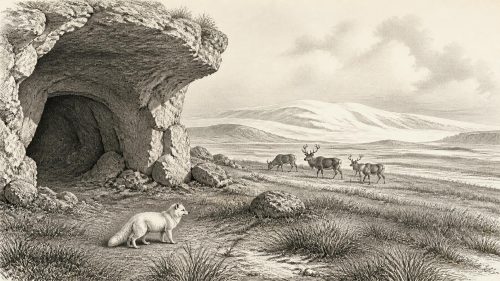
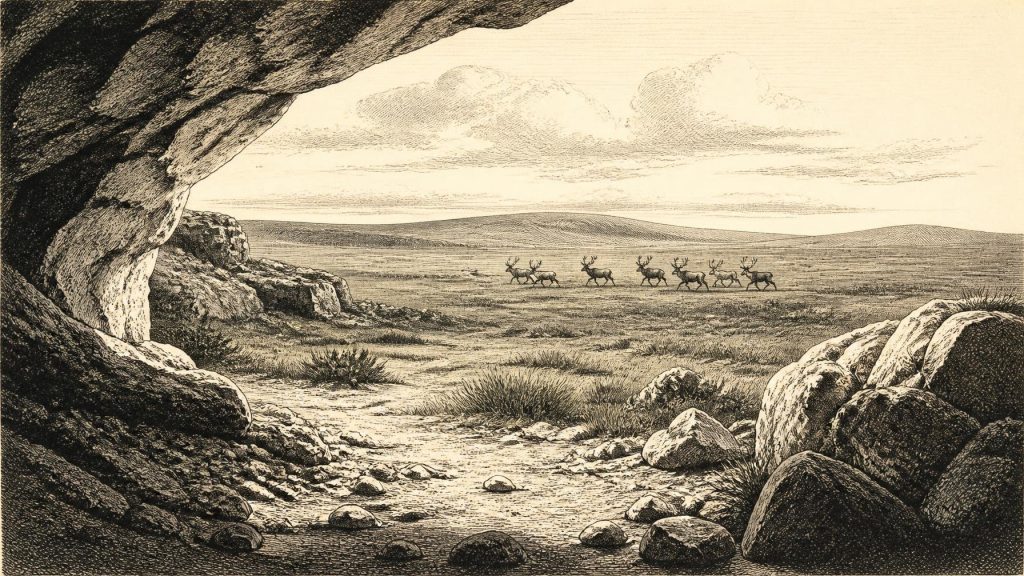
Around 30,889 BCE, Ireland’s evidence is environmental rather than historical. Castlepook Cave in County Cork preserves over 2,000 Late Pleistocene animal bones, including mammoth, reindeer, giant deer, hyaena, bear, Arctic fox and lemmings, accumulated and disturbed over many millennia. These remains indicate a fluctuating, cold, open landscape within the wider north-west European ecosystem as ice sheets expanded towards the Last Glacial Maximum. A marked reindeer bone may represent exceptionally early human butchery, but its interpretation remains uncertain and does not prove settlement. Routes into Ireland are unknown. Castlepook remains an active research site, potentially refining understanding of Ireland’s deep prehistory.
Dateline
30,889 BCE cannot be treated as a date at which an Irish event can be placed. It is a modern calendar label imposed on a deep-prehistoric interval for which neither written records nor annually resolved archaeological sequences exist. Measured against the conventional radiocarbon reference year of 1950, it falls about 32,838 calendar years before present, within Marine Isotope Stage 3 (MIS 3), part of the Late Pleistocene. That calculation is useful only as orientation: radiocarbon determinations of this age calibrate to ranges, not single years, and the relationship between radiocarbon and calendar time is irregular. Modern calibration curves extend to 55,000 calendar years before present, but their precision does not turn an Ice Age deposit into a historical chronology.
Accordingly, the responsible question is not what happened in Ireland in this particular year, but what evidence illuminates the island in the broad interval around it. The strongest answer lies in caves, animal bone and glacial geology, especially at Castlepook Cave near Doneraile in north County Cork. These remains show that parts of Ireland supported, or at least received, a striking cold-stage fauna before the full Last Glacial Maximum. They do not demonstrate a settled human population, an Irish society or a named prehistoric culture.
A Cave Archive Rather Than a Chronicle
Castlepook, also called Mammoth Cave or Doneraile Cave, is Ireland’s most important known archive for vertebrate life in the period leading towards the Last Glacial Maximum. Its narrow limestone galleries and chambers produced more than 2,000 bones during excavations between 1904 and 1918. The recovered fauna includes woolly mammoth, giant deer, reindeer, brown bear and spotted hyaena; later Ice Age specimens include Arctic fox, wolf and two kinds of lemming. Individual bones have produced radiocarbon results spanning roughly 45,700 to 19,950 years before present. That is a very long span, and it immediately rules out reading the cave as the record of one season, one hunting party or one event.
The cave’s richness is inseparable from its difficulties. Bones accumulated through several processes: carnivores brought in prey and scavenged carcasses; animals may have died in or near passages; water disturbed and redistributed deposits; later burrowing and antiquarian excavation further mixed the evidence. Some bones in older collections may have acquired misleading associations. Recent scientific redating has shown that several earlier determinations from Castlepook were substantially too young, by about 5,000 to 12,000 radiocarbon years. Such revisions are not a minor technicality: they alter which animals were present together, and when.
For around 30,889 BCE, therefore, Castlepook provides a regional environmental window rather than a snapshot. Its animal remains make a cold, open and demanding Irish landscape plausible, but no one should imagine every listed species standing together outside the cave on a single day. The secure conclusion is that, across parts of MIS 3, southern Ireland formed part of a north-west European world in which cold-adapted mammals and large herbivores could occur.
Reindeer, Mammoth and Hyaena
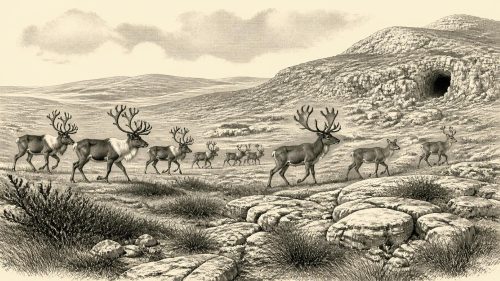
The animal evidence suggests an open mosaic rather than the dense Atlantic woodland familiar in modern Ireland. Reindeer and mammoth are commonly associated with grass-rich steppe-tundra environments; lemmings, Arctic fox and mountain hare point towards severe, treeless or sparsely vegetated conditions. Giant deer and brown bear complicate any simple image of a uniform polar desert, reminding us that climate and habitats fluctuated across centuries and millennia. Wider European MIS 3 pollen evidence also indicates that vegetation changed sharply between warmer and colder phases, with cold herbs and tundra shrubs extending far south of their modern ranges.
At Castlepook, spotted hyaena is especially significant. Hyaenas could use caves as dens, transport bones, gnaw them and leave accumulations that mimic the residue of a kill or a human camp. Their presence tells us that Ireland was ecologically connected, however intermittently, to the wider distribution of large Pleistocene mammals. It does not prove that people followed the same route. The cave itself was a landscape feature repeatedly used by non-human animals, not a demonstrated home for human beings.
Climate was not stable. The British-Irish Ice Sheet was beginning its long build-up during the broader period: one influential synthesis places its growth after about 35–32 thousand years ago, while its maximum extent came much later, around 27–21 thousand years ago. More recent work likewise stresses that ice growth and readvance in MIS 3 were dynamic and uneven. Around the date represented here, Ireland was not yet simply an island buried beneath the maximum ice sheet, but it was entering an increasingly volatile glacial world.
Was Anyone Here?
The question of human presence is both compelling and unresolved. A reindeer femur from Castlepook has been publicised as approximately 33,000 years old and as bearing a deep mark interpreted as having been made by a sharp stone tool while fresh bone was processed. If that interpretation is sustained, it would be extraordinary: potentially the earliest evidence for human activity in Ireland, far earlier than the securely established post-glacial settlement record. The bone is held by the National Museum of Ireland – Natural History, and its potential importance has rightly encouraged renewed investigation of the cave.
Yet the qualification matters as much as the claim. The marked femur is not from a securely excavated occupation floor accompanied by hearths, stone tools, butchered animal concentrations or human remains. Its date is the age of the animal bone, not a calendrical timestamp for the surface mark; identifying a mark as human-made requires separate taphonomic judgement. Nor does a single possible butchery action establish a permanent settlement, a population, a language, a migration route or continuity with the people who returned to Ireland much later.
The most defensible wording for the interval around 30,889 BCE is consequently cautious: people may have reached Ireland, or at least one person may have processed an animal represented at Castlepook, but a human presence remains provisional rather than securely demonstrated. In historical terms, that leaves political affairs, diplomacy and warfare beyond recovery. There is no evidence for leaders, territories, alliances, raids or organised conflict. It would be misleading to fill that silence with assumptions drawn from later hunter-gatherers elsewhere in Europe.
Movement Across a Changing Seascape
How animals, and perhaps people, arrived is also uncertain. Global sea level was lower than today during the Ice Age, exposing more of the continental shelf, but lower water did not automatically create an easy land route between Ireland and Britain. The geography of the Irish Sea changed with ice, relative sea level, coastlines and shallow-water basins. A classic assessment concluded that no dependable late-Quaternary land bridge crossed the southern Irish Sea and that any northern connection was, at most, temporary and discontinuous in a much later period. That does not settle every MIS 3 palaeogeographical question, but it cautions against the popular picture of an uninterrupted walk to Ireland.
For animals, movement could have involved exposed coastal plains, temporary ice links, short crossings, or routes that are now submerged and poorly preserved. For people, each possibility carries different implications of risk, knowledge and technology. But none can presently be chosen from the Irish evidence. There is no excavated harbour, watercraft, trail, camp or lithic source trail from this time. “Trade” is therefore the wrong term: no exchange network or economy can be identified. At most, the fauna demonstrates ecological movement through a changing north-west European region.
Everyday Life Beyond the Evidence
If humans were present, they would have faced a landscape of extreme seasonality, limited shelter and large predators as well as potential prey. Caves may have offered temporary refuge, but Castlepook cannot be called a human dwelling. Reindeer, mammoth and giant deer would have represented substantial food and raw-material resources to any successful hunter, while hides, bone and antler could have been valuable. Those are reasonable comparisons with Upper Palaeolithic lifeways elsewhere, not direct evidence of Irish practice.
Nothing currently supports claims for houses, fire-making, clothing, boats, art, burial, ritual sites, teaching traditions or ceremonial life in Ireland around this date. There is likewise no basis for identifying a local religion or a distinctive Irish material culture. Absence of evidence is not evidence that people lacked culture; it means that the archaeological record has not yet recovered it here. The distinction is essential, particularly when a single cave bone can attract understandable excitement.
A Precarious Irish World
The principal development illuminated by this date is environmental, not political: Ireland lay within a changing Ice Age frontier shortly before the Last Glacial Maximum transformed much of the island. Cold-adapted mammals occupied or passed through southern Ireland; carnivores used caves; ice masses and sea levels were reorganising the surrounding region. Castlepook’s deposits preserve fragments of that world precisely because caves could shelter bones from processes that erased many surface traces.
Future excavation, improved collagen screening, ancient DNA, microscopic study of bone modifications and refined dating may change the picture again. Excavations undertaken at Castlepook in 2022 demonstrate that the cave remains an active research subject rather than a closed antiquarian collection. For now, 30,889 BCE belongs not to the history of an identifiable Irish people, but to the deep environmental prehistory from which later Ireland eventually emerged: a world of limestone passages, reindeer, mammoths, hyaenas and approaching ice.
Primary Sources
- Castlepook Cave: Cork County Geological Site Report
- A Reconsideration of the Radiocarbon Dating of the Marine Isotope Stage 3 Fauna from Southern Ireland
- Heritage Artefacts of County Cork
- 2022:564 – Castlepook Cave, Castlepook South, Cork
- Mammoth Cave
- Pleistocene Vertebrates in the British Isles
- IAH Field Trip 2014: Castlepook (Mammoth) Cave
- Extent and Timing of the Last Glacial Maximum (LGM) in Britain and Ireland: A Review
- Maximum Extent and Readvance Dynamics of the Irish Sea Ice Stream and Irish Sea Glacier Since the Last Glacial Maximum
- Trimlines, Blockfields and the Vertical Extent of the Last Ice Sheet in Southern Ireland
- Dimensions and Chronology of the Last Ice Sheet in Western Ireland
- The Timing and Magnitude of the British–Irish Ice Sheet Between Marine Isotope Stages 5d and 2
- Figure 6: The Subdivision of the Quaternary Period in Ireland
- Cenozoic: Tertiary and Quaternary
- IntCal Publications
- The Problem of a Late Quaternary Landbridge Between Britain and Ireland
- European Vegetation During Marine Oxygen Isotope Stage 3
- Comparison of Climate Model Results with European Vegetation and Permafrost During Oxygen Isotope Stage Three
- The Mesolithic in Ireland: When Was It?
- Ireland’s Palaeolithic Archaeology – Fleeting Footprints in a Frozen Land
- Archaeological Excavations at Killuragh Cave, Co. Limerick: A Persistent Place in the Landscape from the Early Mesolithic to the Late Bronze Age