Carden’s Reindeer Incision30699 BCE
Around 30,699 BCE, Ireland lay within the unstable late Pleistocene, not a datable historical year. Sediments beneath Derryvree drumlin, County Fermanagh, dated broadly to 30,500 BP, preserve evidence of open, wet tundra with arctic-alpine plants, rather than woodland or continuous ice. Castlepook Cave, County Cork, yielded diverse cold-climate animal remains, including a reindeer femur bearing a possible stone-tool cut mark. This may indicate Upper Palaeolithic carcass processing, but lacks secure excavation context and cannot prove settlement, population or route of arrival. Changing ice, sea levels and later glaciation limited access and destroyed evidence, leaving fragments rather than a continuous narrative.
Dateline
“30,699 BCE” is a modern way of pinning a point onto a timescale that prehistoric evidence cannot resolve to a single year. It corresponds approximately to 32,650 calendar years before AD 1950, but neither Ireland’s archaeological deposits nor its climate records can identify an event in that particular year. The responsible subject is therefore Ireland in the broader late Pleistocene interval around it: Marine Isotope Stage 3, during the Midlandian glaciation, when climates shifted abruptly and the island’s landscapes, coastlines and possible accessibility were very different from those of later prehistory.
The evidence is thin but exceptionally important. A freshwater sediment sequence beneath a drumlin at Derryvree, near Maguiresbridge in County Fermanagh, preserves a local record of tundra vegetation and wet ground. At Castlepook Cave near Doneraile in north County Cork, cave deposits and older collections preserve bones of Ice Age animals; one reindeer femur carries a mark interpreted as stone-tool damage. Together, these places reveal a cold, open Irish environment and raise the possibility of a very early human encounter with it. They do not supply a political history, a named population or an exact date of arrival.
A Date Without a Chronicle
There were no written records, rulers, states or historically identifiable communities in Ireland at this time. Modern calendar precision is unavailable. Radiocarbon results are conventionally reported in years “before present”, where present is AD 1950, and must be calibrated against changing atmospheric radiocarbon levels. At more than 30,000 years ago, calibration produces ranges rather than a single secure calendar equivalent. The date used for this article should therefore be read as a convenient point within a long archaeological horizon, not as an anniversary.
Derryvree demonstrates the problem and the value of the evidence. Roadworks in 1969 cut through a drumlin and exposed silts and fine sands between glacial deposits. Organic material from the freshwater bed produced a conventional radiocarbon determination of 30,500 years BP, with a substantial uncertainty of +1,170 and −1,030 years. That is not a date for one day, season or even one generation. Nor does it map simply onto 30,699 BCE. It nevertheless places the deposit broadly within the cold, unstable middle part of the last glacial cycle and makes it one of Ireland’s key windows onto the environment near this remote period.
Fermanagh’s Open Tundra
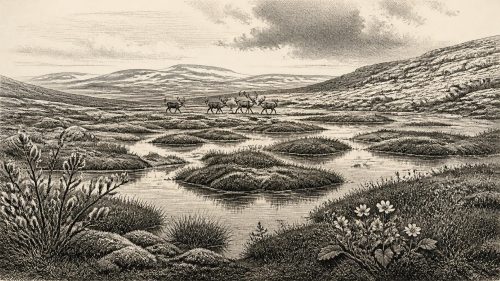
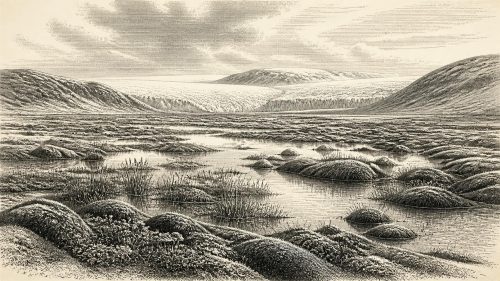
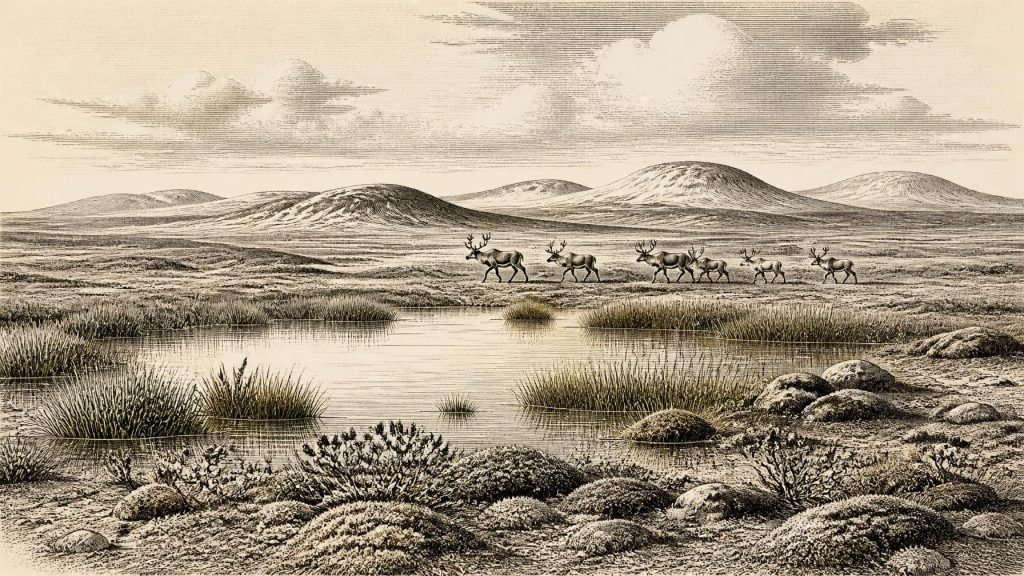
The Derryvree deposit is evidence for a landscape that was cold, largely treeless and wet in places, rather than a uniformly lifeless sheet of ice. Its pollen was poorly preserved, but plant macrofossils and spores were more revealing. They include mosses and species associated with arctic-alpine or periglacial conditions, among them mountain avens (Dryas octopetala), bogbean (Menyanthes trifoliata) and lesser clubmoss (Selaginella selaginoides). Such finds indicate that shallow freshwater, saturated ground and tundra plants survived locally around a basin or pool.
This was not modern Fermanagh transplanted into colder weather. There is no basis for imagining dense woodland, settled farms or a familiar bog landscape. Herbaceous pollen dominates, and the available evidence points to sparse vegetation on exposed ground. Dwarf shrubs, sedges, grasses, mosses and small wetland plants could exploit sheltered or damp niches; bare mineral ground, frost-shattered slopes and seasonally frozen soils probably occupied much of the wider terrain. Occasional tree pollen does not prove local forest: it may have travelled long distances or been redeposited from older sediments.
That distinction matters. Derryvree records a particular depositional setting, not a complete map of the island. It is reasonable to infer a periglacial mosaic of open ground, wet hollows and freshwater margins in south Fermanagh. It is not reasonable to extend every species from one buried basin to all Irish regions, or to infer a stable climate from a single sedimentary interval. The major lesson is variability: Ireland contained habitats capable of supporting cold-adapted life during a period when advancing ice and rapidly changing climate constrained them.
The Doneraile Bone Archive
Castlepook Cave, also called Mammoth Cave, offers a different kind of testimony. Early twentieth-century excavations recovered a rich but complicated collection of Pleistocene animal remains from its limestone passages. The fauna includes reindeer, woolly mammoth, giant deer, brown bear, wolf, fox, hare, lemmings and spotted hyaena. These remains show that Ireland was reached, at different times within the late Pleistocene, by a far broader cold-climate fauna than survives on the island today.
The most consequential object is a reindeer femur in the National Museum of Ireland’s Natural History collection. County Cork’s heritage publication assigns it broadly to about 31,000 BC and records zooarchaeologist Ruth Carden’s interpretation of a deep incision as a mark made by a sharp stone tool while fresh bone was being processed. If that interpretation is sustained, it is evidence that a person handled a reindeer carcass in Ireland vastly earlier than the long-established terminal-Pleistocene evidence for human activity.
Yet the qualification is central, not incidental. The bone was recovered from an antiquarian cave assemblage rather than a modern, sealed excavation of a camp. A cut mark can demonstrate an action on a carcass; it cannot by itself identify who made it, whether they hunted the animal, how many people were present, how long they stayed, or whether they returned. There is no securely associated hearth, stone-tool assemblage, dwelling surface, burial, artwork or food-processing area of comparable age at Castlepook. Carnivores also used the cave, and bones may have been moved, gnawed, scavenged or accumulated over long spans of time.
Consequently, Ireland around 30,699 BCE cannot responsibly be described as continuously inhabited. The careful conclusion is narrower and more significant: the Castlepook femur is a credible, still-investigated indication that Upper Palaeolithic people may have reached the island during the late Pleistocene. Ongoing cave survey, excavation, dating and taphonomic study seek the decisive contextual evidence that the old collection lacks.
People at the Edge of the Record
If people did process reindeer in Ireland during this broader interval, their way of life was almost certainly mobile. Across north-west Europe, Upper Palaeolithic groups depended on flexible knowledge of animal movements, stone resources, weather, shelter and seasonal routes. A reindeer limb bearing a possible cut mark supports an inference of meat or carcass processing. It does not establish a permanent settlement, a population size, a language, a tribal name or affiliation with a particular archaeological culture. Terms such as Aurignacian or Gravettian describe material traditions on the continent; they should not be imposed on Ireland without diagnostic tools or securely dated occupation deposits.
Nor can boats, trade or diplomacy be demonstrated. Lower global sea levels and changing ice-sheet margins altered the geography around Ireland, but scholarly reconstructions disagree about the availability and continuity of land routes between Ireland and Britain at different stages of the glacial cycle. Animals and any human visitors may have crossed exposed terrain, ice, short water gaps or combinations of these; the evidence does not decide the route at this date. A connection, if one existed, was a changing physical opportunity rather than a proved trade corridor.
There is likewise no evidence for political affairs, organised warfare, treaties or religious institutions. Caves should not automatically be treated as shrines, and the remarkable animal bones from Castlepook are not grave goods or ritual deposits. The strongest social inference is more elementary: survival in this landscape, whether by animals or occasional people, depended on movement, ecological knowledge and the ability to exploit narrow windows of suitable habitat.
Ice, Water and Change
This was a world approaching the expansion of the last British–Irish Ice Sheet, not yet the familiar maximum glaciation of roughly 27,000 to 21,000 years ago. Reconstructions show that ice-sheet growth and maximum extent were asynchronous across Ireland and its surrounding shelves. At the approximate time represented by this article, local ice conditions, exposed land and coastlines could have differed sharply from place to place and changed over millennia. Later ice advances also destroyed, buried or reworked many earlier land surfaces, helping to explain why Ireland’s record of this age is so fragmentary.
For everyday life, the environmental evidence is more secure than the human story. Wetland plants at Derryvree, and the cold-adapted animals represented at Castlepook, show that Ireland contained productive but demanding habitats. Reindeer and large herbivores could feed predators and, perhaps intermittently, people. Fresh water and sheltered hollows offered resources, while exposure, cold, seasonal darkness and volatile weather imposed formidable limits. There is no evidence of farming, pottery, metalworking, monuments, formal learning or long-distance exchange in Ireland at this date.
The year 30,699 BCE is therefore best understood as an archaeological threshold rather than a historical episode. Beneath a Fermanagh drumlin, plants record an open tundra wetland. In a Cork cave collection, a marked reindeer bone poses a profound question about human presence. These traces make the distant Irish past more tangible, but their scarcity is itself part of the history: a changing glacial island preserved fragments, not a narrative. The proper response is not to fill that silence with invented hunters, chiefs or ceremonies, but to recognise how much can be learned from one buried pool and one disputed mark on bone.
Primary Sources
- Palaeoecology: Irish Quaternary Association Field Guide
- HERITAGE ARTEFACTS of County Cork
- Archaeology Research Excavation Grant 2022: Castlepook Cave, Co Cork
- 2022:564 – CASTLEPOOK CAVE, Castlepook South, Cork
- The Irish Quaternary Fauna Project
- New insights on the fauna of Ireland's Younger Dryas and Early Holocene from Alice & Gwendoline Cave
- Red deer in Ireland: Phylogeography and population genomics
- Could brown bears (Ursus arctos) have survived in Ireland during the Last Glacial Maximum?
- BSBI: Menyanthes trifoliata
- BSBI: Dryas octopetala
- BSBI: Selaginella selaginoides
- Extent and timing of the Last Glacial Maximum (LGM) in Britain and Ireland: a review
- The timing and magnitude of the British–Irish Ice Sheet between Marine Isotope Stages 5d and 2
- Timing and pace of ice-sheet withdrawal across the marine–terrestrial transition west of Ireland during the last glaciation
- Stratigraphic and palaeo-geomorphological evidence for the glacial-deglacial history of the last British-Irish Ice Sheet in the north-western Irish Sea
- Pattern and timing of retreat of the last British-Irish Ice Sheet
- Growth and retreat of the last British–Irish Ice Sheet, 31,000 to 15,000 years ago: the BRITICE-CHRONO reconstruction
- The Island of Ireland: Drowning the Myth of an Irish Land-Bridge?
- The problem of a late Quaternary landbridge between Britain and Ireland
- The IntCal20 Northern Hemisphere Radiocarbon Age Calibration Curve (0–55 cal kBP)
- IntCal – History
- Landscapes and environments of the last glacial-interglacial transition: a time of amazingly rapid change in Ireland