Derryvree’s Tundra Aquarium30710 BCE
Labelled 30,710 BCE, this interval belongs to Marine Isotope Stage 3 and cannot be reconstructed as a single Irish year. At Derryvree, County Fermanagh, freshwater sediments between glacial tills, broadly dated to the period, preserve evidence of an ice-free interval: shallow water, wetland plants and open, periglacial tundra. Ireland’s ice cover, coastlines and possible travel routes changed repeatedly. Castlepook Cave, County Cork, yielded cold-stage animals including mammoth, reindeer, giant deer, predators and lemmings, though its deposits are mixed and imprecisely dated. Human presence remains uncertain: a cut-marked reindeer bone suggests visitation, but no contemporary settlement, tools or society is established.

Dateline
30,710 BCE is a modern calendar label, not a date at which Ireland’s Late Pleistocene past can be resolved into a named event, season or individual life. In the archaeological convention of years before present, measured from AD 1950, it lies about 32,659 years ago. That places it within Marine Isotope Stage 3, a long and climatically unsettled part of the last Ice Age. Ireland at this depth of time is known through imperfect physical traces: layers of sediment, pollen and plant fragments, fossil bones, cave deposits, glacial landforms and scientific dates. These records can illuminate a broad interval around the notional year; they cannot provide calendar-year precision.
A Date with a Wide Margin
The most informative Irish environmental sequence close to this point is at Derryvree, near Maguiresbridge in County Fermanagh. Roadworks in 1969 cut through a drumlin and exposed an unusual sequence: a lower sheet of glacial till, then freshwater silts and fine sands rich in organic remains, then a second thick till. Till is debris deposited directly by glacier ice. The order of deposits therefore records glaciation, an intervening period when water and life occupied the locality, and a later return or advance of ice.
Organic material from the Derryvree freshwater bed produced the radiocarbon determination BIRM-166, conventionally dated to 30,500 radiocarbon years before present, with a substantial uncertainty of +1,170 and −1,030 years. Radiocarbon years are not calendar years: atmospheric carbon-14 has varied over time, and calibration creates ranges rather than a single secure date. Published calibrations have placed the deposit broadly around 36,900–31,700 calibrated years before present, approximately 34,950–29,750 BCE. The date 30,710 BCE falls within that broad span, but not at a point that can be isolated in the sediments. Derryvree is evidence for an interval, not a diary entry for a particular year.
A Small World Between Ice Advances
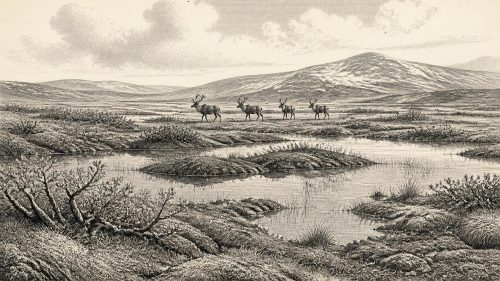
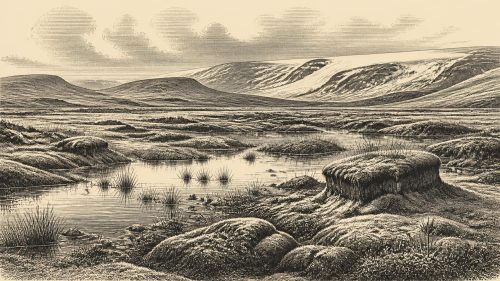
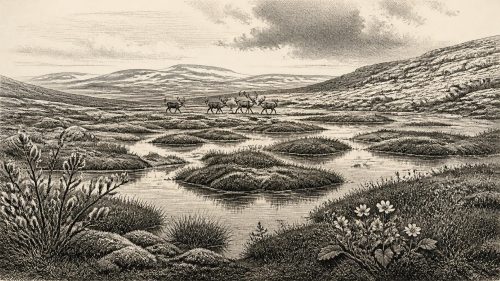
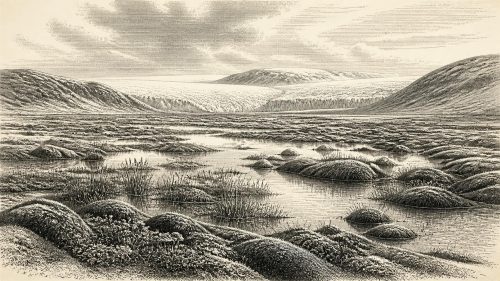
The Derryvree material shows that at least this part of Fermanagh was not continuously entombed beneath ice during the relevant phase of the Midlandian glaciation. Freshwater accumulated in a basin, while plants colonised its margins and surrounding ground. The investigators described an open tundra vegetation and a periglacial climate: land shaped by intense freezing and thawing, often close to glacier ice, rather than by woodland or an established temperate landscape. The locality was cold, exposed and treeless, but it was not lifeless.
Fossil plant remains are unusually eloquent here because they record both terrain and water. Mosses, sedges and other wet-ground plants occurred with species suited to cold or alpine conditions, including dwarf willow, mountain-avens, lesser clubmoss and bogbean. Aquatic plants such as alternate water-milfoil point to shallow freshwater. This was not a modern Irish bog transplanted into the Ice Age. Rather, it was a patchwork of wet silts, pools, mossy ground and sparse herb-rich tundra, sustained during a window between glacial episodes. The low vegetation would have left much ground exposed to wind, frost action and seasonal meltwater.
The phrase “tundra” should not conceal local variation. Derryvree’s pond or wetland could shelter plants and small animals that could not have lived on the same terms across a windswept ridge, a frozen valley floor or beside an ice margin. Nor does a deposit in Fermanagh prove identical conditions in Cork, Clare, Waterford or the western seaboard. Ireland was a varied landscape even in the Ice Age, and changing ice cover further complicated that variation. What Derryvree securely demonstrates is the existence of a freshwater, biologically active refuge within a severe wider environment.
An Unstable Island Landscape
At the scale of the British–Irish Ice Sheet, this was a period of advance, retreat and reorganisation measured in centuries and millennia, not in annual political or historical time. Modern reconstructions indicate that ice masses around Ireland and Britain were dynamic during Marine Isotope Stage 3, and that major growth towards the later Last Glacial Maximum was under way or impending in different sectors. Yet the precise extent and timing of Irish ice around 32,659 years before AD 1950 remain debated. Some evidence indicates substantial earlier glaciation and shifting ice margins; the Derryvree intertill deposit is important precisely because it preserves an ice-free or ice-withdrawn episode between tills.
Sea level was much lower than today because vast volumes of water were stored in continental ice. The shape of coastlines and the availability of routes across the Irish Sea region consequently differed greatly from the modern map. But lowered sea level did not automatically create an easy, continuous land crossing from Ireland to Britain or continental Europe. Ice margins, rivers, cold seas, marshy lowlands and changing shorelines all mattered. For animals and any people who reached Ireland, movement would have depended on conditions that altered repeatedly as climate and ice changed.
Cork Caves and Cold-Stage Fauna
County Cork provides the other major Irish body of evidence relevant to this distant world. Castlepook Cave, also called Mammoth Cave, near Doneraile in the Awbeg Valley, has yielded Ireland’s best-known pre-Last Glacial Maximum mammal assemblage. Identifications from its older cave collections include woolly mammoth, reindeer, giant deer, brown bear, wolf, Arctic fox, mountain hare, collared and Norwegian lemmings, and spotted hyena. A mammoth bone has returned a Middle Devensian radiocarbon age of about 33,400 ± 1,200 radiocarbon years before present. These animals establish that Ireland supported a far richer cold-stage fauna than the modern island.
They should not, however, be arranged into a single imagined scene at 30,710 BCE. Castlepook’s fossils were recovered through early twentieth-century excavations from cave deposits affected by water, animal activity, sediment movement and later disturbance. Some remains may be of different ages, and improved laboratory methods have shown that legacy radiocarbon results from Irish cave material require careful reassessment. The cave is powerful evidence for recurring animal presence in Late Pleistocene Ireland, but not a securely dated census of one herd, one hyena den or one season.
Even so, the faunal evidence gives substance to the wider ecology suggested by Derryvree. Reindeer and giant deer could exploit open country; lemmings, Arctic foxes and mountain hares indicate cold-adapted habitats; wolves and spotted hyenas were predators and scavengers within a food web that included large herbivores. Mammoths belonged to this broader northern European cold-stage world, although their Irish remains are few. Carcasses, antler, hides, sinews and marrow were valuable biological resources for carnivores and, where present, humans. None of this implies agriculture, managed herds or permanent settlement.
The Human Question
There is no securely excavated settlement, hearth, stone-tool assemblage or burial that can be assigned to Ireland in 30,710 BCE. Consequently, there is no responsible basis for describing a resident population, a tribe, a language, a leader or an established Palaeolithic society. A reindeer femur from Castlepook has been reported as bearing marks consistent with cutting by a sharp stone tool and has been publicised as evidence of human activity around 33,000 years ago. If that interpretation is upheld, it would be an exceptionally important indication that hunter-gatherers entered Ireland during the Upper Palaeolithic.
Its implications must remain narrow. A marked bone can suggest the handling or processing of an animal; it does not prove that people lived permanently at Castlepook, that the cave was a domestic base, or that occupation continued without interruption. No associated toolkit presently permits archaeologists to identify a particular cultural tradition. The better-contextualised evidence from Alice and Gwendoline Cave in County Clare demonstrates human butchery only much later, around 12,800–12,600 calibrated years before present. It confirms that Irish cave collections can transform understanding, while also underlining how unusual and fragile the evidence remains.
No Kingdoms, No Commerce
Political affairs, warfare, diplomacy, organised religion, formal learning and trade networks are beyond the reach of the evidence for this date. There were no states, towns, coinage, writing or monuments from which such subjects might be reconstructed. Should people have visited Ireland around this time, their economy would have been one of highly mobile hunter-gathering: obtaining food and materials from a seasonally difficult landscape rather than farming, mining or market exchange. That is an inference from the ecological setting and Upper Palaeolithic lifeways elsewhere in north-west Europe, not a directly documented Irish economy.
Culture is similarly almost invisible. No Irish art, dwelling plan, clothing, ritual site or spoken tradition can be assigned to 30,710 BCE. Yet the survival of the Derryvree freshwater bed and the Castlepook animal bones has its own importance. They show that Ireland was not merely an empty stage awaiting later history. It was a changing northern landscape of ice, water, sparse vegetation and mobile animals, intermittently habitable and repeatedly reshaped by climate. For this year, the most truthful historical account is one of deep environmental time: a tundra wetland beneath a future drumlin, and a fragmentary record from which human possibility must be distinguished carefully from human certainty.
Primary Sources
- A Middle Midlandian Freshwater Series at Derryvree, Maguiresbridge, County Fermanagh, Northern Ireland
- Irish Pleistocene Biostratigraphy
- The Irish Quaternary Fauna Project
- Pleistocene Vertebrates in the British Isles
- Occurrence of Mammalia Relicts at Site Castlepook Cave
- New Insights on the Fauna of Ireland's Younger Dryas and Early Holocene from Alice & Gwendoline Cave
- First Evidence of a Late Upper Palaeolithic Human Presence in Ireland
- Growth and Retreat of the Last British–Irish Ice Sheet, 31,000 to 15,000 Years Ago: The BRITICE-CHRONO Reconstruction
- The Timing and Magnitude of the British–Irish Ice Sheet Between Marine Isotope Stages 5d and 2
- New Data for the Last Glacial Maximum in Great Britain and Ireland
- Pattern, Style and Timing of British–Irish Ice Sheet Advance and Retreat over the Last 45,000 Years: Evidence from NW Scotland and the Adjacent Continental Shelf
- Growth, Dynamics and Deglaciation of the Last British-Irish Ice Sheet: The Deep-Sea Ice-Rafted Detritus Record
- Trimlines, Blockfields and the Vertical Extent of the Last Ice Sheet in Southern Ireland
- Palaeoecology
- The Subdivision of the Quaternary Period in Ireland
- The IntCal20 Northern Hemisphere Radiocarbon Age Calibration Curve (0–55 cal kBP)
- Consistently Dated Atlantic Sediment Cores over the Last 40 Thousand Years
- Spotted Hyena Skull
- Areas of Scientific Interest in County Cork: Castlepook Caves
- Castlepook Cave, Doneraile, County Cork: Excavation Report 32564