
Armies Held Apart1113 CE
In 1113, Ireland was dominated by rivalry between Muirchertach Ua Briain of Munster and Domnall Ua Lochlainn of Ailech, whose coalitions threatened conflict. Domnall expelled Donnchad Ua hEochada and partitioned Ulaid, while Muirchertach mobilised Leinster and Connacht forces in response. On two occasions Cellach, successor of Patrick at Armagh, prevented battle, ultimately securing a year’s truce with the sacred Bachall Ísu. The events demonstrated Armagh’s ecclesiastical authority amid church reform. Local dynastic killings, cattle mortality, pilgrimage deaths on Croagh Patrick, and shrine-work at Clonmacnoise also reveal instability, devotion, economic vulnerability, and patronage. Neither overking prevailed before Muirchertach’s illness in 1114.
Dateline
Ireland in 1113 was dominated by a contest between two exceptionally powerful overkings: Muirchertach Ua Briain of Munster and Domnall Ua Lochlainn of Ailech. Their rivalry drew rulers from almost every province into opposing coalitions, yet the year’s most important political achievement was not a decisive victory. Twice, according to the annals, armies approached battle and were separated through the intervention of Cellach, the successor of St Patrick at Armagh. His success demonstrated that relics, ecclesiastical office and negotiated truces could restrain even the greatest kings.
The surviving chronicles do not present a complete narrative, and some details differ between texts. The Annals of Ulster and Annals of Loch Cé provide the fullest account of the northern crisis, while the Annals of Tigernach preserve additional notices concerning Munster, Mide and Clonmacnoise. The later Four Masters largely follow the same tradition. Events supported by several annals can be placed confidently in 1113; isolated marvels and conflicting reports require greater caution.
Two Rival Overkings
Muirchertach Ua Briain was the leading southern ruler and is called “king of Ireland” by the Annals of Tigernach. This title expressed a claim to island-wide supremacy rather than the authority of a centralised monarch. His immediate strength rested upon Munster, but in 1113 he could also summon contingents from Leinster and Connacht. He controlled or influenced Dublin and had long cultivated connections with reforming churchmen and communities around the Irish Sea.
Domnall Ua Lochlainn, king of Ailech and overking of the northern half of Ireland, commanded Cenél nEógain and could call upon Cenél Conaill and Airgialla. He had repeatedly resisted Ua Briain’s attempts to establish authority in the north. Their struggle had already produced invasions, cattle raids, the destruction of strongholds and a major northern victory at Mag Coba in 1103. Successive truces negotiated by Armagh had interrupted this conflict without resolving it.
The year also brought Muirchertach’s capture of Murchad Ua Máelshechlainn, a ruler of Mide, as recorded by the Annals of Tigernach and Chronicon Scotorum. The notice is terse and gives no circumstances, but it illustrates the pressure placed upon strategically situated midland dynasties. Mide lay between the principal northern and southern power blocs, and its rulers could seldom remain detached from their rivalry.
The Partition of Ulaid
The immediate crisis arose in Ulaid, broadly corresponding to eastern Ulster. Its overking, Donnchad Ua hEochada of the Dál Fiatach, had a long and troubled relationship with Domnall Ua Lochlainn. Donnchad had previously been imprisoned by him, restored through church mediation and compelled to surrender hostages. In 1111 the Ulaid had attacked Telach Óc, the Cenél nEógain inauguration place, provoking a retaliatory raid in which thousands of cattle were reportedly taken.
In 1113 Domnall invaded with forces from Cenél nEógain, Cenél Conaill and Airgialla. The armies advanced to Glenn Rige and expelled Donnchad from the kingship. The victors then partitioned Ulaid between Eochaid Ua Mathgamna and members of the Ua Duinn Sléibe family, while the annals represent Domnall as retaining direct control or superiority over Dál nAraide and Uí Echach. This was not a permanent redrawing of fixed provincial borders. It was an imposed political settlement designed to weaken a troublesome overking, reward rivals and ensure obedience through divided lordship.
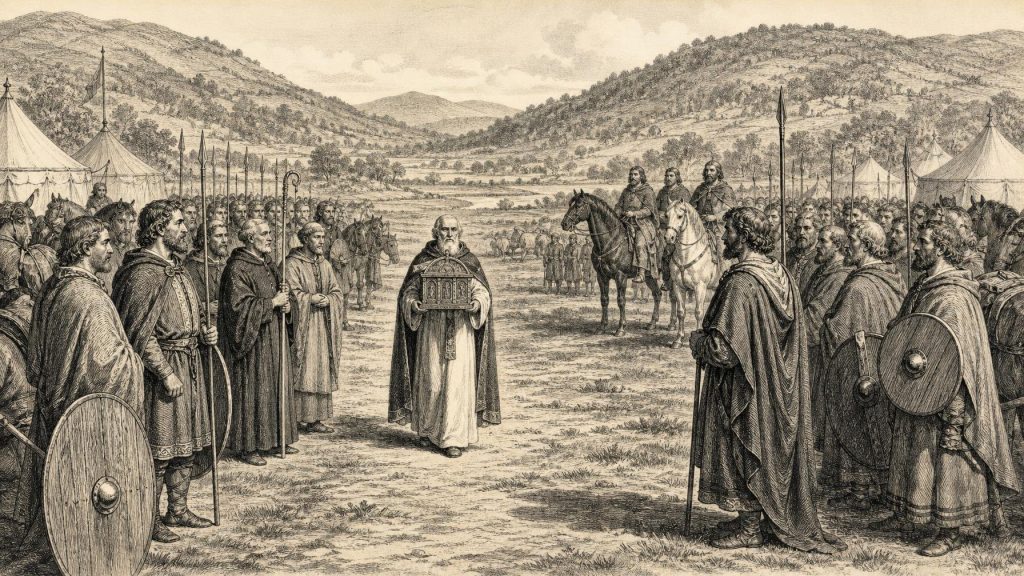
Muirchertach responded by bringing the men of Munster, Leinster and Connacht to Mag Coba, near modern Dromore, in support of the deposed Donnchad. Domnall approached with his northern coalition. A battle appeared imminent, but Cellach of Armagh intervened and separated the forces under what the Annals of Ulster sceptically call a “semblance of peace”. The phrase suggests that immediate violence was prevented without removing the causes of war.
Donnchad nevertheless suffered a politically decisive punishment. Eochaid Ua Mathgamna and the Ulaid blinded him, a recognised means of disqualifying a rival from kingship. The act reveals that the crisis was not simply an invasion from Ailech. It also involved factions within Ulaid prepared to use Domnall’s intervention to settle dynastic disputes. Donnchad died in or soon after this period, leaving the regional kingship divided and weakened.
A Month of Confrontation
The greater rivalry soon resumed. Muirchertach assembled the people of Leth Moga, the traditional southern half of Ireland, including both laymen and clerics, and marched to Grenóc. The Annals of Tigernach describe the expedition as a great hosting intended to meet Domnall. The northern king did not appear at the proposed meeting place, but Cellach came on his behalf and requested a period of truce.
Other annals continue the story by placing Domnall and the northern nobles at Cluain Caín in the territory of Fir Rois, around the later borderlands of Louth and Monaghan. The rival forces remained facing one another for a month. Maintaining a host for so long demanded food, fodder, messengers, pack animals and contributions from surrounding communities. Even without battle, such gatherings placed a severe burden upon ordinary households and church estates along their routes.
Cellach eventually made a year’s peace while carrying the Bachall Ísu, the Staff of Jesus. This celebrated relic was associated with both Christ and Patrick and served as a principal emblem of Armagh’s authority. Its presence transformed the negotiations into a sacred undertaking. Agreements made before such a relic carried the force of solemn oaths and the threat of spiritual as well as political consequences.
Armagh and Reform
Cellach’s role was especially significant because the Irish Church was undergoing institutional reform. The Synod of Ráith Bressail had met only two years earlier, in 1111, with Muirchertach, Cellach and numerous bishops, priests and students in attendance. It sought to organise territorial dioceses and impose rules upon clergy and laity. The reforms did not instantly replace Ireland’s older networks of monasteries, hereditary ecclesiastical families and saintly federations, but they strengthened the public standing of bishops and leading church centres.
In 1113 Cellach was therefore more than a private peacemaker. As comarba Pátraic, or successor of Patrick, he represented Armagh’s claim to primacy throughout Ireland. Armagh had close connections with northern rulers, yet Muirchertach also needed its recognition to support his own wider ambitions. Cellach’s ability to move between the camps shows how ecclesiastical authority operated alongside secular power rather than entirely beneath it.
The annals record several notable church deaths. Connla Ua Flainn, successor of Molaisse of Leighlin, died, as did Diarmait Ua Cellaig, successor of Ua Suanaig. Flannacán son of Máel Ísu, abbot-designate of Armagh, died after anointing and penance. These short notices reflect the importance attached to succession within major religious communities and to a properly prepared Christian death.
Violence Beyond the Great Armies
Local warfare continued beneath the struggle of the overkings. Donn Ua Tairchert, a chief associated with Cenél Conaill, was killed by Niall Ua Lochlainn. In Fernmag, corresponding approximately to Farney in modern County Monaghan, an internal clash killed two potential royal successors, Ua Crícháin and Ua Donnocáin. The Annals of Tigernach also report fighting between two kindreds, Muinter Gillgain and Muinter Máel Mártain, in which the chief and several nobles of Muinter Gillgain were killed.
Máel Sechlainn Ua Conchobair, king of Corcomroe in north-west Clare, also died. Some annals state that he died after penance, while the Annals of Tigernach say that his brother killed him. The contradiction cannot now be resolved and should not be concealed. Taken together, these notices show that political instability was not confined to the confrontation between Ua Briain and Ua Lochlainn. Competition within ruling families and smaller territories remained a persistent source of violence.
Pilgrimage, Livestock and Craft
On the night of St Patrick’s feast, 17 March, disaster struck people fasting on Cruachán Aigle, now Croagh Patrick. The Annals of Ulster call the phenomenon a ball of fire, while the Annals of Loch Cé describe a thunderbolt; thirty fasting people were said to have been killed. Although the precise physical event cannot be reconstructed, the entry is important evidence for organised devotional activity on the mountain by 1113. Pilgrims were undertaking a night vigil or fast there in honour of Patrick centuries before the modern Reek Sunday observance.
Chronicon Scotorum adds a terse notice of severe cattle mortality. Livestock represented food, portable wealth, tribute and political power, so widespread losses could threaten households at every social level. The armies and raids described elsewhere in the annals likewise centred repeatedly upon cattle and grazing land. Most people lived outside the towns, working mixed farms and supporting secular or ecclesiastical lords through produce, labour and renders.
The same chronicle records work on Ciarán’s shrine at Clonmacnoise, involving stone or slate and a copper crest. This brief entry provides a valuable glimpse of skilled craftsmanship and investment in a saint’s cult. Clonmacnoise stood at a major Shannon crossing and supported clerics, pilgrims, craftspeople and lay dependants. Another annalistic curiosity was an extraordinarily large salmon allegedly caught there, although Chronicon Scotorum instead places it at Limerick. Its fantastic measurements belong to the annals’ tradition of recording wonders and should not be treated as reliable natural history.
Ireland’s coastal towns, especially Dublin, Waterford and Limerick, remained centres of manufacture and overseas commerce, linking rural produce with markets around Britain and the Continent. No specific commercial reform can be assigned to 1113, however. The year’s evidence is strongest for cattle-based wealth, burdensome military musters, religious travel and patronage of ecclesiastical metalwork.
An Uneasy Peace
By the end of 1113 neither great overking had defeated the other. Domnall Ua Lochlainn had successfully reshaped the politics of Ulaid, while Muirchertach Ua Briain had demonstrated that he could still mobilise an imposing island-wide coalition. Cellach’s year-long truce prevented their confrontation from becoming a major battle. That restraint mattered: Muirchertach fell gravely ill in 1114, rapidly changing the balance of power. Thus 1113 stands as the last full year of his undiminished ascendancy and as a striking demonstration of Armagh’s power to hold Ireland’s rival armies apart.
Primary Sources
- The Annals of Ulster: Year U1113 — English Translation
- The Annals of Ulster: Year U1113 — Irish Text
- Annals of Loch Cé: Years 1099–1113
- The Annals of Tigernach: Years 1109–1115 — English Translation
- The Annals of Tigernach: Years 1109–1115 — Irish Text
- Annals of the Four Masters: Year M1113
- Chronicon Scotorum: Years CS1111–CS1114
- Chronicon Scotorum — CELT Edition Description
- Annals of Inisfallen — CELT Edition Description
- Ua Briain, Muirchertach
- Ua Lochlainn (Mac Lochlainn), Domnall
- Ua hEochada, Donnchad
- Cellach (Celsus)
- Patrick (Patricius, Pátraic, Pádraig)
- Ua Máelshechlainn, Murchad
- The Transformation of the Irish Church in the Twelfth Century
- Have There Been Synods in Ireland in the Past?
- Crisis and Recovery: Church and Society in Twelfth-Century Ireland
- Bachal Isu: The Symbolism of St Patrick’s Crosier in Early Medieval Irish Hagiography
- The Relic Cult of St Patrick Between the Seventh and the Late Twelfth Centuries
- The Staff, the Snake and the Shamrock: St Patrick in Art
- Viking Collections
- Medieval Ireland 1150–1550
- Clonmacnoise, County Offaly
- S. Ciarán’s Church and His Lands: A Study of the History and Development of Clonmacnoise
- The “Cathedral”, Temple Kelly and Temple Ciarán: Notes from the Annals
- The History and Provenance of Two Early Medieval Crosiers from Clonmacnoise