Kildare Fire and Fergal710 CE
In 710, Irish annals recorded the burning of Kildare, a major Leinster ecclesiastical centre, alongside the death of Congal Cennmagair, king of Tara. Congal’s sudden death enabled Fergal son of Máel Dúin of Cenél nÉogain to assume the kingship, shifting northern Uí Néill power from Cenél Conaill. The sources provide no evidence linking the fire to political events or identifying its cause and damage. Conamail, abbot of Iona, also died amid complex Columban leadership arrangements. Violence around the Irish Sea and Pictish religious change formed a wider context. These events reveal interconnected religious, political and economic institutions adapting to disruption.
Dateline
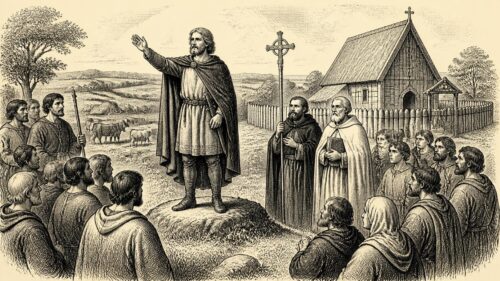
In 710 CE, Ireland’s annalists placed two striking developments in the same year: the burning of Kildare, one of the island’s most prestigious ecclesiastical communities, and the sudden death of Congal Cennmagair, king of Tara. The Annals of Tigernach record both succinctly, then state that Fergal son of Máel Dúin began to rule. The entries are brief, but their combination gives the year unusual weight. A famous Leinster church suffered a destructive fire while the most exalted secular kingship passed from the northern Cenél Conaill to their rivals, the Cenél nÉogain.
What Can Be Dated to This Year
Medieval Irish annals preserve events in yearly sequences, rather than providing modern-style narratives. Their early dating systems can differ by a year between manuscripts and editions, and no surviving source gives a month or day for the Irish occurrences discussed here. Nevertheless, the Annals of Tigernach explicitly place the death of Congal, the fire at Kildare, the death of Conamail of Iona, that of Colmán of Lorrha, and Fergal’s accession under 710. The Annals of Inisfallen also enter Congal’s death under that year. These converging notices make 710 a responsible calendar setting for the principal events, while the detail behind them remains limited.
The annals do not identify who set Kildare alight, whether the blaze was accidental, or which buildings burned. Nor do they say that Congal’s death and the fire were connected. Later storytelling could encourage tempting moral explanations, especially at a saint’s foundation, but the contemporary-shaped annalistic record offers none. The safest conclusion is also the most important: a major religious centre was burned in 710, and its losses were serious enough to enter a wider historical chronicle.
The Burning of Kildare
Kildare was far more than a small church beside a local cemetery. By the later seventh century it stood among the most influential religious establishments in Leinster and Ireland. Cogitosus, writing several decades before 710 in his Life of Brigit, presented the foundation as a great community of women and men, associated with Brigit and the bishop Conláed. His account is hagiography, designed to celebrate the saint and advance Kildare’s standing, so its grand claims cannot be read as a literal town plan. Yet it still reflects an institution with extensive religious ambitions, precious relics, clerical personnel and an established public reputation.
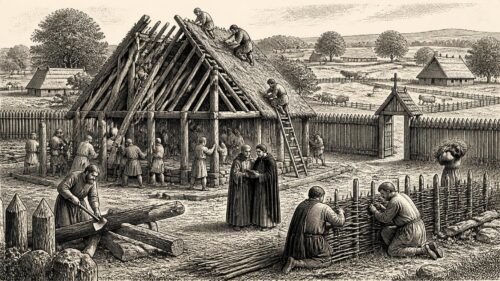
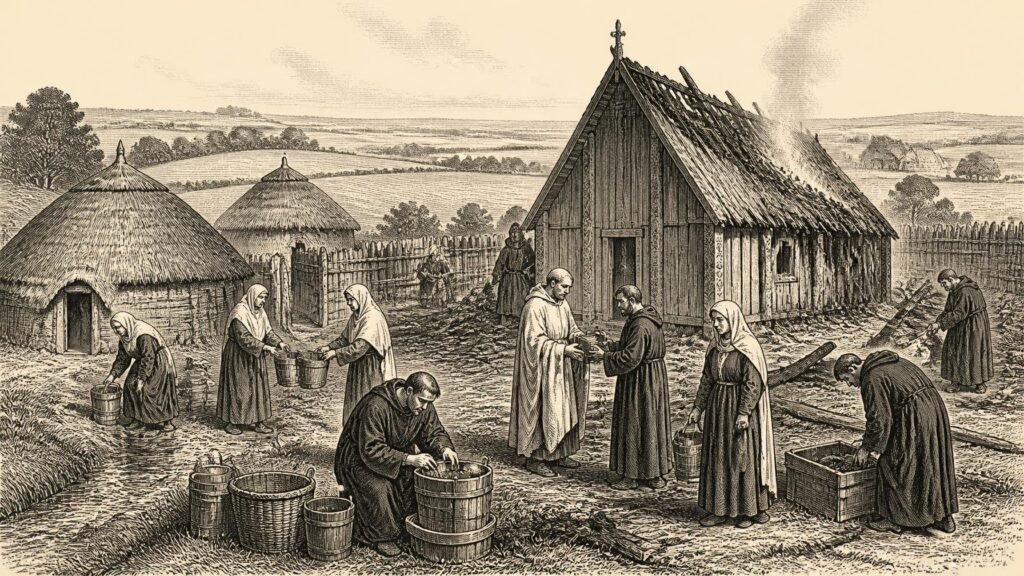
Cogitosus’s description of the church is especially suggestive of the stakes involved in a fire. He envisaged distinct spaces for clergy, religious women and lay worshippers, with shrines and costly ornament at the altar. Whether every feature he describes survived unchanged into 710 cannot be demonstrated. Timber buildings, roofs, workshops, dwellings, storehouses and boundary structures could all be vulnerable to flames, and early Irish ecclesiastical settlements were renewed repeatedly. The annal simply says that Kildare was burned. It does not licence an inventory of ruins, casualties or stolen treasures.
Even so, the notice reveals how interwoven religious life and regional society had become. Kildare’s community depended on food renders, labour, land, patronage and visitors from its surrounding Leinster hinterland. In return, a great church offered worship, burial, education, hospitality, commemoration and access to the prestige of Brigit’s cult. Rebuilding after a major fire would have required more than carpentry: it would have drawn upon the resources and political protection of the church’s allies. The burning therefore mattered to aristocrats, tenants, clergy and religious women as well as to the community’s immediate residents.
A King of Tara Dies
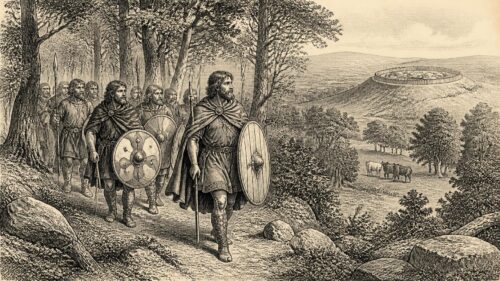
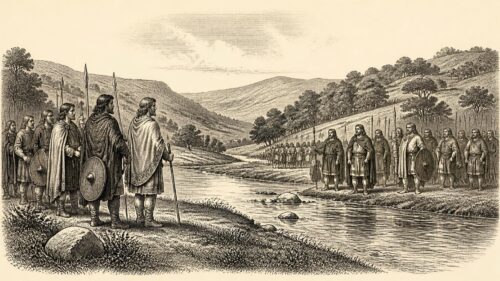
Congal Cennmagair died suddenly in the same annal. The Annals of Ulster specify that he died “of a fit”, while the Annals of Tigernach call him king of Tara. Congal belonged to Cenél Conaill, an important northern Uí Néill dynasty with roots in what is now Donegal. He had succeeded after the death of his kinsman Loingsech in 704 and had already led a hosting against Leinster in 707. That earlier campaign provides political background for 710, but it must not be used to explain the Kildare fire: the sources never make that connection.
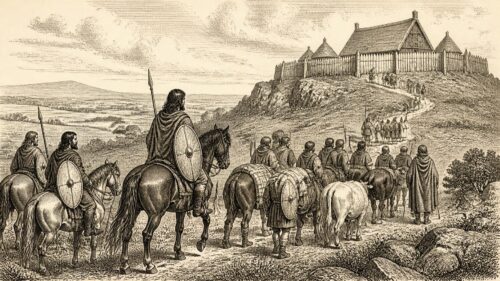
“King of Tara” did not mean ruler of a centrally governed Irish state. Tara was the pre-eminent royal centre of the Uí Néill world and supplied a powerful claim to overkingship, but authority rested on personal alliances, tribute, hostage-taking, military followings and recognition by other rulers. Provincial and local kings retained their own interests and armed households. Congal’s death was thus a dynastic turning point rather than a smooth constitutional succession. It opened the way for Fergal son of Máel Dúin of Cenél nÉogain, another northern Uí Néill branch, who is recorded as beginning his rule in 710.
Fergal’s accession shifted the balance within northern politics. His later career would show a ruler determined to press claims over Leinster and the midlands, but those later conflicts should not be projected backwards as achievements of his first year. For 710, the firm point is narrower: a new claimant obtained the kingship of Tara after Congal’s sudden death. The transfer underlines both the prestige of Tara and the instability inherent in a kingship that depended on the continuing strength of a particular dynasty and its allies.
Iona and Columban Authority
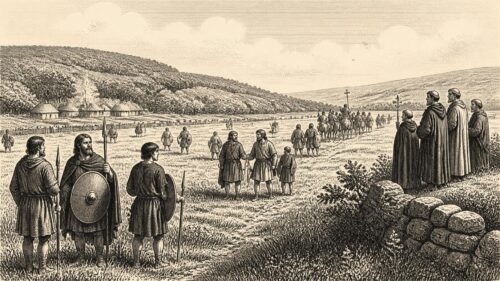
The year also brought the death of Conamail son of Fáilbe, abbot of Í, better known as Iona. Though the island lies off the west coast of modern Scotland, its monastery was a major Irish-founded institution, linked by kinship, religious authority and travel to communities in Ireland and northern Britain. Iona’s abbot headed a Columban network that reached beyond any single kingdom. Conamail’s death was therefore relevant to Irish ecclesiastical politics as well as to the island itself.
There is an important complication. Annals record Dúnchad as holding the principatus, or leadership, of Iona from 707, before Conamail’s death. Modern scholarship treats this as evidence of an unusually complex and perhaps divided arrangement of authority rather than a simple one-man succession. In 710, then, Conamail’s death did not necessarily create an uncomplicated vacancy. It belongs to a period when Columban leadership was being negotiated amid dynastic connections, relations with Pictish rulers and debates over ecclesiastical practice.
Conflict Around the Irish Sea
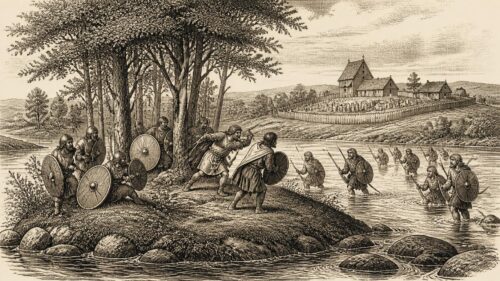
The Annals of Ulster add several violent notices to their sequence for this period: conflict among Cenél Comgaill, in which two sons of Nechtan son of Dar Garta were killed; the killing of Aengus son of Máel Anfaid at Sci; and the slaying of Fiachra son of Dúngal among the Cruithin. The terse wording and uncertain place-identifications prevent a fuller reconstruction. What they securely show is that political violence was not confined to Tara or Leinster. Irish-speaking, Pictish and Brittonic worlds around the north channel and western seaways remained tightly connected by kinship, warfare and monastic travel.
This wider setting matters for 710 because Iona’s affairs cannot be isolated from Ireland, nor can Irish kingship be understood solely within the island’s shores. In the same year, Bede recorded the Pictish king Nechtan’s adoption of Roman Easter observance with Northumbrian assistance. That event occurred in northern Britain, not Ireland, but it formed part of the religious and diplomatic environment in which the Columban community operated. It helps explain why leadership at Iona could carry consequences across the sea.
Life Beyond the Annals
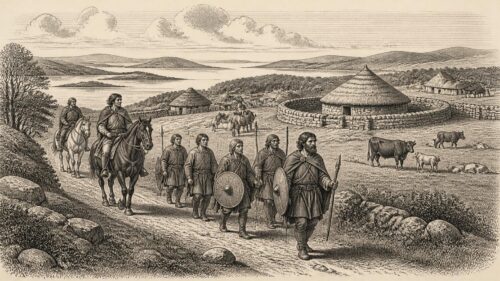
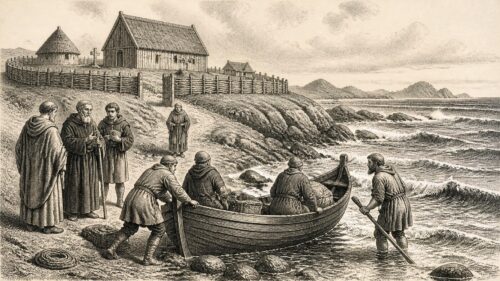
The annals privilege kings, abbots, killings and fires; they say little about ordinary households. Archaeology nevertheless provides a cautiously drawn background. Ireland in 710 was overwhelmingly rural, its people living in dispersed farmsteads, enclosed raths, crannógs and ecclesiastical settlements rather than in later-style towns. Cattle remained central to wealth, food and social obligation, while oats and barley were widely cultivated and processed. Fields, cereal-drying kilns and watermills show a managed mixed economy in which arable production stood alongside pastoral farming.
Such evidence should not be mistaken for a report from Kildare in 710. It cannot tell us the harvest that year, the exact size of Kildare’s population, or the immediate cost of the blaze. It does, however, clarify why a religious centre could command substantial resources. Monasteries and churches were embedded in productive landscapes and exchange networks. They were places of prayer and learning, but also employers, landholders, consumers, hosts and recipients of rents and gifts. A fire at Kildare was consequently a disruption to a living regional economy, not merely damage to a sacred building.
Seen together, the year’s notices illuminate an Ireland in which authority had several centres. Kildare represented the influence of a Leinster church and Brigit’s enduring cult. Tara represented an overkingship contested among powerful northern dynasties. Iona represented a religious network extending across the Irish Sea. The sources do not permit a dramatic story tying these events together. Their real significance lies elsewhere: 710 was a year when a renowned sanctuary burned, a king of Tara died without warning, and the institutions through which power, faith and resources were organised continued to adapt.
Primary Sources
- The Annals of Tigernach
- The Annals of Ulster
- Annals of Inisfallen
- Chronological Synchronisation of the Irish Annals
- Congal Cennmagair
- Cogitosus
- The Life of Brigit
- County Kildare Urban Archaeology Survey
- Kildare: Irish Historic Towns Atlas
- Conversion and Consolidation in Leinster's Royal Heartland
- Early Mechanisms of Abbatial Succession: The Case of Iona (563–704)
- Exploring the Irish Annals
- Early Medieval Dwellings and Settlements in Ireland, AD 400–1100, Volume 1: Text
- The Economy of Early Medieval Ireland
- Agriculture, Settlement and Society in Early Medieval Ireland
- Early Medieval Farming and Food Production: A Review of the Archaeobotanical Evidence from Archaeological Excavations in Ireland
- Ancient DNA, Lipid Biomarkers and Palaeoecological Evidence Reveals Construction and Life on Early Medieval Lake Settlements
- Life, Death and Environment at Lagore Crannog: Parasites, Land-use and a Royal Residence in Later Prehistoric and Early Medieval Ireland
- Early Medieval Ireland: Archaeological Excavations, 1930–2009
- Bede's Ecclesiastical History: How the Abbot Ceolfrid Sent Master-Builders to King Nechtan
- Bede's Ecclesiastical History: Iona and the Northern Churches
- Two Lives of Saint Brigid
- The Social Roles of the Early Irish Monastery of Kildare and Its Paruchia within the Kingdom of Leinster