Castlepook’s Mammal Archive30667 BCE
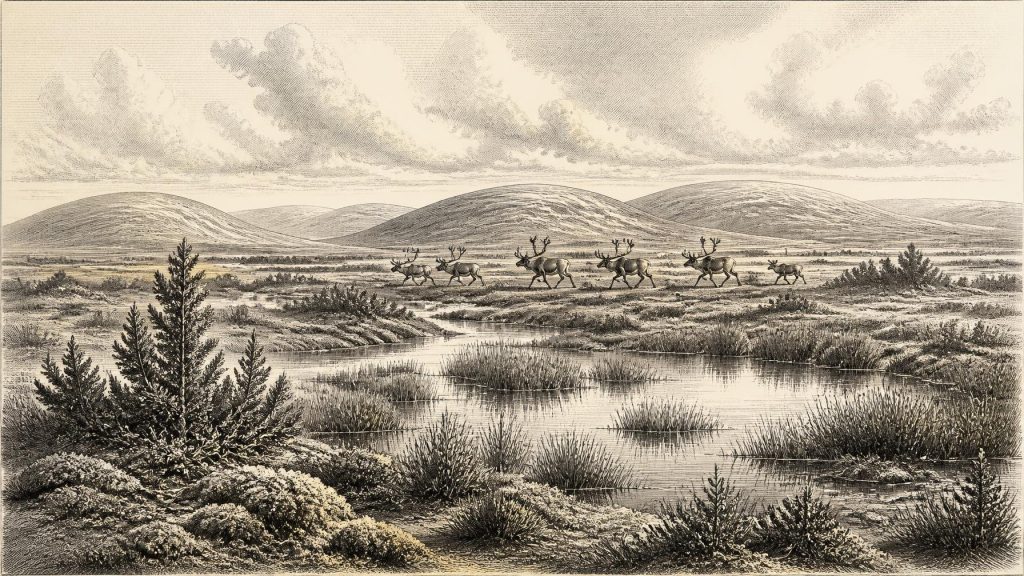
Around 30,667 BCE, Ireland was an unstable Late Pleistocene landscape rather than a documented society. Derryvree, County Fermanagh, preserves freshwater sediments indicating cold, open tundra, wetlands and intermittent ice-free conditions before later ice-sheet expansion. Castlepook Cave, County Cork, contains a diverse MIS 3 fauna, including mammoth, giant deer, reindeer, bear, wolf, Arctic fox and hyaena, demonstrating episodic animal colonisation. A possibly butchered reindeer femur may indicate fleeting Upper Palaeolithic human activity, but remains contested and unsupported by camps, tools or settlements. The evidence reveals ecologically active, climatically precarious Ireland, not continuous human occupation or recoverable political, cultural or social history.
Dateline
The label 30,667 BCE cannot denote a recorded Irish year. No written calendar, named individual, political event or dated settlement can be placed in Ireland with that precision. It is a modern way of pointing towards the Late Pleistocene, approximately 32.6 thousand years before AD 1950, within Marine Isotope Stage 3 (MIS 3) and the Midlandian phase of the last glacial cycle. The responsible history of this moment is therefore one of ranges, deposits and probabilities. Ireland was a northern Atlantic landscape undergoing severe climatic change, inhabited at least intermittently by large mammals, while the evidence for people remains exceptionally slight and contested.
Dating an Unrecorded World
Radiocarbon dates are conventionally expressed as years “before present”, with present fixed at AD 1950. They are not identical to calendar years because atmospheric carbon-14 varied over time. Calibration converts radiocarbon determinations into calendar ranges, but uncertainty increases at this depth in time. The numbered date 30,667 BCE should thus be treated as a useful filing point, not an anniversary. It broadly falls within the span of the important Derryvree environmental sequence near Maguiresbridge, County Fermanagh: organic freshwater sediments there have been placed at about 36.9–31.7 thousand calibrated years before present. That range embraces the general period, but cannot describe the weather, season or inhabitants of one particular year.
Derryvree Between the Tills
In 1969 roadworks cut through a drumlin at Derryvree and revealed a remarkable layer of silts and fine sands between two thick deposits of till. Till is debris left directly by glacier ice. The Derryvree sequence showed that, after one phase of ice action and before another, a freshwater environment had existed at the site. Organic material from the sediments produced the radiocarbon determination Birm-166, conventionally reported as 30,500 radiocarbon years before present, with a large uncertainty. Its calibrated range makes the deposit one of the clearest Irish windows on conditions broadly relevant to 30,667 BCE.
The importance of Derryvree is not that it supplies a picture of a settled community. It supplies a landscape archive. Plant macrofossils, pollen, insects and sediment point to open tundra or muskeg: wet, cold ground with pools and marshy margins amid largely treeless vegetation. Mosses, sedges, grasses and herbs were significant, alongside plants associated with damp ground, including bogbean and water-milfoil. Juniper occurred in the record, but this was not a wooded Ireland. The environment was patchy rather than featureless: shallow water and seasonally thawed soils could sustain local ecological richness even where long winters, permafrost conditions and short growing seasons restricted productivity.
Ice in a Changing Island
It would be misleading to imagine the whole island suddenly buried beneath a uniform sheet of ice in this period. The British–Irish Ice Sheet grew and changed unevenly across different regions. Modern reconstructions place major ice-sheet growth after roughly 31 thousand years ago, with maximum extent later, around 26 thousand years ago, and maximum ice volume still later. Derryvree and other buried organic deposits indicate that at least parts of north-central Ireland were ice-free during portions of the preceding interval. They do not prove that every Irish region was ice-free at the same time, or that conditions were stable from century to century.
For people or animals, this instability mattered more than any modern boundary. Glaciers could transform drainage, crush older deposits and restrict usable ground; periglacial conditions could create frozen soils, braided streams, exposed sediment and temporary wetlands. Lower global sea levels altered coastal outlines, but the exact accessibility of Ireland from Britain or the European mainland at any particular time is not securely reconstructed from the evidence available for this date. Movement may have depended on changing sea passages, ice margins and seasonal conditions. No responsible account can turn that uncertainty into a claimed migration route.
Castlepook and the Animal Record
Farther south, Castlepook Cave near Doneraile in north County Cork provides Ireland’s richest known archive of pre-Last Glacial Maximum vertebrate remains. Antiquarian excavations in the early twentieth century recovered more than 2,000 bones from its narrow limestone passages and chambers. Subsequent dating and reassessment have shown that the cave’s material spans a long and complicated period. Water movement, carnivore activity, old excavation practices and later disturbance mean that it is not a neatly sealed snapshot. Yet it establishes beyond doubt that Ireland supported, at different times during MIS 3, an impressive cold-stage fauna.
The recorded animals include woolly mammoth, giant deer, reindeer, brown bear, wolf, Arctic fox and spotted hyaena, as well as lemmings. This list should not be converted into a claim that all species lived side by side in every valley in 30,667 BCE. Some specimens have different ages; some may have entered the cave through predation, scavenging, natural death or water transport. Nonetheless, the assemblage demonstrates a landscape capable of supporting large herbivores and formidable carnivores during milder or more habitable episodes of the Ice Age. The absence or scarcity of other familiar mainland species is equally informative, suggesting that Ireland’s fauna was selective, intermittent and shaped by difficult routes of colonisation.
The Reindeer Femur Question
Castlepook has particular archaeological importance because a reindeer femur from the old collection has been reported as carrying a deep incision interpreted as a stone-tool butchery mark. If that identification and its chronological association are sustained, it would be evidence that a person handled a reindeer in Ireland during the Upper Palaeolithic, far earlier than the previously secure terminal-Pleistocene evidence from Alice and Gwendoline Cave in County Clare. It is an important possibility, not a licence to write a story of permanent settlement.
The limitations are decisive. There is no securely dated camp floor of this age in Ireland, no associated stone-tool assemblage, hearth, house, grave, human bone, artistic object or repeated concentration of butchered remains. A single marked bone cannot tell us whether people killed the animal, merely processed carrion, stayed briefly, travelled in a small party or returned at all. The cave itself was also used by carnivores and affected by natural processes. The evidence may indicate a fleeting human episode at the Atlantic edge of Upper Palaeolithic Europe; it does not demonstrate an Irish population, tribe, territory or lineage.
Society Beyond Recovery
Accordingly, political affairs, diplomacy and organised conflict cannot be reconstructed for Ireland around this date. There is no evidence for chiefs, states, borders, alliances or battles. Nor can archaeologists responsibly assign a language, ethnic identity or later Irish ancestry to any possible visitors. Even everyday life is recoverable only in the most conditional sense. If hunter-gatherers entered Ireland, they would have had to manage cold exposure, mobile animal resources and a landscape in which shelter and food were seasonal concerns. But this is an inference from the wider Upper Palaeolithic world, not direct evidence from an Irish camp.
There is likewise no Irish evidence for religion, ritual, learning, art or formal exchange networks at this date. Caves can acquire ritual meanings in other periods and places, but Castlepook’s value here is principally palaeontological. Its deposits record animals and environmental processes, not ceremonies. Trade is also beyond demonstration. The only defensible “economy” is ecological: grazing herbivores converted tundra vegetation into meat, hides, bone and antler; predators, scavengers and perhaps occasional human visitors competed for parts of that resource. Whether people exploited it in Ireland remains the central unresolved question.
An Archive, Not an Origin Story
The chief development relevant to 30,667 BCE was environmental rather than institutional. Ireland contained locally ice-free, cold and changing habitats before the later maximum of the British–Irish Ice Sheet. Derryvree preserves the wetland side of that world; Castlepook preserves its mammalian side. Together they replace the old image of an empty, permanently ice-covered island with a more complex one: a place of tundra pools, shifting ice margins and episodic animal colonisation. They do not, however, turn this period into the beginning of continuous Irish settlement.
That distinction matters. The archaeological record for later human activity is much firmer, while the evidence around this modernly numbered year is sparse, disrupted and still being reassessed with improved dating methods. Around 30,667 BCE, Ireland’s history is best told through sediments, plant remains and bones. These are not silent relics: carefully read, they show an island at the north-western margin of Ice Age Europe, ecologically alive, climatically precarious and only possibly visited by people.
Primary Sources
- A Middle Midlandian Freshwater Series at Derryvree, Maguiresbridge, County Fermanagh, Northern Ireland
- A reconsideration of the radiocarbon dating of the Marine Isotope Stage 3 fauna from southern Ireland
- Castlepook Cave, County Geological Site Report
- The Irish Quaternary Fauna Project
- Growth and Retreat of the Last British–Irish Ice Sheet, 31,000 to 15,000 Years Ago: the BRITICE-CHRONO Reconstruction
- Extent and Timing of the Last Glacial Maximum in Britain and Ireland: a Review
- Pattern and Timing of Retreat of the Last British-Irish Ice Sheet
- New Data for the Last Glacial Maximum in Great Britain and Ireland
- Dating Constraints on the Last British-Irish Ice Sheet: a Map and Database
- The IntCal20 Northern Hemisphere Radiocarbon Age Calibration Curve (0–55 cal kBP)
- The IntCal20 Northern Hemisphere Radiocarbon Age Calibration Curve (0–55 cal kBP)
- First Evidence of a Late Upper Palaeolithic Human Presence in Ireland
- Revisiting Alice and Gwendoline Cave, Co. Clare: New Light on the 1902 Excavations
- New Insights on the Fauna of Ireland's Younger Dryas and Early Holocene from Alice & Gwendoline Cave
- Upper Palaeolithic
- The Archaeology of Caves in Ireland
- Heritage Artefacts of County Cork
- Outreach and Education Resources
- Irish Quaternary Association
- Ireland: Submerged Prehistoric Sites and Landscapes