Castlepook Fauna30618 BCE
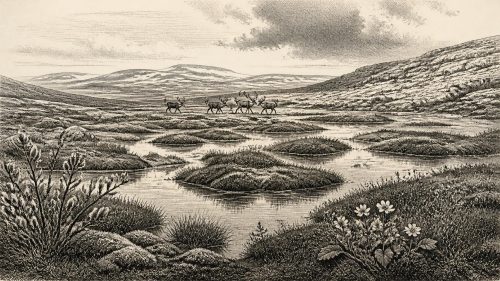
Around 30,618 BCE, Ireland lay in a volatile Late Pleistocene climate before the Last Glacial Maximum, not beneath uniform ice. Inter-till wetland deposits at Derryvree, County Fermanagh, preserve pollen and plants indicating cold, open vegetation, freshwater and seasonal habitats. Castlepook Cave in County Cork contains a varied, non-contemporary fauna, including reindeer, mammoth, giant deer, bear, wolf, fox and hyaena, demonstrating productive tundra ecosystems and changing animal routes across lower sea levels. A cut-marked reindeer femur may indicate Upper Palaeolithic carcass processing, but remains disputed and cannot prove settlement. Later ice erased evidence, leaving cautious reconstructions of wetlands and human presence.
Dateline
Modern calendar-year precision is not available for Ireland in 30,618 BCE. This label is a retrospective convenience, placing the reader roughly 32,600 calendar years before 1950, within the Late Pleistocene and broadly within Marine Isotope Stage 3. It does not identify a recorded Irish year, season, ruler or event. The evidence consists instead of deposits, animal bones, pollen and plant remains, ice-shaped landforms, and radiocarbon determinations with substantial uncertainties. The responsible history of this point is therefore one of environmental ranges and cautious probabilities.
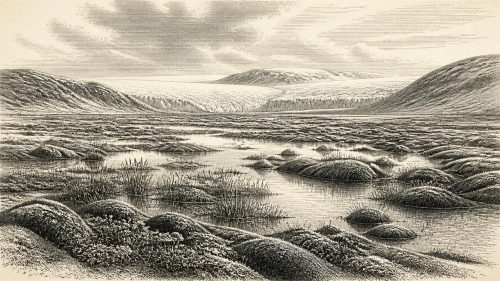
Ireland was then on the north-western margin of Europe, in a climatic world that changed sharply over centuries and millennia. The Last Glacial Maximum, when the last Irish Ice Sheet became most extensive, lay ahead: present syntheses place its main maximum broadly between about 26,500 and 19,000 years ago. Around 30,618 BCE, ice was growing and landscapes were unstable, but it is not sound to imagine every part of Ireland as buried beneath one uniform sheet of ice. Local conditions varied greatly between uplands, lowlands, caves, wetlands and the exposed continental shelves that are now sea.
A Date Without an Annal
Nothing resembling political affairs, diplomacy, formal warfare or government can be recovered for Ireland at this depth of time. There are no settlements, burials, structures, tool assemblages or written records securely attributable to this particular year. Nor can archaeologists identify a people, language, religion or enduring community. To fill those absences with an Ice Age “tribe” or a named migration would be invention.
Even the chronology needs care. Radiocarbon laboratories report ages in radiocarbon years before present, where “present” conventionally means 1950, while archaeologists often convert them into calibrated calendar ranges using curves built from several archives. At around 30,000 radiocarbon years ago, calibration is necessarily broad and sensitive to the material dated, contamination, laboratory method and the curve used. An old published Irish date is not automatically a precise calendar point, and a date on an animal bone dates the animal’s death rather than every later process that affected the bone.
This is especially important because many famous Irish Pleistocene finds came from nineteenth- and early twentieth-century cave excavations. Their recovery created irreplaceable collections, now principally associated with the National Museum of Ireland, but often without the stratigraphic control expected today. Modern re-dating and taphonomic work can improve the picture, yet it cannot always reconstruct precisely where a bone lay, whether sediments were disturbed, or whether several occupations and natural accumulations had become mixed.
Fermanagh’s Buried Wetland
The closest important environmental archive is not a settlement but a road-cut sequence at Derryvree near Maguiresbridge, County Fermanagh. There, freshwater and organic sediments occur between glacial tills: in simple terms, an earlier ice advance laid down one body of sediment, an interval without ice at that spot allowed a wetland or shallow-water environment to develop, and a later advance sealed it beneath another till. The sequence demonstrates that northern Ireland experienced a more complicated Late Pleistocene history than a single uninterrupted freeze.
A radiocarbon determination known as BIRM-166, obtained from the organic horizon, was reported at about 30,500 radiocarbon years BP, with a large uncertainty. It should not be converted into an exact anniversary or treated as proof that the Derryvree pool existed specifically in 30,618 BCE. It does, however, place the site within the broad environmental neighbourhood of the date. Plant macrofossils and pollen from such inter-till deposits point to open, cold-ground vegetation and freshwater margins rather than dense woodland: sedges, mosses, dwarf shrubs and Arctic-alpine taxa are central to the reconstruction.
Water-milfoil and bogbean are particularly evocative finds, but they should not be misread. Their presence signals suitable freshwater conditions in the sedimentary basin, not a warm modern-style bog. Along with dwarf willow, mountain-avens, clubmosses and other cold-tolerant plants recorded in Irish interstadial deposits, they suggest a patchwork of shallow water, saturated ground, herb-rich open terrain and exposed mineral soils. The wider climate was severe, windy and highly seasonal; the local wetland nonetheless supported plant life and insects where water, sediment and growing-season warmth permitted.
Animals at the Atlantic Edge
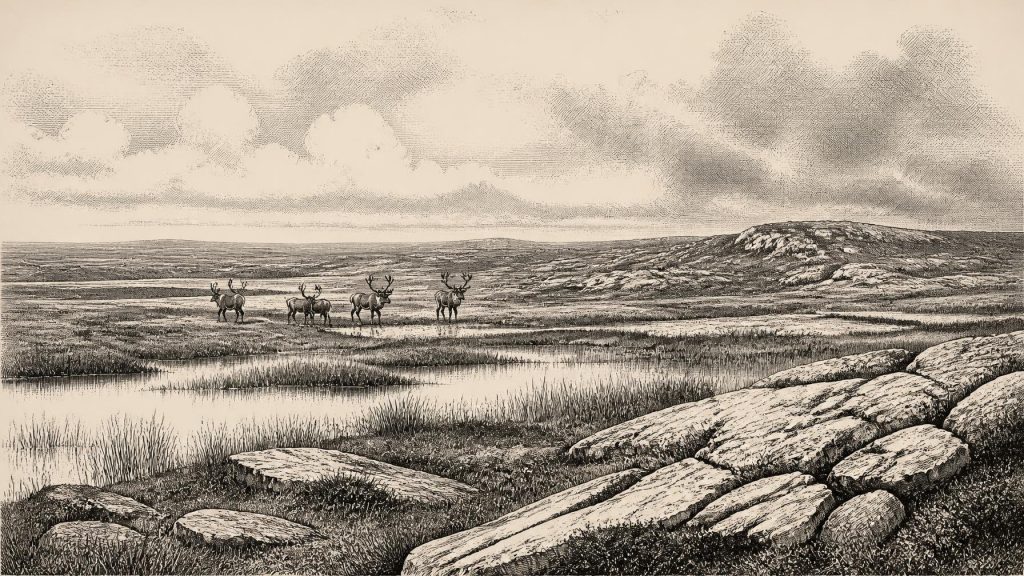
Southern Irish caves provide the main fossil evidence for the mammals that could occupy this changing country. Castlepook Cave, also called Mammoth Cave, near Doneraile in north County Cork is the best-known pre-Last Glacial Maximum assemblage. The Irish Quaternary Fauna Project demonstrated that a surprisingly varied fauna reached Ireland during the long interval from at least about 45,000 to 20,000 radiocarbon years ago. Its members included reindeer, giant deer, brown bear, woolly mammoth, wolf, Arctic fox, mountain hare, lemmings and spotted hyaena, although not all are securely contemporary with one another or with the year under discussion.
That qualification is vital. Caves are attractive to carnivores, hibernating bears and flowing water; bones may be dragged in, gnawed, scattered, redeposited or excavated from deposits of different ages. Castlepook is therefore an archive of repeated animal presence, not a photograph of one day’s fauna. The strongest conclusion is that parts of Ireland supported, at varying times in the later Ice Age, a cold-adapted mammalian community. Reindeer and mammoth indicate grassland- and herb-rich tundra resources; hyaena, wolf and fox indicate predators and scavengers within that food web. Their presence also shows that “tundra” was biologically productive rather than empty.
At the date represented by this article, the coast was not the coast known today. Global sea level was lower than now, exposing parts of the Irish, Celtic and Atlantic shelves and changing the distances between Ireland, Britain and continental Europe. This could have eased movements of animals and, potentially, people, but the precise configuration of coastlines, ice margins, rivers and crossing routes changed through time. It would be rash to claim a simple permanent land bridge. Ireland’s relationship with Britain and the mainland was a shifting geographical problem, not a fixed frontier.
The Reindeer Femur Question
One Castlepook specimen has brought the possibility of much earlier human activity into the discussion. A fragment of reindeer femur has been publicised as bearing a deep incision interpreted by zooarchaeologist Ruth Carden as a cut made by a sharp stone implement while a fresh carcass was processed. Public heritage accounts place the bone broadly around 31,000 BC, while reports commonly describe its radiocarbon age as about 33,000 years old. Either expression is necessarily approximate; neither makes it a securely dated event of 30,618 BCE.
If the mark is confirmed as human-made, it is important evidence that Upper Palaeolithic hunters may have reached Ireland before the Last Glacial Maximum. It would imply a brief episode of carcass processing, probably with a stone cutting edge, rather than a mapped settlement, a permanent population or a political territory. A reindeer carcass could have been acquired through hunting, scavenging or other circumstances that cannot now be resolved from a single fragment. The bone does not identify the hunters’ language, ancestry, beliefs, route to Ireland or length of stay.
Scepticism is not dismissal. Bone surfaces can be altered by carnivore teeth, trampling, sediment abrasion, excavation damage and natural cracking. The distinction between a cut mark and a non-human groove relies on microscopic form, location, orientation and context. The lack of a securely associated lithic assemblage, hearth, dwelling surface or undisturbed occupation layer at Castlepook means that the claim must remain proportionate. It is a serious possibility, not a licence to reconstruct an Irish Palaeolithic society in detail.
Everyday Life: What Cannot Be Seen
If people did visit Ireland in this period, their lives would probably have been mobile and organised around weather, animal movements, shelter and access to workable stone, as elsewhere in Upper Palaeolithic north-west Europe. Reindeer offered meat, fat, hides, sinew and bone; a carcass would have been a major resource in a demanding seasonal landscape. Yet this is an informed comparison with better-preserved European evidence, not direct evidence from an Irish campsite. No Irish house plan, hearth, food store, clothing, personal ornament, art or grave can responsibly be assigned to 30,618 BCE.
The same limit applies to religion, culture and learning. People elsewhere in Upper Palaeolithic Europe made sophisticated tools, ornaments and images, but there is no basis for attributing any particular tradition to Ireland at this date. The caves of Cork should not be called shrines merely because they later yielded remarkable bones. They were geological spaces used by animals and subject to natural sedimentary processes; whether humans ever entered them, and why, must be decided from evidence site by site.
Change as the Defining Fact
The most important development around 30,618 BCE was not the rise of a kingdom or the foundation of a settlement, but environmental volatility on the threshold of major glaciation. In Fermanagh, sediments preserve a fleeting freshwater world between ice advances. In Cork, caves preserve traces of mammals adapted to open, cold environments and a debated hint of human butchery. Across the island, later ice would erode, bury and rearrange much of the earlier record, helping to explain why the evidence is so sparse.
For Ireland, then, this date illuminates a country of mobile ice margins, tundra wetlands and intermittently connected animal routes. It was not yet a historical Ireland in the usual sense. The honest account is narrower but no less compelling: life existed in difficult habitats, large mammals crossed a changing Atlantic-edge landscape, and one marked reindeer bone leaves open the possibility that people briefly stood among them long before permanent human settlement can be demonstrated.
Primary Sources
- The Irish Quaternary Fauna Project
- A reconsideration of the radiocarbon dating of the Marine Isotope Stage 3 fauna from southern Ireland
- New insights on the fauna of Ireland's Younger Dryas and Early Holocene from Alice & Gwendoline Cave
- Quaternary deposits and glacial stratigraphy in Ireland
- First evidence of a Late Upper Palaeolithic human presence in Ireland
- The colonization of Ireland: A human ecology perspective
- Growth and retreat of the last British–Irish Ice Sheet, 31,000 to 15,000 years ago: the BRITICE-CHRONO reconstruction
- The timing and magnitude of the British–Irish Ice Sheet between Marine Isotope Stages 5d and 2
- Trimlines, blockfields and the vertical extent of the last ice sheet in southern Ireland
- Dimensions and chronology of the last ice sheet in Western Ireland
- Stratigraphic and palaeo-geomorphological evidence for the glacial-deglacial history of the last British-Irish Ice Sheet in the north-western Irish Sea
- The deglaciation of the western sector of the Irish Ice Sheet from the inner continental shelf to its terrestrial margin
- Timing and pace of ice-sheet withdrawal across the marine–terrestrial transition west of Ireland during the last glaciation
- Geomorphic evidence for patterns of late Midlandian ice advance and retreat in the Omagh Basin
- Reconstruction and 36Cl based geochronology of the deglaciation of central Ireland
- Castlepook Cave
- Archaeological Heritage of County Cork
- Heritage Artefacts of County Cork
- Occurrence of mammalia relicts at site Castlepook Cave
- Phylogeographic, ancient DNA, fossil and morphometric analyses reveal ancient and modern introductions of a large mammal: the complex case of red deer in Ireland
- Response of the Irish Ice Sheet to abrupt climate change during the last deglaciation
- The Irish Quaternary Association Newsletter 58