
Synod of Ráith Bressail1111 CE
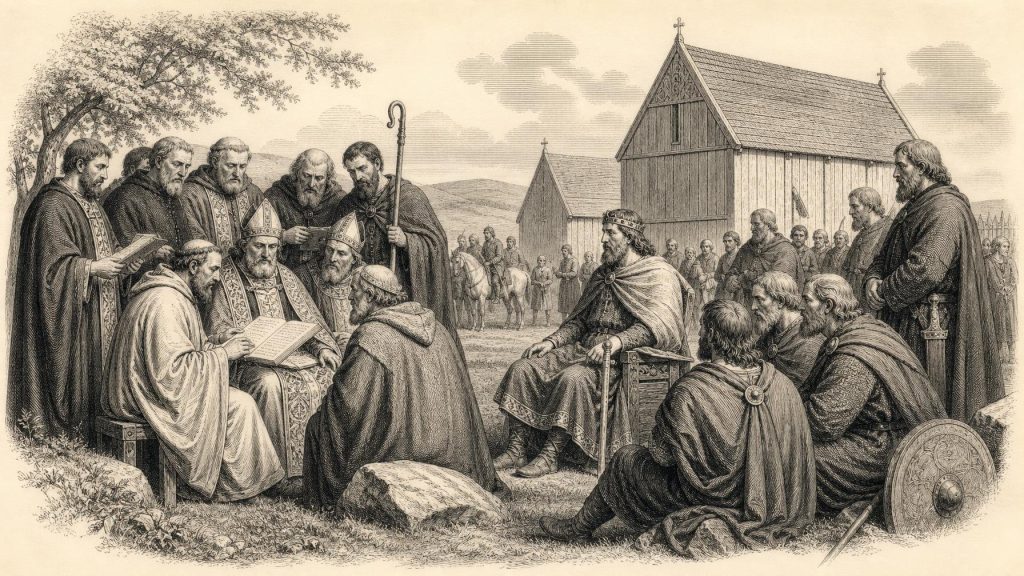
In 1111 Ireland remained divided among competing rulers, notably Muirchertach Ua Briain in the south and Domnall Ua Lochlainn in the north, while Tairdelbach Ua Conchobair extended Connacht’s influence. Raids, hostage-taking, dynastic conflict and attacks on churches, including Clonmacnoise, demonstrated political instability. The Synod of Ráith Bressail, attended by leading clerics and royal patrons, promoted ecclesiastical discipline and a territorial diocesan framework under Armagh and Cashel, though implementation was uneven. A Meath synod also negotiated church boundaries. Ulaid’s conflict with Cenél nÉogain, harsh winter conditions, and fires at several settlements further affected society, trade and rural livelihoods across Ireland broadly.
Dateline
Ireland in 1111 was neither a unified kingdom nor an isolated collection of local communities. It was an island of competing overkings, ambitious provincial dynasties, influential churches and commercially active ports. The annals record an unusually rich mixture of events: a major church council, royal expeditions, the destruction of ceremonial trees, the taking of hostages, attacks on ecclesiastical settlements, severe winter weather and fires in several towns. Their entries are terse and sometimes disagree over numbers or names, but together they show a society in which political power, religious authority and material wealth were closely intertwined.
Two Overkings
The dominant political rivalry remained that between Muirchertach Ua Briain, king of Munster and the leading ruler in the southern half of Ireland, and Domnall Ua Lochlainn, king of Cenél nÉogain and the strongest ruler in the north. Some contemporary annalists called Muirchertach king of Ireland, but that title expressed a claim to supremacy rather than uncontested government. Domnall had repeatedly resisted him, while lesser kings negotiated between the two powers, changed allegiance or defended their own regional interests.
Muirchertach demonstrated his reach during 1111 through expeditions into the midlands and Bréifne. The Annals of Tigernach record a great raid against the Conmaicne and the people of Tethba. The Annals of Inisfallen describe another campaign against Bréifne, from which women and cattle were carried into Munster. Such expeditions served several purposes: they punished resistance, supplied portable wealth, supported allies and publicly advertised a king’s ability to operate far beyond his hereditary territory.
Yet Muirchertach’s family was not entirely obedient. Domnall mac Taidc, his nephew and a member of a rival branch of the Uí Briain, travelled through northern Ireland and forcibly seized the kingship of the Isles. The brief annalistic notice does not explain who supported him. His action may have been directed against his uncle’s interests, but certainty is impossible. Muirchertach himself remained at Dublin from the feast of St Michael, 29 September, until Christmas. That prolonged presence may have been connected with control of the Irish Sea and the challenge posed by Domnall, although the source does not explicitly say so.
The same annal reports that Brian, son of Murchad Ua Briain, went into Leth Cuinn—the northern half of Ireland—after being cast off by Muirchertach. These movements reveal strains within the wider Uí Briain dynasty. The struggle for supremacy was therefore not simply a contest between north and south: it also depended upon the loyalty of royal cousins, nephews and subordinate branches.
The Synod of Ráith Bressail
The most enduring development associated with 1111 was the great ecclesiastical assembly held at Fiad Mac nAengusa, identified by the Annals of Inisfallen with Ráith Bressail. Its precise location remains disputed. The Annals of Ulster place Cellach, coarb or successor of Patrick, and Máel Muire Ua Dúnáin among its leaders, together with Muirchertach Ua Briain and the nobles of southern Ireland. Different chronicles give slightly different totals, but they agree that about fifty bishops, more than 300 priests and a very large body of other clerics attended.
The figures may have been rounded to convey the council’s scale and dignity, rather than compiled as a modern attendance list. Even so, the gathering was exceptional. It brought royal patrons, bishops, priests, monastic dignitaries and other clerics together to impose what the annals called good conduct, discipline and law upon both church and laity. The Annals of Inisfallen, writing with particular enthusiasm, claimed that the assembly enacted better discipline and law than any previously made in Ireland.
A later account preserved by Geoffrey Keating supplies the detailed diocesan scheme traditionally attributed to Ráith Bressail. Ireland was to be organised into territorial bishoprics grouped beneath two metropolitan centres, Armagh in the north and Cashel in the south, with Armagh retaining primacy. The plan sought to define episcopal authority geographically and to align Irish structures more closely with reforming practice elsewhere in western Christendom. Gilbert, bishop of Limerick and a papal legate, is identified in that later tradition as the council’s president.
This was not the instantaneous replacement of an entirely monastic church by a completely new diocesan system. Bishops and territories already existed, while great churches, hereditary ecclesiastical families and local patrons retained considerable influence. Nor was the proposed arrangement implemented uniformly. Dublin’s ecclesiastical relationship with Canterbury, regional rivalries and the claims of powerful communities complicated reform. Nevertheless, Ráith Bressail provided an influential framework from which the later organisation of the Irish church developed.
A second great synod was held at Uisnech during the year. Chronicon Scotorum states that the churches of Meath were divided between the bishops of Clonmacnoise and Clonard, with Murchad Ua Máel Sechnaill and other local leaders participating. Scholars have debated the precise relationship between this meeting and Ráith Bressail. What can safely be said is that ecclesiastical boundaries were being negotiated through assemblies in which kings, bishops and major religious communities all had interests.
Churches and Royal Violence
The language of reform did not protect churches from political pressure. Clonmacnoise was plundered by Dál Cais forces, according to several chronicles, acting on Muirchertach’s advice. Chronicon Scotorum also records that Áed Ua Ruairc imposed forced billeting there. Such actions could extract food, lodging and valuables from a wealthy community, while demonstrating that even a celebrated religious centre on the Shannon could be drawn into struggles among Munster, Meath, Bréifne and Connacht.
Clonmacnoise remained a centre of worship, burial, learning and skilled production despite these intrusions. The recently compiled manuscript known as Lebor na hUidre, or the Book of the Dun Cow, illustrates the literary culture associated with the community around this period. Its surviving texts preserve religious and secular learning, including heroic narrative. It should not be assigned specifically to 1111, but it provides firm evidence for the intellectual world within which the year’s synods and annal-keeping took place.
Cathasach Ua Leda, a distinguished elder associated with Patrick’s community, died during the year. The Annals of Inisfallen place the death of a notably pious Cathasach at Inis Cealtra on Lough Derg, apparently referring to the same churchman. His obituary reflects the prestige enjoyed by learned and senior clergy whose authority could cross dynastic boundaries.
War in the North and West
In Ulster, the Ulaid invaded Tulach Óc, an important royal and ceremonial centre of Cenél nÉogain, and cut down its revered trees. This was more than routine destruction. Trees at inauguration places embodied ancestry, legitimacy and lordship, so their felling was a symbolic attack upon the standing of Domnall Ua Lochlainn’s dynasty. Niall Ua Lochlainn retaliated with a raid into Ulaid, carrying away what the chronicles variously describe as one thousand or three thousand cows.
The confrontation ended, at least temporarily, in negotiation. Domnall Ua Lochlainn met Donnchad Ua hEochada, king of Ulaid, at a place called the Cuan. They concluded a full peace, and the Ulaid supplied hostages guaranteeing Domnall’s tribute. Hostages were central instruments of Irish diplomacy: living securities for obedience, payment and political agreements that could otherwise be difficult to enforce.
Connacht was also expanding its political range. Tairdelbach Ua Conchobair raided the protected territory of Dabheóc and campaigned northwards towards the country around Lough Erne. In 1111 he was still a younger ruler whose kingship had originally been assisted by Muirchertach, but these operations foreshadowed Connacht’s emergence as a major power. Meanwhile, the killing of Donnchad Ua Anluain, king of Uí Nialláin, by his own kinsmen was followed within twenty nights by the deaths of the killers in an act of communal vengeance.
Winter, Fire and Livelihood
The year began with severe frost and snow. The Annals of Ulster report deaths among domestic and wild animals, while other chronicles remembered horses and travelling herds crossing frozen lakes. For a predominantly rural population dependent upon cattle, sheep, pigs and stored crops, prolonged cold threatened food, transport and household wealth. The evidence does not permit a nationwide mortality estimate, but the weather was exceptional enough to be remembered independently by several annalists.
Fire struck Kells, Louth and Waterford, although the chronicles usually give no cause. Lightning burned Downpatrick, including its ráth and trian, terms referring to major divisions of the settlement. Waterford was an important Hiberno-Norse port, connected by shipping with other Irish towns, Britain and wider trading networks. Its destruction would have affected homes, workshops, warehouses and merchants, but the scale of the damage is not recorded.
Most people nevertheless lived outside towns, supporting themselves through mixed farming and local exchange. Cattle remained stores of value as well as sources of milk, meat, hides and status, explaining their prominence in both tribute and raiding. Dublin-issued silver coins circulated, especially in commercial settings, but wealth could equally be counted in livestock, precious metal, food renders and human labour. The chronicles’ references to captured women, prisoners, burned settlements and seized herds remind us that the political ambitions of kings imposed their heaviest costs upon ordinary households.
A Year of Reordering
No ruler secured uncontested command of Ireland in 1111. Muirchertach Ua Briain displayed formidable reach, Domnall Ua Lochlainn confirmed his authority over Ulaid, and Tairdelbach Ua Conchobair pressed beyond Connacht. Against that background of raids, hostages and dynastic division, Ráith Bressail attempted a different kind of reordering: the definition of religious authority across the island. Its programme was incomplete and contested, yet it gave 1111 a lasting place in Irish history. The year joined political fragmentation with institutional ambition, showing both the violence of competitive kingship and the capacity of Irish churchmen and rulers to imagine structures extending throughout Ireland.
Primary Sources
- The Annals of Ulster: Year U1111
- The Annals of Tigernach
- Annals of Inisfallen: Annal AI1111
- Annals of the Four Masters: Annal M1111
- Chronicon Scotorum: Annal CS1111
- Annals of Loch Cé: Annal LC1111
- The History of Ireland by Geoffrey Keating: Ráith Bressail
- ‘Regulating the Dioceses of the Bishops of Ireland’
- Where Was Ráith Breasail?
- Councils and Synods of the Gaelic Early and Central Middle Ages
- Crisis and Recovery: Church and Society in Twelfth-Century Ireland
- Ua Briain, Muirchertach
- Ua Lochlainn (Mac Lochlainn), Domnall
- Cellach (Celsus)
- Ua Dúnáin, Máel-Muire
- Gilbert (Gille, Gilla, Gilli)
- Ua Conchobair, Tairdelbach (O'Conor, Turlough)
- Máel-Muire
- The Viking Age in Ireland
- 950–1450: Vikings, Normans and Medieval Mints
- Early Medieval Ireland
- Pre-Norman Dublin: Capital of Ireland
- The Dublin Region in the Middle Ages: Settlement, Land-use and Economy
- Clonmacnoise
- Wooden Plank with Viking Ship and Weathervane Graffiti
- St Bernard of Clairvaux’s Life of St Malachy of Armagh